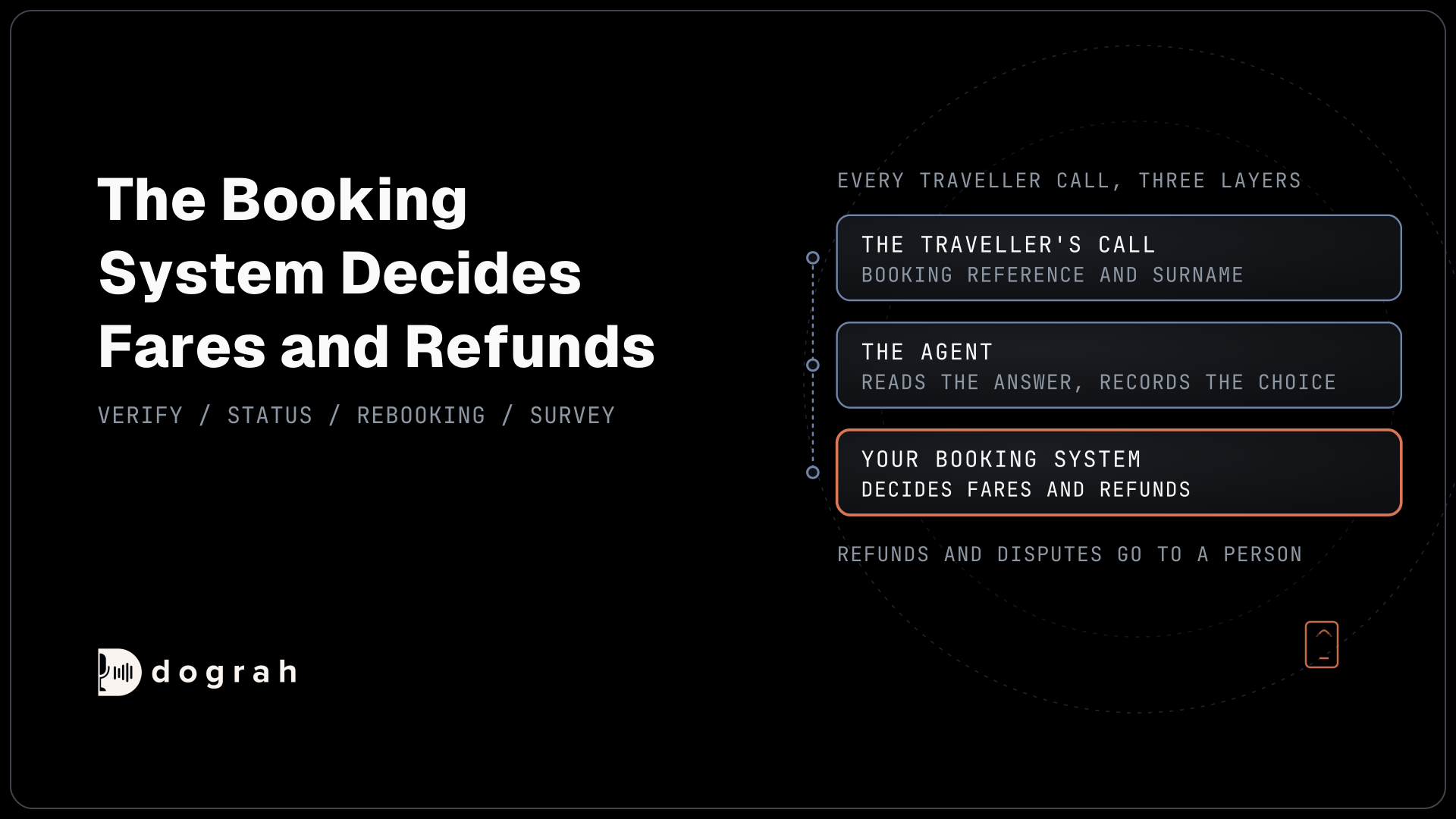

AI voice agents for airlines and travel are phone agents that take traveller calls about trip reminders, booking changes, flight status, rebooking and post-trip surveys. They verify the traveller with the booking reference and surname, read the booking system during the call and write the result back. Fares and refunds stay with the company's own rules.
Key Takeaways
- Verify with booking reference and surname before naming any itinerary detail.
- The booking system decides fares and refunds; the agent reads and records.
- Plan concurrency for disruption days, when every affected traveller calls at once.
A travel call starts with a booking reference, and everything the agent says after it should come from the booking system. This guide maps the traveller calls a voice agent can take, in the order a trip happens, and how each one runs in Dograh, an open-source voice agent platform that reads and writes your booking system during the call. You can self-host it or run it on Dograh Cloud.
How the agent works with your booking system
An airline voice agent is only as good as what it can read. Fare rules, change fees, refund eligibility and open seats already live in the reservation system and the published rules. The agent reads them, says them clearly and writes back exactly what the traveller chose. In travel, that write-back carries legal weight, as the rebooking section shows.
Disruption is why this matters now. In the Bureau of Transportation Statistics Flight Delays at a Glance figures for January to July 2026, US reporting carriers cancelled 92,612 flights, 2.25% of 4,120,343 operations. In the same months of 2025 the count was 67,107, or 1.65%. On-time arrivals slipped from 75.53% to 74.96%. Each cancellation sends a planeload of travellers to the phone at once, a spike no contact centre can staff for.
A voice agent that isn't connected to the booking system can only guess on those calls, and the traveller will hold the company to what it said about a fare or refund.
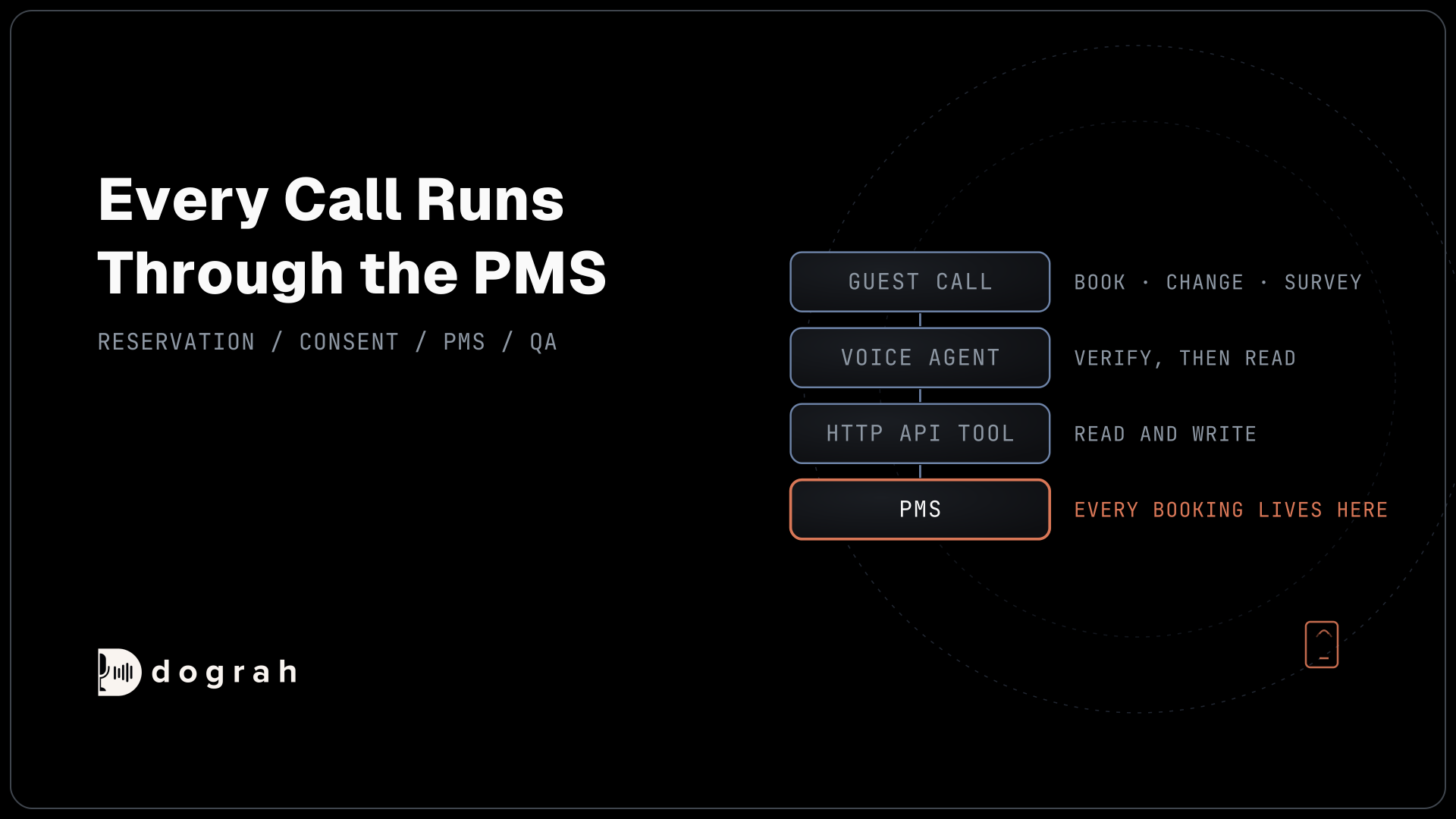
Dograh works the other way round. During the call, an HTTP API tool reads the booking or the list of alternative flights. After the call, a webhook writes the outcome to the booking system. Outbound calls start from the operations or booking system through the API Trigger, or from a CSV list in Campaigns. There are no built-in connectors for any reservation system; your systems connect through HTTP API tools, MCP tools, the Webhook node, Pre-Call Data Fetch or the API Trigger (n8n and similar tools connect through these). Our guide to Integrating Voice Agents With Your Stack covers the mechanics, and API Triggers: Start a Voice Agent Call From Any System shows how another system starts a call.
Travel agencies and tour operators add one extra step. When an agency is the merchant of record, the US refund rule requires the carrier to tell it "without delay whether the consumer is eligible for a refund". The agency's agent reads that answer from its own system and never works it out. We built a dedicated landing page for travel agencies and tour operators covering verified booking calls, reminders and change requests on your own booking system.
Verify the traveller before any itinerary detail
Every call in this guide runs greet, verify, disclose. Dograh's optional Greeting Text is spoken word for word when the call connects. Use it to name the airline or agency. If you want to tell travellers they're speaking with an automated assistant, or your location requires it by law, write that there too. It plays before verification, so it never names a flight or a date.
The check is the booking reference plus the surname. Travellers know it from "manage my booking" pages. On an inbound call, Pre-Call Data Fetch at the bottom of the Start Call node can look up a booking by the caller's number when the call connects. That finds a record but does not prove who is calling, so the agent still asks for the reference and the surname before it reads anything back.
Status for a flight number is public and needs no verification. Anything about the caller's own booking does. Higher-risk requests such as changing the contact details on a booking, or anything involving a refund, go straight to a person, with no extra checks added to the call. The agent never asks for payment-card digits, for any reason.
A person must always be reachable. Transfer Call puts the traveller through to an agent at the airline or agency. It works on Twilio only and passes no summary by default, so the agent writes the details to your system first. If nobody answers within 30 seconds (the default), the agent writes a callback request through an HTTP API tool.
With speech-to-text set to Multilingual (Auto-detect), the agent follows the language the traveller speaks. The Greeting Text plays before any language is detected, so for a line that serves two languages, write a short greeting in both.
Before the trip: reminders that ask for an action
A reminder call earns its place only when the traveller has something to do before departure. Check-in opening, a missing passport number, a visa form or a tour balance due are good reasons to call. "Your flight is tomorrow" is a text from the company's own messaging system, because Dograh has no SMS tool.
The call verifies the traveller, then reads the departure details and the one action needed from the booking system. Any change asked for, such as a dropped passenger, is recorded as stated and written back. A new phone number or email goes to a person, never changed on the call. A balance due never becomes a card payment on the call: an HTTP API tool asks the agency's own system to send a secure payment link by text or email. The traveller pays there.
Campaigns runs these calls from a list, with up to 10 retries (2 by default) and calling hours by weekday. It has no per-traveller cap, so any such limit lives in your own list. Our post on AI Voice Agents for Travel Reminders covers the schedule and what each call says.
Consent comes before any outbound call. This is general information, not legal advice. In the US, the Federal Communications Commission (FCC) treats an AI-generated voice as an artificial voice. Under 47 CFR 64.1200, such a call to a mobile number generally needs "the prior express consent of the called party". A call that "includes or introduces an advertisement" needs "prior express written consent". So an upgrade or insurance offer added to a reminder generally makes it a marketing call with a higher consent bar. Keep reminders free of offers, and confirm your position with counsel before the first campaign.

Open Source Alternative to Vapi / Retell
Self-hosted voice agent platform — no per-minute fees
dograh-hq/dograh
Star on GitHub
When the traveller asks for a change or cancellation
The traveller starts this call, wanting a new date or a cancellation. The agent verifies, reads the fare rules and the change fee from the booking system, offers only the options the system returns, reads the traveller's choice back and writes the change. If the new fare costs more, an HTTP API tool asks the company's own system to send a secure payment link by text or email.
Rules such as the US 24-hour cancellation window are checked by the booking system, and the agent reads the result. Refund requests and disputes go to a person. Our post on AI Voice Agents for Booking Changes and Cancellations walks through the call and the US rules each step depends on.
Hotel stays have their own rules, so they sit in a separate guide: AI voice agents for hotels and hospitality.
When the airline changes the plan
When the operation changes, the call starts from the airline's side in two stages: the traveller hears what changed, then, if the flight is gone, chooses what happens next.
Flight-status updates
Status calls tell and answer, read live from the operations system and never guessed. Inbound, the agent answers "is my flight on time?" from a live lookup during the call. Outbound, the operations system calls the API Trigger with the flight and the new time, and the agent asks a question only if a decision is needed. A delay with nothing to decide is better sent as a text, the rule set out in AI Voice Agents for Delivery Delay and Exception Alerts. The consent rules above apply to every outbound alert.
Once a cancelled flight needs a choice, it becomes a rebooking call. Our post on AI Voice Agents for Flight-Status Updates covers both directions.
Rebooking after a cancellation or missed connection
Here the airline broke the plan, and the agent offers only the alternatives the booking system returns. It never invents a flight. An Amadeus report written with Microsoft, published in June 2026, lists automated voice rebooking among five agentic AI use cases for airlines, and notes that call centres quickly fill up during disruption.
The agent reads the traveller's choice back, then writes the outcome to the booking system. Under the US rule, a traveller who declines the new flight, or never answers before it leaves, is owed a refund. So the agent must record "declined" and "no answer" as carefully as "accepted". Compensation questions go to a person and to the airline's published rules. See AI Voice Agents for Rebooking.
After the trip: a short survey call
The survey call closes the loop on the whole journey, and it starts by reading what happened on it. Before dialling, the agent checks the booking system for a cancellation or long delay. A traveller whose trip went wrong hears that first and is offered a person before any rating.
A trip that went to plan gets one rating and one open question, recorded as stated and sent by webhook to the customer relationship management (CRM) system. It never scores the traveller or the crew, and a complaint or a compensation question goes to a person. See AI Voice Agents for Post-Trip Surveys.
Join the Dograh Community
Dograh is an OSS alternative to Vapi. Join our Slack community for queries, releases, best practices & community interactions.
Who decides refunds and compensation
Published rules and the company's own system decide money in travel. The agent reads the answer and records the choice. This section is general information, not legal advice.
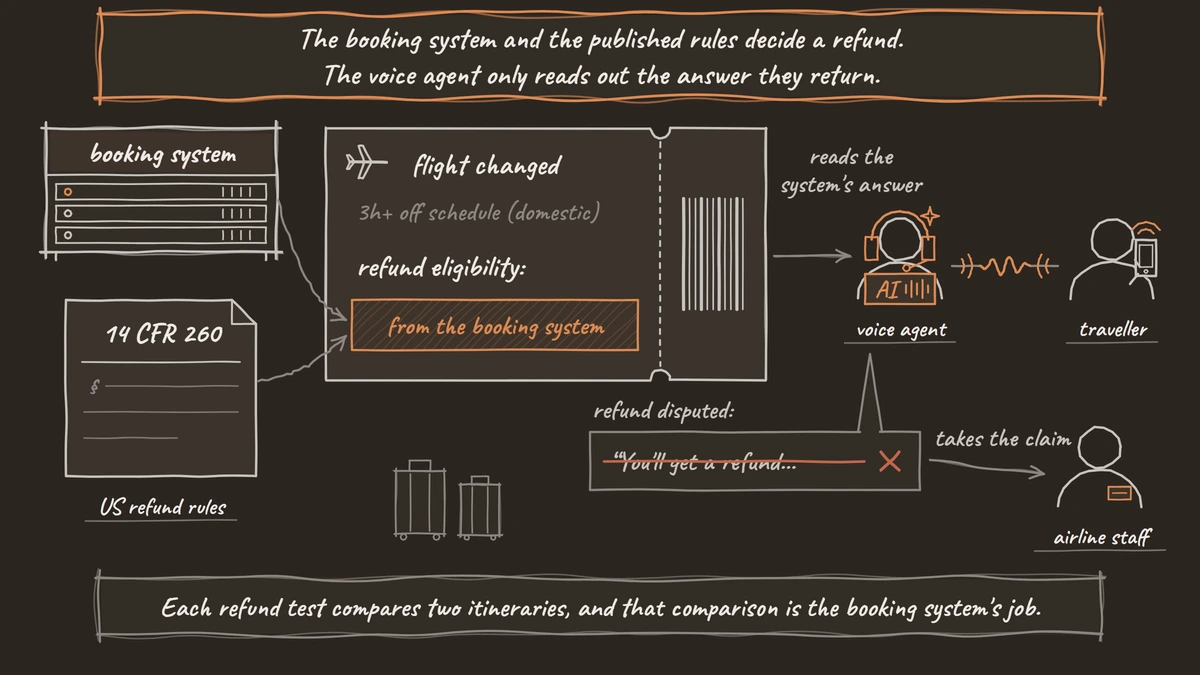
In the US, 14 CFR part 260 sets the refund rule. Under 260.6(a)(1), a carrier "must provide a full and prompt refund" of the airfare "for any cancelled flight or significantly delayed or changed flight where the consumer chooses not to" fly the changed flight, accept rebooking or accept a voucher. Section 260.2 defines a significant change: a departure or arrival three hours or more off schedule on a domestic itinerary, or six hours or more on an international one, a different airport, more connections, a downgrade, and two cases for travellers with a disability.
Each test compares two itineraries, which is the booking system's job. The agent reads which case applies and what is offered. It does not judge whether a change is significant, and it never promises a refund the system has not confirmed.
In the European Union, the Commission welcomed a political agreement on revised air passenger rights on 15 June 2026. Passengers "can claim compensation after a cancellation or a delay of 3 hours", at EUR 250, 400 or 600 depending on flight distance. Airlines must "proactively inform passengers within 96 hours of their rights" when a disruption happens. The revised rules apply 12 months after publication in the Official Journal.
That last duty points at a call a voice agent can carry. In research for the UK Civil Aviation Authority, carried out by Yonder Consulting from February to April 2025, only one in ten passengers (10%) said they felt fully informed about their rights when a flight was disrupted. That gap is about information, and giving clear information is what the agent does well.
A statement of rights has to come out word for word, and a node prompt cannot guarantee wording. Put the fixed rights text in a pathway's Transition Speech on a standard (cascade) agent, because text Transition Speech does not play on speech-to-speech models, or use a recorded clip. Transition Speech cannot carry per-traveller details, so the agent reads this booking's amount or options from the system's data.
So the agent says the rule exists, reads the system's answer for this booking and hands claims to a person. Confirm your obligations with counsel, by country, before the agent says anything about money.
Own the call data and plan for the surge
A travel call carries a name, an itinerary, contact details and sometimes passport data, and the recording keeps it all. Self-hosting Dograh puts the call platform on your own servers. Dograh is the orchestration layer (call flow, tools, telephony). The speech and language models are a separate layer you choose. The traveller's audio stays inside your infrastructure only when those models run on your servers too. Using your own API keys for hosted models changes who your contract is with, but the audio still goes to that provider.
Dograh has no retention setting, so your own policy decides how long recordings and transcripts are kept. Self-hosted, call recording can be switched off only for the whole server, and transcripts are still saved.
The surge is the other half of the plan. Self-hosted Dograh runs 10 concurrent calls by default, raised with the DEFAULT_ORG_CONCURRENCY_LIMIT setting, and you can add workers as the load grows. Server size and the phone provider set the real ceiling. Dograh Cloud's Pay as you go plan includes 10 concurrent calls; for higher concurrency, contact Dograh. Self-hosted Dograh has no per-minute platform fee (servers, any paid model keys and phone minutes still cost), and Dograh Cloud has a 1¢-a-minute platform fee.
Raise concurrency in steps and load-test each on real phone lines. A storm of cancellations is the worst moment to find the ceiling.
Where to start
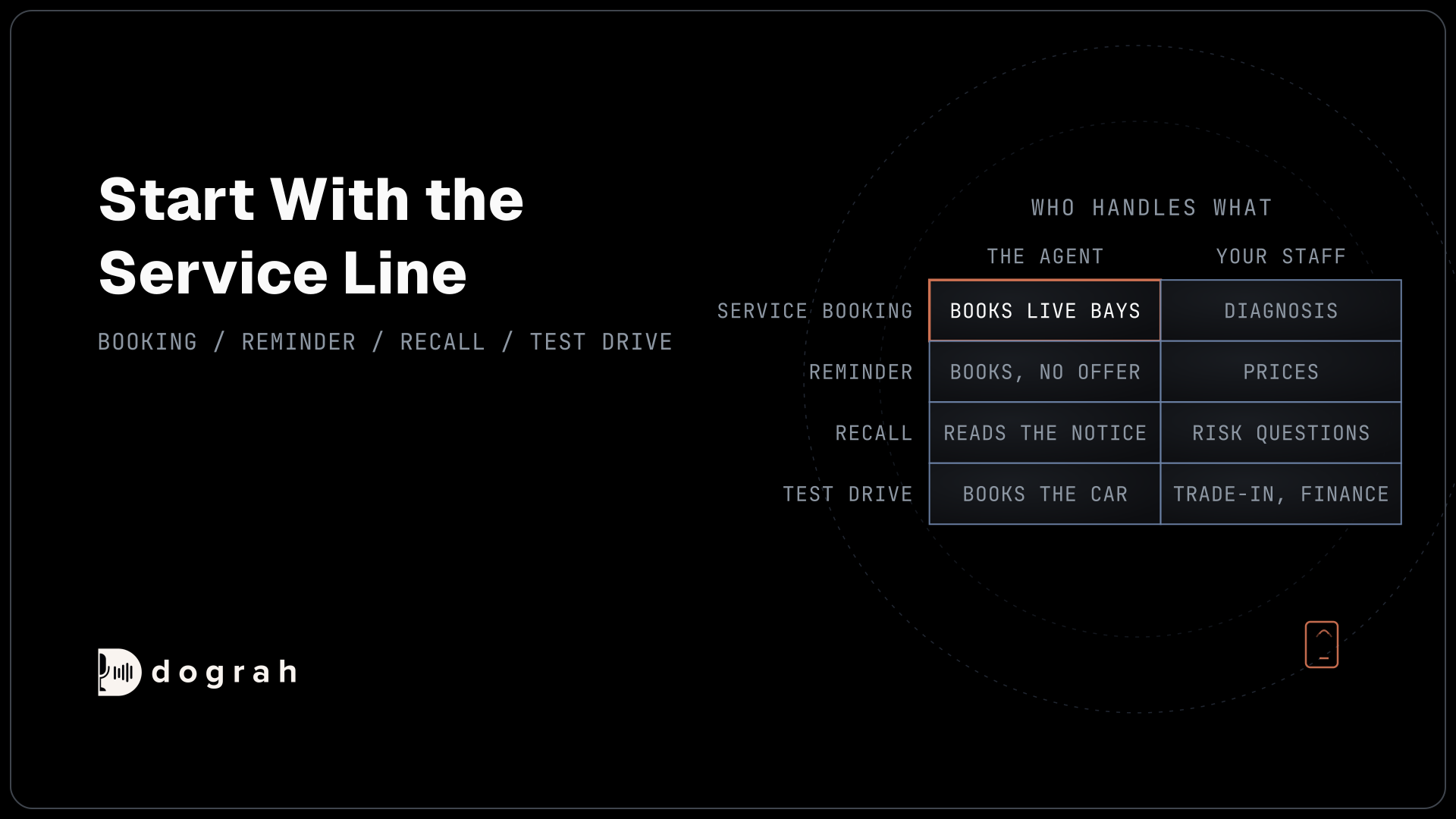
Start with the inbound status line. It only reads, needs no verification by flight number and takes the first wave of a disruption day. Run it on a real phone number rather than a browser test, because most phone calls still reach the agent as 8 kHz audio, while a browser demo runs at 16 kHz. Our post on Testing Voice Agents Before You Go Live gives the test order.
Next come verified booking lookups and outbound reminders for travellers who gave consent. The calls that write changes, booking changes and rebooking, come last. Run quality assurance (QA) on a sample of live calls (the QA node's Sample Rate), and widen what the agent may do only as transcripts earn it. Every answer still comes from the booking system.
Each call above has its own deep dive:
- AI Voice Agents for Travel Reminders
- AI Voice Agents for Booking Changes and Cancellations
- AI Voice Agents for Flight-Status Updates
- AI Voice Agents for Rebooking
- AI Voice Agents for Post-Trip Surveys
Glossary
- Booking reference
- The code that identifies a reservation, often called a PNR or record locator. With the traveller's surname it is the check the agent asks for before reading any itinerary detail.
- Prior express consent
- The permission a traveller gives before a company can call their mobile with an AI or recorded voice under US rules. A call that includes an offer, such as an upgrade, needs the stricter prior express written consent.
- Concurrent calls
- How many calls the agent can handle at the same moment. Dograh runs 10 by default; on a disruption day, this number decides whether travellers get through.
- HTTP API tool
- The Dograh tool the agent uses during a call to read from or write to another system, such as fetching a booking or saving the traveller's choice to the booking system.