
AI voice agents for rebooking call or answer travellers after a cancellation or missed connection. They verify the booking reference and surname, offer only the alternative flights the booking system returns, read the choice back and write it. Under US rules, a declined offer or no answer can make a refund due, so every outcome is recorded.
Key Takeaways
- The agent offers only the flights the booking system returns.
- Declined and no answer are outcomes with legal weight. Record both.
- Compensation questions go to a person and the published rules.
This post is part of our guide to AI voice agents for airlines and travel. The guide's rebooking section draws the line this post works inside: the airline broke the plan, and the agent offers only the alternatives the booking system returns. When the traveller is the one asking for a change, that is booking changes and cancellations. Here the disruption call is built on Dograh, an open-source, self-hostable voice agent platform, from the first offer to the outcome written back.
Disruption calls arrive all at once
Rebooking is a surge job, because one cancelled flight puts every traveller on it in the same queue. US reporting carriers cancelled 2.25% of their flights from January to July 2026, up from 1.65% in the same months of 2025, according to the Bureau of Transportation Statistics. Airlines call these days irregular operations, and the phone line is where they hurt most.
An Amadeus report written with Microsoft, published in June 2026, puts it plainly: "Call centres quickly become saturated during disruption, lengthening wait times." Amadeus says it has tested voice rebooking, in which an agent finds the booking and proposes alternatives with a human handover when needed, and plans to move it into production.
The call reaches the agent in two ways. Outbound, the disruption or re-accommodation system calls the API Trigger for each affected booking, with the cancelled flight in the request. Inbound, the same agent answers travellers who call first, often straight after a flight-status alert told them the flight was gone.
Offer only the flights the system returns
Every option the agent reads out is one the booking system returned. The call runs greet, verify, disclose. The Greeting Text names the airline. If you want to tell travellers they're speaking with an automated assistant, or your location requires it by law, write that there too. The agent then asks for the booking reference and the surname before it says which flight was affected.
Once the traveller is verified, an HTTP API tool asks the re-accommodation system for the alternatives on this booking. If the system has already protected a seat on a later flight, that is the first option the agent reads. While the lookup runs, the tool's Messages setting plays a short line, so the traveller hears something rather than silence.
The agent reads out only the flights that came back. A traveller who asks for a flight not on the list gets a second lookup with that flight, or a person, and never a promise. If a chosen option costs more, for example a different cabin, an HTTP API tool asks the airline's own system to send a secure payment link by text or email. The agent never asks for card digits.

Open Source Alternative to Vapi / Retell
Self-hosted voice agent platform — no per-minute fees
dograh-hq/dograh
Star on GitHub
Every answer is an outcome, including no answer
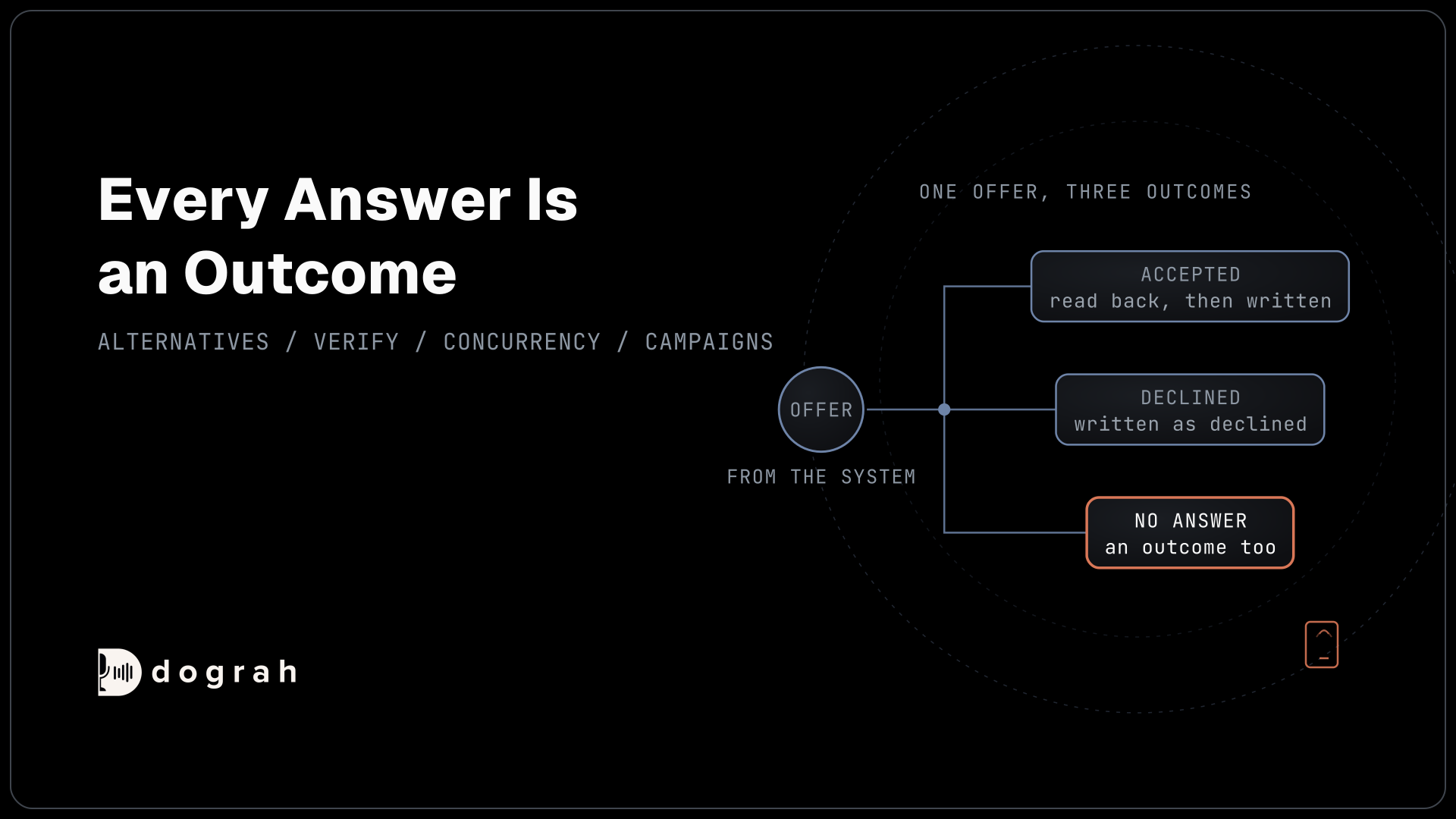
In rebooking, the read-back is a legal record, because under the US rule a declined offer or an unanswered one can trigger an automatic refund. This is general information, not legal advice.
Under 14 CFR 260.6(a)(2), a full refund is due when "a consumer rejects the significantly delayed or changed flight, rebooking on an alternative flight, or any voucher, credit, or other form of compensation offered by the covered carrier". It is also due when "a consumer does not respond to an offer of" a changed or alternative flight "and the flight departs without the consumer". So "accepted" is one result among several, and each of the others carries money.
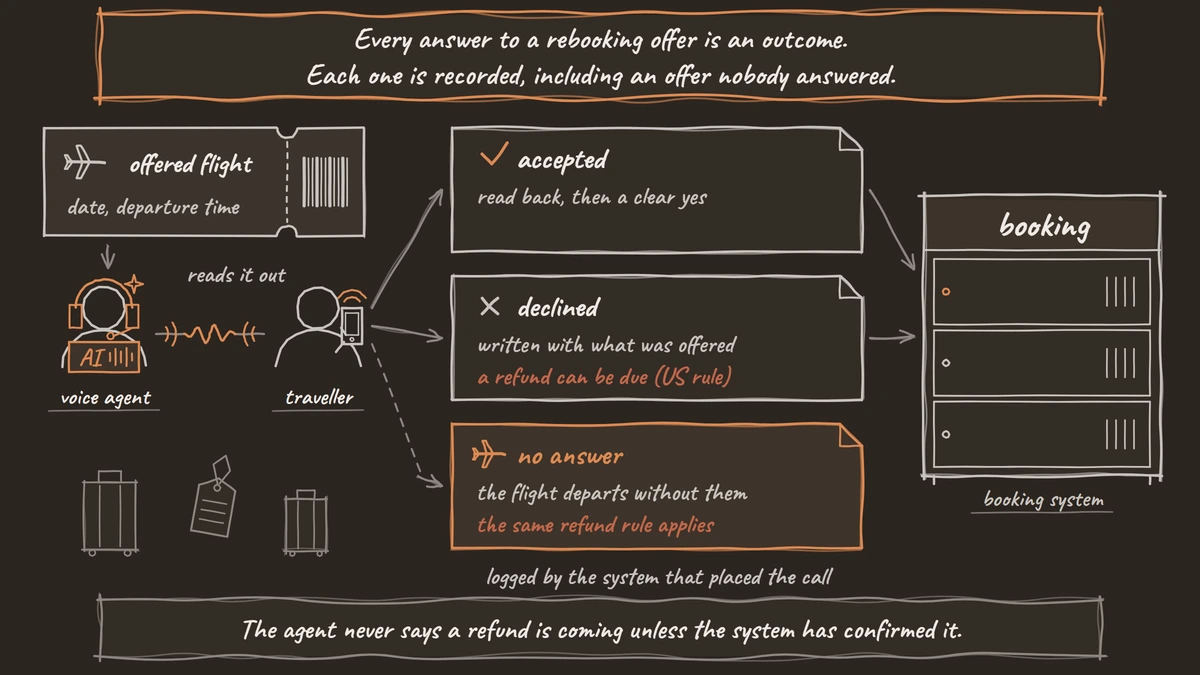
The agent reads the chosen flight back, with its date and departure time, and waits for a clear yes. An HTTP API tool then writes the result to the booking system during the call. "Declined" is written with what was offered, so the system knows which offer the traveller turned down. After the call, a webhook writes the outcome and the transcript link to the booking record, as in Webhook-Driven Voice Agents: Real-Time Data In and Out.
A call nobody answers is an outcome too. The disruption system that started the call should log that an offer was made and not answered, because the rule turns on whether the flight leaves without the traveller. The agent records each answer as the traveller stated it and never says a refund is coming unless the system has confirmed it. Generally, the system decides what is owed and the agent's record shows what was offered and said. Confirm with counsel how your own process meets the rule.
Compensation stays with the rules and a person
A traveller who is owed compensation is owed it by a rule, and the agent does not apply that rule. In the European Union, the Commission welcomed a political agreement on 15 June 2026 under which passengers can claim compensation after a cancellation or a three-hour delay, at fixed amounts by distance. The guide's money section covers it.
When a traveller asks about compensation or a refund, the agent says that the rules exist and how to claim under them, then hands over. Transfer Call puts the traveller through to a person. It works on Twilio only and passes no summary by default, so the agent writes the details to your system first. If nobody picks up within 30 seconds, the default, the traveller stays with the agent, which writes a callback request through an HTTP API tool.
A traveller stranded overnight, or anyone who asks for a human, goes to a person at once, whatever the question.
Join the Dograh Community
Dograh is an OSS alternative to Vapi. Join our Slack community for queries, releases, best practices & community interactions.
Plan concurrency before the storm
How many rebooking calls run at once is a setting you plan, not a number you discover on the day. Self-hosted Dograh runs 10 concurrent calls by default, raised with the DEFAULT_ORG_CONCURRENCY_LIMIT setting, and you can add workers as the load grows. Server size and the phone provider set the real ceiling. Dograh Cloud's Pay as you go plan includes 10 concurrent calls; for higher concurrency, contact Dograh.
Raise the limit in steps and load-test each step on real phone lines, because a call over telephony behaves differently from a browser test. How to Test, Monitor, and Scale AI Voice Agents in Production sets out that order.
A rebooking list sent through Campaigns can retry busy or unanswered numbers, up to 10 times with 2 by default, with a retry delay from 30 seconds to an hour. Campaigns has no per-traveller cap, so the disruption system removes a traveller from the list once a choice is recorded, and stops calling once the flight has left.
Where the disruption data lives
A rebooking call carries the traveller's name, itinerary, contact details and choices, and the recording keeps all of it. Self-hosting Dograh puts the call platform on your own servers, and the traveller's audio stays inside your infrastructure only when the speech and language models run there too. Self-hosted Dograh has no per-minute platform fee (servers, any paid model keys and phone minutes still cost), and Dograh Cloud has a 1¢-a-minute platform fee.
Start with inbound rebooking for travellers who call first, where the system already holds a protected seat. Add outbound offers next, and widen the options the agent may read out only as the written outcomes match the transcripts.
Glossary
- Automatic refund
- Under 14 CFR 260.2, a refund issued without waiting for a request, when the traveller's right to it is undisputed because the service was not provided and the traveller rejected the alternative or none was offered.
- Irregular operations
- The airline term for disruption that breaks the published schedule, such as cancellations and long delays. It is when rebooking calls arrive all at once.
- Read-back
- The step where the agent repeats the chosen flight with its date and time and waits for a clear yes before it writes anything to the booking system.
- DEFAULT_ORG_CONCURRENCY_LIMIT
- The self-hosted Dograh setting that sets how many calls run at the same time. It is 10 by default, and server size and the phone provider set the practical ceiling.