
AI voice agents for booking changes and cancellations take the calls a traveller starts to move or cancel a trip. The agent verifies the booking reference and surname, reads the fare rules and change fee from the booking system, offers only the options it returns and writes the choice back. Refunds and disputes go to a person.
Key Takeaways
- The booking system checks the 24-hour rule; the agent reads the result.
- A voucher offer must state the refund right, word for word.
- Refunds and contact-detail changes go straight to a person.
This post is part of our guide to AI voice agents for airlines and travel. The guide's section on changes the traveller asks for sets the rule this post builds on: the booking system checks windows such as the US 24-hour rule, and the agent reads the result. Here the traveller starts the call, and when the airline cancels or moves the flight instead, that is rebooking. Below, the change call is built step by step on Dograh, an open-source, self-hostable voice agent platform, reading and writing your booking system during the call.
What the traveller wants decides the call
A change call is the traveller's own decision, so the agent first learns what they want and confirms who they are. Most callers want a different date on the same trip, or out of the trip altogether, and both touch a live booking.
The call runs greet, verify, disclose. The Greeting Text names the airline or agency. If you want to tell callers they're speaking with an automated assistant, or your location requires it by law, write that there too. The agent then asks for the booking reference and the surname, the same check travellers use on a "manage my booking" page. On an inbound line, Pre-Call Data Fetch set to Inbound calls only can look up a booking by the caller's number when the call connects. That finds a record. It never proves who is calling, so the reference and surname still come first, and the agent never asks for payment-card digits.
Some requests carry more risk. A new email address or phone number would redirect every future notice, and a refund moves money back, so both go to a person with no extra checks added to the call. LOT Polish Airlines drew a similar line for its 2026 hotline agent, which makes a booking change itself or passes the call to staff, with "disputes, special accommodations, or policy exceptions" kept for trained staff, ePlane AI reported in June 2026.
Read the fare rules from the booking system
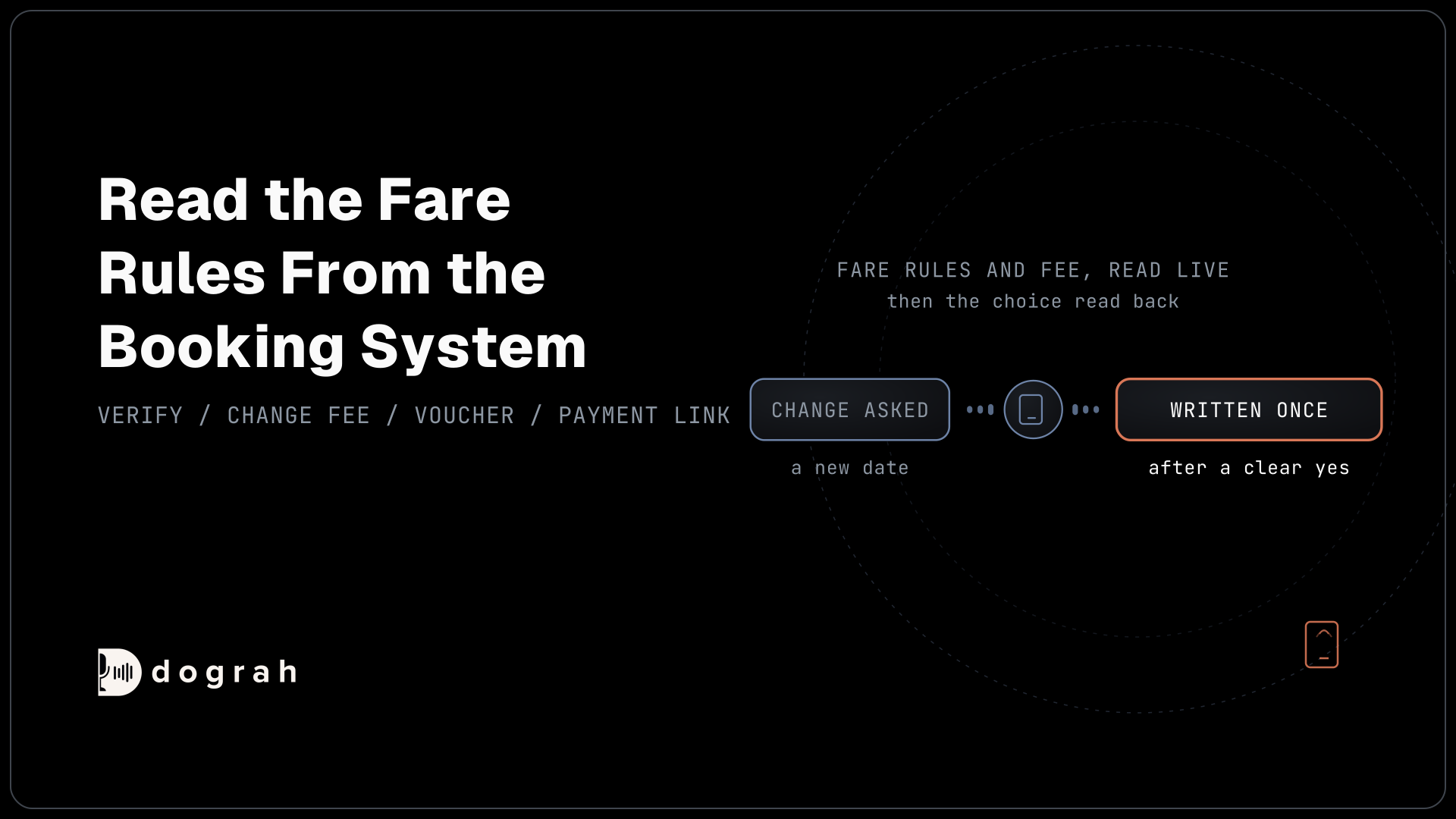
Every number the agent says about a change comes from the booking system, read during the call. An HTTP API tool sends the booking reference and the requested date to your reservation or agency system. The system returns the fare rules, the change fee, any fare difference and the flights that are open. While the lookup runs, the tool's Messages setting plays a short line, so the traveller hears something rather than silence.
The agent offers only what came back. If the system lists two flights on the new date, the traveller hears two flights, never a third the model guessed at. If the fare cannot be changed, the agent says so and reads out what the system allows instead.
A general question, such as what a fare type includes, can be answered from a policy document in the Knowledge Base. The fee for this booking never comes from there.
When the new fare costs more, the traveller pays outside the call. An HTTP API tool asks the airline's or agency's own system to send a secure payment link by text or email, and that system completes the change once the payment clears. Card numbers are never read out on the call.

Open Source Alternative to Vapi / Retell
Self-hosted voice agent platform — no per-minute fees
dograh-hq/dograh
Star on GitHub
The 24-hour rule is a check the system runs
Whether a booking can still be cancelled without penalty is a comparison of two dates, so the booking system makes it and the agent reports it. This section is general information, not legal advice.
Under 14 CFR 259.5(b)(4), a covered carrier's customer service plan must allow "reservations to be held at the quoted fare without payment, or cancelled without penalty, for at least twenty-four hours after the reservation is made if the reservation is made one week or more prior to a flight's departure." The carrier chooses which of the two it offers. Whether a booking qualifies turns on when it was made and when the flight leaves.
Both dates sit in the booking record, so the system works out eligibility and returns it with the fare rules. The agent reads "inside the window" or "outside it" and never counts the hours itself. A ticket sold by an agency still follows the airline's plan. When the window applies and money is due back, the agent confirms the cancellation request and passes the refund to a person.
Generally, the agent should repeat what the system decided and add nothing of its own. Confirm with counsel how your plan applies, especially to agency sales.
A voucher offer must state the refund right
Sometimes a traveller calls to cancel a flight the airline has already cancelled or moved by hours. The traveller still started this call, but the money rules change, because the US rule may now owe a full refund. Whether the change counts as significant is a comparison of the old and new itineraries against the definitions in 14 CFR 260.2, and the booking system makes it.
If the system offers a voucher or credit in place of that refund, 14 CFR 260.6(c) sets the terms. This is general information, not legal advice. The offer must include "a clear and conspicuous notice of" its terms and of "the consumer's right to a full refund under this section", and the voucher must stay valid "for a period of at least five years".
That notice cannot be left to the model, because a node prompt cannot guarantee the words it produces. Put the refund-right sentence in a pathway's Transition Speech on a standard (cascade) agent, because text Transition Speech does not play on speech-to-speech models, or play a recorded clip. Transition Speech carries no per-traveller details, so the agent reads the voucher amount and expiry from the system's data. Prompt and Flow Design Patterns for Reliable Voice Agents explains why that guarantee has to live in the flow.
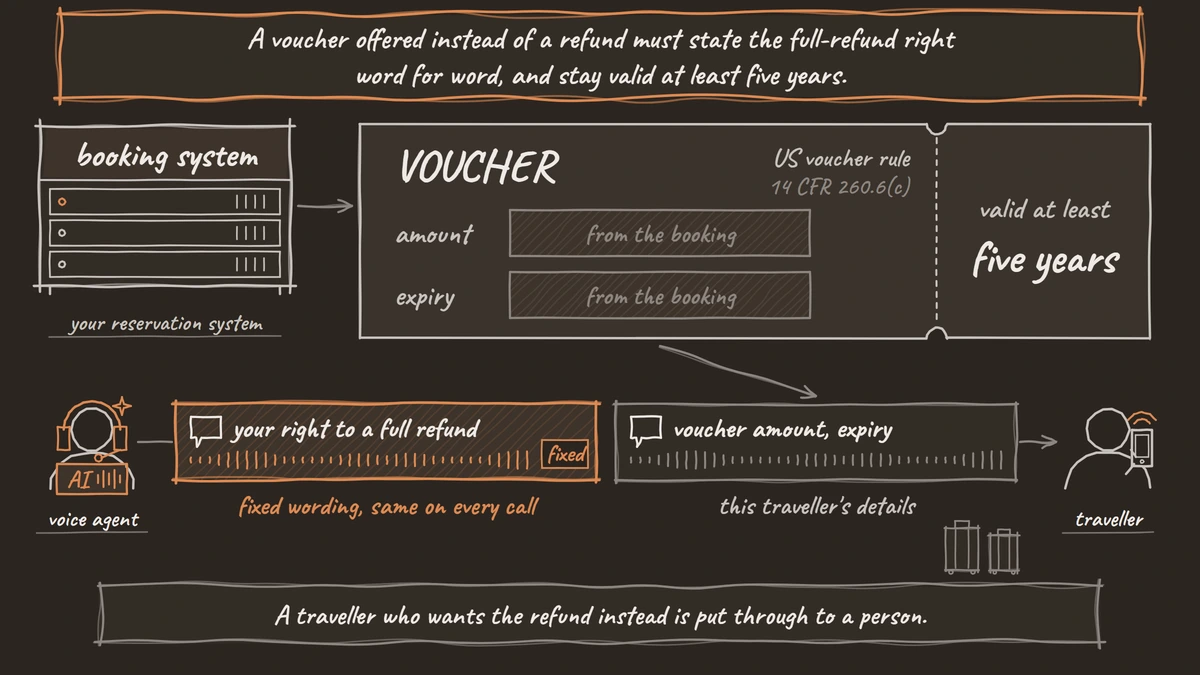
If the traveller takes the voucher, the agent reads the choice back and writes it. If they want the refund, or ask anything about it, Transfer Call puts them through to a person. It works on Twilio only and passes no summary by default, so the agent writes the details to your system first. If nobody answers within 30 seconds, the default, the traveller stays with the agent, which writes a callback request through an HTTP API tool. Confirm the exact notice wording with counsel.
Join the Dograh Community
Dograh is an OSS alternative to Vapi. Join our Slack community for queries, releases, best practices & community interactions.
Read the change back, then write it once
A change is finished only when the traveller has heard it back and the booking system holds it exactly once. Before writing, the agent reads back the new flight with its date and any fee the system quoted, and waits for a clear yes.
The write goes through an HTTP API tool. Calls drop and requests get retried, so add a Preset Parameter named workflow_run_id with the value {{initial_context.workflow_run_id}}. Dograh adds no Idempotency-Key header itself, so your booking system uses that ID to ignore a duplicate request, and no traveller is changed twice. After the call, a webhook writes the outcome and the transcript link to the booking record, the pattern in Webhook-Driven Voice Agents: Real-Time Data In and Out.
The agent records each answer as the traveller stated it, and the transcript and recording remain the exact record. Hotel stays follow their own cancellation policies, covered in AI voice agents for cancellations and rescheduling in hotels.
Where the booking data lives
A change call touches the traveller's name, itinerary, contact details and fare, and the recording keeps all of it. Self-hosting Dograh puts the call platform on your own servers. Dograh is the orchestration layer: it runs the call flow, tools and telephony, and the speech and language models are a separate layer you choose. The traveller's audio stays inside your infrastructure only when those models run on your servers too. Dograh has no retention setting, so your own policy decides how long recordings and transcripts are kept.
Self-hosted Dograh has no per-minute platform fee (servers, any paid model keys and phone minutes still cost), and Dograh Cloud has a 1¢-a-minute platform fee.
Start with date changes on fares that allow them, where the system returns a fee and a short list of flights. Add cancellations next, with every refund handed to a person, and widen what the agent may do only as the transcripts earn it.
Glossary
- Booking reference
- The code that identifies a reservation, also called a PNR or record locator. With the traveller's surname it is the check the agent asks for before reading or changing anything on the booking.
- Fare rules
- The terms attached to a fare that decide whether it can be changed or cancelled and at what cost. The booking system holds them for each ticket, and the agent reads them during the call.
- 24-hour rule
- The US requirement in 14 CFR 259.5(b)(4) that a carrier hold a reservation at the quoted fare, or let it be cancelled without penalty, for at least 24 hours when it is booked a week or more before departure.
- Transition Speech
- Fixed text or a recorded clip that Dograh plays when a pathway is taken. It is spoken word for word, so it suits required notices, and it cannot include per-traveller details.