
AI voice agents for post-trip surveys call travellers after they return, ask one rating and one open question, and send the answers, recorded as the traveller stated them, to the CRM by webhook. Before dialling, the agent reads the booking for disruptions. A traveller whose trip went wrong hears an acknowledgement and is offered a person before any rating.
Key Takeaways
- Read the booking for disruptions before choosing which survey call to make.
- A traveller whose trip went wrong is offered a person before any rating.
- Keep offers out of the call; any review link goes to everyone.
This post is part of our guide to AI voice agents for airlines and travel. The guide's section on the short survey call after the trip says that call starts by reading what happened on the journey. This post builds that call for airlines, travel agencies and tour operators in Dograh, an open-source, self-hostable voice agent platform, with the answers sent to your CRM by webhook.
Read the trip before you dial
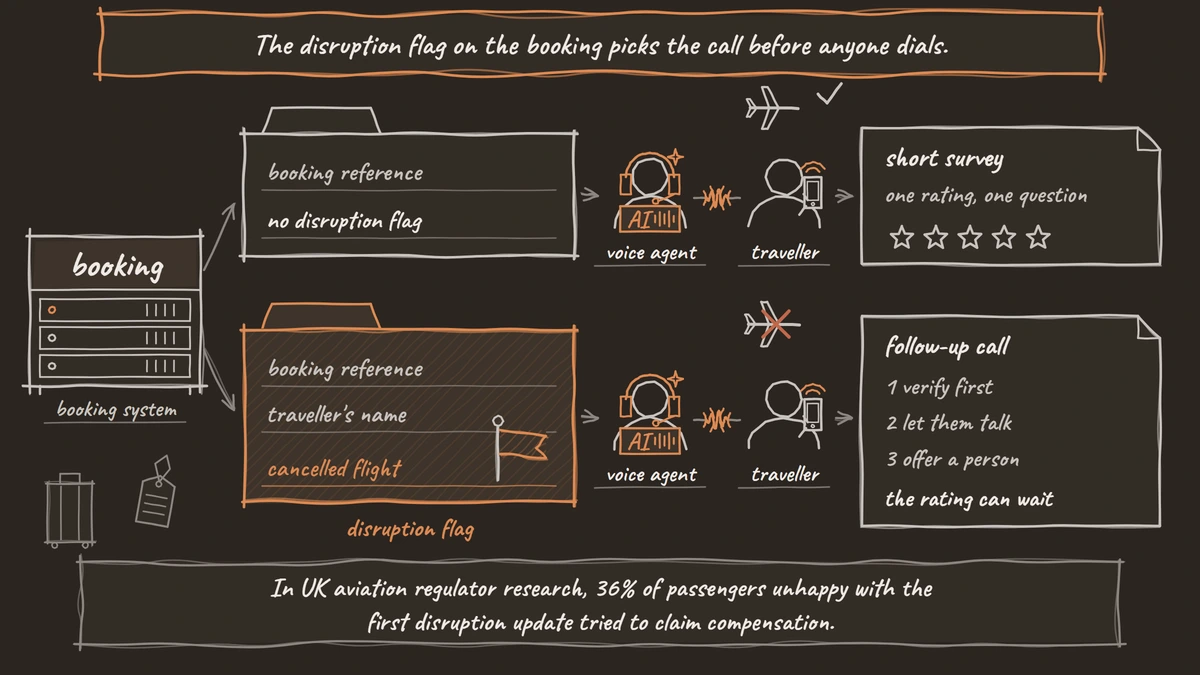
The booking system already knows which trips went wrong, so the survey starts there. Before each call, your system checks the booking for a cancellation, a long delay, a rebooking or a missed connection, and passes that disruption flag to the agent with the traveller's name and booking reference. Dograh's API Trigger starts the call from the booking system after the return date, or a Campaigns upload runs the day's list from a CSV file. Test the timing. The day after the return flight lands is a sensible first try.
The flag matters because a disrupted trip changes what the traveller wants from the call. In research for the UK Civil Aviation Authority, carried out by Yonder Consulting from February to April 2025, only 34% of passengers were satisfied with how often their airline updated them during disruption. Of those unhappy with the first communication, 36% went on to try to claim compensation, against 27% of those who were satisfied. A traveller who spent a night in a departure hall will answer a rating request with a complaint, and quite possibly a claim.
So the flag picks one of two calls. A trip that went to plan gets the short survey. A trip that went wrong gets a follow-up call that listens first and offers a person, and the rating can wait. Tour operators and agencies can flag more than flights, such as a missed transfer or an excursion cancelled on the day.
Follow up after a disruption before asking for a rating
A traveller whose trip went wrong should hear that the company knows, and be offered a person, before anyone asks for a number. Because this call talks about the booking itself, it runs greet, verify, disclose. The Greeting Text names the company and says the call is about a recent trip, and it names nothing else from the booking. If you want to tell travellers they're speaking with an automated assistant, or your location requires it by law, write that there too. The agent then asks for the booking reference and the surname, the same check travellers use on "manage my booking" pages. Only after that does it mention the cancelled flight or the missed connection. It never asks for payment-card digits.
Next, the agent asks how the disruption affected the traveller and lets them talk. It records the answer as the traveller stated it, and the transcript and recording stay the exact record. Then it offers a person. Transfer Call puts the traveller through to your customer care team. It works on Twilio only and passes no summary by default, so the agent writes the details to your system first through an HTTP API tool. If nobody answers within 30 seconds (the default), the traveller stays with the agent, which writes a callback request to your system.
Compensation questions come up on most of these calls, and the agent answers none of them. Whether a refund or compensation is owed is decided by the published rules and your own system, and our post on rebooking covers how those outcomes are recorded. On the survey call the agent records that the traveller asked, says a person will look at it and hands over. It never tells a traveller what they are entitled to, and it never offers a voucher of its own.
Skip the rating on this call if the traveller is still angry. One missing rating costs less than a second complaint.

Open Source Alternative to Vapi / Retell
Self-hosted voice agent platform — no per-minute fees
dograh-hq/dograh
Star on GitHub
A trip that went to plan: one rating, one question
For a trip without a disruption flag, the call is short. The design rules, one rating and one open question recorded as stated, are set out in AI Voice Agents for Delivery Feedback and CSAT Surveys: One Rating, One Question, and they carry over to a journey unchanged.
What a journey adds is the question of who the rating is about. A package holiday passes through an airline, a transfer company, a local guide and the agency itself. Word the open question so the traveller can say which part they mean, such as "Which part of the trip would you change?". Add your supplier and route names to the agent's Dictionary (it works with Deepgram and Dograh speech-to-text), so the transcript spells them correctly.
This version names no flight, date or destination, so it needs no verification step. If the traveller starts talking about the booking, the agent asks for the booking reference and surname before it says anything about it.
Extraction fields record the rating and the comment, and a webhook node sends them to your CRM with the booking reference and the disruption flag. The agent never scores the traveller or the crew, the rule set out in AI Voice Agents for Claims CSAT Surveys: Record It, Never Score It.
Review links: the same words for everyone, and no offer
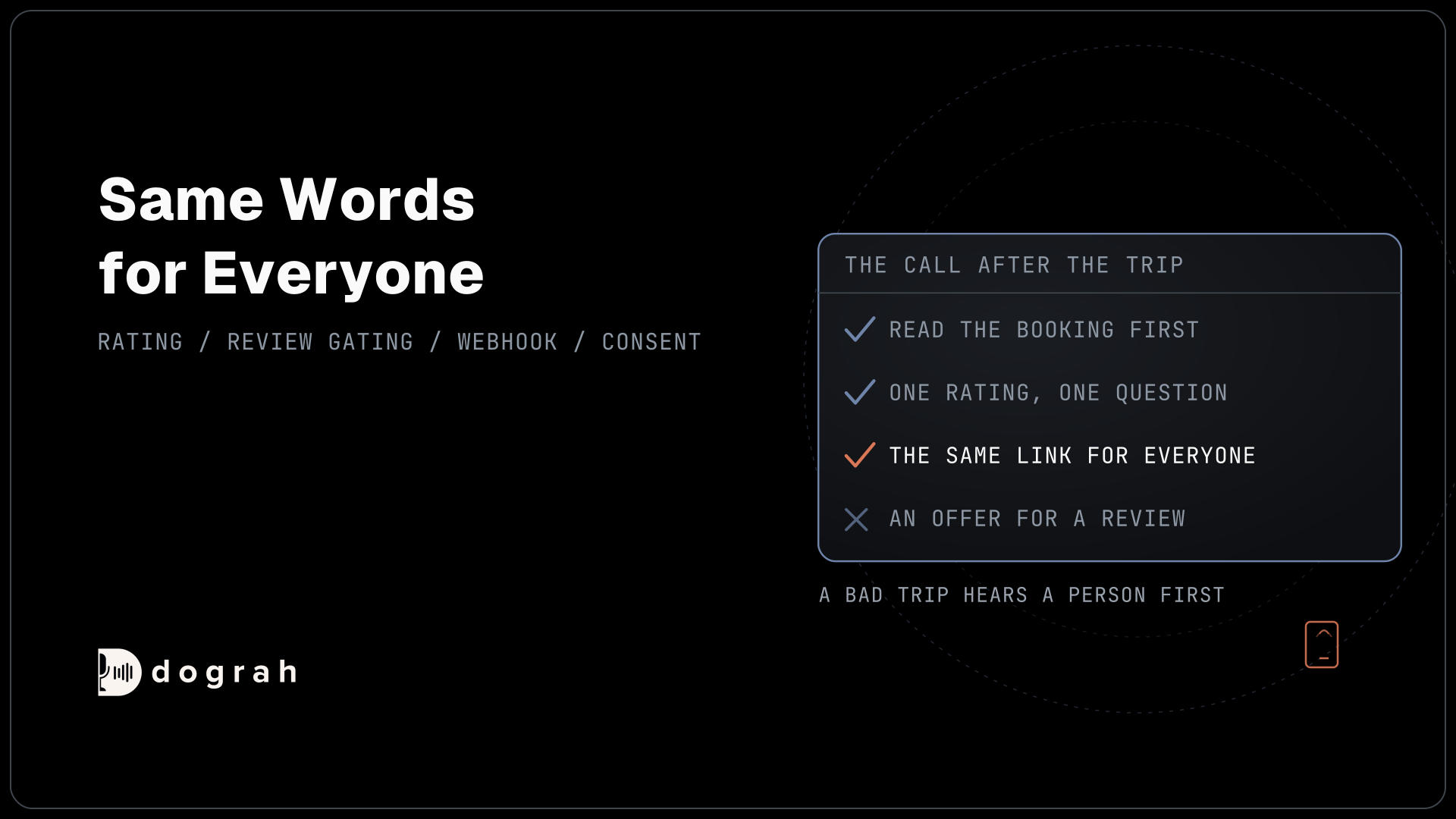
A review request is fine when every traveller hears the same one. If you ask for reviews, the agent closes every call with the same sentence, whatever rating it heard. Dograh has no SMS tool, so your own messaging system sends the review link by text or email after the call, with the same words to everyone. Asking only the happy ones is called review gating, and Google's Maps content policy lists as prohibited any attempt to "selectively solicit positive reviews from customers", and offering incentives "such as payment, discounts, free goods and/or services" in exchange for a review.
Keep every offer out of the survey call. This is general information, not legal advice. In the US, the FCC treats an AI-generated voice as an artificial voice. Under 47 CFR 64.1200, such a call to a mobile number generally needs "the prior express consent of the called party", and a call that "includes or introduces an advertisement" needs "prior express written consent". A survey with no sales content generally sits in the first tier. A discount on the next trip or an upgrade offer generally moves it to the second.
Goodwill after a bad trip is for your team to decide after the call, and the agent makes no offer during it. Take a traveller who asks you to stop calling off the list at once, and confirm your own position with counsel before the first campaign.
Join the Dograh Community
Dograh is an OSS alternative to Vapi. Join our Slack community for queries, releases, best practices & community interactions.
Compare your scores and keep the recordings
A post-trip score means most next to your own disruption flag. For an outside yardstick, the ACSI Travel Study 2026 puts airlines at 76 out of 100, up 3% and one point off their 2024 high, with online travel agencies also at 76. It rests on 14,910 email surveys of randomly chosen customers, taken from April 2025 to March 2026, so treat it as a rough benchmark. The more useful comparison is internal: ratings from trips that went to plan against the comments from trips that went wrong, route by route.
Run QA on a sample of live calls, set by the QA node's Sample Rate, to check that the agent offered a person after every disruption and said nothing about money. QA grades each step of the agent and never the traveller, as Automated QA for Voice Agents explains. The same call pattern for other industries is on our page about open-source voice AI for survey calls.
Survey recordings hold a traveller's booking and their own account of a bad trip. Self-hosting Dograh puts the call platform on your own servers, and the audio stays inside your infrastructure only when the speech and language models run there too. Dograh has no retention setting, so your own policy decides how long recordings and transcripts are kept. Self-hosted Dograh has no per-minute platform fee (servers, any paid model keys and phone minutes still cost), and Dograh Cloud has a 1¢-a-minute platform fee.
Start with the disrupted trips. That list is shorter than the full passenger list, and it holds the calls you most need to hear.
Glossary
- Disruption flag
- A marker your booking system passes to the agent when a trip had a cancellation, a long delay, a rebooking or a missed connection. It decides which of the two survey calls the traveller gets.
- Extraction fields
- The fields Dograh fills from the conversation, such as the rating and the comment, recorded as the traveller stated them. The transcript and recording remain the exact record.
- Review gating
- Asking only satisfied customers for public reviews. Google's Maps content policy prohibits selectively soliciting positive reviews.
- Prior express written consent
- The US consent tier for an artificial-voice call that includes or introduces an advertisement. An offer added to a survey generally moves the call into this tier.