
AI voice agents for travel reminders call travellers before departure when they still have something to do: check in, send a missing document or pay a balance. The agent reads the task from the booking system, verifies with the booking reference and surname, and writes the answer back. Reminders that need no answer go by text instead.
Key Takeaways
- Call only when the traveller still has a task before departure.
- Read document rules from your own data, never from the model.
- Keep upgrades and insurance offers out of reminder calls.
This post is part of our guide to AI voice agents for airlines and travel. The guide's section on reminders before the trip sets one test: a reminder call earns its place only when the traveller has something to do before departure. This post turns that test into a schedule and a call flow, built in Dograh, an open-source, self-hostable voice agent platform, with every detail read from and written back to the booking system.
Call when the traveller has something to do
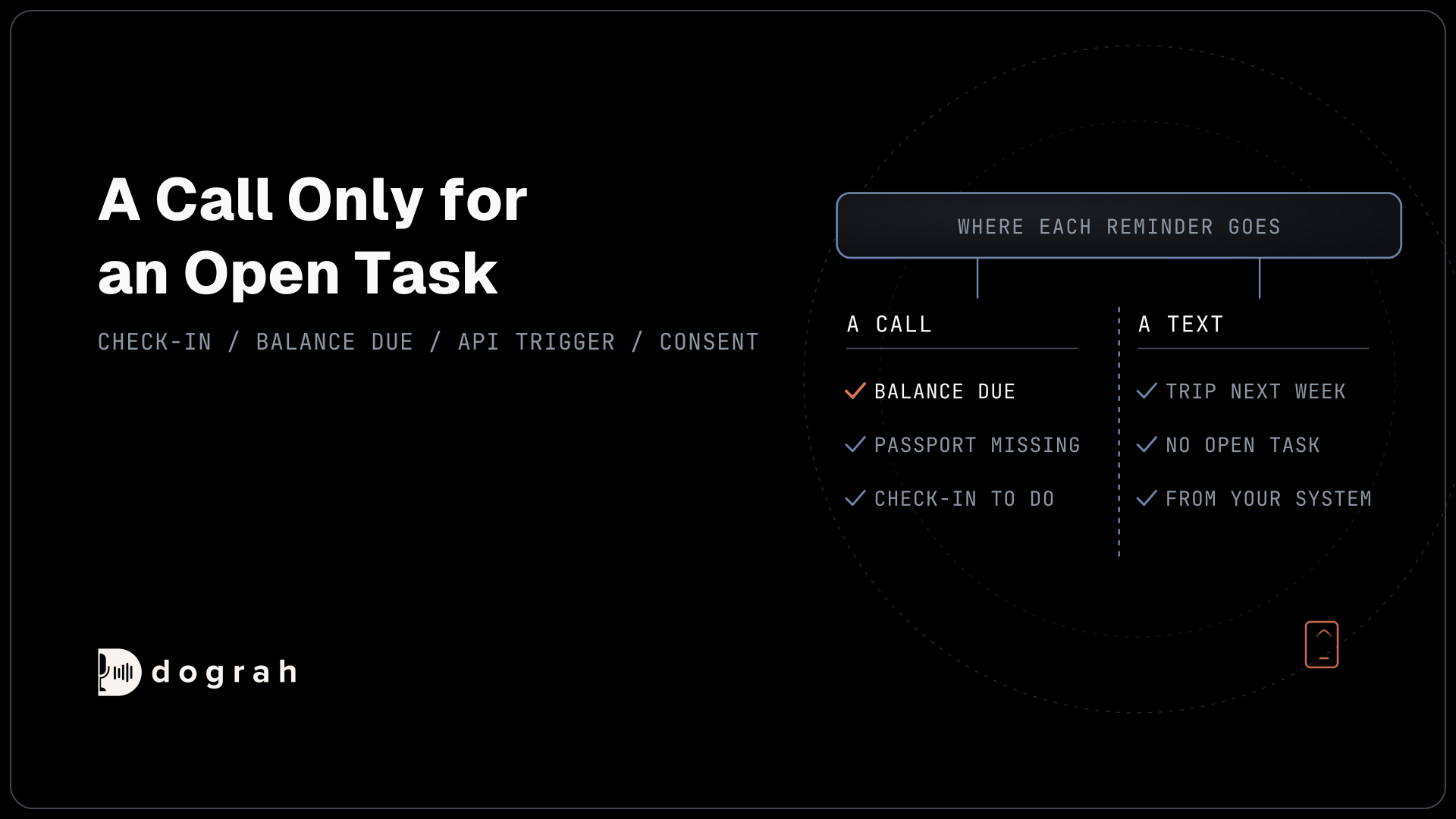
A reminder deserves a call only when it asks the traveller to act. Online check-in that the traveller has not done, a passport number missing from the booking, a document deadline for a tour or a balance falling due all pass that test. "Your trip is next week" does not. It belongs in a text or email from your own messaging system, because Dograh has no SMS tool and sends no texts itself.
The same test drives reminder calls in other industries, and Healthcare No-Show Reduction: Why AI Voice Agents Beat Reminders argues it with appointment data. What changes in travel is the size of the miss. A forgotten dental visit costs a slot. A traveller who reaches the airport without accepted ID, or a tour place released because the balance went unpaid, can cost the whole trip.
Reminders are also a different call from flight-status alerts. A reminder is scheduled from the booking before departure. A status alert starts when the operation changes, such as a delay or a gate change, and our post on AI Voice Agents for Flight-Status Updates covers that call.
Build the schedule from open tasks
Each reminder call should be tied to one open task and its due date in the booking system, and it should stop the moment the task is done. A fixed cadence of calls at set intervals before departure keeps calling travellers who paid last week. A task list does not, because a traveller who completes the task leaves the list.
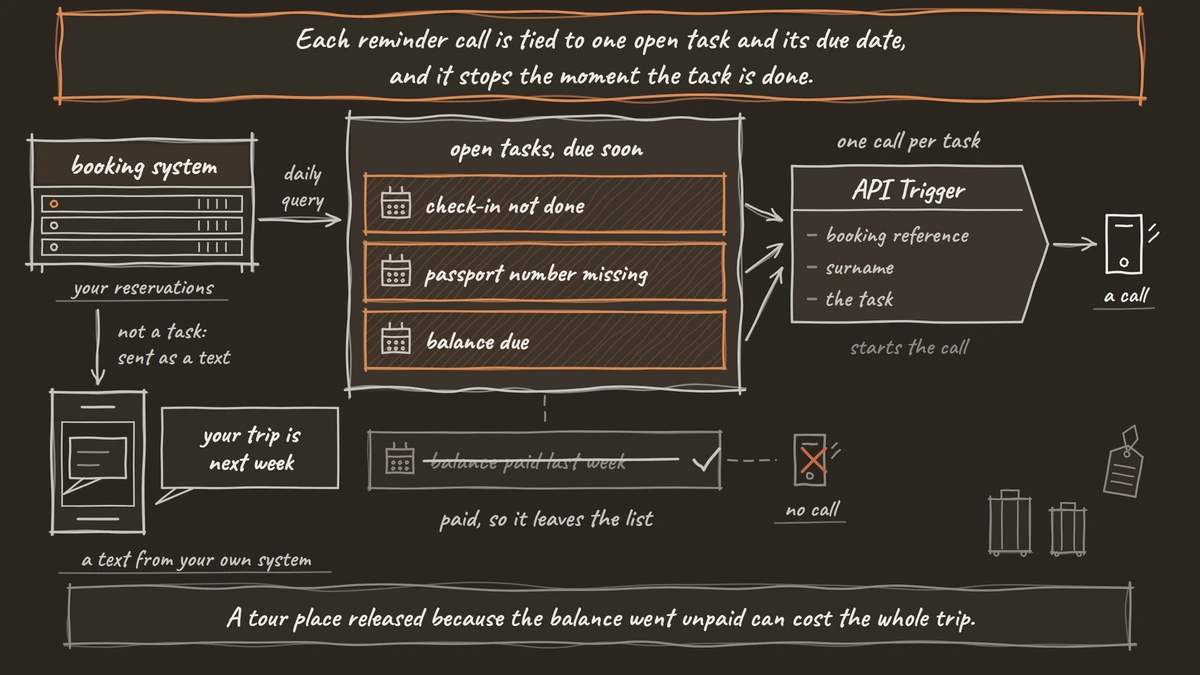
So the trigger is a daily query in your booking system for tasks that are open and due soon. Each match starts a call through Dograh's API Trigger, passing the booking reference, the surname and the task in the request. API Triggers: Start a Voice Agent Call From Any System shows how. Teams without that integration can export the day's list as a CSV file and upload it to Campaigns.
Campaigns handles the retries. Max retries runs from 0 to 10 (2 by default), the retry delay from 30 seconds to 1 hour (2 minutes by default), and separate switches retry on busy, no answer or voicemail. Calling hours are set by weekday in one time zone per campaign, not each traveller's local time. For travellers spread across time zones, run one campaign per zone so nobody is called at night. Campaigns has no per-traveller cap, so the limit on how often one person is called has to live in your own list, or set retries to 0.
Read document rules from your data, never from the model
Entry and ID rules change too often for an agent to state them from memory. Two recent changes show how quickly they move. In the US, TSA ConfirmID now lets a traveller without a REAL ID or other acceptable ID pay "the $45 fee" through Pay.gov so that TSA can try to verify their identity, and "the payment is valid for 10 days from the date entered". In Europe, the European Commission's smart borders page says the Entry/Exit System (EES) "became fully operational on 10 April 2026", while "ETIAS is currently not in operation". A language model trained before either change could tell a traveller the wrong thing with complete confidence.
The fix is to keep every requirement in your own data. The booking system holds what this booking needs, such as a passport number for an international flight or a signed form for a tour, and an HTTP API tool reads it during the call. Your general pre-departure guide can go in the agent's Knowledge Base, which accepts PDF, DOCX, DOC, TXT and JSON files up to 5 MB each. The agent reads the requirement for this booking and stops there.
When a traveller asks about anything the data does not cover, such as whether they need a visa, the agent says so and hands the question to a person. It never guesses at entry rules.

Open Source Alternative to Vapi / Retell
Self-hosted voice agent platform — no per-minute fees
dograh-hq/dograh
Star on GitHub
Verify, deliver one task, write back
Every reminder runs greet, verify, disclose. The Greeting Text in Dograh is fixed text spoken when the call connects. Use it to name the company and say the call is about an upcoming trip, with no destination or date. If you want to tell travellers they're speaking with an automated assistant, or your location requires it by law, add that too. The agent then asks for the booking reference and the surname before it names the trip or the task. It never asks for payment-card digits.
Travellers often do not have the reference to hand. In that case the agent says nothing about the booking, and an HTTP API tool asks your system to send the reminder to the email address already on the booking. The traveller still gets the task, and nothing was disclosed to a caller who could not be checked.
Once verified, the agent reads the departure details from the booking, such as the flight and the time check-in opens, then delivers the one open task and asks the question that closes it. Each answer is recorded as the traveller stated it, with the transcript and recording as the exact record, and a webhook writes the outcome to the booking system after the call: checked in, will check in by a stated time, document to follow, balance to be paid. A balance never turns into a card payment on the call. An HTTP API tool asks the agency's own system to send a secure payment link by text or email. Passport details go the same way, through a secure link from your system, and are never read out on the call.
Some answers are not the agent's to act on. A traveller who wants a new date or wants to cancel moves into the change call described in AI Voice Agents for Booking Changes and Cancellations. A request to change the contact details on the booking, or anything about a refund, goes to a person. Transfer Call works on Twilio only and passes no summary by default, so the agent writes the details to your system first. If nobody answers within 30 seconds, the default, the agent writes a callback request.
Consent before the first reminder
An outbound reminder needs the right consent on file before the first call. This is general information, not legal advice. In the US, the FCC treats an AI-generated voice as an artificial voice, so under 47 CFR 64.1200 a reminder to a mobile number generally relies on "the prior express consent of the called party", usually given with the booking.
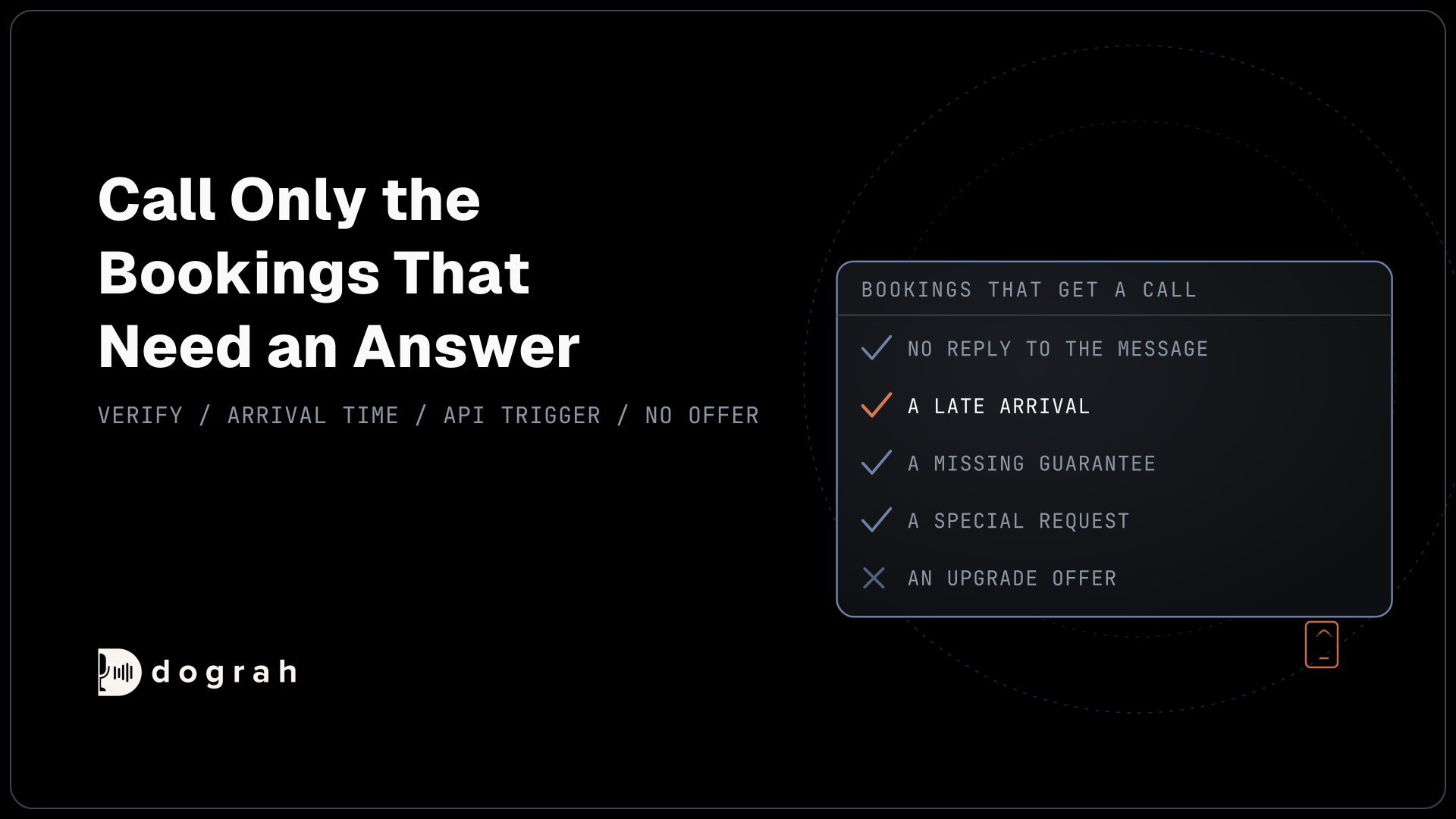
The trap is the add-on. A call that "includes or introduces an advertisement" needs "prior express written consent", so offering travel insurance or a seat upgrade inside a reminder generally changes the consent the whole call needs. Keep reminders to the task. A traveller who asks not to be called again goes onto your suppression list straight away, and confirm your own position with counsel before the first campaign.
Join the Dograh Community
Dograh is an OSS alternative to Vapi. Join our Slack community for queries, releases, best practices & community interactions.
Run it on your own servers
Reminder calls touch itineraries and, through the booking, passport data. Self-hosting Dograh puts the call platform on your own servers, and the audio stays inside your infrastructure only when the speech and language models run there too. Dograh has no retention setting, so your own policy decides how long recordings and transcripts are kept. Self-hosted Dograh has no per-minute platform fee (servers, any paid model keys and phone minutes still cost), and Dograh Cloud has a 1¢-a-minute platform fee.
Start with the balance-due list. It has one task with a fixed date, and a paid booking leaves the list on its own.
Glossary
- Open task
- Something a traveller still has to do before departure, such as online check-in, a missing document or a balance due, recorded with its due date in the booking system. It is the only reason a reminder becomes a call.
- Entry/Exit System (EES)
- The EU's system that registers non-EU travellers when they cross its external borders. The European Commission says it became fully operational on 10 April 2026.
- Calling hours
- The Campaigns setting that limits outbound calls to set hours for each weekday. Each campaign uses one time zone, so run one campaign per zone.
- Prior express consent
- The US consent tier that generally covers an informational artificial-voice call to a mobile number, such as a reminder with no sales content.