
AI voice agents for feedback surveys in restaurants call a guest on the same day as the visit or delivery, ask for one rating and one open question, and record both answers as the guest stated them. A webhook sends them to your review or CRM system. Complaints and refund requests go to a manager.
Key Takeaways
- Call the same day, while a complaint can still be fixed privately.
- Call only guests with a reason; everyone else gets a text.
- The agent never offers refunds; a manager calls back instead.
This post is part of our guide to AI voice agents for restaurants. The guide's section on calls around the order sets out the feedback call in a few lines: the same day, one rating and one open question, complaints to a manager. This post covers who to call and what the agent says to an unhappy guest, with Dograh, an open-source, self-hostable voice agent platform, getting each answer to the manager while there is still time to put it right.
Why the call goes out the same day
A complaint heard on the evening of a bad delivery can still be fixed, and the same complaint read in a public review a week later is mostly damage. BrightLocal's 2026 Local Consumer Review Survey, research by a local-search software company with 1,002 US adults, found that 74% look for reviews written in the last three months. It also found that 77% say negative reviews make them less likely to choose a business.
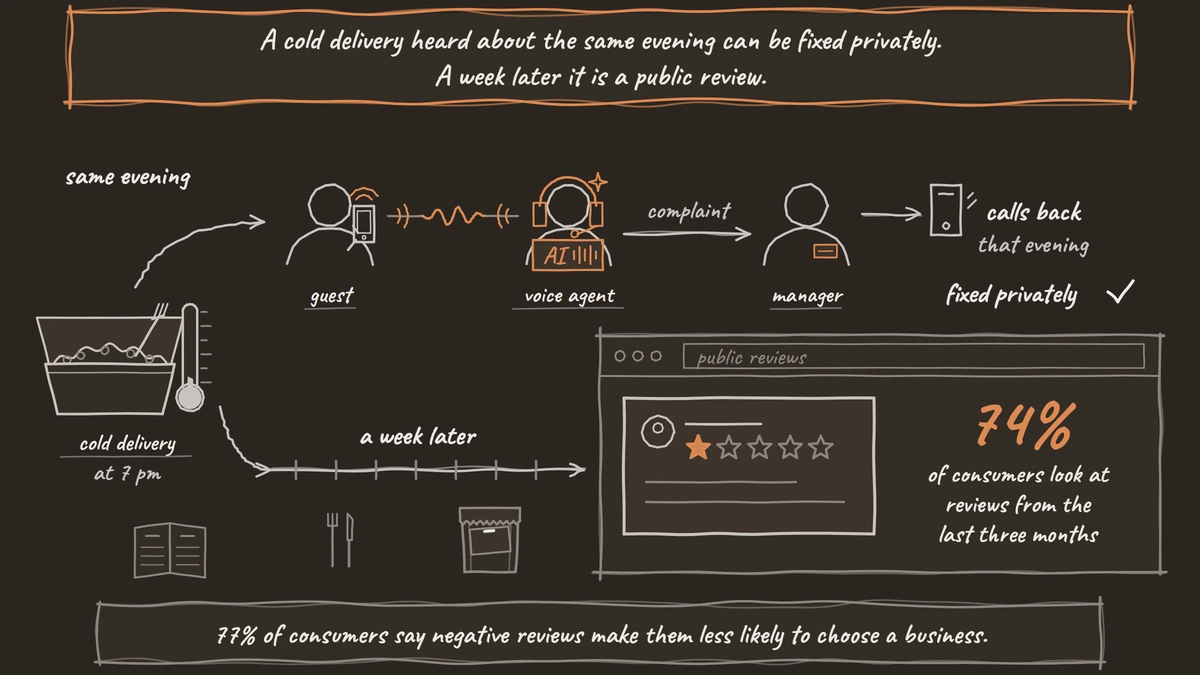
Guests now expect owners to move fast. In the same survey, 89% expect business owners to respond to reviews, and 19% expect a same-day response, up from 6% the year before. The survey covers local businesses in general, not restaurants alone. A manager who hears about a cold delivery at 7 pm can call back that evening, before anything is written.
The call never asks a guest to keep quiet. BrightLocal found that 29% of consumers wrote a negative review in the last 12 months, and a guest who wants to post one is free to. The call only gives the manager the first chance to fix it.
Which guests get a call, and which get a text
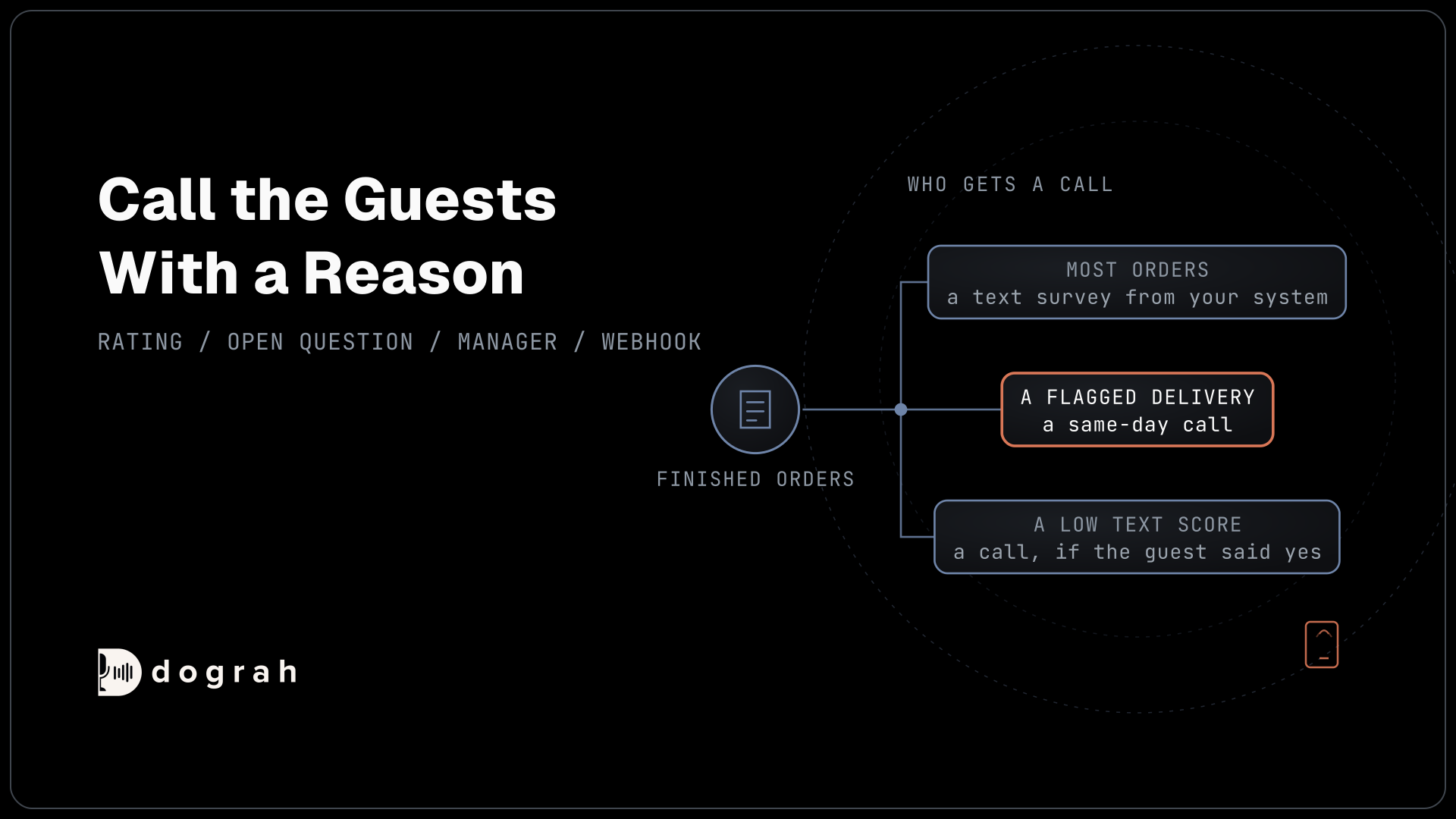
Most guests are better asked by text, so the call is kept for visits where a spoken answer is worth the interruption. A text survey from the restaurant's own feedback tool is cheap and easy to ignore politely. Dograh sends no texts itself, so that survey runs from your own system.
A call earns its place in four cases. The first is a delivery the POS or the driver flagged as late or short of an item. The second is a large party or private event. The third is a catering order, since a catering buyer often orders again, as our post on catering inquiries explains. The fourth is a guest who left a low score by text and said yes to a call.
The call goes out the same day, inside calling hours. A lunch order that went wrong gets a call mid-afternoon; a late dinner may wait for the first polite hour next morning. A flagged order can start the call through Dograh's API Trigger, with the order number and items passed in initial_context, or a daily list can go into Campaigns, which set calling hours by weekday. Campaigns have no per-guest call cap, so your list decides how often one guest is called.
The call: verify, then one rating and one open question
The call names the restaurant. If you want to tell guests they're speaking with an automated assistant, or your location requires it by law, write that in the same Greeting Text. It confirms who is on the line before it mentions the order. Greeting Text plays word for word, with a fallback such as {{customer_name | there}} for a missing name.
The check is the name on the order or booking plus its date and time. A phone number finds the order, but it does not prove the person answering placed it, so the agent names nothing from the order until the guest has confirmed both.
Then come the two questions: one rating and one open question about what happened. The method is set out in AI Voice Agents for Delivery Feedback and CSAT Surveys: One Rating, One Question, and a restaurant can use it unchanged. What differs is what the open question surfaces: cold food, a missing side, a long wait for the driver, a forgotten birthday candle. Each points at a different part of the business, so the agent records the answer as the guest said it and the manager decides where it goes.
Dograh's variable extraction records the rating and the comment. Extraction is an AI step, so the transcript and the recording remain the exact record. If the call reaches voicemail, the message names the restaurant and a number to call back, and nothing about the order.

Open Source Alternative to Vapi / Retell
Self-hosted voice agent platform — no per-minute fees
dograh-hq/dograh
Star on GitHub
Complaints and refund requests go to a manager
The agent's job with an unhappy guest is to hear the whole complaint and hand it to someone who can fix it. Once the guest has finished, it records the complaint as stated and says a manager will call back. It then writes a callback request to your system through an HTTP API tool, with the order number and the complaint as stated.
The agent offers nothing. It gives no refund or credit, even a small one, because the agent never decides money. During service hours, Transfer Call can pass the guest straight to the manager on Twilio. The transfer carries no summary, so the callback request is written first, and if nobody answers within 30 seconds, the default, the guest stays with the agent and the request stands.
Some complaints are urgent. A guest who says they felt ill after the meal, or had an allergic reaction, is flagged in the callback request for a manager call the same day, and the agent never discusses the cause. If the guest describes a reaction happening now, a fixed line tells them to call 911. Put it in that pathway's Transition Speech, which plays word for word on a cascade agent, so the model never improvises that sentence.
Review links, consent and stop requests
If the call offers a review link at all, it offers it to every guest with the same words, whatever rating they gave. Sending the link only to happy guests is review gating, and Google's policy on prohibited and restricted content bars businesses that "selectively solicit positive reviews from customers". It also bars offering "discounts, free goods and/or services" in exchange for a review. The agent cannot send it; an HTTP API tool asks your own messaging system to text it.
A feedback call stays informational only while it sells nothing. This is general information, not legal advice. Under the Telephone Consumer Protection Act (TCPA), a call with an AI voice to a mobile number generally needs the guest's prior express consent, which usually means the number they gave with the order or booking. Add "10% off your next visit" and the call generally becomes telemarketing, which needs prior express written consent. The state-by-state picture is in AI voice agents for restaurants in the US. Confirm your own position with counsel before the first call.
A guest who says "don't call me again" is written back to your list straight away.
Join the Dograh Community
Dograh is an OSS alternative to Vapi. Join our Slack community for queries, releases, best practices & community interactions.
Where the answers go
Every answer lands in a system your managers already read. When the call ends, a webhook sends the rating and comment, with links to the transcript and recording, to your review or CRM system. A temporary failure such as a timeout is retried automatically, up to 5 attempts. Dograh has no built-in CRM integrations, so the webhook points at your CRM's API or an n8n workflow.
Check the agent as well as the guests. A QA node reviews finished calls, and a Sample Rate below 100 picks calls at random. QA scores each step of the call separately, with its own tags, 1-10 score, sentiment and summary, so you can see whether the agent cut a complaint short or offered something it should not. Summaries are in English by default. Our post on Automated QA for Voice Agents: Grade the Agent, Not the Caller covers the setup.
Feedback calls carry guests' names and complaints. Self-hosting Dograh keeps the recordings and transcripts on your servers, and the guests' audio stays there too only when the speech and language models also run on your servers. Self-hosted Dograh has no per-minute platform fee (servers, model keys and phone minutes still cost); Dograh Cloud is a 1¢-a-minute platform fee.
Glossary
- Review gating
- Asking only satisfied guests for a public review, or sending the review link only after a high rating. Google's content policy bars selectively soliciting positive reviews.
- Callback request
- The record the agent writes to the restaurant's system so a manager calls the guest back, with the order number and the complaint as stated.
- Sample Rate
- The QA node setting for the share of finished calls that get reviewed. A value below 100 picks calls at random.
- Prior express consent
- The consent TCPA rules generally require before an informational call with an AI voice reaches a mobile number, usually the number the guest gave with the order or booking.