
French AI voice agents for hotels answer guests in French and follow them into English on the same call. In Dograh, set speech-to-text to Multilingual (Auto-detect) with French and English hints, and write a bilingual greeting that carries the recording notice. Before naming any booking detail, the agent checks the confirmation number and surname.
Key Takeaways
- The greeting plays before language detection, so write it in both languages.
- Put the recording notice and the AI disclosure in the greeting itself.
- Sales calls to French guests need their consent first.
This post is part of our guide to AI voice agents for hotels and hospitality. The guide's section on building the agent and serving French-speaking guests notes that these guests often call in French and switch to English on the same call. This post covers what changes when that call runs on Dograh, an open-source, self-hostable voice agent platform, from the language settings to the French wording and rules.
Why a hotel in France needs two languages on the phone
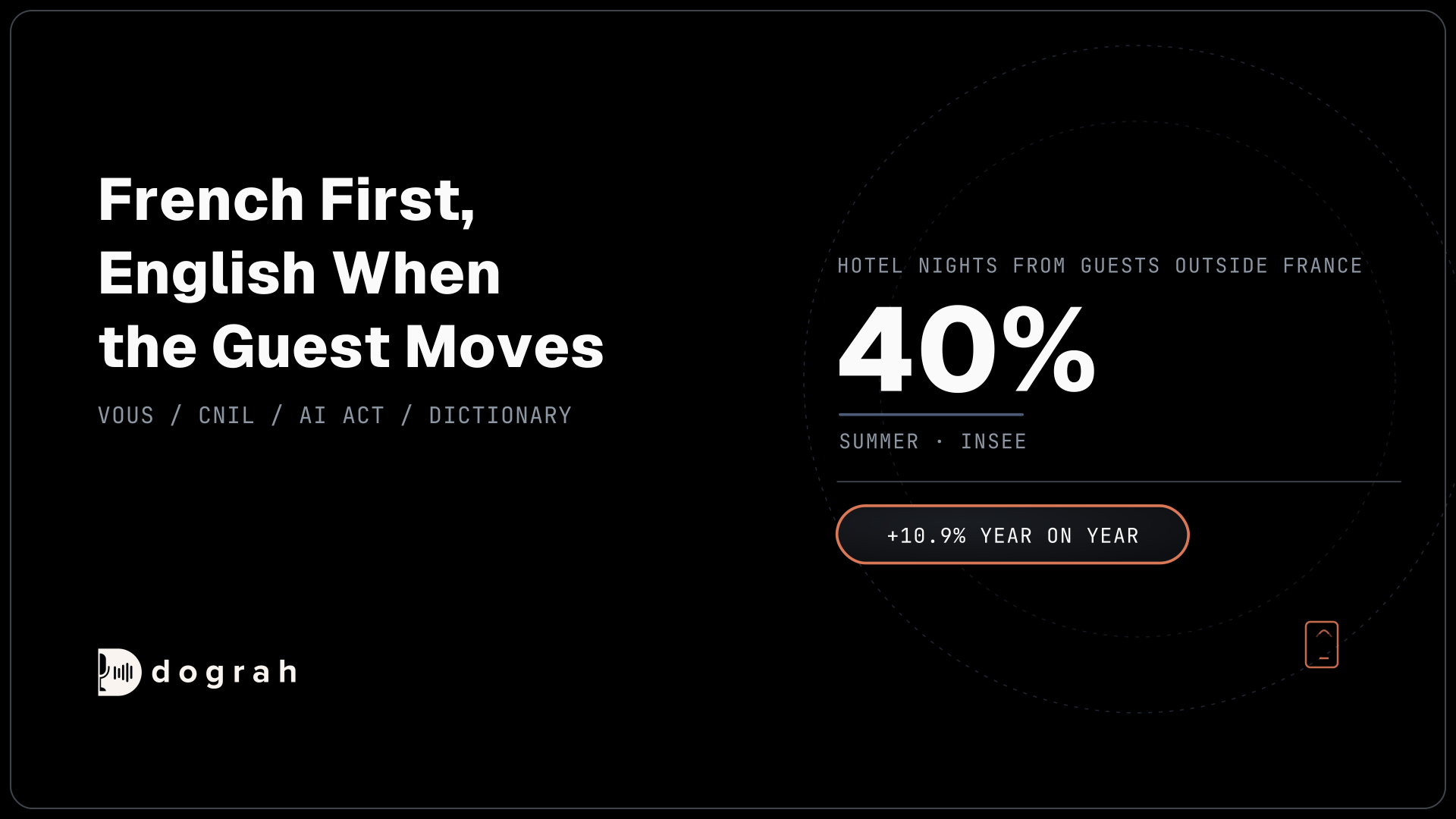
A hotel line in France hears French and English from the same pool of guests, often on the same call. In summer 2025, non-resident guests made 40% of hotel nights in France, according to INSEE's report on the 2025 summer tourist season, which covers May to August. Their hotel nights rose 10.9% on the 2024 season. INSEE marks the July and August figures as provisional.
So two in five hotel nights that summer went to guests from outside France. Many of them book in English, and the rest of the line belongs to French guests and to French speakers from Belgium or Quebec. A front desk handles this by switching language when the caller does. The agent has to do the same, without making the guest ask.
French comes first, because it is the hotel's own language and the default for the notices. English is the second language the agent follows when the guest moves to it.
Setting up French and English on one agent
The language setup is one setting plus a voice that speaks both languages. In the agent's Model tab, open the speech-to-text Language dropdown and choose Multilingual (Auto-detect). Below it, under Language Hints, tick French and English. The hints apply only to languages the Flux multilingual model supports, and Deepgram's language list shows French (fr) for its Flux multilingual model.
The voice must speak French too. ElevenLabs lists French for Multilingual v2 and Flash v2.5, and Cartesia lists French for Sonic 3.6. For a hotel that runs the speech models on its own servers, NVIDIA's Parakeet TDT 0.6B v3 lists French among its 25 languages. Dograh supports more than 70 languages in all, and our tutorial on how to build a voice agent for hotels covers the rest of the build.
Then write the language rule into the prompt. The agent answers in the language the guest is using. When it is unsure which language it heard, it asks a short question offering both, "Vous préférez continuer en français ou en anglais ?", and switches only after the guest confirms. If the guest speaks a language the agent cannot serve well, it transfers to a French-speaking member of staff, or takes only the details it needs and writes a callback request in that language to the hotel's system.

Open Source Alternative to Vapi / Retell
Self-hosted voice agent platform — no per-minute fees
dograh-hq/dograh
Star on GitHub
A bilingual greeting that carries the notices
The greeting is the one line that plays before Dograh knows which language the guest speaks, so it has to work in both. Greeting Text plays the moment the call connects, word for word. A short opening in French and English lets both groups feel addressed, and the agent then follows whichever language the guest answers in:
"Bonjour, hello. Vous êtes bien à l'Hôtel des Tilleuls. Je suis l'assistant automatisé de l'hôtel. Cet appel est enregistré pour traiter votre demande. Vous pouvez vous y opposer et accéder à l'enregistrement, et tous les détails sont sur notre site. This is the hotel's automated assistant. Comment puis-je vous aider ? How can I help?"
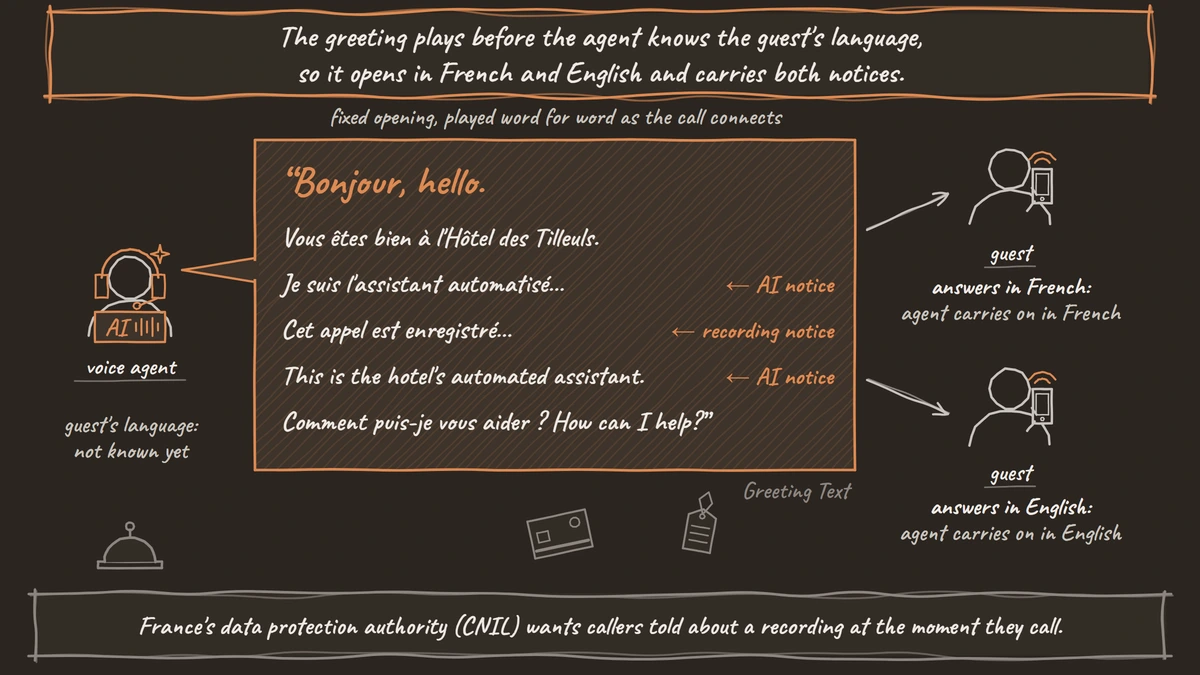
That line carries two notices. The CNIL, France's data protection authority, says each caller must be told "au moment de son appel" about the purpose of a recording, who receives it, and their rights to object and to access it. A message at the start of the call can do this, completed by other documents such as the hotel's website.
The other notice is the AI disclosure. Article 50(1) of the EU AI Act says providers must ensure AI systems that interact directly with people are designed so "that the natural persons concerned are informed that they are interacting with an AI system", unless that is obvious. It applies from 2 August 2026. The duty sits with providers, but saying "assistant automatisé" in the first sentence meets it from the guest's side and costs nothing.
A guest who objects to the recording needs a real alternative. Dograh has no per-agent recording switch, and on a self-hosted server recording can only be turned off for the whole server. So the agent offers a callback from a member of staff and writes the request to the hotel's system.
Vous, spelling and verification in French
French calls follow the same greet, verify, disclose order, with wording that sounds right to a French guest. The agent uses the vous form (vouvoiement) throughout and never switches to tu, even when a guest does.
Before it names anything about an existing booking, it asks: "Pourriez-vous me donner votre numéro de confirmation et votre nom de famille, s'il vous plaît ?" A number on file only finds the booking. It never proves who is calling. The tool checks both answers against the hotel's system before the agent says a date or a price.
Spelling is where French calls break. French letter names differ from English ones, so G sounds like "jé" and J like "ji", and a bilingual model can mix them up. Ask the guest to spell the surname, then read it back letter by letter in the language the guest spelled it in.
Dates and prices follow French habits too. The agent says "du vendredi 13 au dimanche 15 novembre", uses the 24-hour clock ("l'arrivée à partir de quinze heures") and reads amounts in euros as words. Add French place and hotel names to the agent's Dictionary, which works with Deepgram and Dograh speech-to-text.
No card number is taken on any call. An HTTP API tool asks the hotel's own system to send a secure payment link by text or email.
Sales calls to French guests need consent first
An offer turns a service call into a sales call, and France sets its own rules for those. This is general information, not legal advice.
France has moved commercial phone prospecting of consumers to a prior-consent model, so a call that offers something, such as an upgrade or a package, generally needs the guest's consent on file before the agent dials. A call about a booking the guest already holds, with no offer in it, is a separate question. Keep the two apart in the hotel's call list, and record any consent in the hotel's own system.
The upgrade call itself, inbound and outbound, is covered in AI voice agents for room upgrade upsell. Confirm your own position with counsel before the first outbound campaign to French numbers.
Join the Dograh Community
Dograh is an OSS alternative to Vapi. Join our Slack community for queries, releases, best practices & community interactions.
Where guest data lives and how French calls are reviewed
Guests from the EU bring the General Data Protection Regulation (GDPR) with them, so where the audio goes matters. Self-hosting Dograh puts the recordings and transcripts on the hotel's servers. The audio and transcripts stay there only when the speech and language models run on those servers too, as in Running Voice AI on Local, Self-Hosted Models. A model used through an API key still receives the audio: using your own API key changes who your contract is with, but the audio still goes to that provider.
Review needs a French speaker. Dograh's quality assurance (QA) node scores each step of a sample of calls, and its summaries come out in English by default. A French-speaking reviewer should still read the French transcripts of flagged calls, because an English summary can smooth over a misheard name.
Test on a real phone line with French speakers from more than one region. Most phone calls still reach the agent as 8 kHz audio, while a browser test runs at 16 kHz. Our post on Spanish AI voice agents for healthcare follows the same switching rule in Spanish. Self-hosted Dograh has no per-minute platform fee, though servers, model keys and phone minutes still cost money, and Dograh Cloud has a 1¢-a-minute platform fee.
Glossary
- Multilingual (Auto-detect)
- Dograh's speech-to-text Language setting that detects which language the caller is speaking and follows a switch during the call, instead of fixing one language for the whole call.
- Language Hints
- The checkboxes under the Language dropdown that tell auto-detect which languages to expect, such as French and English. They apply only to languages the Flux multilingual model supports.
- Vouvoiement
- Addressing someone with the formal vous rather than tu. A hotel agent uses it with every French-speaking guest for the whole call.
- Dictionary
- The agent setting that lists words for speech-to-text to listen for, such as street, place and hotel names. It works with Deepgram and Dograh speech-to-text. How much it helps in French depends on the provider.