
AI voice agents for interview scheduling book interviews by phone. The agent verifies the candidate, reads open interviewer slots from the ATS or calendar through an HTTP API tool, offers times one to three days out, reads the chosen slot back in full, and writes the booking to the system the recruiter works in.
Key Takeaways
- Send a text link first. Call the candidates who did not book.
- Offer slots one to three days out unless the candidate asks sooner.
- Read the booking back before writing it, and write it retry-safe.
This post is part of our guide to AI voice agents for staffing and recruitment. The guide's section on calls before the interview describes scheduling as the call that books a slot: the agent reads open interviewer slots, offers a few, reads the chosen time back and writes the booking to the ATS. This post covers that call in Dograh, an open-source, self-hostable voice agent platform, from the first slot offered to the reschedule a week later.
When a call beats a text link
Many candidates will book from a text, so a call should go to the ones a text misses. Workday's account of its own recruiting team shows how far text can go. Its assistant texts open slots and handles reschedules by text, and Workday says the time to get a meeting on the calendar fell from more than three days to under six hours, saving more than 12,000 hours a year. That is a vendor describing its own tool, and it is still a fair benchmark.
The call earns its place in two cases. The first is the candidate who has not booked a day after the text, or who calls the number in the text because they would rather talk. The second is the candidate who needs to change a time they already have. Hourly applicants who read texts on a break and answer the phone after a shift are a common example.
Scheduling is the call that books. It follows the screening call once the applicant tracking system (ATS) moves a candidate on, as AI voice agents for candidate screening explains. The reminder call before the interview only confirms the booking and passes any change back to this flow, as covered in AI voice agents for candidate reminder and confirmation calls. An outbound scheduling call needs the consent the guide describes, usually collected on the application form.
Offer slots one to three days out
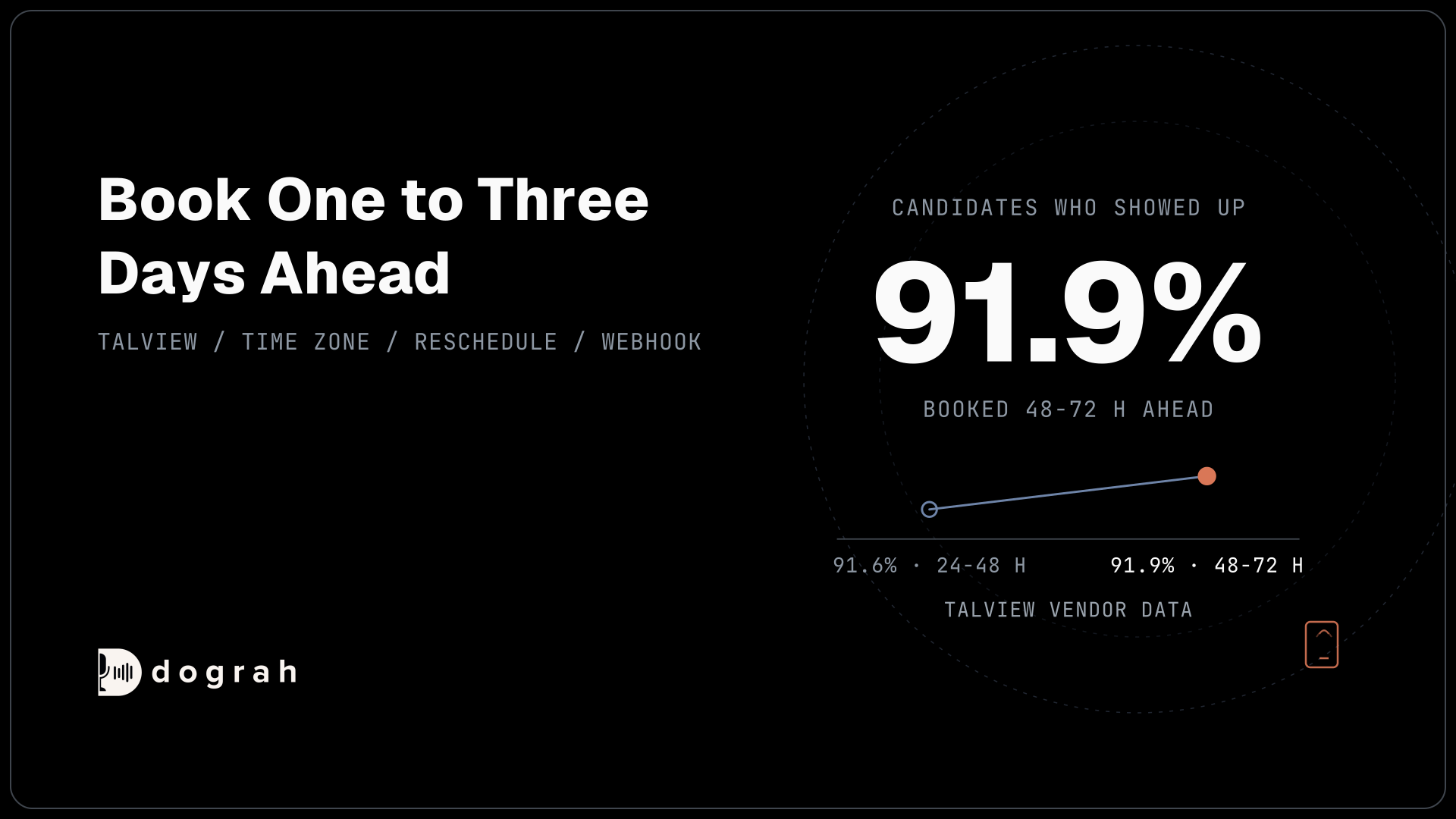
The slots the agent offers first decide how many candidates turn up, and the safest default is one to three days ahead. Talview analysed 93,783 scheduled interviews in a study published in December 2025. In the roughly 80,000 where it could tell how far ahead the booking was made, candidates showed up 72.0% of the time when the interview was booked less than 24 hours ahead. At 24 to 48 hours the show rate was 91.6%, and at 48 to 72 hours it was 91.9%. Beyond 72 hours it slipped to 88.3%. Talview sells interview software and does not state the period it measured, so treat these as vendor data.
Write the window into the slot request itself, so the ATS returns only times between one and three days out. A candidate who asks for today can still have it, because the agent asks the ATS again with a shorter window. Offer two times at once. A longer list is hard to hold in your head on a phone call, and the candidate can always ask for more.
How the booking call runs
The call runs greet, verify, disclose, and it says early that it is only a booking call.
If you want to tell candidates they're speaking with an automated assistant, or your location requires it by law, write it in the Greeting Text along with the agency's name, and nothing else, because it plays before verification: "Hello, this is Northside Staffing's automated assistant. This call is recorded." The agent asks for the candidate by name, then checks the role they applied for and the email or postcode on the application against the record. Only after that does it name the client employer or the interview.
Then it says what the call is for: "This call is only to book a time. It is not an interview, and nothing you say here is assessed." In the Greenhouse 2026 Candidate AI Interview Report, a survey by a company that sells hiring software, 70% of US job seekers surveyed (1,200 of 2,950 across five countries) said they were never clearly told up front that AI would be evaluating them. A candidate who thinks the booking call is a test answers it like one.
During the call, an HTTP API tool asks the ATS or calendar for open slots that match the interview type. Slots fill up while the call is happening, so the agent asks for them live and never works from a list loaded earlier. The candidate picks one, and the agent reads it back in full: "Tuesday 20 October, 10 a.m. Eastern, a video interview with the warehouse team. Is that right?" Read the time zone every time. A candidate in another state hears the time they will actually be sitting down.
Only after a yes does a second HTTP API tool write the booking. Add a Preset Parameter named workflow_run_id with the value {{initial_context.workflow_run_id}}, so the receiving system can ignore a duplicate if the same request arrives twice. Dograh adds no Idempotency-Key header itself. If the slot was taken in the seconds between the offer and the yes, the system says so, and the agent offers the next one.

Open Source Alternative to Vapi / Retell
Self-hosted voice agent platform — no per-minute fees
dograh-hq/dograh
Star on GitHub
Write the booking where the recruiter works
The booking belongs in the system the recruiter already opens every morning, so the agent writes there and keeps no copy of its own.
Dograh has no built-in calendar or ATS integrations. Each HTTP API tool calls the system's own API directly, whether that is the ATS or a shared calendar. Our walkthrough of mid-call booking through Calendly's API shows the request in detail. For panel interviews, the agent books from slots the ATS or scheduling tool already holds for the whole panel. Finding a time across five calendars stays with that system, and the agent never tries.
When the call ends, a webhook sends the outcome to the ATS, booked or not, with links to the transcript and recording. A temporary failure is retried automatically. Dograh has no SMS tool, so the confirmation text comes from the ATS, or from an HTTP API tool that asks the agency's own messaging provider to send it.
Outbound calls usually start the moment the ATS moves a candidate on. The ATS calls Dograh's API Trigger with the candidate's details, as set out in API Triggers: Start a Voice Agent Call From Any System.
Reschedules and cancellations
A reschedule is two writes in a fixed order: the new booking first, then the release of the old one.
The candidate who calls to move an interview goes through the same check, and the agent finds the existing booking through an HTTP API tool. It offers new slots, reads the choice back and writes the new booking. Only when the ATS confirms it does the agent release the old slot. Done the other way round, a failed write leaves the candidate with no interview at all.
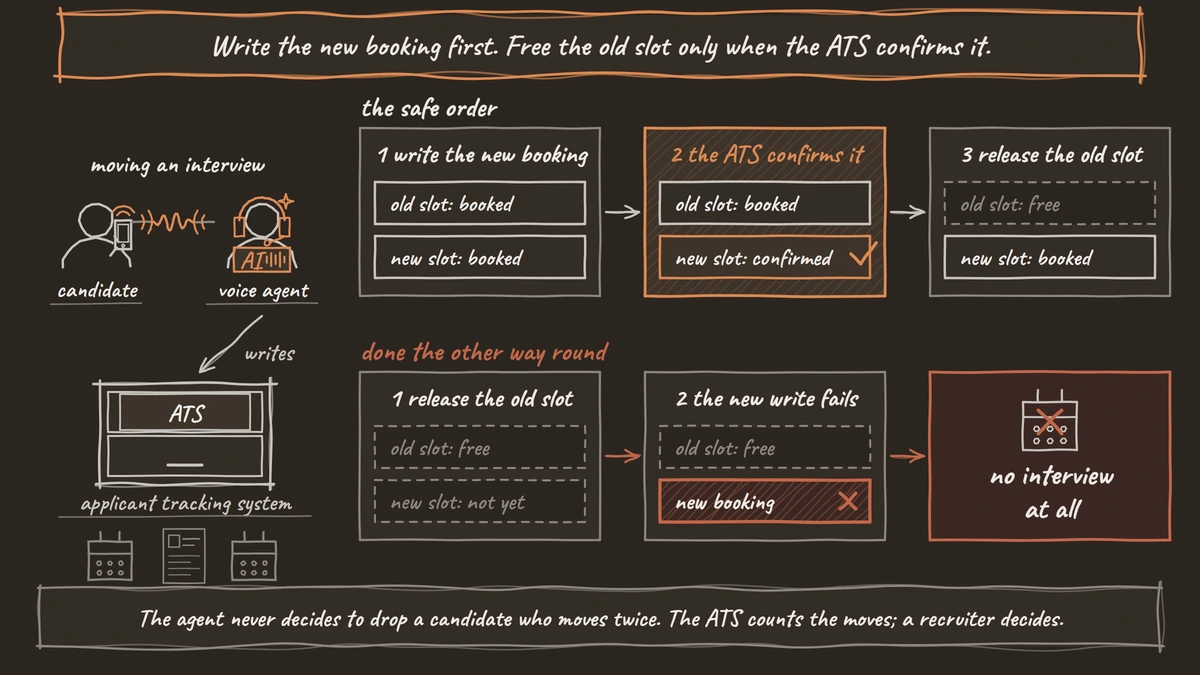
A cancellation is recorded with the reason as the candidate stated it, such as "took another job" or "shift changed". The agent never decides that a candidate who moves twice should be dropped. If your agency has a rule about repeated reschedules, the ATS counts them and a recruiter looks at the record.
A candidate who wants a person is put through with Transfer Call, which works on Twilio only and passes no summary, so the agent writes the details to the ATS first. If nobody answers within 30 seconds (the default), the agent writes a callback request to the ATS through an HTTP API tool.
Join the Dograh Community
Dograh is an OSS alternative to Vapi. Join our Slack community for queries, releases, best practices & community interactions.
Where to start
Start with a book-by-phone number printed in the invitation text, so candidates who would rather talk can call it.
Self-hosting Dograh keeps recordings and transcripts on the agency's own servers, and the audio stays inside your infrastructure only when the speech and language models run there too. Self-hosted Dograh has no per-minute platform fee (servers, model keys and phone minutes still cost); Dograh Cloud has a 1¢-a-minute platform fee.
Watch one number in the first month: the share of booked interviews that happen at the booked time. Then add outbound calls to candidates who have not booked a day after the text.
Glossary
- Show rate
- The share of booked interviews the candidate actually turns up to. Talview's vendor data found much higher show rates for interviews booked one to three days ahead than for same-day bookings.
- Reschedule
- Moving an interview the candidate already has to a new time. The agent writes the new booking first and releases the old slot only after the ATS confirms it.
- HTTP API tool
- A Dograh tool that calls another system's API during the call, such as asking the ATS for open slots or writing a booking. It is how Dograh connects to any calendar or ATS.
- Preset Parameter
- A value Dograh fills from the call's own data, not from the conversation, and adds to every request an HTTP API tool sends. Setting workflow_run_id this way lets the receiving system spot and ignore a duplicate booking request.