
AI voice agents for abandoned-cart recovery call shoppers who left items in a cart and offer help finishing the purchase. Because the call invites a sale and uses an AI voice, in the US it generally needs the shopper's prior express written consent first. With consent on file, the agent makes one short call, answers questions and never takes payment.
Key Takeaways
- A cart call is telemarketing in an artificial voice, so written consent comes first.
- Store the consent record yourself: wording shown, time, phone number.
- One call per cart, inside calling hours, with stop requests written back at once.
This post is part of our guide to AI voice agents for e-commerce and retail. The guide's section on the one sales call puts it plainly: an abandoned-cart call is a sales call, so consent comes before the script. Here is that call in full, built on Dograh, an open-source, self-hostable voice agent platform, starting with who may be called at all.
A cart call is a sales call
A call about an abandoned cart reminds the shopper of products and invites them to buy, so it is generally telemarketing. That matters because of the voice making it.
In February 2024, the Federal Communications Commission said in its declaratory ruling, FCC 24-17, that "the TCPA's restrictions on the use of 'artificial or prerecorded voice' encompass current AI technologies that generate human voices." An AI voice agent's call therefore falls under the Telephone Consumer Protection Act (TCPA) rules for artificial voices.
Paragraph (a)(2) of the FCC's rule at 47 CFR 64.1200 bars "any telephone call that includes or introduces an advertisement or constitutes telemarketing, using an automatic telephone dialing system or an artificial or prerecorded voice" to mobile numbers and certain other lines, "other than a call made with the prior express written consent of the called party". Paragraph (a)(3) sets the same bar for residential lines.
Read together, an AI-voiced cart call generally needs prior express written consent. This is general information, not legal advice, and the merchant, not the voice platform, is the one who placed the call; confirm your position with counsel.
The consent box is the whole feature
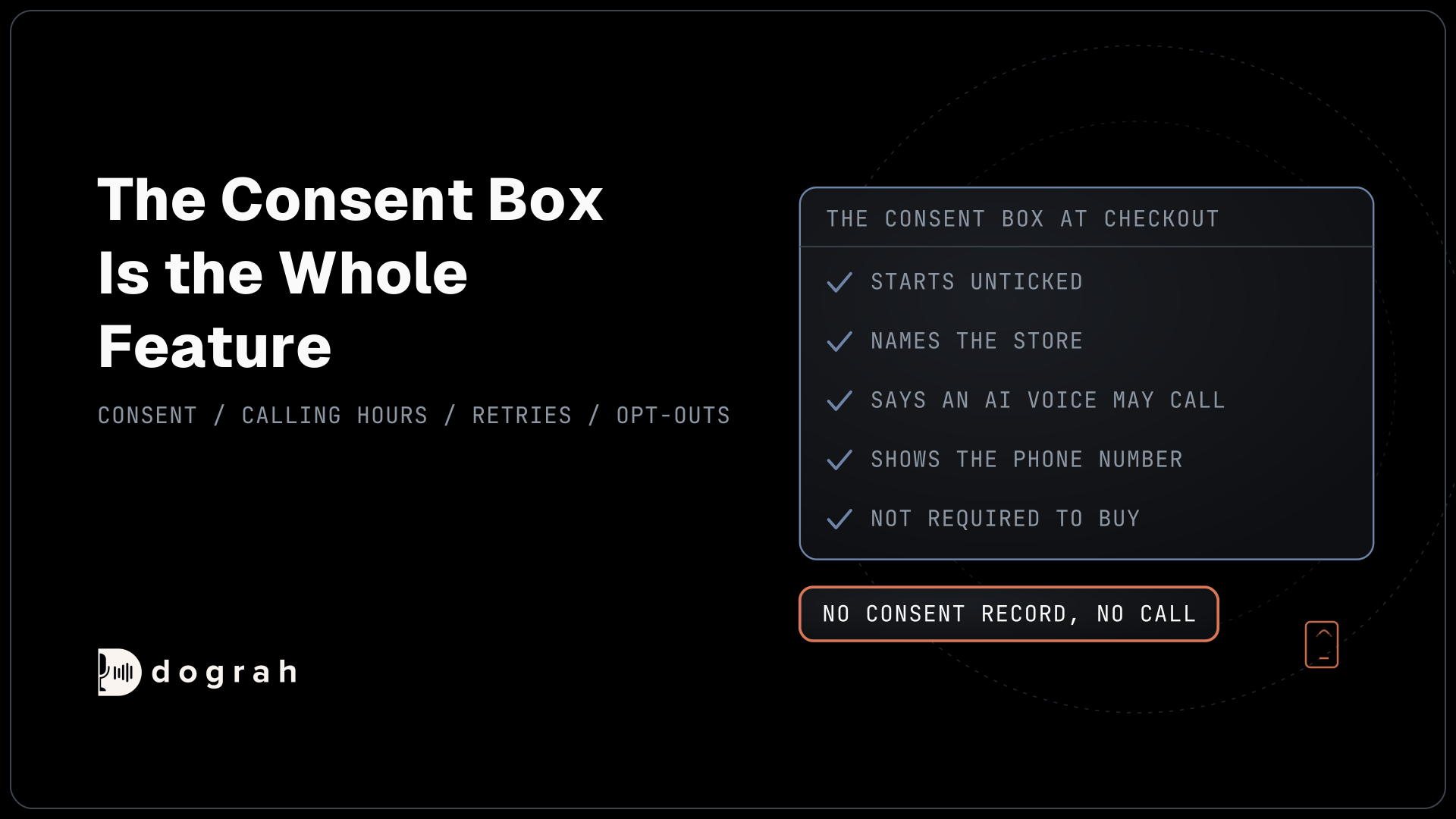
Build the consent check before the call script. Without a consent record, the best script in the world is a liability.
The rule defines prior express written consent in paragraph (f)(9) as "an agreement, in writing, bearing the signature of the person called that clearly authorizes the seller to deliver or cause to be delivered to the person called advertisements or telemarketing messages using an automatic telephone dialing system or an artificial or prerecorded voice". The same paragraph requires telling the person that they are not required to sign as a condition of buying.
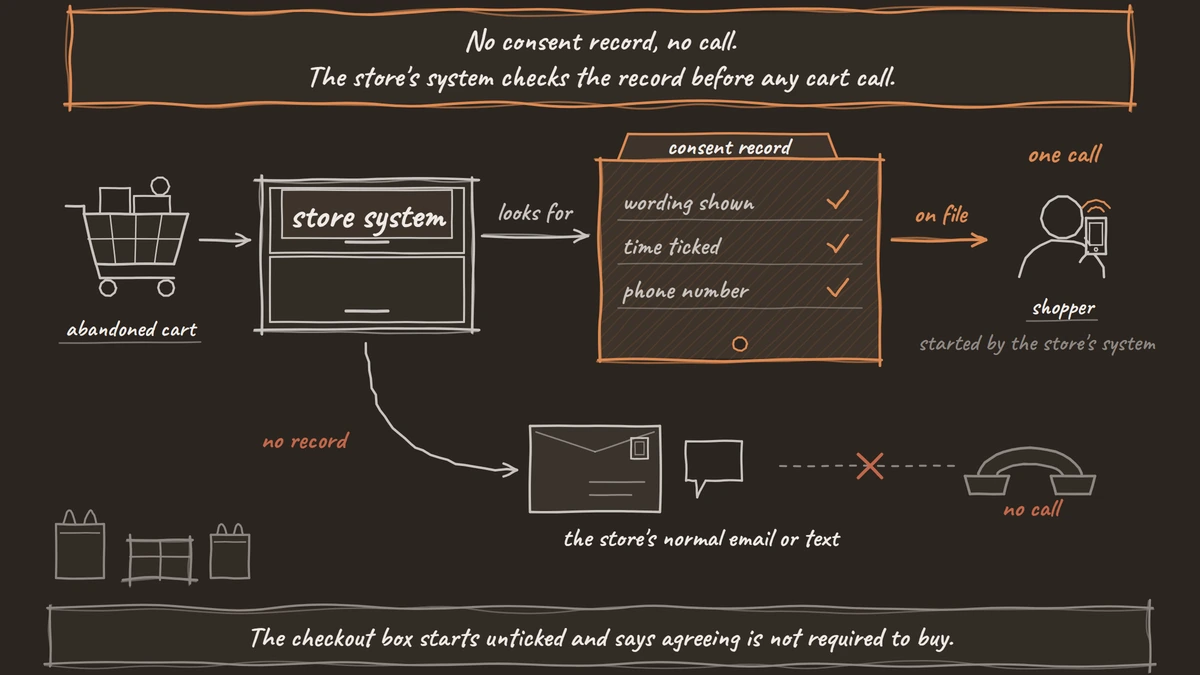
For a store, that generally means a checkbox at checkout that starts unticked, names the store, says calls may come from an automated or AI voice, shows the phone number it covers, and says agreeing is not required to buy. The store's own system keeps the record: the exact wording shown, the time it was ticked and the number.
If the record is missing, the cart gets the store's normal email or text, and no call. Dograh never decides this. The store's system checks the record before it starts any call.
How the call runs
With consent on file, the call is short: a single reminder, then help only if the shopper wants it.
The store's system starts the call through the API Trigger and passes the cart in as context: the shopper's first name and the main item in the cart. Our post on API triggers shows how. The Greeting Text names the store first, because an unexpected call sounds like a scam until the shopper knows who it is from; the first 15 seconds decide whether they stay. Variables in the greeting need a fallback, such as {{customer_name | there}}, or a missing value is read aloud as the raw placeholder. If you want to tell shoppers they're speaking with an automated assistant, or your location requires it by law, write that in the Greeting Text too.
The agent mentions the cart once and asks whether anything stopped the shopper. Questions about shipping, sizing, delivery times or returns are answered from the store's documents in the Knowledge Base. Price and stock come from the store's system through an HTTP API tool during the call, never from the prompt.
If the shopper wants to finish, an HTTP API tool asks the store's own system to send the checkout link by text or email. Dograh sends no texts itself, and the agent never takes a card number on the call. If the shopper says no, the agent thanks them and ends the call.

Open Source Alternative to Vapi / Retell
Self-hosted voice agent platform — no per-minute fees
dograh-hq/dograh
Star on GitHub
Calling hours, retries and opt-outs
The rule generally limits telephone solicitations to between 8 a.m. and 9 p.m. in the called party's local time, under paragraph (c)(1). Dograh campaigns use one time zone per campaign, not each contact's local time, and the API Trigger dials as soon as it is called, with no time field. So the store's system checks the shopper's local time before it triggers a call, or splits campaigns by time zone.
Make one call per cart. Campaigns have no per-contact call cap, so set retries to 0. For voicemail, keep the default setting under "When voicemail is detected", which is "Disconnect the call", unless the consent clearly covers a recorded message; a sales message left on voicemail in an AI voice is itself a call under the same rules.
A shopper who says "stop calling me" is written back to the store's own do-not-call list during the call, through an HTTP API tool or from the webhook after it. Dograh keeps no do-not-call list of its own. It can tag a call as do_not_call, but that never blocks a later call, so the store removes those numbers before each campaign upload.
Join the Dograh Community
Dograh is an OSS alternative to Vapi. Join our Slack community for queries, releases, best practices & community interactions.
Where to start
Start with shoppers who are already customers and have ticked the consent box, and with carts large enough to justify a call. Measure the result honestly: recovered orders from called carts against a similar group that got only the email. Read the transcripts for complaints and stop requests as closely as for sales.
Reorder reminders follow the same consent rule, as AI voice agents for post-purchase follow-up in e-commerce explains. Confirm your consent wording and your position with counsel before the first outbound campaign. Self-hosted Dograh has no per-minute platform fee (servers, model keys and phone minutes still cost); Dograh Cloud has a 1¢-a-minute platform fee.
Glossary
- Prior express written consent
- Under 47 CFR 64.1200(f)(9), a signed written agreement that clearly authorizes a seller to deliver advertisements or telemarketing using an autodialer or an artificial or prerecorded voice to a stated number, and states that signing is not a condition of purchase. An AI-voiced cart call generally needs it.
- Artificial or prerecorded voice
- The TCPA category that, per the FCC's February 2024 ruling FCC 24-17, covers current AI technologies that generate human voices, including AI voice agents.
- Consent record
- The store's own proof that a shopper agreed to calls: the exact wording shown, the time it was ticked and the phone number. The store checks it before any cart call.
- Do-not-call list
- The store's own list of numbers that asked not to be called. Dograh keeps none, so stop requests are written to the store's list and removed before every upload.