
AI voice agents for post-purchase follow-up in e-commerce call customers a few days after delivery to check the order arrived and works. They verify the customer, answer setup questions from the store's manuals, start a return or hand over a problem, and write the outcome back. A call that offers a reorder is a sales call and needs consent.
Key Takeaways
- A check-in call earns its place only when it can fix something.
- Leave out customers with an open ticket or open return.
- Reorder offers turn the call into a sales call that needs consent.
This post is part of our guide to AI voice agents for e-commerce and retail. The guide's section on what happens after delivery sums this call up: it checks that the order arrived and works, and it carries no offer. Here is how to run it on Dograh, an open-source, self-hostable voice agent platform, and how to keep the one sales call apart.
Why the days after delivery matter
The days after checkout are when customers most want to hear from a store. Narvar's 2025 State of Post-Purchase report, a survey of 3,461 US online shoppers in August 2025, found that about two in three consumers feel anxious after clicking buy, and 38% say frequent tracking updates reduce it.
Most of that need is met by messages, not calls. Shipped, out for delivery, delayed and delivered are milestones the store's own tools already send. Before delivery, a late order is covered in AI Voice Agents for Order Status and Updates in E-commerce.
A follow-up call is for the moment after the parcel arrives, when there may be something to settle, such as a missing part or a product that will not set up.
Which orders earn a check-in call
Call where a problem is likely and costly, not every order. High-value orders, furniture and appliances that need assembling, fragile items, and first orders of a product with a known setup step are the usual candidates.
The call opens with the store's name in the Greeting Text, because an unexpected call about a parcel can sound like a scam until the customer knows who it is from. Our post on the first 15 seconds of AI outbound calls covers that opening. The agent asks for the customer by name, but that only finds the right person. Before it names the product or the delivery address, it confirms an approved check, such as the postcode the order went to.
Then it asks whether everything arrived and whether it works. Setup and care questions are answered from the store's manuals and guides in the Knowledge Base, which takes PDF, DOCX, DOC, TXT and JSON files up to 5 MB each. The agent records each answer as the customer stated it, and a Webhook node writes the outcome to the order after the call.
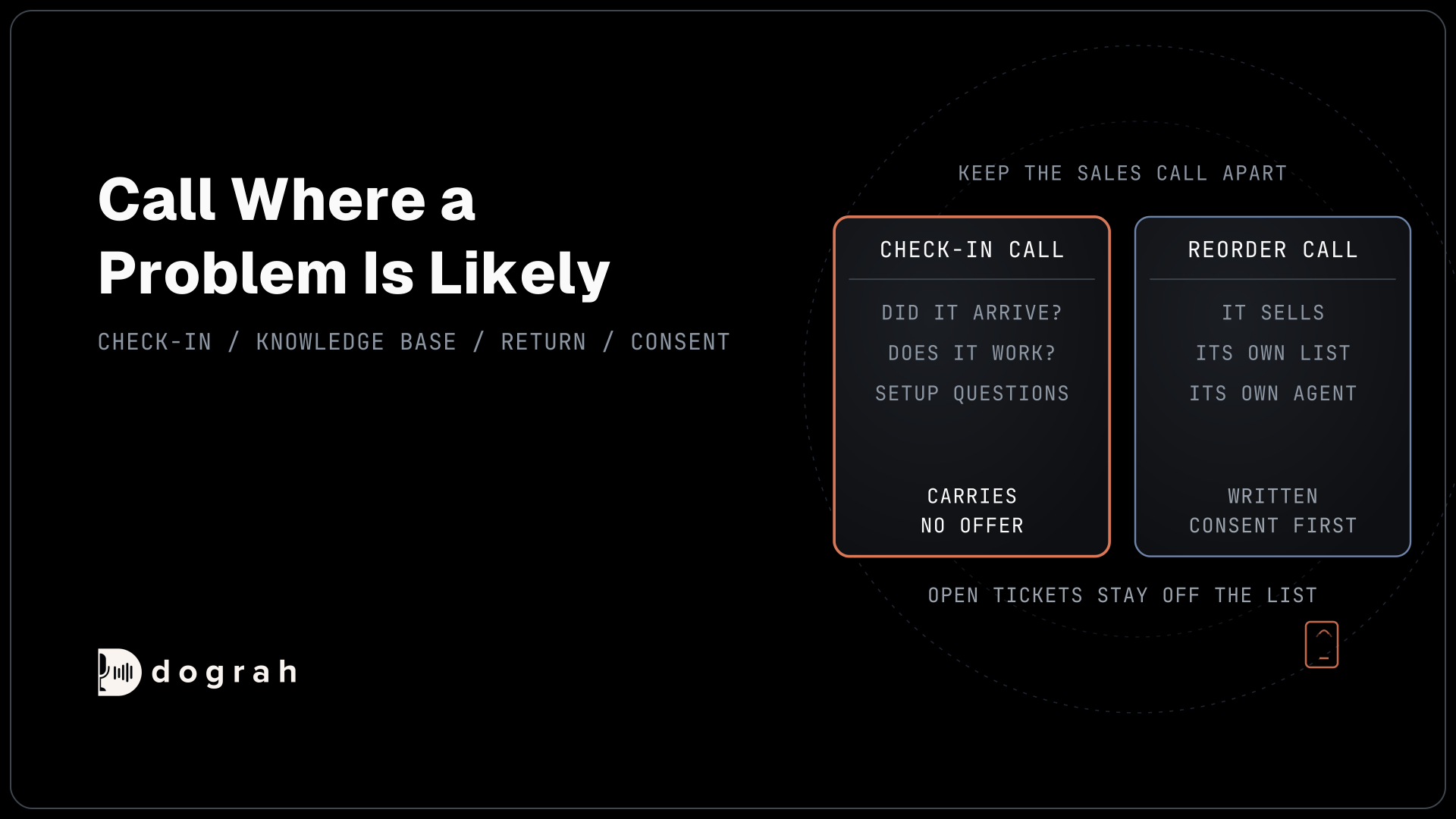
The call carries no offer. It does not suggest accessories or mention a sale, and it offers nothing in exchange for a review.
Who gets a call, and who does not
The store's own system picks who is called, because it knows which orders have an open ticket or an open return. A customer who has already complained should hear from a person, not from a check-in script. Leave them off the list.
Pre-Call Data Fetch, at the bottom of the Start Call node, can run on outbound calls only and refresh the order's details once the customer answers. It never decides whether to call. The list does that.
Calls start from the store's system through the API Trigger, or as a Dograh campaign from an uploaded list. Campaigns have no per-customer call cap, so one follow-up per order is the store's rule to enforce: send each order once, and set retries to 0 or 1. Campaign calling hours use one time zone per campaign, so split the list by time zone. A customer who says "don't call me again" is written back to the store's system at once, because Dograh keeps no do-not-call list of its own.

Open Source Alternative to Vapi / Retell
Self-hosted voice agent platform — no per-minute fees
dograh-hq/dograh
Star on GitHub
When the check-in finds a problem
The agent's job when something is wrong is to start the right process, not to improvise a fix.
If the order has not arrived, the call goes to the order-status flow or to a person, and any new date, replacement or refund comes from the store's system and policy, never from the agent's guess. In the US, when a seller cannot ship on time, the FTC's Mail, Internet, or Telephone Order Merchandise Rule generally requires it to offer the buyer "an option either to consent to a delay in shipping or to cancel the buyer's order and receive a prompt refund"; confirm your position with counsel.
If something arrived broken or wrong, the agent starts the return flow, set out in AI voice agents for returns and RMA. If the customer is upset or the problem involves money, Transfer Call hands them to your team. It works on Twilio only and passes no summary by default, so the agent writes the problem to the helpdesk first.
If the store wants reviews, ask every customer the same way, whatever they said on the call. The FTC's Consumer Review Rule, at 16 CFR 465.4, generally bars incentives "conditioned expressly or by implication on, the writing or creation of consumer reviews expressing a particular sentiment"; confirm your position with counsel.
Reorder reminders are sales calls
A reminder to reorder a consumable is useful to many customers, but it sells, so it plays by different rules. Once the call suggests buying again, it is no longer a service call.
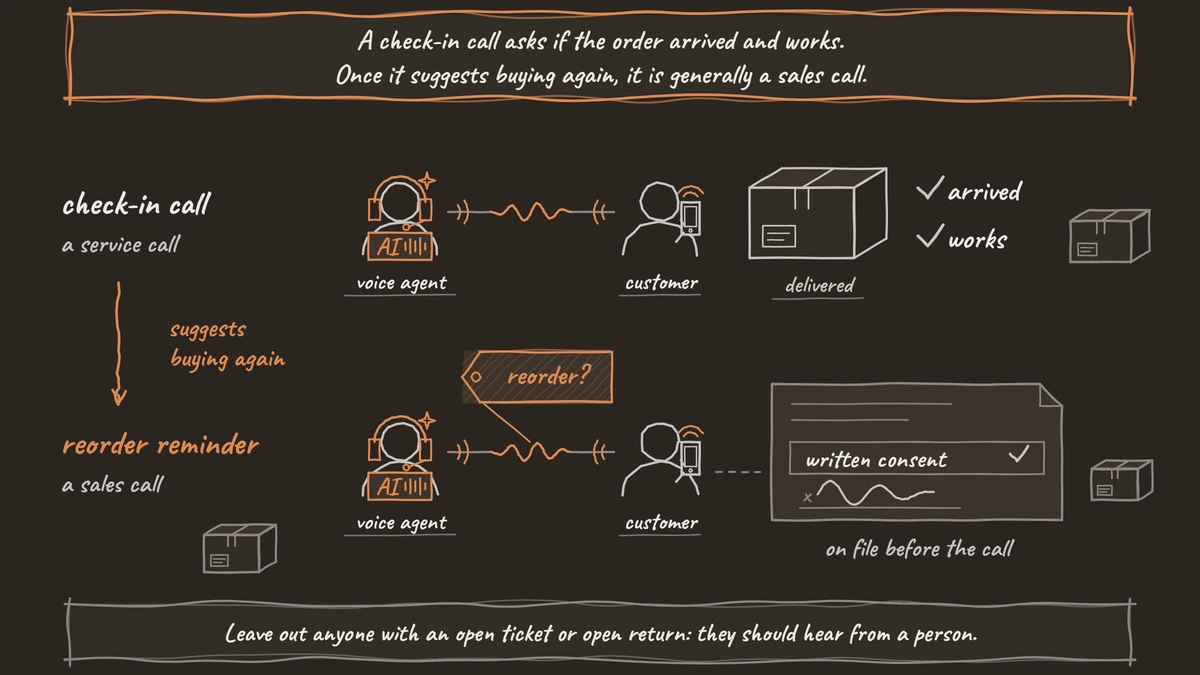
In the US, an AI-voiced call that introduces an advertisement generally needs the customer's prior express written consent under the TCPA, the same rule that governs cart calls. Call only customers whose consent record is on file in the store's system, and keep reorder calls on their own list and their own agent. AI voice agents for abandoned-cart recovery explains the consent record. This is general information, not legal advice; confirm your position with counsel before the first outbound campaign.
Join the Dograh Community
Dograh is an OSS alternative to Vapi. Join our Slack community for queries, releases, best practices & community interactions.
Measure what the call fixed
Judge the follow-up call by problems found and settled, not by revenue. A call that finds a missing part and gets it shipped has done its job.
The Webhook node sends each outcome to the store's system: arrived and working, setup question answered, return started, handed to a person, or no answer. Count the problems the calls found and the share settled within a week. Run QA on a sample of calls and read the transcripts where the agent hesitated or the customer repeated a question.
The rating of the purchase belongs to a different call. AI voice agents for CSAT surveys in e-commerce runs that one, and the follow-up call never asks for a score. Self-hosted Dograh has no per-minute platform fee (servers, model keys and phone minutes still cost); Dograh Cloud has a 1¢-a-minute platform fee.
Glossary
- Check-in call
- An outbound service call a few days after delivery that asks whether the order arrived and works, answers setup questions and starts a fix if needed. It carries no offer.
- Reorder reminder
- A call that suggests buying a consumable again. Because it invites a purchase, it is generally telemarketing under the TCPA and needs the customer's prior express written consent.
- Mail, Internet, or Telephone Order Merchandise Rule
- The FTC rule at 16 CFR part 435 on late shipments. When a seller cannot ship on time, it generally has to offer the buyer a choice: consent to the delay or cancel for a prompt refund.
- Webhook node
- The Dograh step that sends a call's outcome, extracted answers and transcript link to the store's system after the call, retrying automatically on a temporary failure.