
AI voice agents for CSAT surveys in e-commerce call a sample of customers after a purchase or support contact and ask one rating and one reason, in the same words every time. They record the rating as a number and the reason as stated, send low scores to a person and never offer anything for a score.
Key Takeaways
- An emailed CSAT survey hears from about 3 in 100 e-commerce buyers.
- Ask one rating and one reason, in the same words, to everyone.
- Keep review requests separate, and ask every respondent or none.
This post is part of our guide to AI voice agents for e-commerce and retail. The guide's section on what happens after delivery sums up this call: it asks one rating and one reason, in the same words for every customer it reaches. Here is how to run it on Dograh, an open-source, self-hostable voice agent platform, so the answers land in your own systems.
Why a call hears more than an email
Emailed surveys reach almost nobody. Retently, which sells survey software, found in its survey response rate study that e-commerce email surveys averaged a 3.24% response rate across more than 25 million invitations sent by 600 brands from January to December 2025. In the fourth quarter, survey volume nearly doubled while response rates fell 44%. It matches what most stores see: the holiday customers, the ones a store most wants to hear from, answer least.
A phone survey works differently. The store does not call every buyer. It calls a sample, and a short conversation with a sample tells it more about why customers feel the way they do than a 3% email return. No phone response rate is promised here, because it depends on the list and the timing.
Text messages are a real alternative for a simple rating, and many stores should keep using them. A call earns its place when the store wants the reason behind a score, for example after a support call or a problem order.
What the store's CSAT call rates
The e-commerce CSAT (customer satisfaction score) call rates the store: the purchase and, where there was one, the support contact. The courier's delivery is a separate survey, which AI Voice Agents for Delivery Feedback and CSAT Surveys covers from the delivery company's side.
Two moments make good triggers. The first is a few days after a support call closes, to ask whether the problem was solved. The second is after an order that had a problem, such as a late delivery or a replacement, to ask how the store handled it. The store also adds a random sample of ordinary orders, so the scores are not only from customers who had trouble.
One rating, one reason, recorded as said
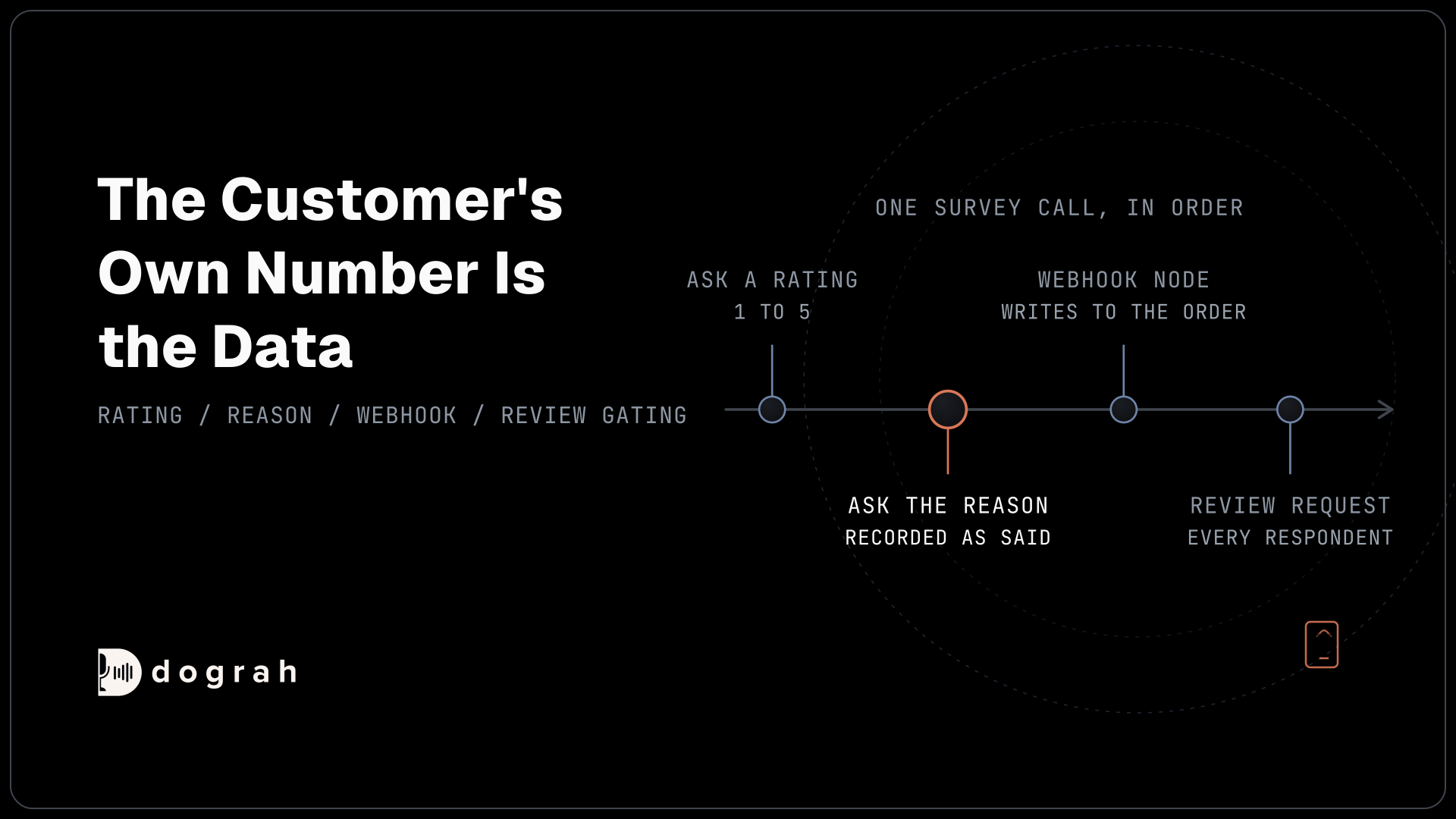
Ask one rating on a fixed scale and one open question, in the same words to everyone. For example: "On a scale of 1 to 5, how satisfied are you with your order?" and then "What is the main reason for that score?"
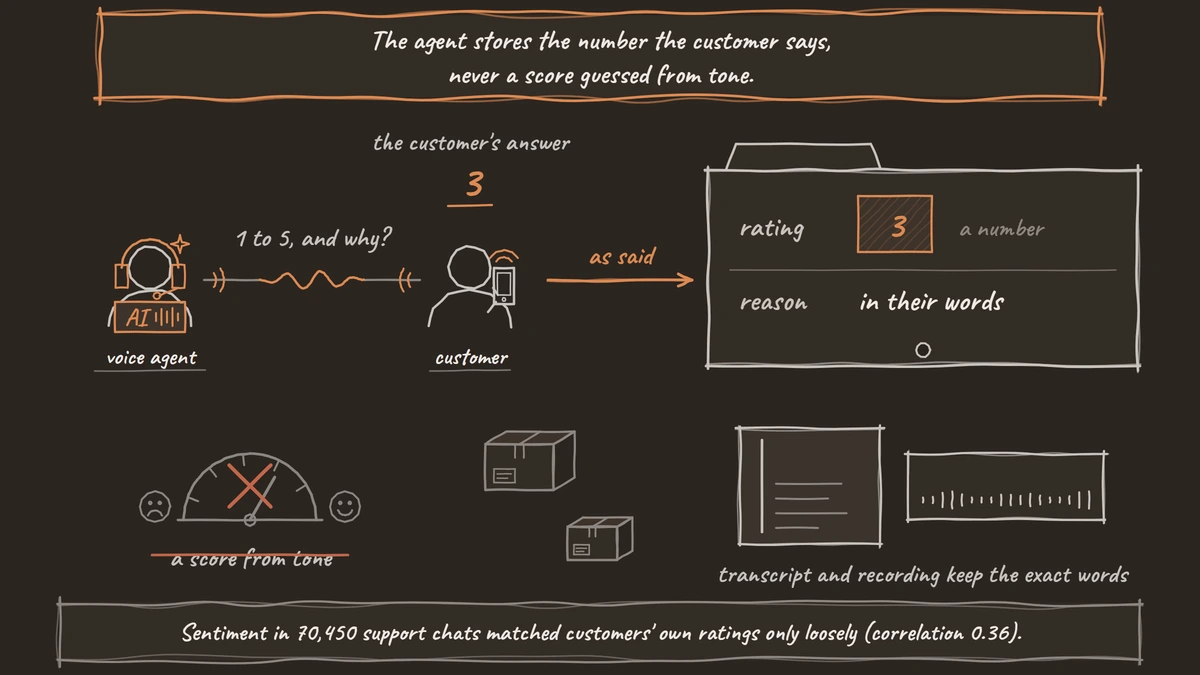
In the agent node, turn on Enable Variable Extraction and add two variables. The rating is a Number variable; the 1 to 5 range is not enforced, so state it in the Extraction Hint and check it in the store's system. The reason is a String variable. Extraction is an AI step, not a word-for-word copy, so the agent records the reason as the customer stated it, and the transcript and recording are the exact record.
The agent never guesses satisfaction from tone. In a June 2026 preprint on 70,450 text support conversations from a fundraising platform, sentiment tracked customers' own 1 to 5 ratings at a correlation of only 0.36. Those were chats, not calls, but the point stands: the customer's own number is the data.
Dograh's own QA is a different tool. It grades the agent's conduct on each step of the call, not the customer's opinion, as Automated QA for Voice Agents explains.

Open Source Alternative to Vapi / Retell
Self-hosted voice agent platform — no per-minute fees
dograh-hq/dograh
Star on GitHub
Who to call, and how often
The store's own system picks who is called: recent support contacts, problem orders and a random sample. Leave out anyone with an open ticket, who should hear from a person first.
Calls start from the store's system through the API Trigger, or as a Dograh campaign from an uploaded list. Campaigns have no per-customer call cap, so one survey per order or support contact is the store's rule to enforce, with retries set to 0 or 1. Campaign calling hours use one time zone per campaign, so split the list by time zone. A customer who asks not to be called again is written back to the store's system at once, because Dograh keeps no do-not-call list of its own.
The call carries no offer and no discount. A survey with no advertising is generally an informational call in the US, but AI-voiced calls to mobiles still have consent rules of their own. This is general information, not legal advice; confirm your position with counsel.
Reviews are a separate step
A CSAT survey and a public review request are two different things, and mixing them slides into review gating.
If the store asks for a public review after the survey, it asks every respondent in the same words, whatever rating they gave. Google's review policy bars businesses that "selectively solicit positive reviews from customers". The FTC's Consumer Review Rule, at 16 CFR 465.4, generally bars incentives "conditioned expressly or by implication on, the writing or creation of consumer reviews expressing a particular sentiment"; confirm your position with counsel. So no discount for a good score, and no review link sent only to the 5s.
What happens to a low score
A low score is a service problem, and it goes to a person. If the store's team is available, Transfer Call hands the customer over; it works on Twilio only and passes no summary by default, so the agent first writes the score and the reason to the helpdesk. Out of hours, the agent writes a callback request instead.
After every call, a Webhook node sends the rating, the reason, the order number and the transcript link to the store's system, so scores sit beside the order and the support ticket they describe. A high score with a complaint in the reason is worth reading too. For the support line those scores describe, see AI voice agents for customer support in e-commerce, and our page on open-source voice AI for survey calls shows the setup.
Join the Dograh Community
Dograh is an OSS alternative to Vapi. Join our Slack community for queries, releases, best practices & community interactions.
QA summaries are in English by default, so read Spanish or French survey calls from the transcript. Self-hosted Dograh has no per-minute platform fee (servers, model keys and phone minutes still cost); Dograh Cloud has a 1¢-a-minute platform fee.
Glossary
- CSAT (customer satisfaction score)
- A rating customers give on a fixed scale, often 1 to 5, about a purchase or a support contact. In a voice survey, the agent records the number the customer says, never a score inferred from tone.
- Review gating
- Asking only satisfied customers to post a public review, or steering unhappy ones away from it. Google's review policy bars selectively soliciting positive reviews, so a survey that asks for reviews asks every respondent.
- Extraction Hint
- The per-variable instruction in Dograh's variable extraction that tells the AI what to capture. For a 1 to 5 rating, it states the range, because the Number type does not enforce one.
- Sample
- The subset of customers a store chooses to call, such as recent support contacts, problem orders and a random share of ordinary orders, rather than every buyer.