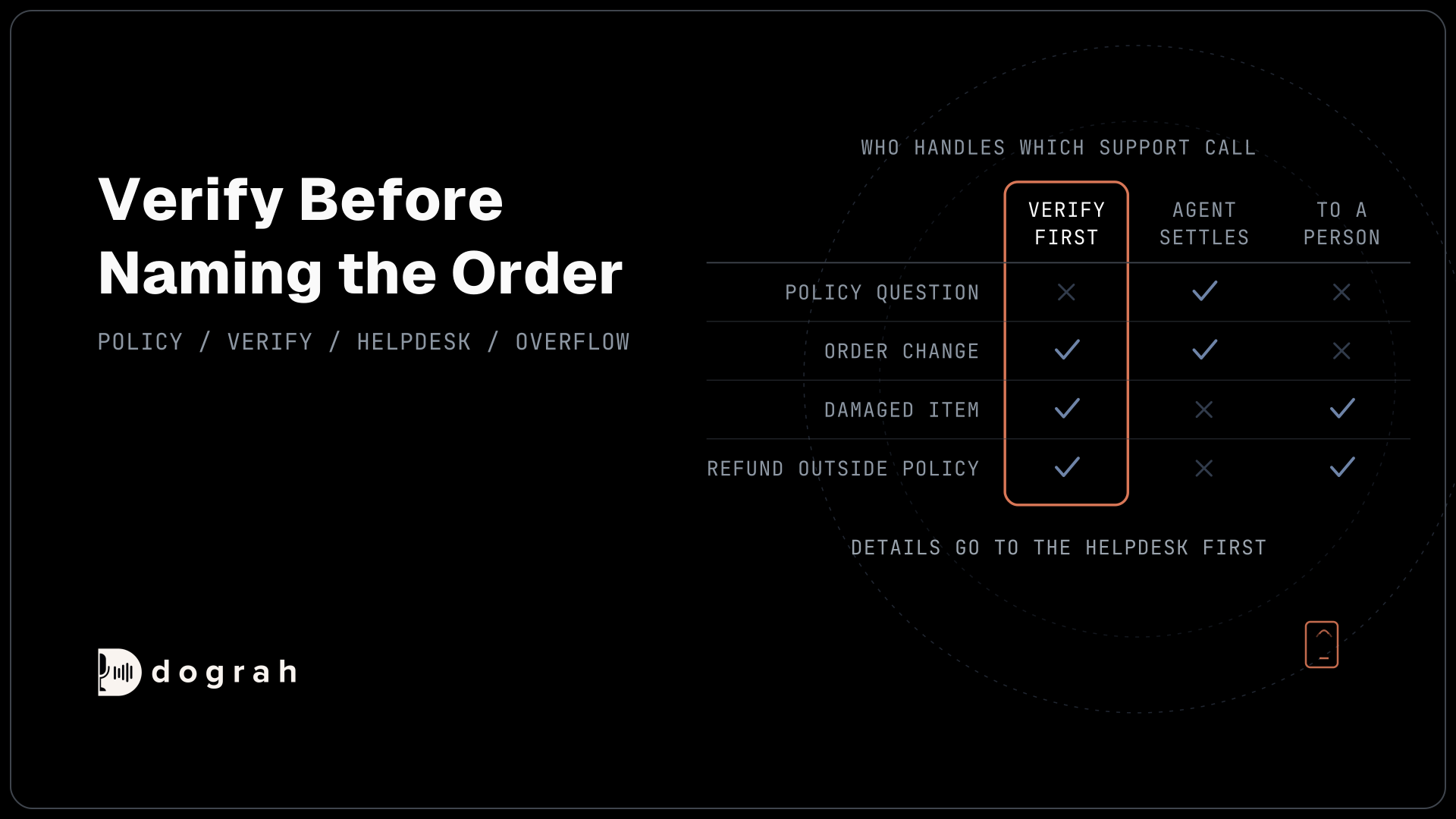

AI voice agents for customer support in e-commerce answer a store's support line: they answer policy questions from the store's documents, verify callers before naming an order, and make order changes only when the store's system accepts them. Damage claims, disputes and anything involving money go to a person, with the details written to the helpdesk first.
Key Takeaways
- Policy questions need no verification; anything about the caller's order does.
- The store's system approves each order change; the agent reads back its answer.
- Write the details to the helpdesk before every transfer to a person.
This post is part of our guide to AI voice agents for e-commerce and retail. The guide's section on inbound calls describes the support line in one line: it takes every call that is not a status check or a return. Here is that line in full, built on Dograh, an open-source, self-hostable voice agent platform, and where the agent's job ends and your team's begins.
Most support calls go unanswered
The first job for a support agent is answering the calls that ring out today. Invoca, which sells call-tracking software, found in its DTC eCommerce Lead Conversion Benchmarks Report 2026 that 53% of calls to direct-to-consumer e-commerce brands were answered by a person. That means close to half of callers hear voicemail or nothing.
Timing is part of it. In Aloware's platform data for the year to 31 August 2026, 24.4% of inbound calls arrived outside 8 a.m. to 6 p.m. on weekdays once weekends were counted. That figure covers all of Aloware's industries, not stores alone, and Aloware sells a phone system, but a team that works days misses roughly a quarter of calls by design.
Sale days add peaks on top. Adobe Analytics counted 25 days above $4 billion in US online spending between 1 November and 31 December 2025. Each of those days sends a wave of questions to the same support line.
What the agent settles on its own
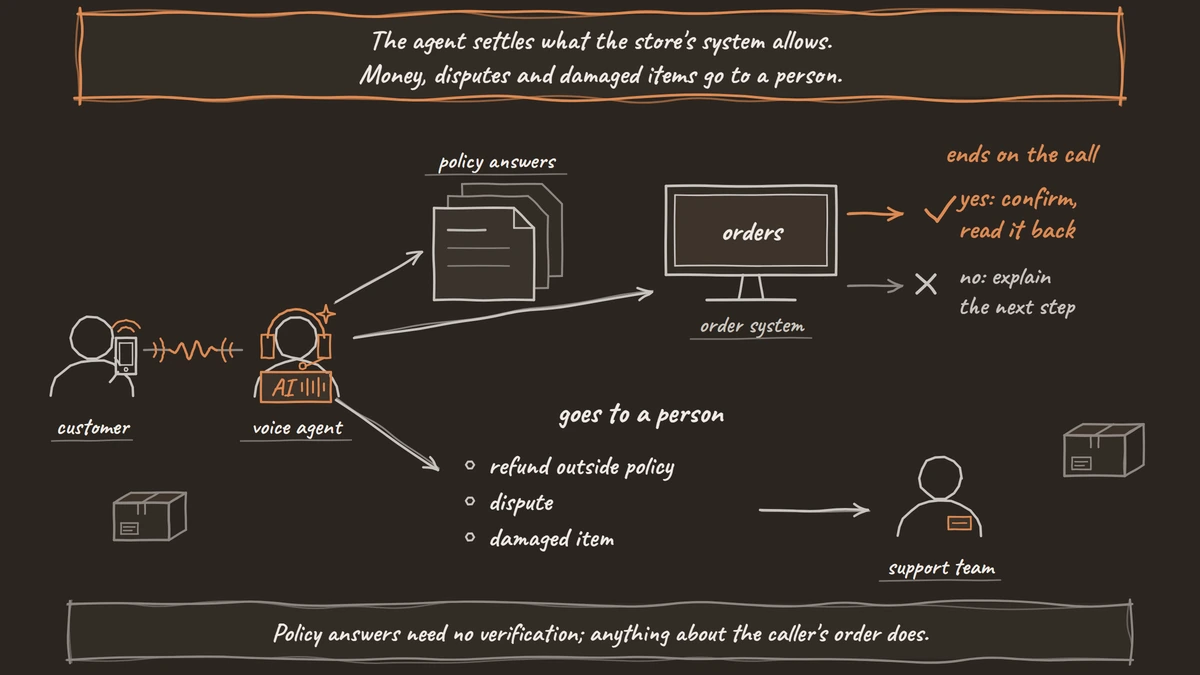
The agent settles a call when the answer is written down or the store's system can confirm it. Everything else goes to a person.
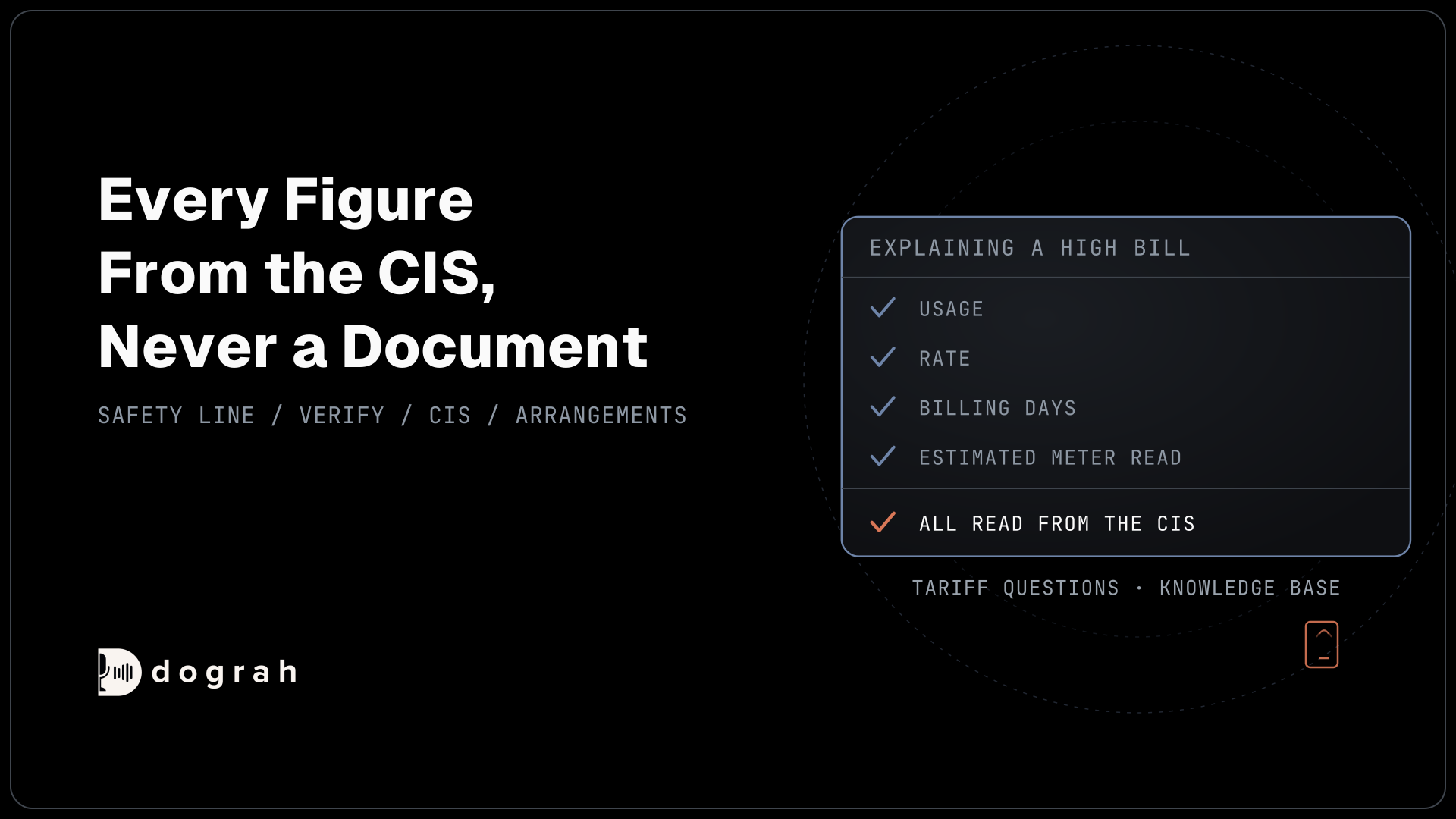
Policy and product questions come first, because they are the easiest. Shipping times, the return window, warranty terms, sizing and care instructions are all answered from the store's own documents in the Knowledge Base, which accepts PDF, DOCX, DOC, TXT and JSON files up to 5 MB each. These answers name no customer data, so they need no verification.
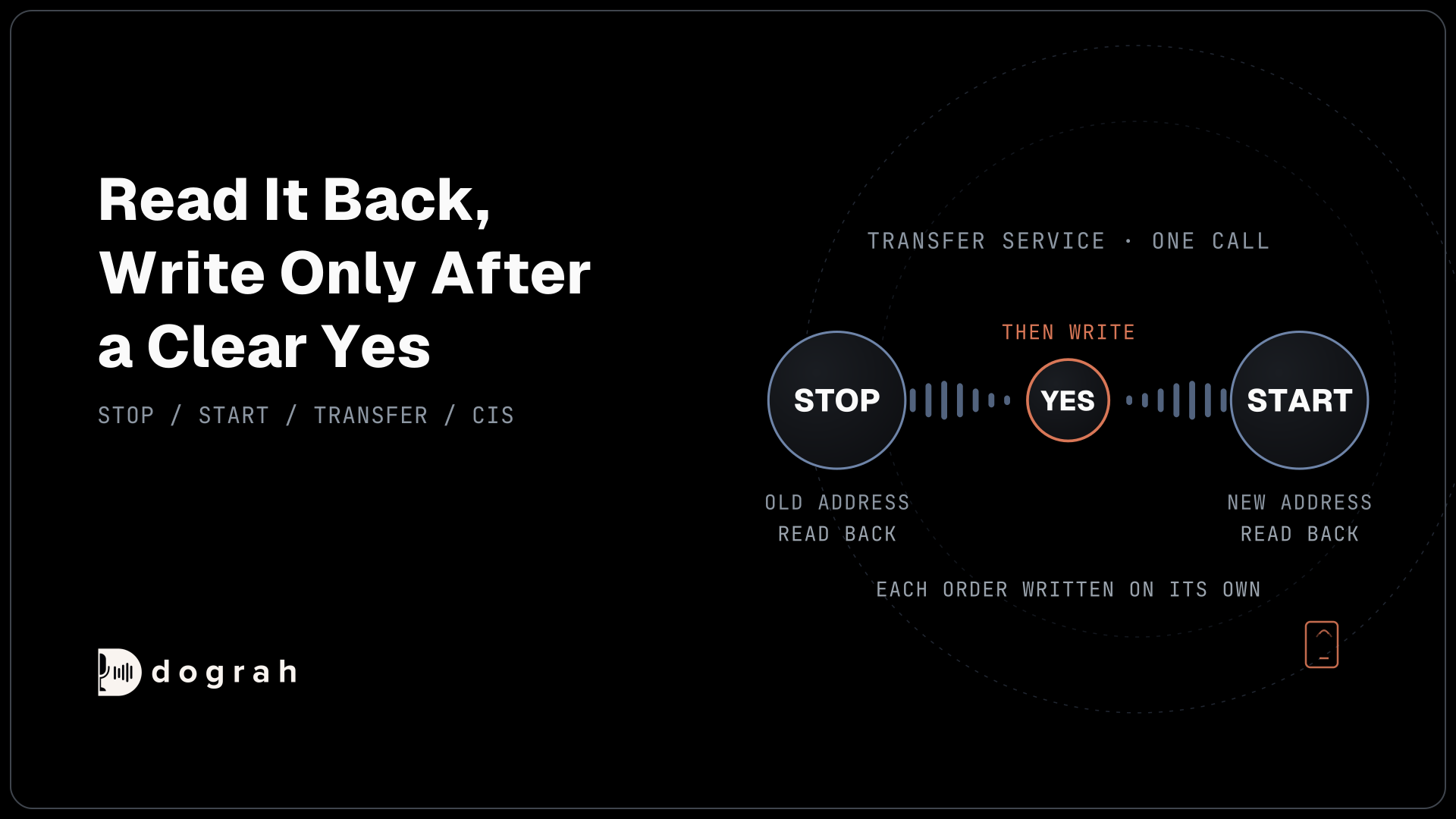
Order changes before shipping come next: a new delivery address, a different size or colour, or a cancellation. The agent never decides whether a change is possible. An HTTP API tool asks the order system, and the system answers. If the system says yes, the agent confirms the change and reads it back; if it says no, the agent says so and explains the store's next step. Dograh has no built-in Shopify connector; that HTTP API tool calls Shopify's API, directly or through n8n. A start line in the tool's Messages, such as "Let me check that order", covers the pause.
Two calls on the same line have their own posts. "Where is my order" is covered in AI Voice Agents for Order Status and Updates in E-commerce, and return requests in AI voice agents for returns and RMA. This post covers the rest of the line.
Verify before naming the order
A phone number finds orders, but it does not prove who is calling. A shared family phone or a reassigned number can reach someone the order does not belong to.
Pre-Call Data Fetch, at the bottom of the Start Call node, can run on inbound calls only and look up the caller's number as the call connects. The caller hears ringing until it returns, so keep the response short: a summary of recent orders, not the full history. Write the prompt so the agent uses none of it (nothing from it is spoken) until the caller is verified.
Before it names an order, an address, an item or an amount, the agent asks for an approved check, such as the order number and the postcode on it, or the email address on the order. Asking "Am I speaking with Maria?" only finds the right person; it does not verify them. A caller who cannot pass the check still gets every policy answer, but nothing about an order.
Never ask a caller to speak a password, a PIN or a card number. Transcripts keep everything said, with no redaction.

Open Source Alternative to Vapi / Retell
Self-hosted voice agent platform — no per-minute fees
dograh-hq/dograh
Star on GitHub
What goes to a person, and what they receive
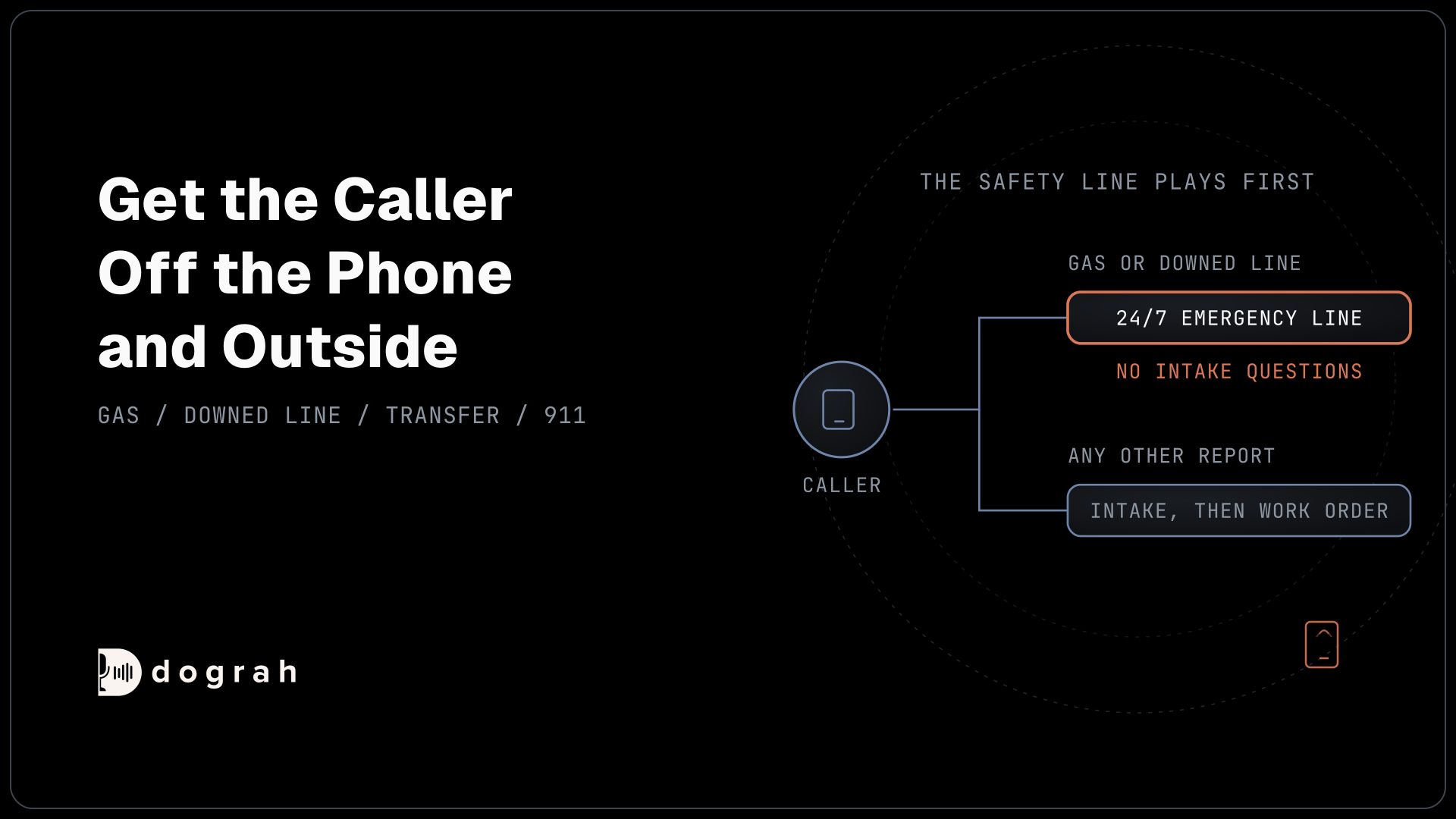
Some calls belong with your team from the start. Anything that moves money, such as a refund outside policy or a price adjustment, goes to a person. So do disputes, damaged or missing items, a change the system declined that the caller wants to contest, and anyone who asks for a person.
Damaged items get one extra step before the handover. The agent asks what arrived damaged and how, records it as the caller stated it, and an HTTP API tool asks the store's own system to send a secure upload link for photos by text or email. Dograh sends no texts itself.
Transfer Call passes no summary by default, so the agent first writes the caller's name, order and request to your helpdesk through an HTTP API tool. Then Transfer Call connects the caller to your team. It works on Twilio only, and the default timeout is 30 seconds. If nobody answers within the 30-second default, the caller stays with the agent; tell it in the prompt to offer a callback and write the request to the helpdesk through an HTTP API tool, because there is no built-in callback task.
On Twilio, you can add a short spoken introduction that both sides hear before they are connected. It is off by default.
Join the Dograh Community
Dograh is an OSS alternative to Vapi. Join our Slack community for queries, releases, best practices & community interactions.
Start with the calls nobody answers
Start with overflow: the evening, weekend and sale-day calls that go unanswered today. That way the agent takes no call a person would have picked up, and your team sees the transcripts before it widens the agent's job. AI voice agents for after-hours coverage covers that handover in detail.
Several phone numbers can point at the same agent through each number's Inbound workflow setting, so one agent can cover the main line and a sale-day number. Size the concurrency limit for your busiest day. Self-hosted Dograh runs 10 concurrent calls by default, raised with DEFAULT_ORG_CONCURRENCY_LIMIT; Dograh Cloud includes 10, and you contact Dograh for more. When every slot is busy, an extra inbound call is rejected at once rather than queued, so add an overflow route at your carrier for the peak.
Self-hosted Dograh has no per-minute platform fee (servers, model keys and phone minutes still cost); Dograh Cloud has a 1¢-a-minute platform fee.
Glossary
- Overflow
- Calls that would otherwise ring out or reach voicemail, such as after-hours and sale-day calls. Routing only these to the voice agent first means it takes no call a person would have answered.
- Approved check
- A verification step the store has chosen, such as the order number plus the postcode on it. The caller passes it before the agent names any order detail; a matching phone number alone is not enough.
- Pre-Call Data Fetch
- A Dograh setting on the Start Call node that calls your endpoint as the call connects and loads what it returns, such as a summary of the caller's recent orders, before the greeting plays.
- Concurrency limit
- The number of calls an agent setup handles at the same moment. Dograh defaults to 10; extra inbound calls beyond it are rejected, so peak days need a higher limit or a carrier overflow route.