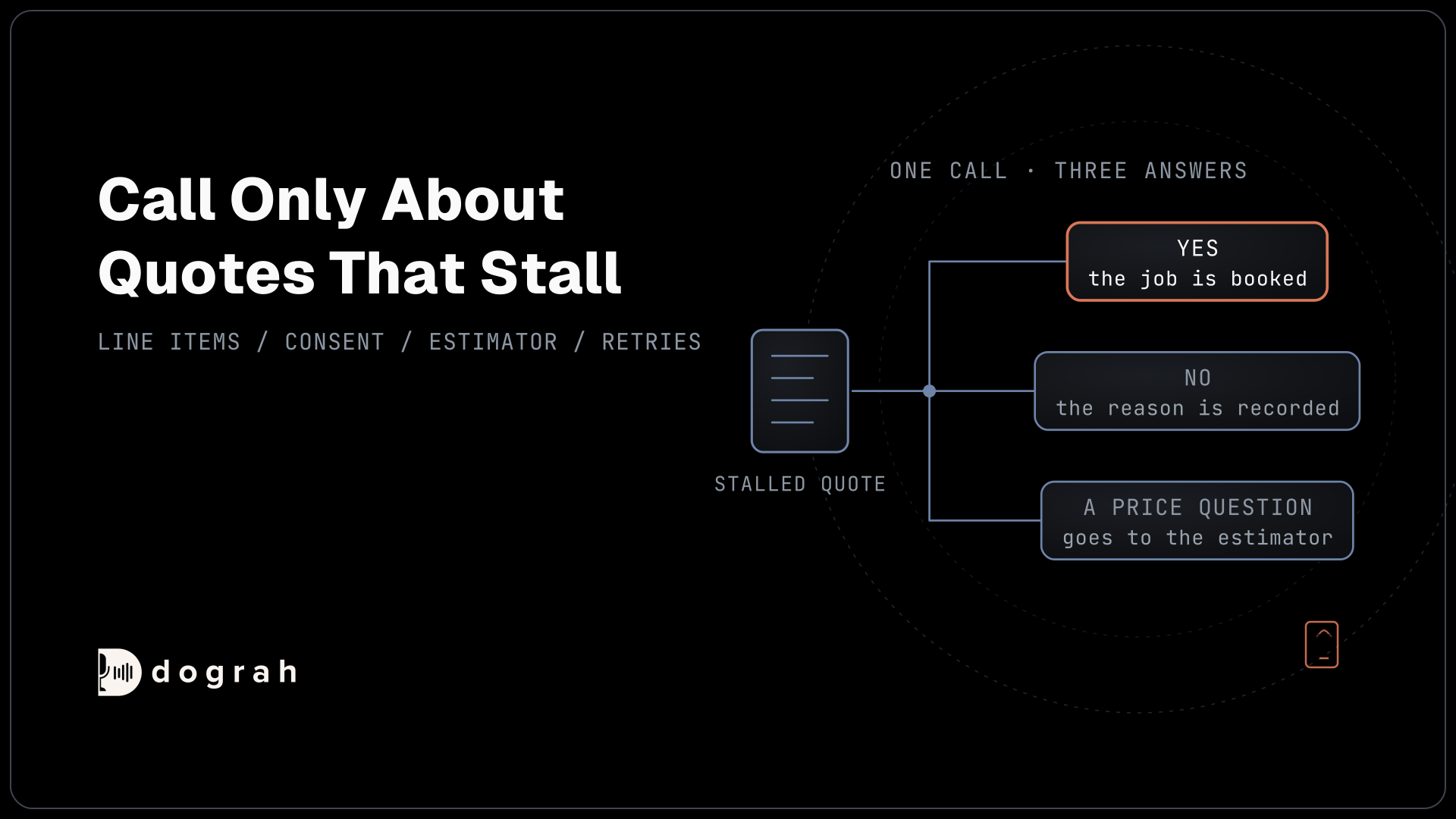

AI voice agents for quote follow-up in home services call once, a set time after a quote goes out, if the customer agreed to it. The agent verifies them, reads the quote's line items from the field-service software, answers scope questions, books the job on a yes, records the reason on a no, and leaves price talk to the estimator.
Key Takeaways
- Call only about quotes that stalled; a text nudges the rest.
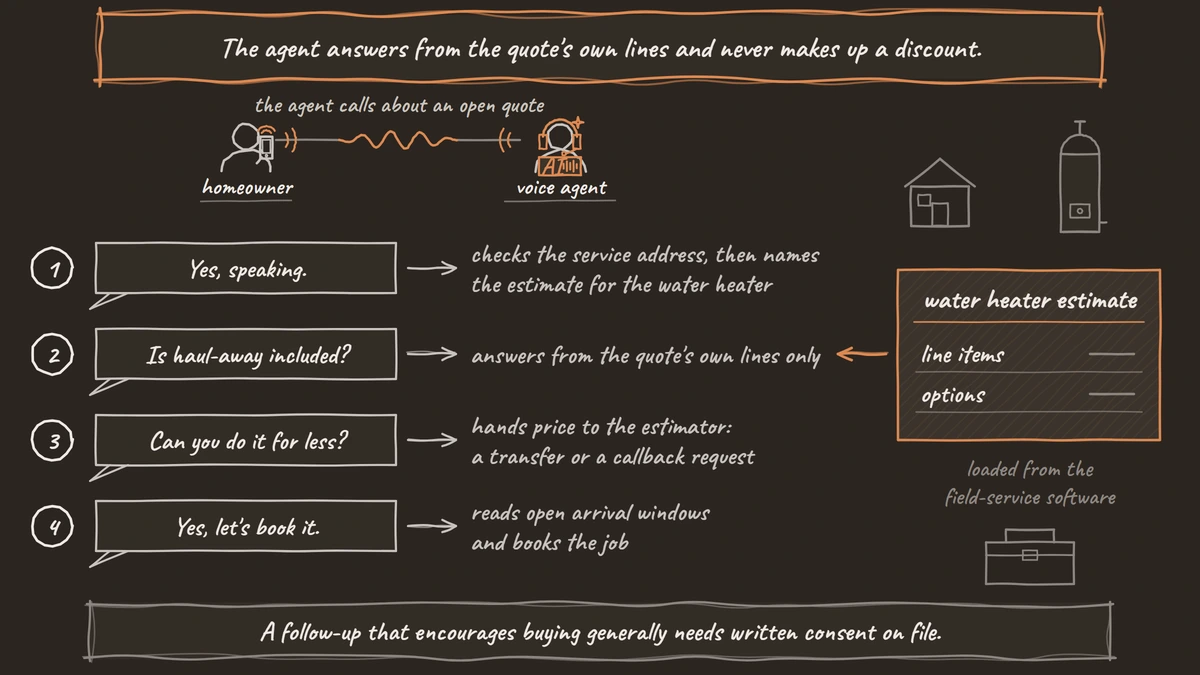
- A follow-up that encourages a purchase generally needs written consent.
- Offers come from the quote system, never from the agent.
This post is part of our guide to AI voice agents for solar and home services. The guide's "Before the job: solar leads and quote follow-up" section sums up this call in one line: it answers the question that is stalling the decision, and it is a sales call. Here is that call in full, built on Dograh, an open-source, self-hostable voice agent platform.
Which quotes need a call
Most quotes are won without one, so the call is for the few that stall. In Jobber's 2026 Home Service Trends Report, a December 2025 survey of 1,050 US home service business owners, 69% of pros reported a win rate of more than 50%, and more than a third close over 70% of their quotes.
The same report shows where a follow-up has something real to talk about. Only 16% of pros offer tiered "good, better, best" options, while Jobber's own data shows optional line items earn upsell rates of 25 to 50%. A quote with options gives the customer a choice to make, and a call can walk them through it.
Our view is simple. A text from your own system is the right nudge for most open quotes, because it asks nothing of the customer. The call earns its place when a question is blocking the decision, such as what the warranty covers or whether the old unit gets hauled away.
A quote follow-up is a sales call
A call that encourages the customer to buy the quoted job is generally telemarketing, and that sets the consent bar. This is general information, not legal advice.
In the US, the Federal Communications Commission's declaratory ruling FCC 24-17 confirmed in February 2024 that the Telephone Consumer Protection Act's limits on artificial voices cover "current AI technologies that generate human voices". The rule text at 47 CFR 64.1200 bars a telemarketing call using an artificial voice to a mobile number "other than a call made with the prior express written consent of the called party". So an AI follow-up call on a quote generally needs that written consent on file, even though the customer asked for the quote.
The simplest place to capture it is the quote request form itself: a checkbox, left unticked by default, that names your business, covers calls from an automated voice and says agreeing is not a condition of buying, with wording your counsel has reviewed and the date stored next to the quote. A customer with no consent on file gets a text from your own system or a call from a person. Confirm your position with counsel before the first outbound campaign.
How the call runs
The call starts from the quote record and stays inside it. Your field-service software fires the API Trigger a set number of days after the quote goes out. The API Trigger dials as soon as it is called, so the wait lives in your own scheduler, such as a cron job or n8n, or in a campaign whose calling hours hold the call until the window opens. Check the quote's status at trigger time, so a customer who already said yes is never called. Our post on API triggers shows how to start a call from another system.
Greeting Text, the fixed line Dograh plays word for word, names the business. The agent asks for the customer by name, which finds the right person but does not verify them, so before it names the quote it asks them to state the service address and compares it with the record. Only then does it say why it is calling: "the estimate we sent for your water heater".
Pre-Call Data Fetch, set to Outbound calls only, loads the quote's line items and options as the call connects. Write the prompt so the agent uses none of it (nothing from it is spoken) until the caller is verified, then answers scope questions from those lines and nothing else. Customers want that clarity: in a Housecall Pro survey of more than 1,000 US homeowners, reported by Contractor Magazine in December 2025, 97% said they expect transparent pricing before they commit.
A yes books the job: an HTTP API tool reads open arrival windows and writes the job. If a deposit is due, another tool asks your own system to send its secure payment link by text or email, because Dograh takes no payments on a call. A no is recorded with the reason as the customer stated it. A question about price goes to the estimator through Transfer Call, which works on Twilio only and passes no summary, or as a callback request written to your system. A discount exists only if the quote system returns one, and the agent never makes one up.

Open Source Alternative to Vapi / Retell
Self-hosted voice agent platform — no per-minute fees
dograh-hq/dograh
Star on GitHub
How many tries, and when to stop
How often to call is your decision, and the system enforces it. Retry policy is a business rule that varies by trade. One call, with one retry if nobody answers, is a sensible start.
Campaigns in Dograh can retry calls that were not answered, from 0 to 10 times (default 2), and never re-call someone who answered. There is no per-contact cap across campaigns, so your own list decides who is called again. A spoken "no thanks" or "stop calling" closes the follow-up for that quote, and an HTTP API tool writes it back at once. Dograh keeps no do-not-call list of its own, so remove those numbers before the next campaign upload.
Voicemail is either disconnected (the default) or a short message. A message names the business and a callback number and says nothing about the quote, because nobody has been verified. After every call, a Webhook node sends the outcome and the reason to your field-service software, and retries automatically on a temporary failure.
Join the Dograh Community
Dograh is an OSS alternative to Vapi. Join our Slack community for queries, releases, best practices & community interactions.
Where to start
Start with quotes the customer asked for in the last week or two and has not answered, with consent on file. Read the first transcripts for answers the agent gave that were not on the quote. Solar proposals belong here too: once AI voice agents for solar lead qualification has booked the site survey and a proposal goes out, the follow-up runs the same way. The same "collect, never negotiate" rule runs in AI Voice Agents for Buyer and Seller Follow-up.
Self-hosted Dograh has no per-minute platform fee (servers, model keys and phone minutes still cost); Dograh Cloud has a 1¢-a-minute platform fee.
Glossary
- Good, better, best
- A quote that offers the same job at tiered options, such as a standard and a premium water heater. The follow-up agent reads the options exactly as the quote lists them and records which one the customer chooses.
- Line item
- One priced entry on a quote, such as the labour or the haul-away of the old unit. The agent answers scope questions only from the quote's own line items, loaded from the field-service software.
- Prior express written consent
- Under the TCPA, a signed written agreement that authorizes a seller to deliver telemarketing using an artificial or prerecorded voice, and states that signing is not a condition of purchase. A quote follow-up call from an AI voice agent generally needs it, captured on the quote request.
- API Trigger
- Dograh's way for another system to start a call. It dials as soon as it is called, so the wait after a quote is set in the business's own scheduler or by a campaign's calling hours.