
AI voice agents for buyer and seller follow-up call people after a viewing or a valuation. The agent verifies the person, asks what they thought and what they want to do next, and records the answers as stated in your CRM. Offers and price talk go to the human agent. Every outbound follow-up needs consent first.
Key Takeaways
- Ask for consent to follow-up calls when the viewing is booked.
- Verify the person before the agent names the viewing or valuation.
- Record reactions as stated; offers and price always go to the agent.
This post is part of our guide to AI voice agents for real estate. The guide's section on follow-up gives this call one job: collect what the person thought and what they want to do next, and leave the deal to the agent. This post builds that call in Dograh, an open-source, self-hostable voice agent platform, for buyers after a viewing and sellers after a valuation.
Consent comes before the follow-up list is built
A follow-up call is outbound, so the consent check happens before anyone is added to the list. This section is general information, not legal advice.
The Federal Communications Commission's (FCC) rules at 47 CFR 64.1200 define telemarketing as a call made "for the purpose of encouraging the purchase or rental of, or investment in, property, goods, or services". A call that asks a buyer about a second viewing, or a seller about listing their home, generally fits that definition, even when it opens with a feedback question. An AI voice counts as an artificial voice under the Telephone Consumer Protection Act (TCPA), and artificial-voice telemarketing to mobile numbers and home lines generally needs prior express written consent. The simplest place to collect it is the booking itself. The viewing form or the valuation request asks, in plain words, whether the agency may call with an automated assistant afterwards, and the customer relationship management (CRM) system stores the answer with the booking.
Before every campaign, the list is cleaned twice. Numbers on the national do-not-call registry come off, and so do people on the agency's own do-not-call list. Under 47 U.S.C. 227(c)(5), a person who receives "more than one telephone call within any 12-month period" from the same entity in breach of those rules can sue. The same rules set calling hours for telephone solicitations: never "before the hour of 8 a.m. or after 9 p.m." in the called person's local time.
In Dograh, a follow-up list is uploaded to Campaigns as a CSV, or the CRM starts each call through the API Trigger once the viewing is marked done. Campaigns lets you set calling hours by weekday and retries from 0 to 10 (2 by default). It has no per-person call cap, so your CRM decides how often anyone hears from you. In our experience, retry policy is a business decision first: decide how many tries a viewing earns, and stop when someone has answered or opted out. Confirm your consent wording and calling rules with counsel before the first campaign.
Verify before the agent mentions the viewing
The follow-up is about a client's own viewing or valuation, so the agent confirms who it is talking to before it names either. The call runs greet, verify, disclose.
The Greeting Text plays the moment the call connects, so it names the agency, plus the automated-assistant line if you want it or your location requires it by law. It never names the property. The agent then asks for the person by name. That finds the right person but proves nothing, so the agent also checks the property address or the email on file. Only when both match does it say "the viewing at 22 Birch Lane on Saturday".
If the person cannot confirm, or someone else answered, the agent shares nothing about the viewing. It offers to have the agent call back and writes a callback request to the CRM. The opening seconds of an outbound call matter more than any later line, as The First 15 Seconds Decide Everything in AI Outbound Calls argues.

Open Source Alternative to Vapi / Retell
Self-hosted voice agent platform — no per-minute fees
dograh-hq/dograh
Star on GitHub
After a viewing: what the buyer thought and what comes next
The buyer call asks for a reaction and a next step, and nothing more. The relationship is what an agency sells. The National Association of Realtors' 2025 Profile of Home Buyers and Sellers, covering purchases from July 2024 to June 2025, found that 91% of buyers would use their agent again or recommend them. A follow-up that sounds like pressure works against that.
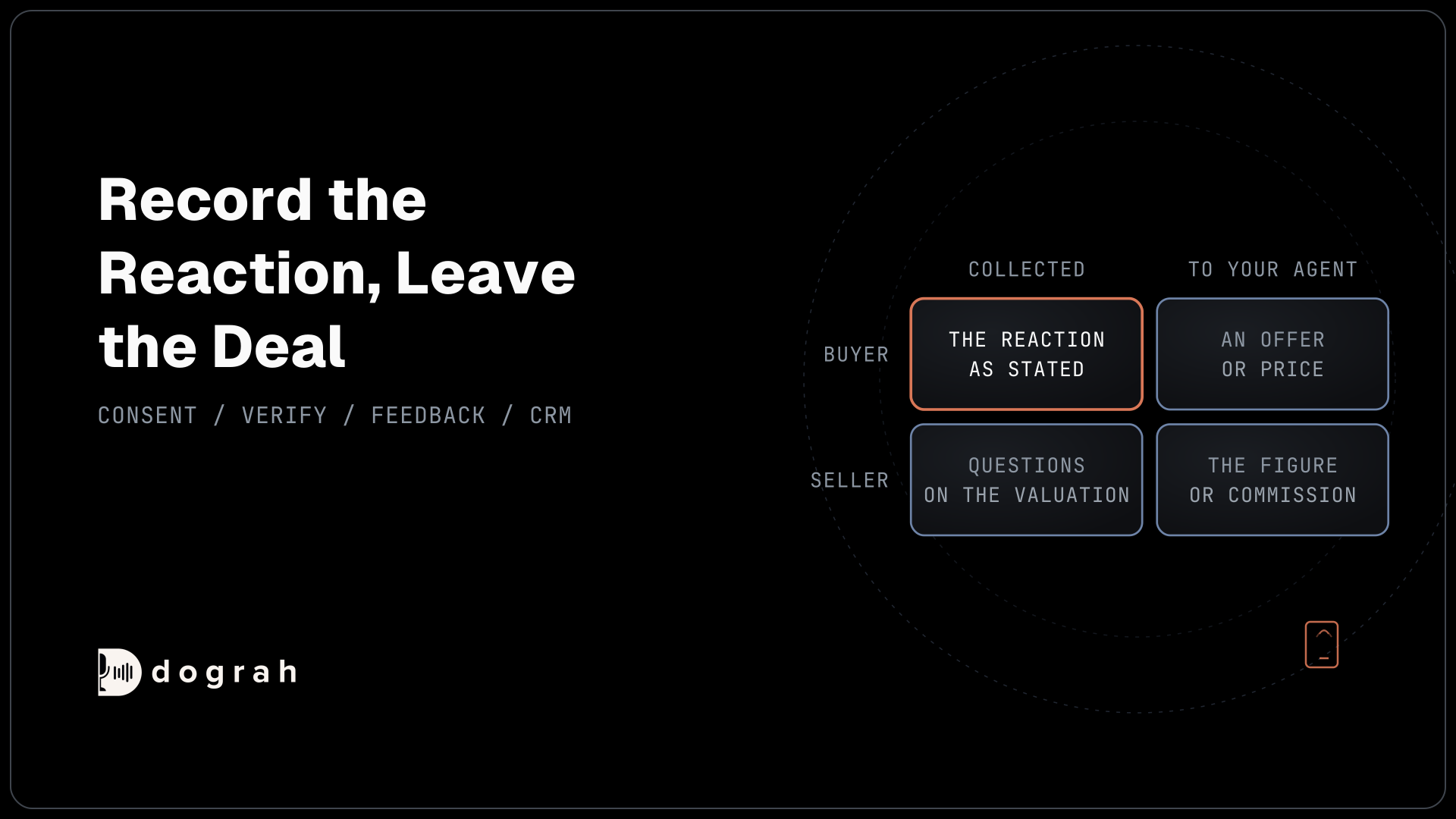
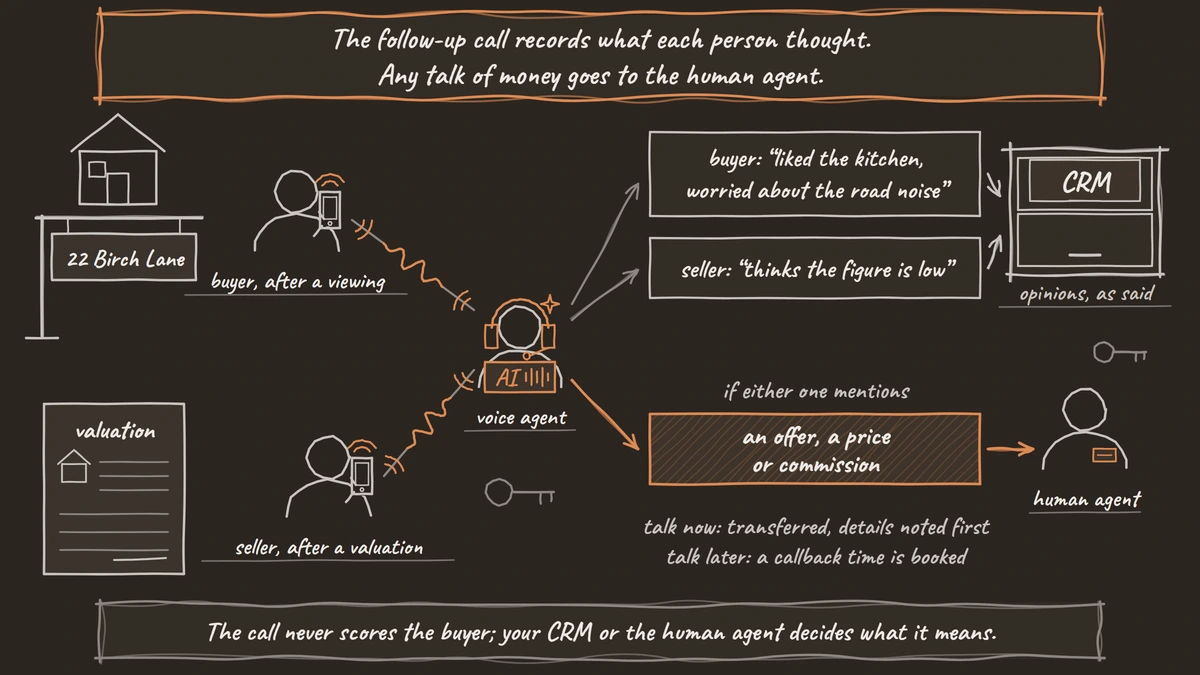
The agent asks what the buyer thought of the home and whether it is still on their list, then asks if they have any questions for the agent. It records each answer as the buyer stated it, such as "liked the kitchen, worried about the road noise". It does not turn that into an interest score. Your CRM or your agent decides what the reaction means. Keep the questions few, so the call stays short.
A buyer who wants a second viewing moves to the booking step, covered in AI voice agents for property-visit scheduling. A buyer who mentions an offer, or asks whether the seller would take less, is past what the voice agent may discuss. The agent writes the details to the CRM through an HTTP API tool, then offers a transfer. Transfer Call works on Twilio only and passes no summary by default. If nobody answers within 30 seconds (the default), the buyer stays with the agent, which writes a callback request.
After a valuation: questions for the seller, never a figure
The seller call checks that the valuation arrived and asks whether the seller wants to talk about it. It never gives a figure.
After verification, the agent asks whether the seller received the valuation and whether they have questions about it. Then it asks whether they would like to talk about putting the home on the market, and when suits them. Each answer is recorded as stated, such as "thinks the figure is low" or "wants to wait until spring".
The agent never states a value or says whether the figure is high or low, and it does not discuss commission. Those conversations belong to the agent who did the valuation. A seller who wants that conversation now gets a transfer, with the details written first. A seller who prefers later gets a time recorded for the agent's call.
Join the Dograh Community
Dograh is an OSS alternative to Vapi. Join our Slack community for queries, releases, best practices & community interactions.
Writing answers and opt-outs back to the CRM
Every answer goes to the CRM, and an opt-out goes there first. Variable extraction records each answer as the person stated it. It is an AI step, so the transcript and the recording remain the exact record. When the call ends, a webhook node writes the fields to the CRM, and a temporary failure is retried automatically, up to 5 attempts.
There is no keypad tool, so people opt out by voice. When someone says "please stop calling me", the agent confirms, and an HTTP API tool writes the opt-out to the CRM during the call. The FCC's rules require a caller to "record the request" and add the number to its do-not-call list "at the time the request is made", so the opt-out cannot wait for the end-of-call webhook.
Calling old, cold leads from a past list is a different call, with a different consent story, and it stays out of this post. A new lead who has not viewed anything yet belongs to AI voice agents for real estate lead qualification.
Self-hosting Dograh keeps recordings and transcripts on your own servers, and the caller's audio stays inside your infrastructure only when the speech and language models run there too. Self-hosted Dograh has no per-minute platform fee (servers, model keys and phone minutes still cost); Dograh Cloud has a 1¢-a-minute platform fee.
Glossary
- Telemarketing
- Under 47 CFR 64.1200, a call made to encourage the purchase or rental of, or investment in, property, goods or services. A follow-up that offers a second viewing or a listing generally fits it.
- Do-not-call list
- The national registry of numbers that do not want telephone solicitations, plus the agency's own list of people who asked it to stop calling. Both are removed from a follow-up list before every campaign.
- Prior express written consent
- A signed written agreement, defined in 47 CFR 64.1200(f)(9), that authorizes a named seller to make telemarketing calls with an artificial or prerecorded voice to a named phone number.
- Callback request
- A record the agent writes to your CRM through an HTTP API tool when a person needs a human, for example after a failed verification or an unanswered transfer. Dograh has no built-in callback task.