
AI voice agents for solar lead qualification call or answer homeowners who asked about solar, ask about ownership, roof, bill, location, financing interest and timeline, and book a site survey from live slots or hand the caller to a closer. Before any outbound call, the installer's system checks for written consent, and every spoken stop request is recorded.
Key Takeaways
- Inbound callers can be qualified on the call they started.
- Web leads need written consent on file before any AI call.
- A spoken "stop calling" goes to your own do-not-call list.
This post is part of our guide to AI voice agents for solar and home services. The guide's "Before the job: solar leads and quote follow-up" section sums up this call in one line: it checks consent first, then qualifies the homeowner and books the site survey. Here is that call in full, built on Dograh, an open-source, self-hostable voice agent platform.
Why solar calling needs the consent check first
Solar sales calls draw lawsuits, so the decision to dial comes before the script. In the US, the Telephone Consumer Protection Act (TCPA) covers calls made with an artificial or prerecorded voice, and the Federal Communications Commission's declaratory ruling FCC 24-17 of February 2024 confirmed that this covers "current AI technologies that generate human voices". An AI qualification call is an artificial-voice call, however human it sounds.
Filings are rising. TCPAWorld, a blog run by the law firm Troutman Amin, reported a record for TCPA filings in March 2026, using WebRecon data: 283 cases, 220 of them class actions. Solar installers have settled such cases too, Momentum Solar among them in 2025, with payments running fifteen years.
This is general information, not legal advice; confirm your position with counsel. Read it as a reason to put the consent check in your own system, ahead of every dial.
Inbound callers and web leads are different calls
A homeowner who phones the installer started that call, and the agent can qualify them on it. Nobody dialled them. If they ask for a callback, the agent writes the request and the time they gave to the CRM.
Web forms and comparison sites are different. The rule text at 47 CFR 64.1200 bars a telemarketing call using an artificial voice to a mobile number "other than a call made with the prior express written consent of the called party". It defines that consent as "an agreement, in writing, bearing the signature of the person called that clearly authorizes the seller" to make such calls. A solar sales call to a web lead generally needs that agreement, such as a checkbox on the form, left unticked by default, that names your business, covers calls from an automated voice and says agreeing is not a condition of buying.
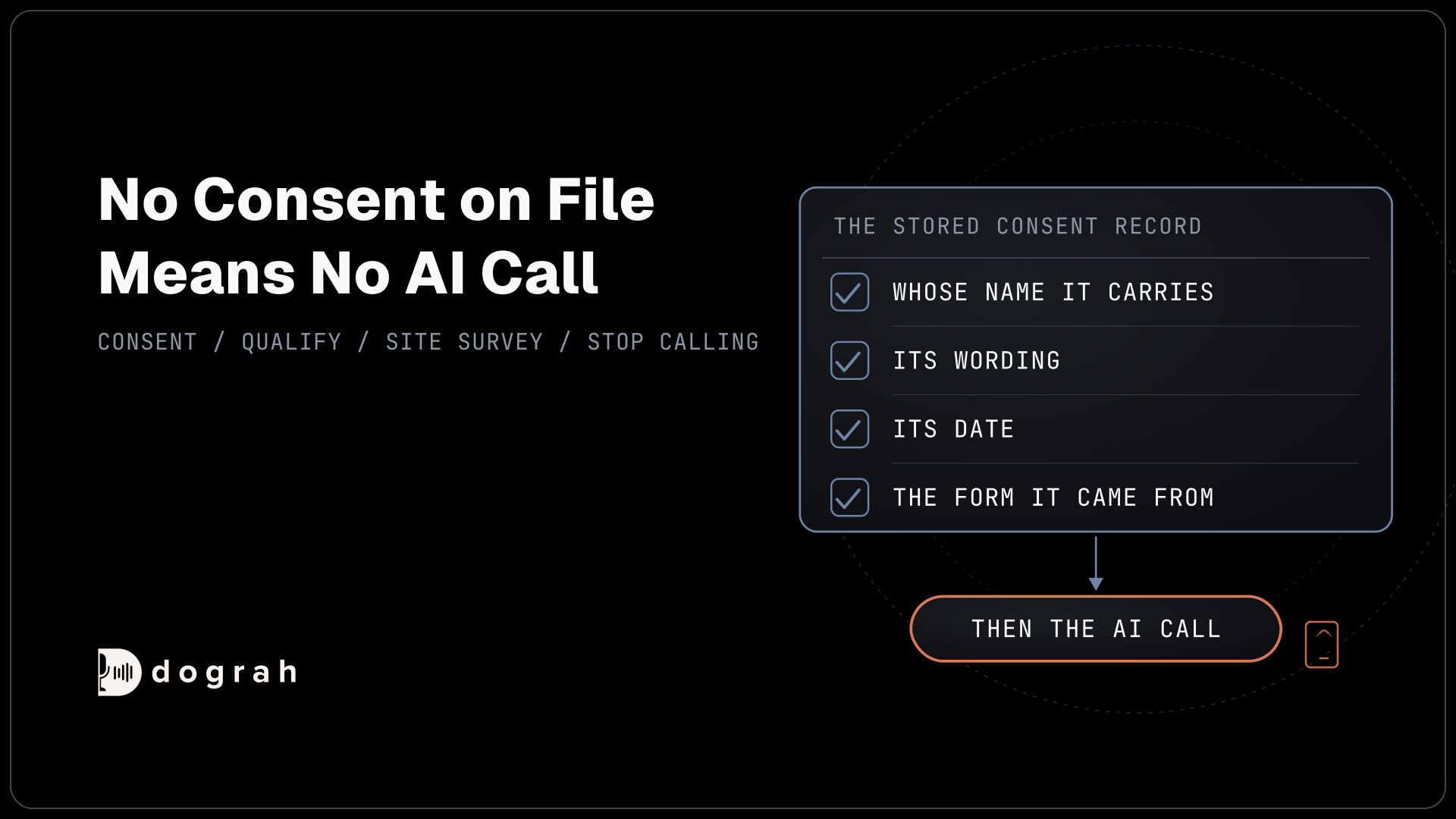
So the check runs before the call exists. Before the API Trigger fires or the number goes into a campaign list, the installer's system checks the stored consent record: whose name it carries, its wording, its date and the form it came from. Comparison-site leads need the closest look. In January 2025 a federal appeals court vacated the FCC's one-to-one consent rule before it took effect, so one form can still name several sellers, but it has to name yours clearly. No consent on file means no AI call: a person calls, or the lead waits for the homeowner to call in.
How the qualification call runs
The call asks questions and reads nothing out. It opens with Greeting Text, the fixed line Dograh plays word for word. The rule requires an artificial-voice message to, "At the beginning of the message, state clearly the identity of the business", so the greeting names the installer. If you want to tell people they're speaking with an automated assistant, or your location requires it by law, write that there too.
Pre-Call Data Fetch, set to Outbound calls only, loads the lead record as the call connects. The agent asks for the homeowner by name, which finds the right person but does not verify them. So write the prompt so the agent never reads back the address or the bill from the form (nothing from the record is spoken). The homeowner states each answer, and the agent records it as they said it.
The questions are short: do they own the home, how old is the roof and how much shade does it get, what is the monthly electric bill, which ZIP code, and when do they want to decide. The market has added two more. In the first six months of 2026, without the 30% federal residential tax credit, the share of installers on EnergySage quoting third-party ownership rose from about 14% to roughly 41%, according to EnergySage marketplace data reported by Solar Power World, partly because the option was new there. Homeowner interest in battery storage reached 76%. The agent asks whether they would buy or consider a lease or power purchase agreement, and whether storage interests them. It gives no financing advice.
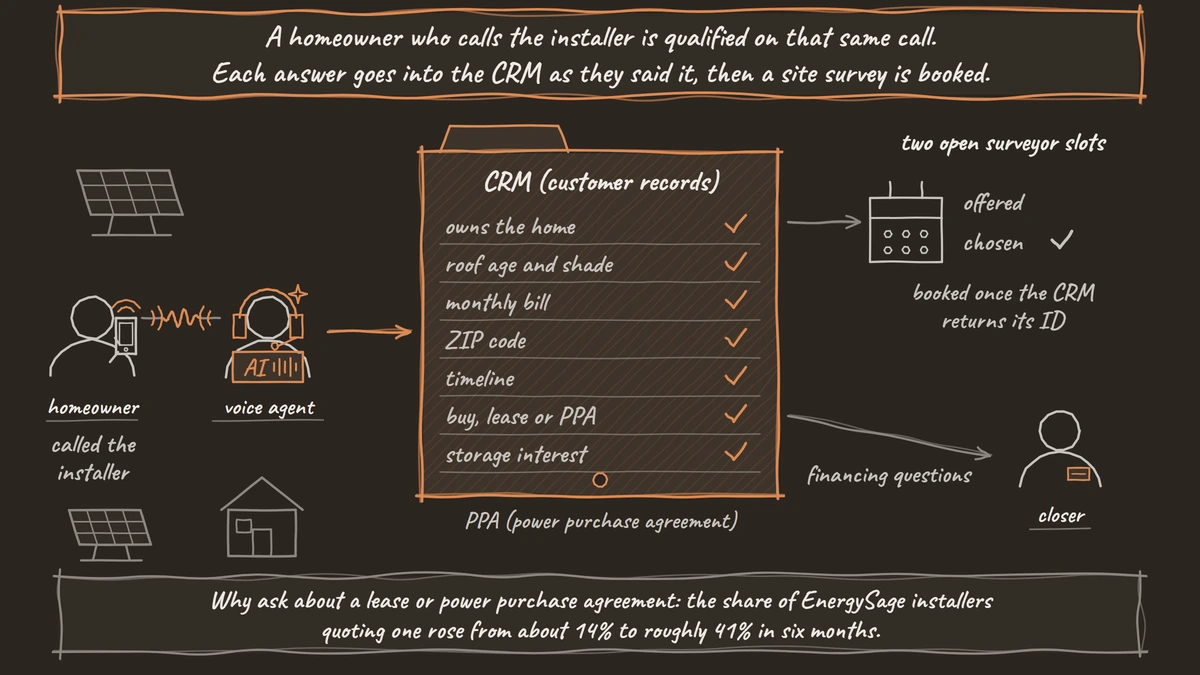
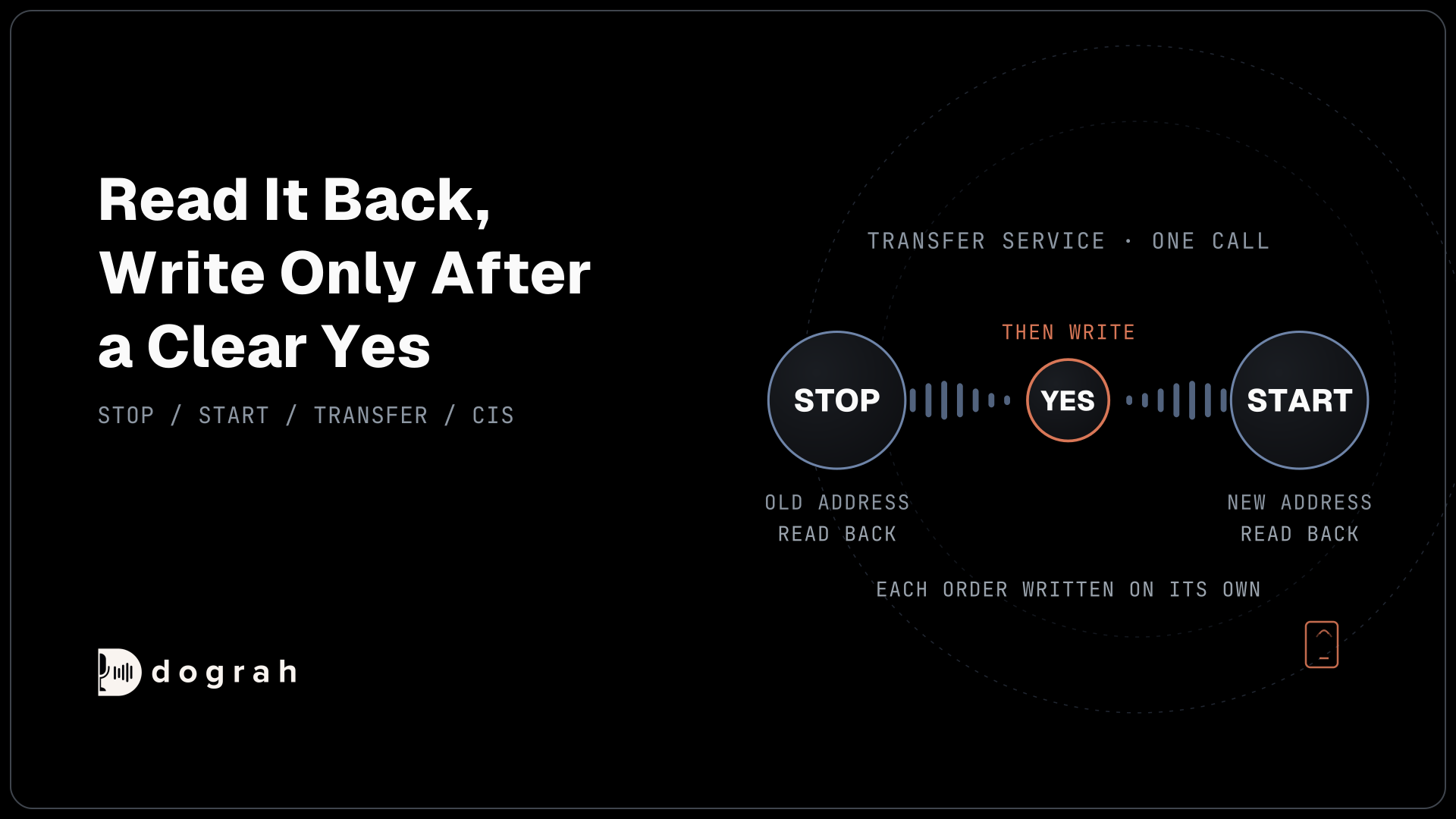
Panel words trip speech-to-text, so add words such as Monocrystalline or your panel brands in the agent's Settings: open Dictionary, type them into the box (comma-separated) and click Save Dictionary. A qualified homeowner gets a site survey: an HTTP API tool reads open surveyor slots, the agent offers two, reads the choice back and writes it, and the booking counts once the CRM returns its ID. Financing questions go to a closer through Transfer Call, which works on Twilio only and passes no summary, so the answers are written to the CRM first. The same ask, record and hand-over pattern runs in AI Voice Agents for Real Estate Lead Qualification.

Open Source Alternative to Vapi / Retell
Self-hosted voice agent platform — no per-minute fees
dograh-hq/dograh
Star on GitHub
Stop requests, voicemail and calling hours
A homeowner can say "stop calling" at any point, and that request has to outlast the call. For telemarketing messages the rule asks for "an automated, interactive voice- and/or key press-activated opt-out mechanism", and a voice agent can take the request by voice. An HTTP API tool writes it to the installer's do-not-call list at once.
Dograh keeps no do-not-call list of its own. It can tag a call do_not_call, but the tag never blocks a future call, so remove those numbers before each campaign upload. A running campaign can be paused but not edited, so for leads that arrive all day, start each call from the CRM with the API Trigger instead.
Sales calls to homes are barred "before the hour of 8 a.m. or after 9 p.m." local time. Campaigns in Dograh use one time zone per campaign, so split a multi-state list into one campaign per time zone. Retries run from 0 to 10, default 2, with no per-contact cap, so set them to your own policy. On voicemail, Dograh either disconnects (the default) or leaves a message; a message names the installer and a callback number and nothing about the home. AI Voice Agents for Logistics and Delivery (US) walks through the same consent framing for another industry.
Join the Dograh Community
Dograh is an OSS alternative to Vapi. Join our Slack community for queries, releases, best practices & community interactions.
Old leads, and where to start
Aged leads are the riskiest list. Call one only if its consent record still covers this call and names your business; otherwise a person decides what to do with it. When a homeowner answers, the first seconds decide the call, which The First 15 Seconds Decide Everything in AI Outbound Calls covers.
Start with inbound callers and fresh web leads, test on a real phone line, and read the first week of transcripts for questions the agent skipped. Once a proposal is out, the next call belongs to AI voice agents for quote follow-up in home services. Confirm your consent wording and process with counsel before the first outbound campaign.
Self-hosted Dograh has no per-minute platform fee (servers, model keys and phone minutes still cost); Dograh Cloud has a 1¢-a-minute platform fee.
Glossary
- Prior express written consent
- Under the TCPA, a signed written agreement that clearly authorizes a seller to deliver advertisements or telemarketing using an artificial or prerecorded voice, and states that signing is not a condition of purchase. A solar sales call from an AI voice agent to a web lead generally needs it, naming the installer.
- One-to-one consent rule
- An FCC rule that would have required each consent to name a single seller. A federal appeals court vacated it in January 2025 before it took effect, so one form can still name several sellers, as long as it names yours clearly.
- Third-party ownership
- A solar lease or power purchase agreement, where a third party owns the panels and the homeowner pays for their use or their power. The qualification call records interest in it and leaves the financing talk to a person.
- Site survey
- The visit where the installer checks the roof, shading and electrical panel before a proposal. In this post it is the end of qualification: the agent books it from live surveyor slots and writes it to the CRM.