
AI voice agents for solar and home services are phone agents that handle a job's routine calls: qualifying solar leads, following up on quotes, booking and changing visits, reminding plan members and asking for reviews. During the call they read the job from the field-service software or CRM, write each outcome back, and pass emergencies to a person.
Key Takeaways
- The agent reads each job from your field-service software and writes changes back.
- Check consent before any outbound dial, not inside the call script.
- Emergency calls get a fixed safety line first, then a person.
This guide follows a job from the first call to the review request, then sets out the rules for every outbound call and how each one runs in Dograh, an open-source voice agent platform that reads and writes your field-service software and CRM during the call. You can self-host it or run it on Dograh Cloud.
The calls a solar installer and a home-services company take
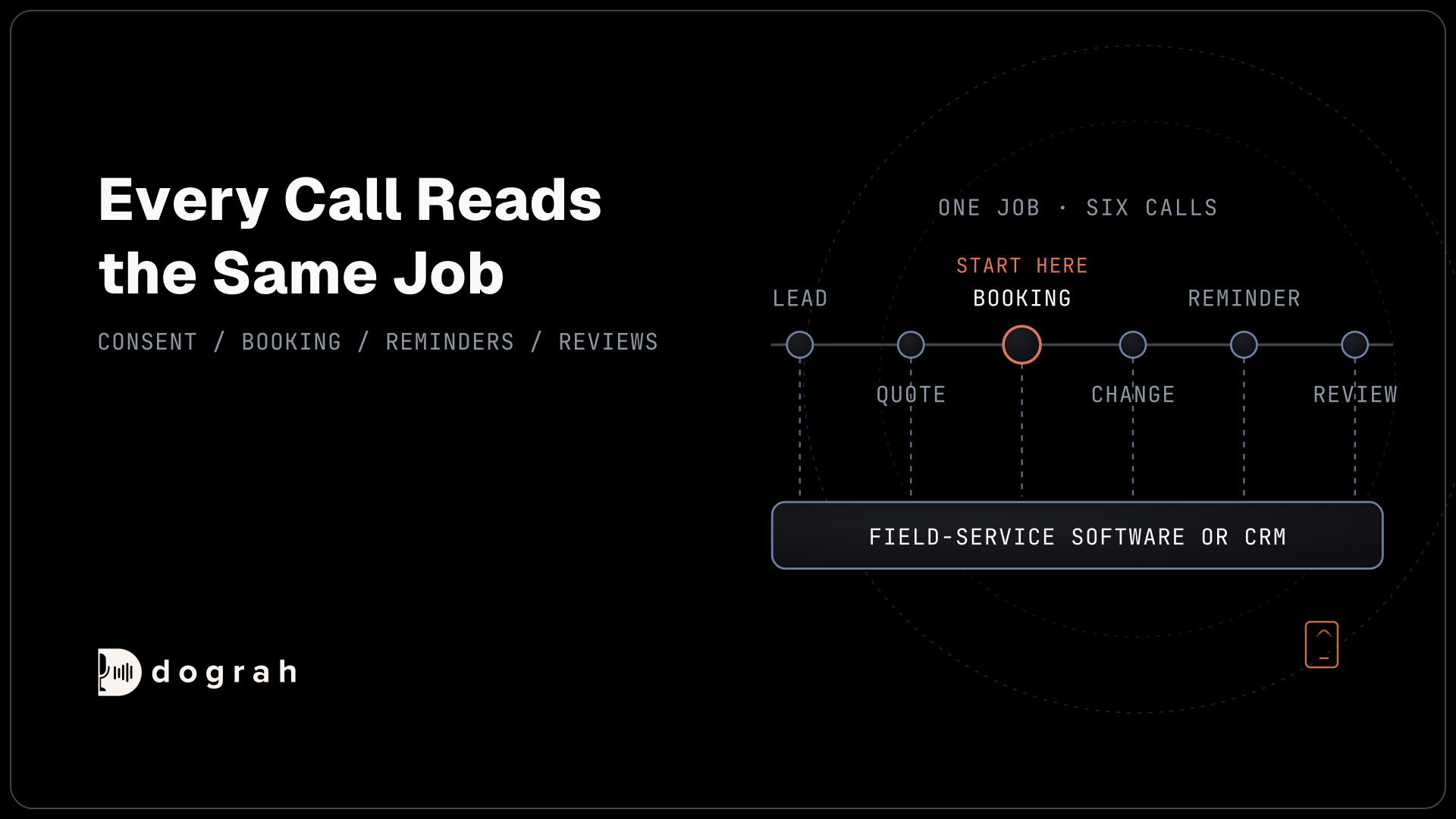
Solar installers and home-services companies take the same calls in the same order: a lead, a quote, a booked visit, changes, repeat visits and a review. Only the length differs. A plumbing repair can close in a day, while a solar sale can take months.
Owners are already moving. In Jobber's 2026 Home Service Trends Report, a survey of 1,050 US home service business owners in December 2025, 52% said they use AI day to day and another 27% plan to adopt it in the next year. The same owners say over 70% of customers expect a same-day response, and more than half expect one within the hour. An agent answers every lead the moment it calls and books the visit from your own schedule, which the sections below cover call by call.
Even a well-run agent will not finish every call alone. Some callers need a person, so the handover matters as much as the booking. Our post What 1 Million AI Voice Calls Reveal for Restaurants and Home Services looks at what happens across a million calls when a write fails or a retry repeats.
The agent reads every job from your field-service software
Every call in this guide reads the job from the business's own system and writes the outcome back, so the agent never keeps a separate list. For home services that system is field-service management (FSM) software such as ServiceTitan, Jobber or Housecall Pro; for a solar installer it is usually the CRM. For HVAC and plumbing companies, our page on self-hosted voice agents for HVAC and plumbing shows bookings, changes and reminders written into your field-service software.
Dograh runs each call as a flow you draw in its visual workflow builder. During the call, an HTTP API tool asks the FSM for the customer, the service address, open arrival windows or a quote, and the agent says only what comes back. A second HTTP API tool writes the booking, the change or the answer. After the call, a Webhook node sends the outcome and the transcript link to the same system, and retries automatically on a temporary failure.
Dograh has no built-in integration with these products. Each connection is an HTTP API tool pointed at that product's own API, or one of the other routes: MCP tools, Pre-Call Data Fetch as the call connects, and the API Trigger, which lets your system start a call. Our posts on API triggers and Webhook-Driven Voice Agents cover calls going out and data coming back.
A booking counts only when the FSM returns a job number, which the agent reads to the customer. If a write could be sent twice, add a Preset Parameter named workflow_run_id with the value {{initial_context.workflow_run_id}} to the tool, and the receiving system uses that ID to ignore the duplicate. HTTP API tools do not retry by themselves, so tell the agent in its prompt to say a person will confirm when a write fails.
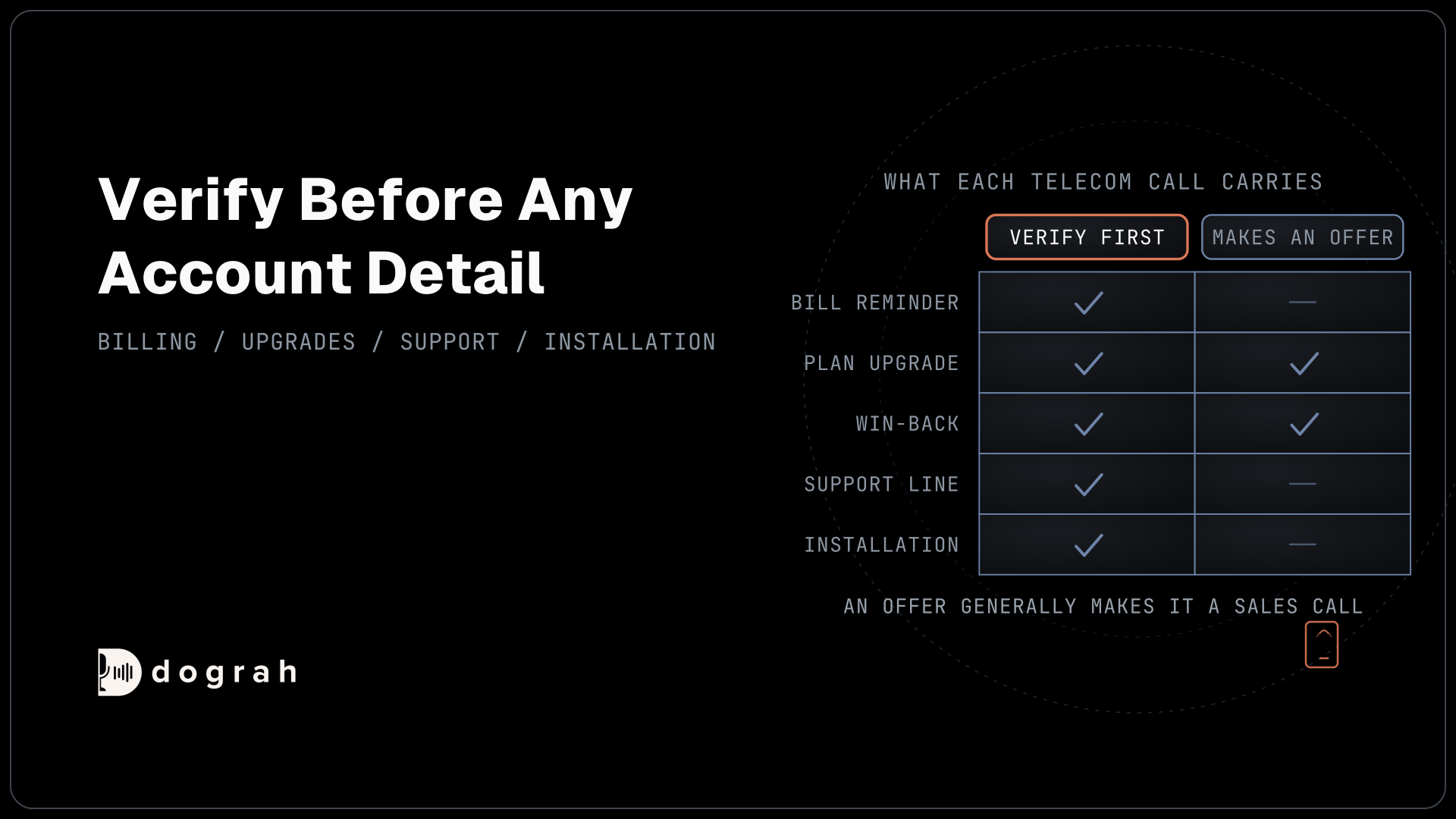
Every call runs greet, verify, then disclose. A phone number finds a customer record but does not prove who is calling. Before the agent mentions a job, a price or a visit date, it asks the caller to state a detail your business approves, such as the service address on the account, and compares it with the record. Pre-Call Data Fetch can load that record as the call connects; write the prompt so nothing from it is spoken until the check passes.
When a person is needed, Transfer Call hands the caller over. It works on Twilio only and passes no summary, so the agent writes the details to the FSM or CRM first. If nobody answers within the 30-second default, the caller stays with the agent; tell it in the prompt to offer a callback and write the request through an HTTP API tool.
Before the job: solar leads and quote follow-up
Two calls come before any work is booked.
Solar lead qualification
A solar lead call checks consent first, then qualifies the homeowner and books the site survey. A homeowner who phones the installer started that call, and the agent can qualify them on it. Web and comparison-site leads are different. Before the API Trigger fires or the number goes into a campaign list, the installer's system checks the stored consent record: whose name it carries, its wording, its date and the form it came from. No consent on file means no AI call.
On the call, the agent asks about home ownership, roof and shade, the monthly bill, the ZIP code and the timeline, and records each answer as the caller stated it. In the first half of 2026, the first six months without the 30% federal residential tax credit, the share of installers on EnergySage quoting third-party ownership rose from about 14% to roughly 41%, according to EnergySage marketplace data reported by Solar Power World, partly because the option was new to the marketplace. The agent asks whether they would buy or consider a lease or power purchase agreement, and leaves financing to a person. AI voice agents for solar lead qualification covers the consent check and the full call.
Quote follow-up
A quote follow-up call answers the question that is stalling the decision, and it is a sales call. In Jobber's report, 69% of pros say they win more than half their quotes, so the call is for the ones that stall.
The FSM starts it through the API Trigger a set number of days after the quote goes out. The trigger dials at once, so the wait lives in your own scheduler or a campaign's calling hours. After verification, the agent names the quote, reads its line items from the record and answers scope questions. A yes books the job; a no is recorded with the reason as given. Discounts exist only if the quote system returns one, and price talk goes to the estimator. Because the call encourages a purchase, it generally needs prior express written consent, best captured on the quote request form. AI voice agents for quote follow-up in home services sets out the timing and the stop rule.

Open Source Alternative to Vapi / Retell
Self-hosted voice agent platform — no per-minute fees
dograh-hq/dograh
Star on GitHub
Booking the job and handling changes
Two calls keep the schedule right: the booking, and every change after it.
Appointment booking
The booking call offers only the slots the field-service software returns, and it confirms only when the software returns a job number. The agent checks the service area by ZIP code, takes the job type from a short allowed list, asks how urgent it is, reads open arrival windows through an HTTP API tool and offers two or three. It reads the details back, collects access notes such as a gate code, then writes the job.
Capacity is the real limit: an agent can only book the slots your schedule has open. Start with a narrow list of job types the agent may book, and widen it once the flow is proven. The agent never diagnoses a fault or prices a repair, though it can read a fixed trip or diagnostic fee from the price list. AI voice agents for home-services appointment booking walks through the whole call.
Reschedules and cancellations
A change call moves or cancels a booked visit, and it starts from the booking already in the system. After verification, the agent reads the current booking, offers new slots from the FSM, writes the change and reads it back. For a cancellation, it reads any late-change policy from the record, offers one other day, records the reason as stated and writes the cancellation. Deposits, refunds, disputes and damage complaints go to a person.
Start with reschedules on routine job types and keep cancellations with staff until the flow is proven. AI voice agents for reschedule and cancellation handling in home services covers inbound and outbound changes.
After and between jobs: reminders and review requests
Two calls keep a customer after the work is done, and neither one carries an offer.
A service reminder tells a plan member their included visit is due and books it, with no offer on the call. A Campaign built from the service agreements in the FSM calls each member, verifies them, offers live slots and writes the booking. A renewal or upgrade pitch generally makes the call telemarketing, so that becomes a separate, consented call. The details are in AI voice agents for service reminders in home services.
A review request goes to every customer whose job is closed, in the same words, with no reward. Asking only the customers you expect to be happy is review gating, and Google's policy says merchants may not "selectively solicit positive reviews from customers". The FTC's Consumer Review Rule bars incentives tied to a review's sentiment, and Google bars incentives for any review. So the trigger is a job status, and the ask is fixed text in a Transition Speech or a recorded clip, so the wording cannot drift into "if you were happy". When a customer says yes, an HTTP API tool asks the business's own system to text the review link, since Dograh has no SMS tool. A customer who raises a problem is passed to the service team, and the ask still stands. AI voice agents for review requests in home services covers the wording and the rules.
Join the Dograh Community
Dograh is an OSS alternative to Vapi. Join our Slack community for queries, releases, best practices & community interactions.
Emergencies get a fixed line and a person
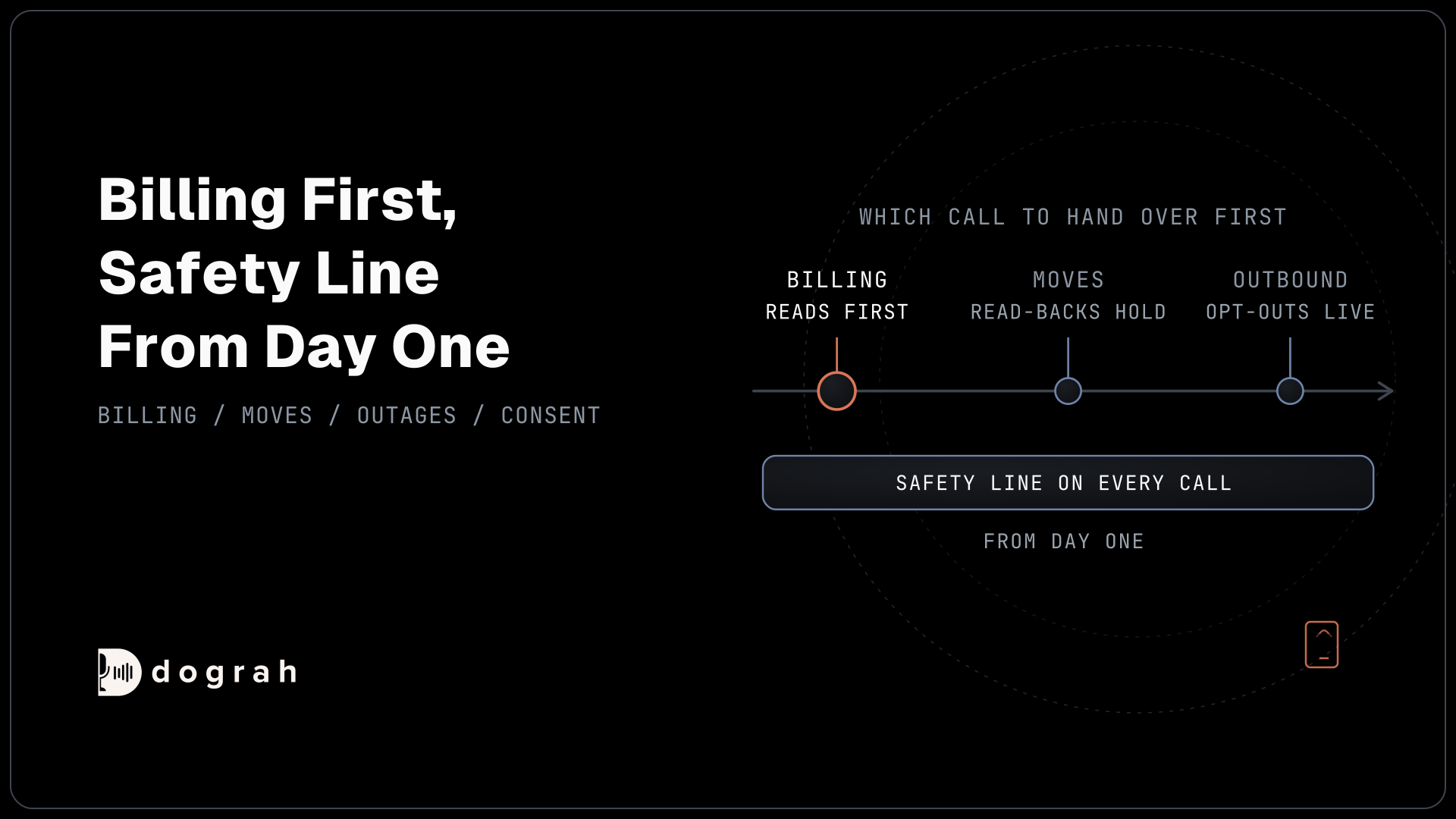
A caller who reports a gas smell, a carbon monoxide alarm, active flooding or a sparking panel needs a safety instruction your business approved, never one the language model wrote.
Exact wording holds only where Dograh speaks fixed text: the Greeting Text, a pathway's Transition Speech, a recorded clip, or the Transfer Call tool's Pre-Transfer Message. Inside a node the AI writes its own words. Put the safety line there, for example "If you smell gas, leave the house now and call 911 or your gas utility from outside." Set it before the transfer, because if nobody answers, Dograh hands the failure back to the AI, which writes its own reply.
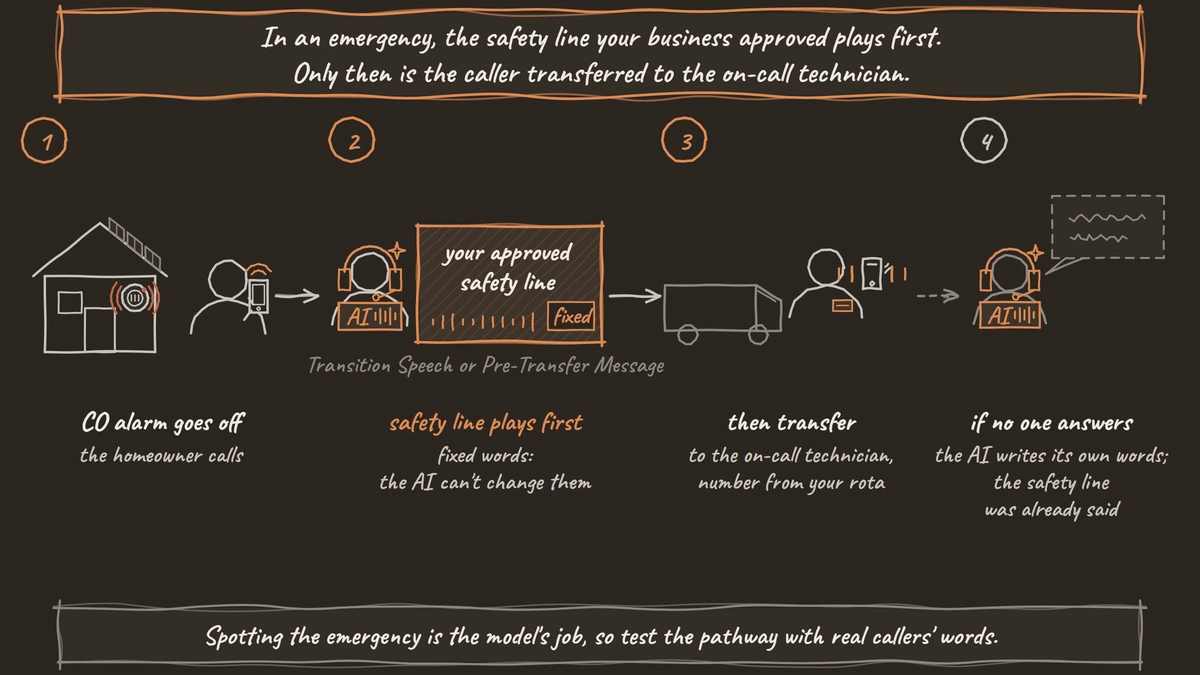
Transfer Call can take its number from a Dynamic HTTP Resolver, so your rota system returns whoever is on call. Spotting the emergency rests on the language model reading the pathway's condition, so test it with real callers' words.
The rules for every outbound call
Most calls here can also be outbound, and outbound calls share one set of rules. This is general information, not legal advice.
In the US, the Telephone Consumer Protection Act (TCPA) covers calls made with an artificial or prerecorded voice. The Federal Communications Commission's declaratory ruling of February 2024, FCC 24-17, confirmed that this covers "current AI technologies that generate human voices". The rule text at 47 CFR 64.1200 bars a telemarketing call using an artificial voice to a mobile number "other than a call made with the prior express written consent of the called party". So a quote follow-up or a solar sales call generally needs written consent on file, while a reminder for a paid visit generally rests on the consent the customer gave with their number.
An artificial-voice message must, "At the beginning of the message, state clearly the identity of the business", so the Greeting Text names it. Sales calls to homes are barred "before the hour of 8 a.m. or after 9 p.m." local time. Dograh campaigns use one time zone each, so split a multi-state list by time zone. If you want to tell people they're speaking with an automated assistant, or your location requires it by law, write it in the Greeting Text along with the business's name.
Opt-outs live in your own system: when a customer says "stop calling", an HTTP API tool writes it there. Dograh keeps no do-not-call list: it can tag a call do_not_call, but the tag never blocks a future call, so remove those numbers before each campaign upload. A running campaign can be paused but not edited, so for lists that change daily, start calls from your own system with the API Trigger. Campaigns have no per-contact call cap, so set retries (0 to 10, default 2) to your own policy. Confirm your position with counsel before the first outbound campaign.
Which call to automate first
Start with inbound booking: it reads before it writes and raises no outbound consent question. Nights and weekends make a good first window; AI voice agents for after-hours coverage covers that handover, and The Ultimate Guide to AI Receptionists covers one agent answering every call.
Put the agent on a real phone line before any customer hears it: most phone calls still reach the agent as 8 kHz audio, while a browser test runs at 16 kHz. Add trade words such as monocrystalline or a furnace model under the agent's Settings, in the Dictionary box (comma-separated), then click Save Dictionary. Once live, run the QA node on a random 5 to 10% sample of calls and fix what the transcripts show. Add change calls and reminders next, then review requests, and leave outbound sales calls for last, once consent is recorded in your own system.
Self-hosted Dograh has no per-minute platform fee (servers, model keys and phone minutes still cost); Dograh Cloud has a 1¢-a-minute platform fee.
Each call above has its own deep dive:
- AI Voice Agents for Solar Lead Qualification
- AI Voice Agents for Quote Follow-up in Home Services
- AI Voice Agents for Home-Services Appointment Booking
- AI Voice Agents for Reschedule and Cancellation Handling in Home Services
- AI Voice Agents for Service Reminders in Home Services
- AI Voice Agents for Review Requests in Home Services
Glossary
- Field-service management (FSM) software
- The system a home-services company runs on, such as ServiceTitan, Jobber or Housecall Pro, holding customers, jobs, technician schedules and service agreements. In this guide the voice agent reads every job from it during the call and writes each outcome back.
- Third-party ownership
- A solar lease or power purchase agreement, where a third party owns the panels and the homeowner pays for their use or their power. A qualification call records the homeowner's interest in it and leaves the financing conversation to a person.
- Prior express written consent
- Under the TCPA, a signed written agreement that authorizes a seller to deliver advertisements or telemarketing using an artificial or prerecorded voice. A solar sales call or a quote follow-up from an AI voice agent generally needs it.
- Review gating
- Asking only the customers you expect to be happy for a public review, or steering unhappy ones away from it. Google's policy bars it, so a review request goes to every customer with a closed job, in the same words.