
AI voice agents for review requests in home services call every customer whose job is closed and ask, in the same fixed words, whether they would share their experience online. No reward is offered. On a yes, the business's own system texts the review link, and any complaint goes to the service team instead of stopping the ask.
Key Takeaways
- Ask every customer with a closed job, never only the happy ones.
- No reward of any kind for a review, positive or not.
- Put the ask in fixed text so the wording cannot drift.
This post is part of our guide to AI voice agents for solar and home services. The guide's "After and between jobs: reminders and review requests" section sums up this call in one line: it goes to every customer whose job is closed, in the same words, with no reward. Here is that call in full, built on Dograh, an open-source, self-hostable voice agent platform.
The rules: ask everyone, reward no one
Two sets of rules shape the review call, and both point the same way. This is general information, not legal advice.
The first is the platform's. Google's policy for reviews on Maps says merchants may not "Discourage or prohibit negative reviews, or selectively solicit positive reviews from customers". It also bars offering incentives such as payment or discounts "in exchange for posting any review". Asking only the customers you expect to be happy is called review gating, and it breaks the first line.
The second is the law. The FTC's Consumer Review Rule, at 16 CFR 465.4, makes it unfair or deceptive "to provide compensation or other incentives in exchange for, or conditioned expressly or by implication on, the writing or creation of consumer reviews expressing a particular sentiment, whether positive or negative". The FTC's advice in its guide for marketers is plainer: "Don't ask for reviews only from customers you think will leave positive ones."
The FTC rule targets incentives tied to sentiment. Our advice goes further: offer no incentive at all, which also keeps you inside Google's policy. Confirm your own position with counsel before the first campaign.
Who gets the call
The trigger is a job status in your field-service software, the same for every customer: the job is closed and invoiced, with no open work order. Nothing about the customer's mood or a survey score decides it. A satisfaction score from a survey is useful for fixing problems, and the reason it must never pick who gets the review ask is set out in AI voice agents for CSAT surveys in e-commerce.
An open complaint can hold the call only while the fix is under way, with a real end point such as the return visit being completed. Once it is closed, that customer goes back under the same rule as everyone else. A hold with no end point is gating by another name.
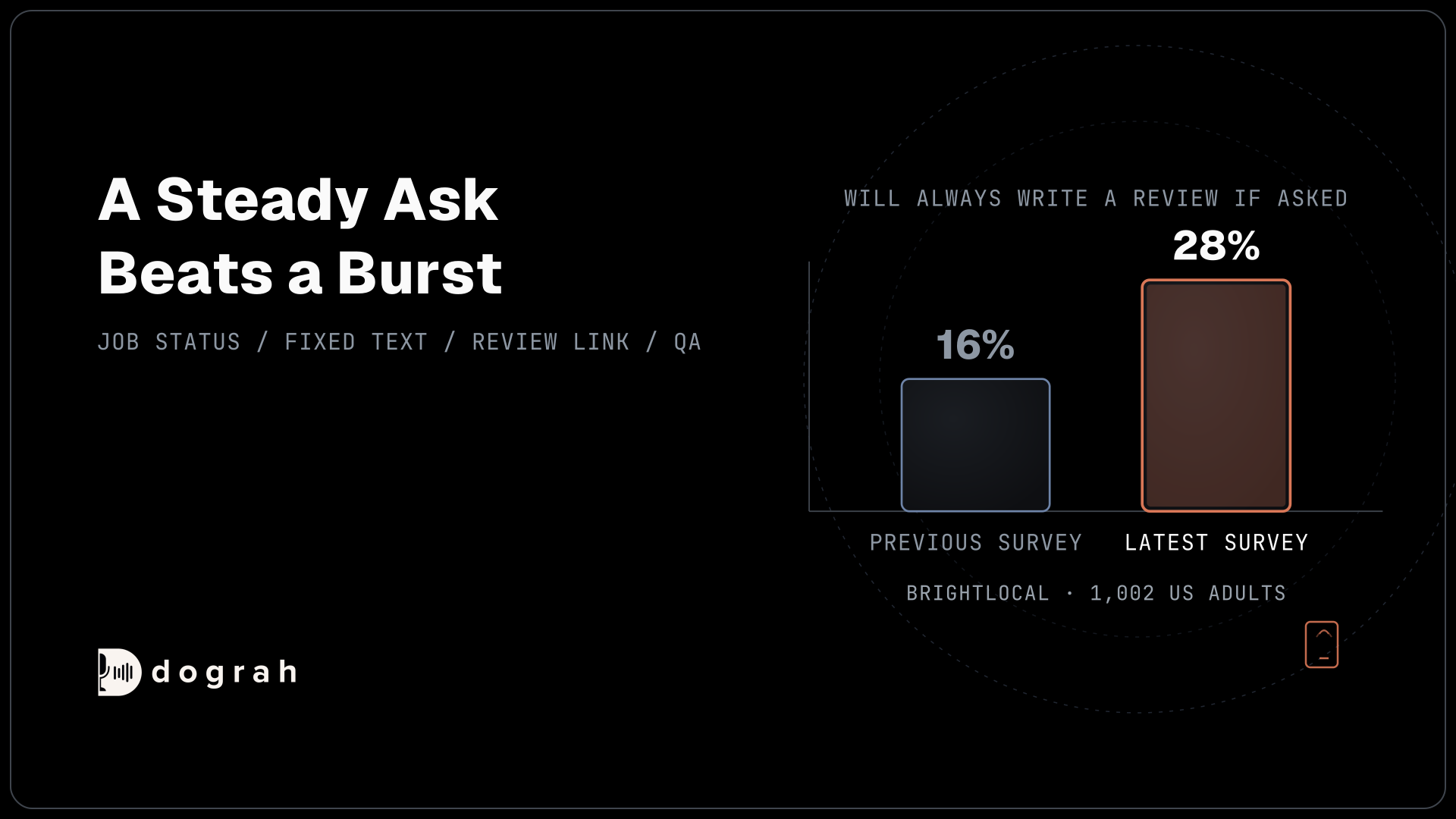
Asking works, and a steady ask beats a burst. In BrightLocal's Local Consumer Review Survey 2026, of 1,002 US adults, 78% had been asked to leave feedback in the past 12 months, and 28% said they will "always" write a review if asked, up from 16% in 2025. 74% only care about reviews written in the last three months.
How the call runs
The call is short and the same every time. A Campaign built from closed jobs, or the API Trigger fired when a job closes, starts it. Greeting Text, the fixed line Dograh plays word for word, names the business. The agent asks for the customer by name, then asks them to confirm the service address before it mentions the visit, because a name finds the person but does not verify them.
Then comes the ask, as fixed text in a pathway's Transition Speech or a recorded clip: "We ask every customer the same thing. Would you be willing to share your experience on Google?" Inside a node, the language model writes its own words and can drift into "if you were happy with the work". Fixed text cannot. Transition Speech carries no per-customer variables, which suits a line that should never change. Agree the wording with your team once, record it if you want a human voice, and change it only on purpose, so every customer in a month heard exactly the same words. If someone other than the customer answers, the agent asks when to call back and makes no ask at all.
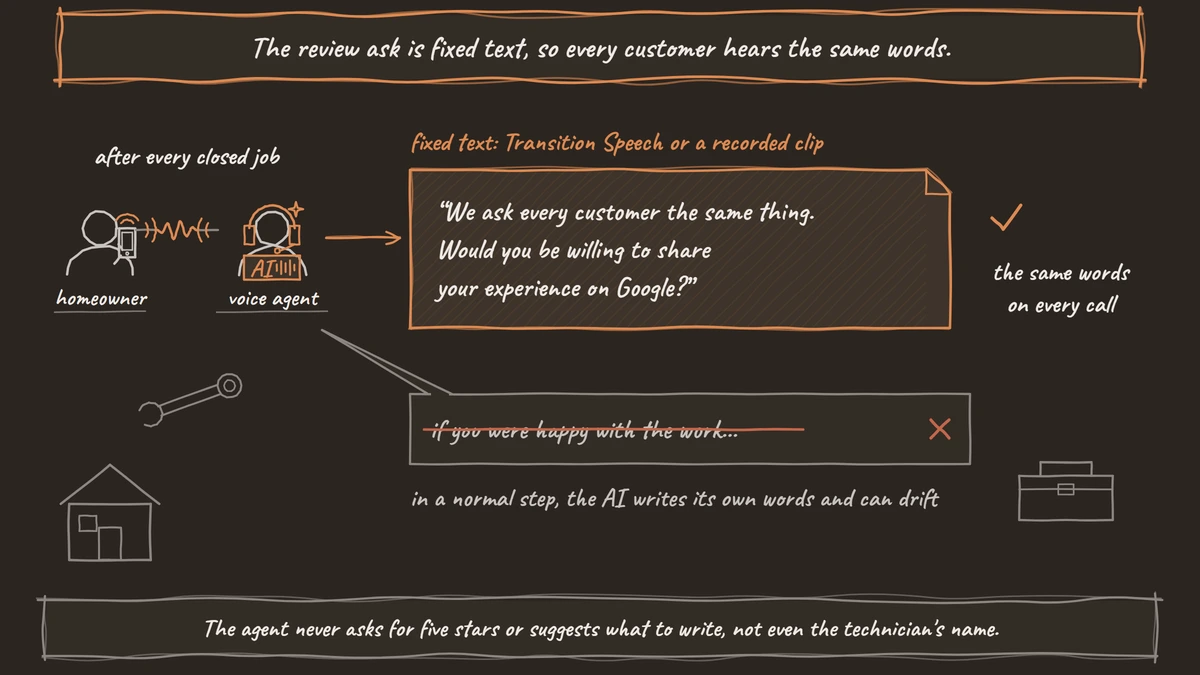
The agent never asks for five stars or suggests what to write, including the technician's name; Google's policy also says merchants should not "request that specific content be included". On a yes, an HTTP API tool asks your own system to text the review link, since Dograh sends no texts itself. On a no, the agent thanks them and ends the call, and the answer is recorded. On voicemail, Dograh either disconnects (the default) or leaves a message with the business name and a callback number only.

Open Source Alternative to Vapi / Retell
Self-hosted voice agent platform — no per-minute fees
dograh-hq/dograh
Star on GitHub
When the customer raises a problem
Sometimes the review call is where a problem first comes out. The agent records it as the customer stated it and hands it to the service team: through Transfer Call, which works on Twilio only and passes no summary, so the details are written first, or as a callback request in your system.
The agent never says "please don't post that" and never asks for a review to be changed or taken down. The FTC rule's section on review suppression, 16 CFR 465.7, covers threats and intimidation aimed at stopping or removing reviews. The ask was made in the same words, and it still stands.
Check the calls as well as the setup. Run the QA node on a random sample and read the transcripts for any line that conditions the ask on satisfaction. Google is watching too: it says it blocked or removed over 292 million policy-violating reviews in 2025. Hotels face the same choice after a stay, covered in AI Voice Agents for Post-Stay Surveys.
Join the Dograh Community
Dograh is an OSS alternative to Vapi. Join our Slack community for queries, releases, best practices & community interactions.
Where to start
Run the call for every closed job in one trade for a month, with one attempt and one retry. Call soon after the job closes, while the visit is fresh, and keep the delay the same for everyone, because a delay you set by hand for some customers is another way of choosing who gets asked. Stop after a yes or a no; a customer who declined is not asked again for that job. A feedback survey is a different call with a different job, as AI Voice Agents for Feedback Surveys in Restaurants shows.
Self-hosted Dograh has no per-minute platform fee (servers, model keys and phone minutes still cost); Dograh Cloud has a 1¢-a-minute platform fee.
Glossary
- Review gating
- Choosing who receives a public review request based on what you expect them to say, such as asking only customers who sounded happy. Google's policy bars it, so the review call goes to every customer with a closed job.
- Consumer Review Rule
- The FTC rule at 16 CFR Part 465. Among other things, it bars incentives conditioned on a review expressing a particular sentiment, and it bars review suppression through threats or intimidation.
- Review suppression
- Trying to stop a review being written or get one removed through threats or false accusations. A review call never discourages a review or asks for one to be taken down.
- Transition Speech
- Fixed text or a recorded clip that Dograh plays word for word when a pathway is taken. It carries no per-customer variables, which makes it the right place for a review ask that must never change.