
AI voice agents for application follow-up call applicants whose application is missing an item, after checking that the form they filled in gave consent to be called. The agent verifies the applicant, names the missing item from the admissions system, explains why it is needed and records the date the applicant promises. File decisions stay with admissions staff.
Key Takeaways
- Check the consent each form collected before a number reaches the list.
- Name the missing item only after verifying student ID and date of birth.
- The school's own system sends upload links; the call never collects documents.
This post is part of our guide to AI voice agents for edtech and universities. The guide's section on the application in progress describes these as the calls that turn a stalled application back into a live one. Here is the full design of that outbound call in Dograh, an open-source, self-hostable voice agent platform, from the consent check before the list to the date the applicant promises.
Most offices never call the number they collect
Phone follow-up is the step admissions offices skip most often, even when the applicant has handed over a number. In UPCEA's 2025 secret shopper study, shoppers left a phone number on 49% of the request forms they filled in between July and September 2025. Only 24% of those got even one phone call within 30 days. Those who were called got 2.4 calls on average, with a median of one. The report notes that its phone sample is smaller, since some incoming calls could not be traced to the institution.
Texts did a little better, reaching 29% of the shoppers who gave a number. A text is the right first nudge for a missing item, and it comes from the school's own messaging system, since Dograh has no SMS tool. The call earns its place for the applicants who did not act on the text, or whose missing item needs explaining before they can send it.
Check consent before anyone is called
Consent is checked when the call list is built, because an outbound AI-voice call generally needs it before the phone rings. This section is general information, not legal advice.
The Federal Communications Commission (FCC) ruled in FCC 24-17 that AI-generated voices count as artificial voices under the Telephone Consumer Protection Act (TCPA), so these calls generally need the applicant's prior express consent. The guide's consent section covers the ruling. What matters for a follow-up list is the next layer.
A call that advertises needs more. 47 CFR 64.1200(a)(2) requires "the prior express written consent of the called party" for an artificial-voice call to a mobile number that "includes or introduces an advertisement or constitutes telemarketing". The same paragraph accepts prior express consent when "the call is made by or on behalf of a tax-exempt nonprofit organization". A reminder about a transcript is generally informational. Mention a scholarship or a different paid program, and the call can start to look like marketing.
In practice, the export that builds the list carries the consent each number came with: the form it came from and the date it was given. Numbers without a matching consent stay off the list. The Greeting Text names the institution, as 64.1200(b)(1) requires the call to "state clearly the identity of the business, individual, or other entity" at the beginning. Dograh has no keypad tool, so an applicant opts out by voice, and the agent writes that answer to your list at once. Confirm your own position with counsel before the first campaign.
Build the call list from the admissions system
The admissions system decides who is called and when, and Dograh only runs the calls it is given. There are two ways to start them. The admissions system can call the API Trigger the moment an item has been missing for the number of days you choose, or a nightly export can run through Campaigns as a CSV upload.
Campaigns has its own retry settings: max retries from 0 to 10 (default 2), a retry delay from 30 seconds to an hour (default 2 minutes), switches for retrying on busy, no answer and voicemail, and calling hours set by weekday. It has no per-applicant cap. If the same applicant appears in tonight's file and tomorrow's, both calls go out, so the export enforces the limit, for example one call per missing item per week, and drops anyone who asked not to be called.
Pre-Call Data Fetch, set to "Outbound calls only" at the bottom of the Start Call node, pulls the applicant's checklist again once the call connects. If the transcript arrived after the export ran, the agent sees it and moves on to anything still missing.
How the call runs
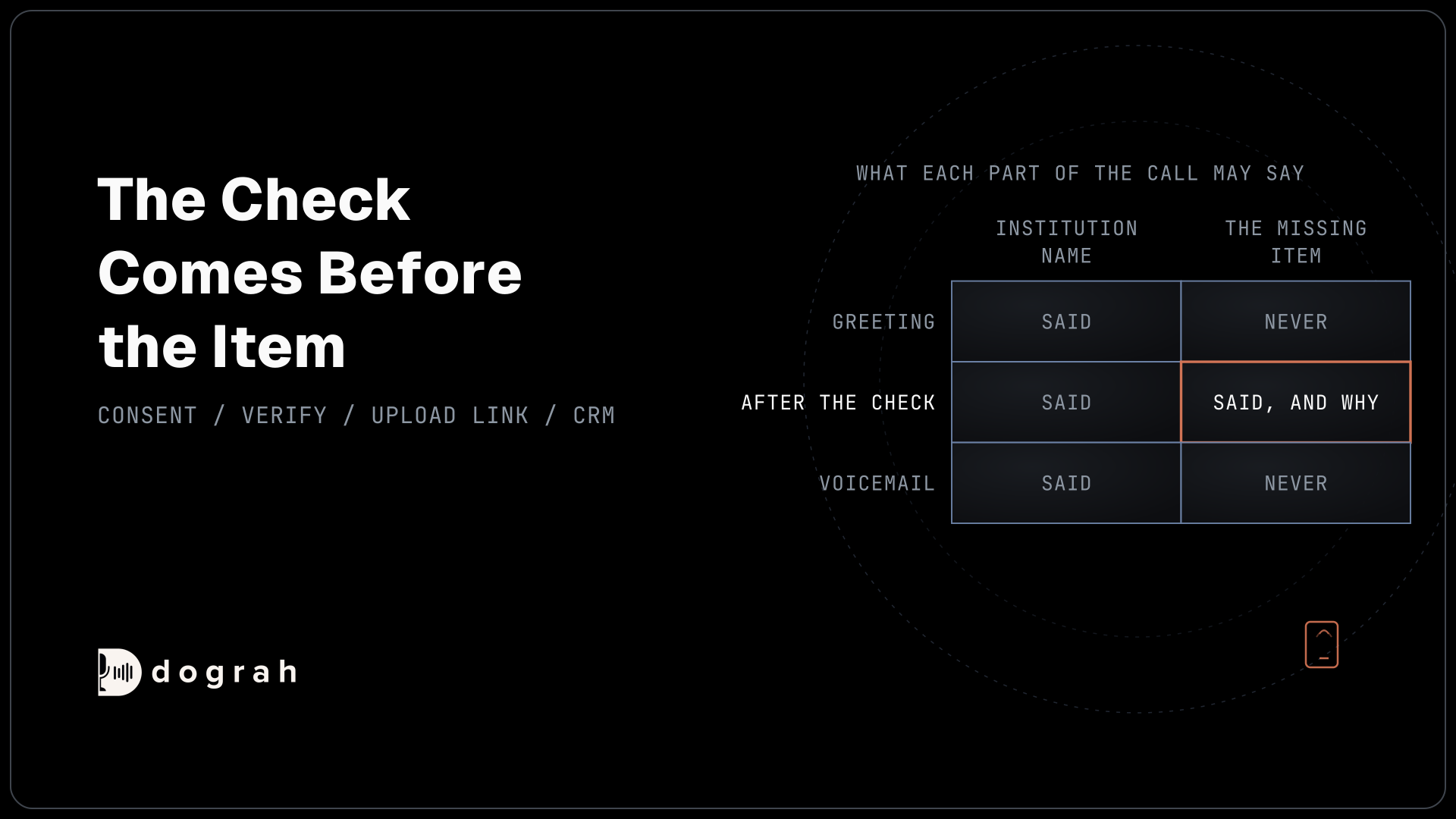
The call follows greet, verify, then name the item, and each step has its own limit on what can be said. The Greeting Text is fixed. It names the institution and asks for the applicant by first name, using a fallback such as {{first_name | there}} so a missing value is never read aloud as a placeholder. If you want to tell applicants they're speaking with an automated assistant, or your location requires it by law, write that there too. It never names the program or the missing item, because the person who answered may not be the applicant. The opening seconds of an outbound call carry a lot of weight, as The First 15 Seconds Decide Everything in AI Outbound Calls explains.
Next comes the check: the student ID from the application plus the date of birth. A phone number finds the application; it never proves who answered. Only after a match does the agent name the missing item and say why it is needed, such as "the transcript from your previous college, so the department can check your credits". Applicants rarely ignore a request on purpose. They miss it because nobody told them clearly which document was needed and why.
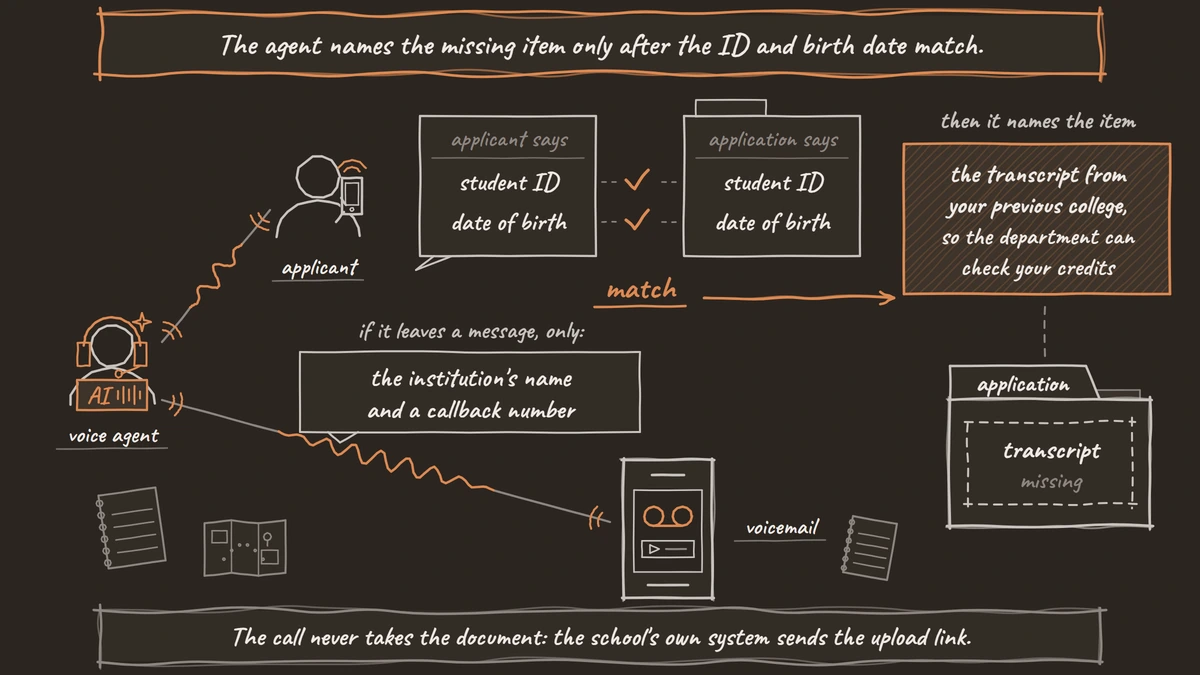
The agent never takes a document on the call. If the applicant wants to send it now, an HTTP API tool asks the school's own system to send a secure upload link by text or email. The same pattern runs claims paperwork in AI Voice Agents for Claims Document Collection in Insurance. The agent records the date the applicant promises and any reason for the delay as the applicant stated them, and a webhook writes both to the admissions customer relationship management (CRM) system when the call ends.
Machines answer many of these calls. Voicemail detection is set in the agent's Settings under "Enable voicemail and screening handling": "Disconnect the call" (the default) leaves no message, and "Leave a message" plays one. A message carries only the institution's name and a callback number, never the program or the missing item.

Open Source Alternative to Vapi / Retell
Self-hosted voice agent platform — no per-minute fees
dograh-hq/dograh
Star on GitHub
What the agent hands to staff
Anything that needs a judgement about the file goes to a person. That covers whether a late item will still be accepted, deadline extensions, fee waivers, financial aid questions and appeals. The agent never says an application is at risk, or that it will be accepted once the item arrives.
Transfer Call puts the applicant through to an admissions counsellor. It works on Twilio only and passes no summary, so the agent writes the applicant's question to your system first. If nobody answers within the timeout, 30 seconds by default, the applicant stays with the agent, which takes a callback request and writes it to the CRM through an HTTP API tool.
Join the Dograh Community
Dograh is an OSS alternative to Vapi. Join our Slack community for queries, releases, best practices & community interactions.
Admitted students: next steps only
Once an applicant is admitted, the same call can mention what comes next, such as the enrollment deposit deadline or the orientation date, as the system returns them. It mentions them as next steps at the end of the call and never chases them as a balance. Tuition and fee balances after enrollment belong to a different call, covered in AI voice agents for fee and payment reminders in education. Questions from people who have not applied yet belong on the inbound line in AI voice agents for admissions and enrollment.
Before the first campaign, call yourself on a real phone, because phone audio is rougher than a browser test. Then run QA on a sample of live calls and read the ones where the applicant asked for a person. Self-hosted Dograh has no per-minute platform fee, though servers, any paid model keys and phone minutes still cost money. Dograh Cloud has a 1¢-a-minute platform fee.
Glossary
- Prior express consent
- Permission to be called that the TCPA rules generally require before an artificial or AI-voice call to a mobile number. Calls that advertise need the written form, unless the caller is a tax-exempt nonprofit.
- Campaigns
- Dograh's outbound list runner. You upload a CSV of numbers and set max retries, the retry delay, which outcomes to retry and calling hours by weekday; it has no per-person cap.
- Secure upload link
- A link generated by the school's own admissions system that lets an applicant send a document. During the call, an HTTP API tool asks that system to send it by text or email.
- Voicemail detection
- The Dograh setting that decides what the agent does when a machine answers. For application follow-up, the message names only the institution and a callback number.