
AI voice agents for edtech and universities are phone agents that answer admissions questions, chase incomplete applications, remind students about fees and handle routine student support, reading and writing the institution's own student system during the call. They verify the student before any record detail and never decide admission or money questions; those go to staff.
Key Takeaways
- The agent reads each record from the student system during the call and writes every change back to it.
- Verify student ID and date of birth before reading any record detail.
- Outbound AI-voice calls need consent, and sales calls need written consent.
Most calls a university or edtech company takes follow one student from first question to first term. This guide takes each call in that order, then the rules that apply to all of them, and how each call runs in Dograh, an open-source voice agent platform that reads and writes your student system during the call. You can self-host it or run it on Dograh Cloud.
How the agent works with your student system
A voice agent helps an admissions or student services team only when it reads and writes the system staff already trust. For most institutions, the first problem is answering at all.
In UPCEA's 2025 secret shopper study, the online and professional education association sent 1,000 inquiries to member programs between July and September 2025, and 44% got no reply at all. Replies took 14 hours and 23 minutes on average (median 3 hours and 18 minutes). Of the shoppers who left a phone number, only 24% got even one call within 30 days.
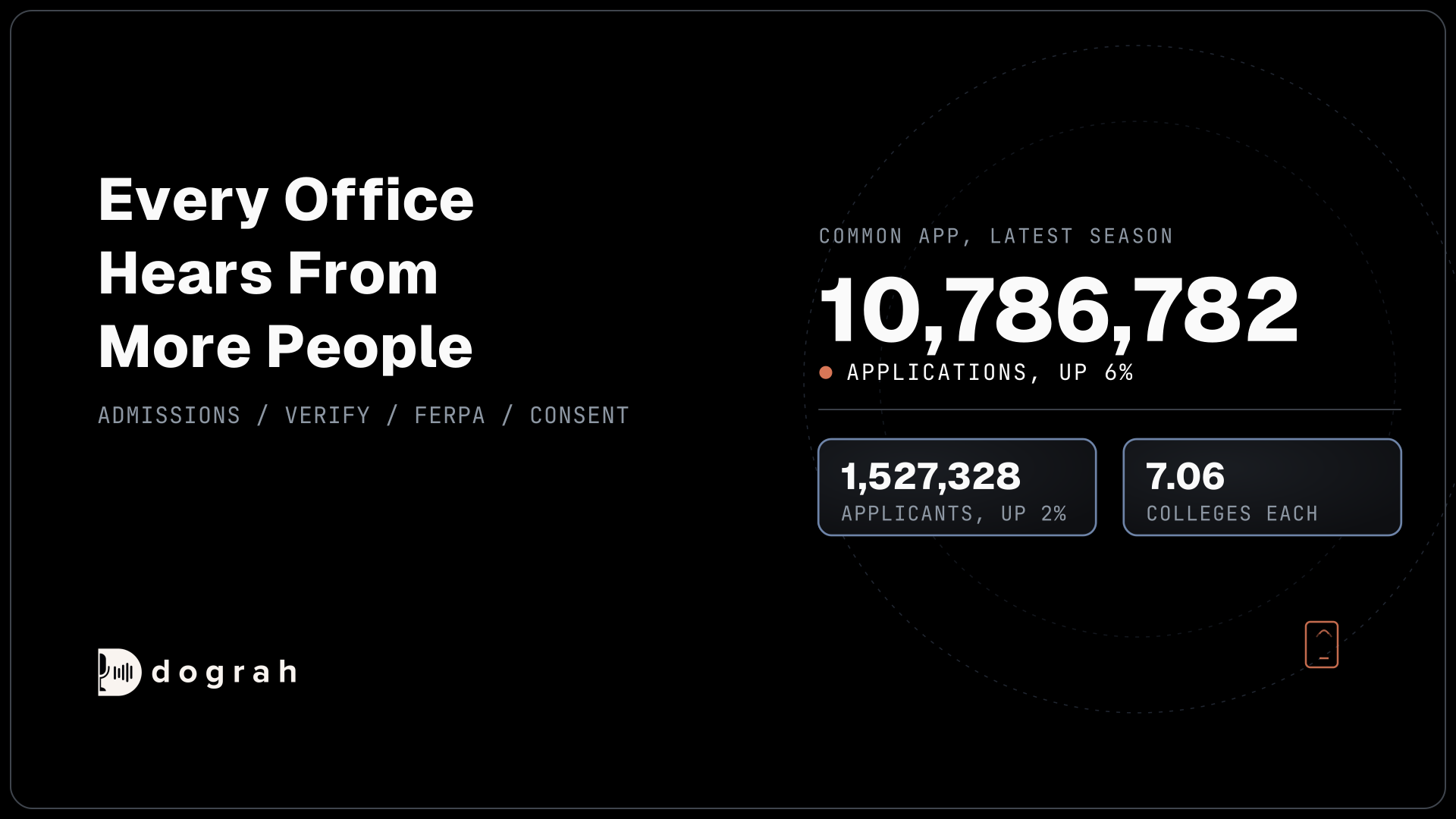
Common App's 2025-26 end-of-season report counts 1,527,328 first-year applicants, up 2%, sending 10,786,782 applications, up 6%. Each applicant applied to 7.06 member colleges on average, so every admissions office hears from far more people than it will enroll.
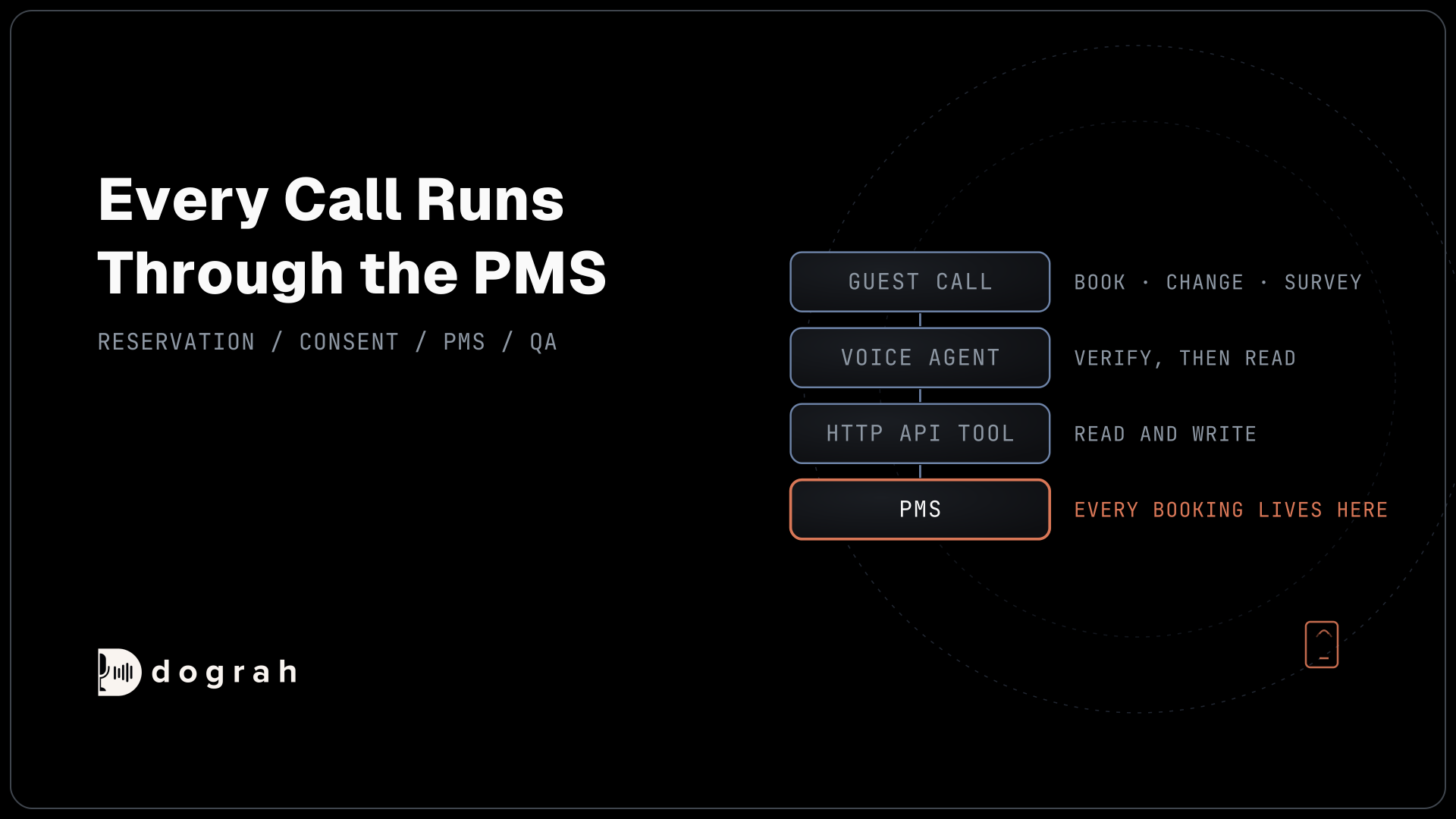
Dograh runs these calls on top of the student information system (SIS) and the admissions customer relationship management (CRM) system. It runs the call flow, tools and telephony; the speech and language models are a separate layer you choose. An HTTP API tool reads the record during the call, such as an application checklist or a balance, and a webhook writes the outcome back after it.
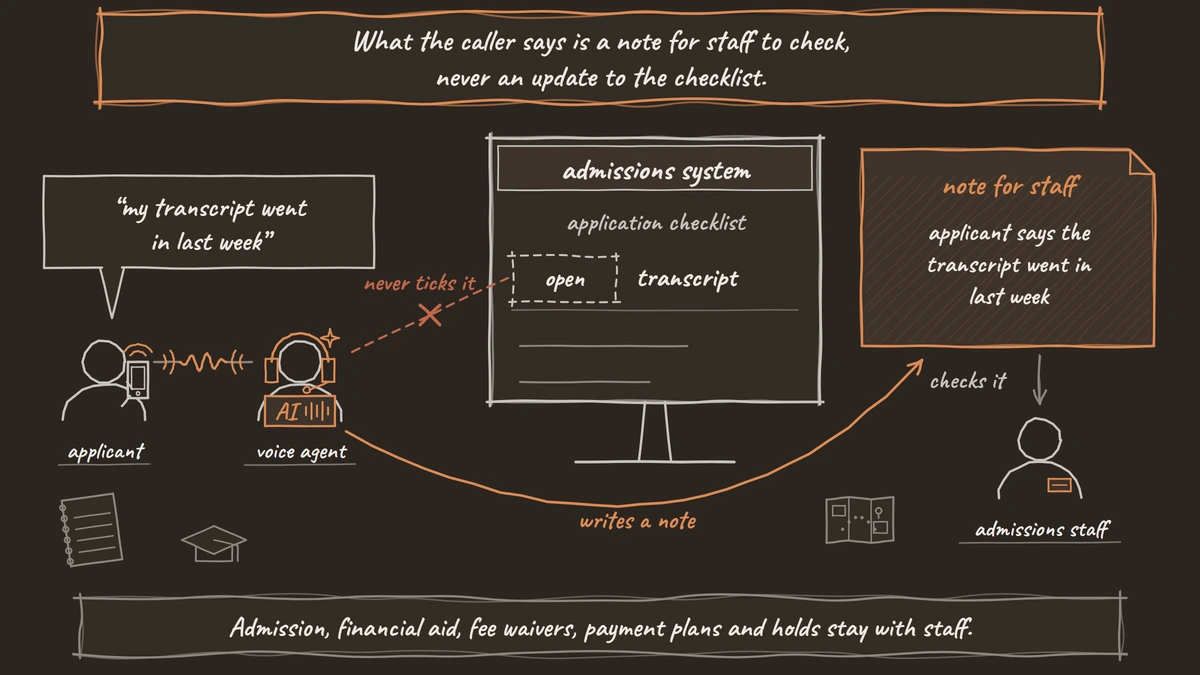
The agent records what the caller says as a claim: "my transcript went in last week" is a note for staff to check, never an update to the checklist. It never decides anything with a place or money attached; admission, financial aid, fee waivers, payment plans and holds stay with staff.
Before the application: answering admissions questions
Prospective students call with the same questions every cycle, and an inbound agent answers them and logs every caller.
The answers come from the agent's Knowledge Base, loaded with the program pages, deadlines, entry requirements and fee schedules admissions already publishes (PDF, DOCX, DOC, TXT or JSON, up to 5 MB each). The agent answers from those files, not the model's general knowledge, so the deadline it reads out is your own.
Every caller is logged: name, program of interest, start term, contact number and whether they agree to a follow-up, sent to the admissions CRM by webhook. A counsellor booking or campus visit goes through an HTTP API tool against the calendar or CRM during the call.
The agent never predicts admission. "Will I get in with a 3.2?" gets the published requirement and an offer to book a counsellor. Deferral and visa questions go to staff too, since they depend on the applicant's own file and current policy. AI voice agents for admissions and enrollment covers the inquiry line in detail, and our guide to AI receptionists covers answering a business phone well.
During the application: follow-up calls for missing items
Outbound calls to applicants with an unfinished application read the missing items from the admissions system, explain the next step and record what the applicant says they will do.
The admissions system can start the call through the API Trigger when an application stalls, as starting a voice agent call from any system explains, or a nightly list can run through Campaigns as a CSV upload. Either way, Pre-Call Data Fetch, set to "Outbound calls only" at the bottom of the Start Call node, pulls a fresh checklist once the call connects, so the agent never chases a transcript that arrived this morning.
The order is greet, verify, then name the item. No document is collected on the call: for a missing transcript or recommendation, an HTTP API tool asks the school's own system to send a secure upload link by text or email (Dograh has no SMS tool of its own). The date the applicant promises goes back to the CRM by webhook, so staff see it the next morning.
Campaigns has retry settings but no per-person cap, so the school's own list decides how often one applicant is called. An admitted student's enrollment deposit and orientation are mentioned as next steps as the call ends, never chased as a balance. AI voice agents for application follow-up walks through the call and the consent check before it.

Open Source Alternative to Vapi / Retell
Self-hosted voice agent platform — no per-minute fees
dograh-hq/dograh
Star on GitHub
Paying: fee and payment reminders
Fee reminder calls tell a verified student the amount and due date the finance system holds, then hand anything about hardship or payment plans to a person. They are reminders before a due date, never collection calls.
Published prices are a poor guide to what one student owes. College Board's Trends in College Pricing 2025 puts average published in-state tuition and fees at a public four-year college at $11,950 for 2025-26, while first-time, full-time in-state students there pay an estimated $2,300 on average after grant aid. That gap is why the agent reads the student's own balance live from the finance system and never quotes a page price.
The balance is read only after verification, and only to the student unless the institution's own consent record names someone else, such as a parent. Payment never happens by voice: an HTTP API tool asks the institution's own system to send a secure payment link by text or email, and the agent never takes card numbers. Requests for a payment plan, a hardship review or a dispute go to the bursar's office with the details written to its system first.
The Greeting Text names the institution itself in fixed words, never left to the model, because a name that suggests someone else is collecting can bring federal debt collection rules into play. Edtech companies selling courses in instalments run the same call, with their own billing system holding every balance. The full design is in AI voice agents for fee and payment reminders in education.
After enrollment: student support calls
Enrolled students call about timetables, campus services and IT basics, and an inbound agent answers from the Knowledge Base.
General questions need no check: library hours, building locations, campus Wi-Fi and term dates are the same for every caller. Anything from the student's own record, such as a class schedule, a hold on registration or a balance, waits for verification and then comes live from the SIS through an HTTP API tool.
Wellbeing and crisis language changes the call. When the caller's words match the crisis pathway, its Transition Speech plays fixed wording, or a recorded clip on speech-to-speech models, and Transfer Call puts the student through to student services staff. Transfer Call works on Twilio only and passes no summary, so the agent writes the details to your system first. If nobody answers within the timeout (30 seconds by default), the student stays with the agent, so the fixed wording also gives the institution's crisis line and, in the US, the 988 Suicide and Crisis Lifeline.
The pathway is still chosen by the language model reading a written condition, never a hard rule, so test it with real crisis phrasings before launch. AI voice agents for student support covers the support line, including this handoff.
Choosing a platform by where student records go
Education voice tools differ most in where call audio and transcripts end up, so ask every vendor that first.
The tools fall into four types: a higher-education CRM with a voice add-on, a campus helpdesk product with voice built in, a general hosted voice agent platform, and an open-source platform you host yourself. With the first three, every call passes through the vendor's servers, and often a model provider's too. With a self-hosted platform, the institution decides where each part runs.
Self-hosted Dograh has no per-minute platform fee (servers, any paid model keys and phone minutes still cost); Dograh Cloud has a 1¢-a-minute platform fee. The audio stays inside your infrastructure only when the speech and language models run on your servers too. The wider case for keeping voice data close is in Why Voice Data Needs to Stay Local: Privacy, PII, and Biometric Risk. Our roundup of the best AI voice agents for education compares named tools on this question.
Join the Dograh Community
Dograh is an OSS alternative to Vapi. Join our Slack community for queries, releases, best practices & community interactions.
Rules that apply to every call
Three rules sit under every call. This section is general information, not legal advice.
Verify the student before any record detail
Under 34 CFR 99.31(c) of FERPA, the Family Educational Rights and Privacy Act, an institution "must use reasonable methods to identify and authenticate the identity of parents, students, school officials" and others before it discloses personally identifiable information from education records.
For a voice agent, that means a fixed check before any record detail: student ID plus date of birth. A phone number finds the record but never proves who is calling, because students share phones and parents call from theirs. At a college, the rights under FERPA generally belong to the student, so a parent on the line hears nothing from the record unless the institution's consent record says otherwise.
The Greeting Text, which plays before verification, names the institution and never mentions an application, a balance or a hold. If you want to tell callers they're speaking with an automated assistant, or your location requires it by law, write that there too.
FERPA and the vendors a school hires
FERPA applies to an institution "to which funds have been made available under any program administered by the Secretary" of Education, under 34 CFR 99.1(a). That generally includes most US colleges and universities.
A vendor that handles education records for such a school generally needs to qualify as a school official. Under 34 CFR 99.31(a)(1)(i)(B), a contractor counts when it "Performs an institutional service or function for which the agency or institution would otherwise use employees", "Is under the direct control of the agency or institution with respect to the use and maintenance of education records", and is bound by the redisclosure limits in 99.33(a). Every hosted voice platform and model provider that hears a student's call is one more party that test has to cover.
Self-hosting changes that count. When Dograh and open-weight models run on the institution's own servers, the call audio, transcripts and record lookups stay inside its infrastructure, and direct control is easier to show. Using your own API keys for a hosted model provider changes who your contract is with, but the audio still goes to that provider. Dograh has no retention setting, so the institution's own policy decides how long recordings and transcripts are kept. Self-hosted, recording can be switched off only for the whole server, and transcripts are still saved. We built a dedicated landing page for self-hosted voice AI at universities covering admissions, fee and support calls on your own servers.
One detail affects admissions calls. FERPA's definition of a student in 34 CFR 99.3 is someone "who is or has been in attendance", so records about an applicant who never enrolls generally fall outside FERPA. State privacy laws and the institution's own policy still apply, so treat applicant data with the same care.
Consent and caller identity on outbound calls
Outbound calls bring in the Telephone Consumer Protection Act (TCPA). The Federal Communications Commission (FCC) ruled in FCC 24-17 that the TCPA's limits on artificial or prerecorded voices "encompass current AI technologies that generate human voices". Such calls generally need the called party's prior express consent, absent an emergency or an exemption.
A call that sells something needs more. Under 47 CFR 64.1200(a)(2), an artificial-voice call to a mobile number that includes an advertisement or is telemarketing needs "the prior express written consent of the called party". An offer made on an application follow-up call can turn it into a marketing call. The same rule set, at 64.1200(b)(1), requires the call to "state clearly the identity of the business, individual, or other entity" at the beginning, which the fixed Greeting Text does.
Dograh has no keypad tool, so opt-outs are by voice: the agent asks whether the person wants no more calls and writes a yes to your list at once. Use the consent your inquiry and application forms actually collected, and confirm your position with counsel before the first outbound campaign.
Universities and edtech companies: which rules apply
A university and an edtech company can run identical calls under different rules, depending on who holds the record and why.
A university that receives Department of Education funds is covered by FERPA for its students' education records, so every call above sits inside it. An edtech company that runs a learning platform, an admissions service or a support line for such a university is in scope too, as a contractor that generally has to meet the school-official test above, including the 99.33(a) limits on passing records on.
An edtech company that sells courses directly to learners is generally outside FERPA, since it is not a funded institution. Its outbound sales calls are telemarketing, so the written-consent rule above applies. State privacy laws still apply to both; confirm your own position with counsel.
Where to start
Start with the inbound admissions line. It reads only the Knowledge Base, gives no record detail before verification and raises no outbound consent questions, so it is the lowest-risk call that still fixes a measured problem.
Test it on a real phone number, not only in the browser: most phone calls still reach the agent as 8 kHz audio, while a browser demo runs at 16 kHz, and that changes what the speech model hears. Run QA on a sample of live calls and widen what the agent may do only as the transcripts earn it. Testing Voice Agents Before You Go Live gives the test order.
Add the outbound calls next, application follow-up first, once the consent each form collected has been checked.
Each call above has its own deep dive:
- AI Voice Agents for Admissions and Enrollment
- AI Voice Agents for Application Follow-up
- AI Voice Agents for Fee and Payment Reminders in Education
- AI Voice Agents for Student Support
- Best AI Voice Agents for Education
Glossary
- School official
- FERPA's term for the people who may see education records without the student's consent. A contractor counts only when it does work staff would otherwise do, is under the institution's direct control for the records, and follows the redisclosure limits.
- Education records
- Under FERPA, records directly related to a student and kept by the institution or by a party acting for it. Call recordings and transcripts that discuss a student's record can fall inside this definition.
- Prior express written consent
- The signed agreement the TCPA rules require before a call that includes an advertisement or telemarketing is placed with an artificial or AI-generated voice to a mobile number.
- Pre-Call Data Fetch
- The setting at the bottom of Dograh's Start Call node that requests fresh data from your system once a call connects, such as an applicant's current checklist, so the agent never works from a stale list.