
AI voice agents for fee and payment reminders in education call students before a tuition or fee due date, verify them, then read the amount and due date from the institution's finance system. Payment happens through the institution's own secure link, never by reading out card numbers. Hardship and payment-plan requests go to bursar staff.
Key Takeaways
- Remind before the due date, and always in the institution's own name.
- A college student's balance goes only to them, unless a consent record says otherwise.
- Stop any caller who starts reading a card number aloud.
This post is part of our guide to AI voice agents for edtech and universities. The guide's section on paying calls these reminders before a due date, never collection calls. This post works through each part of that call in Dograh, an open-source, self-hostable voice agent platform, from who may hear the balance to what happens when a student cannot pay.
Fee reminders come before the due date
A fee reminder call tells a student what is due and when, before the date passes, so that paying on time is easy. The sums are large and rising. College Board's Trends in College Pricing 2025 puts average published tuition and fees at private nonprofit four-year colleges at $45,000 for 2025-26, up 4.0% in a year.
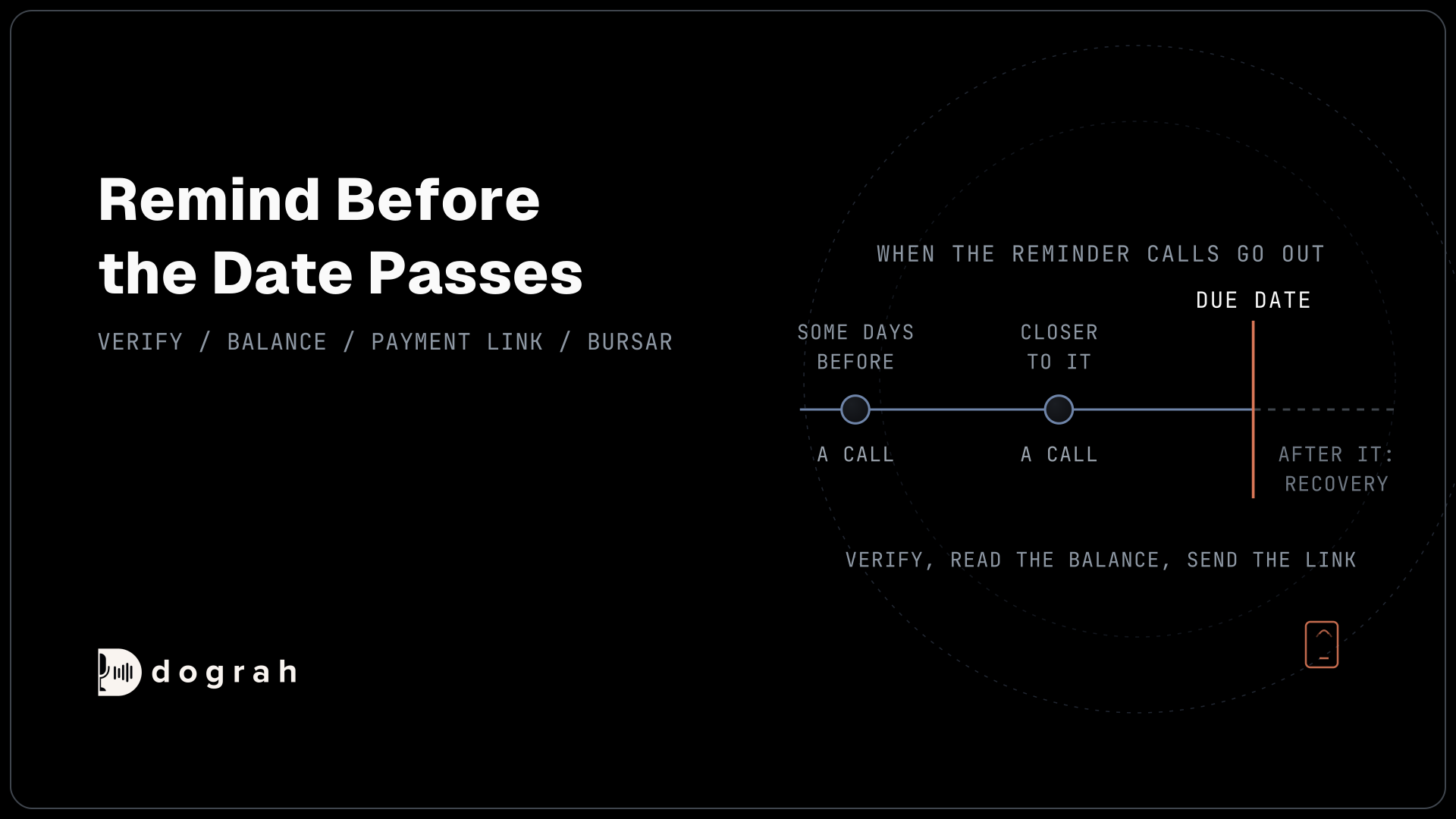
Timing is what keeps this a reminder. A call before the due date offers help. A call after it, about money already owed, is recovery, a different call with different rules, covered in AI Voice Agents for Debt Collection: Verify First, Then Talk.
The institution's own name matters too. The Fair Debt Collection Practices Act (FDCPA) defines a debt collector, in 15 U.S.C. 1692a(6), as someone who collects debts "owed or due or asserted to be owed or due another". A college collecting its own tuition is generally outside that definition as a first-party creditor. The same paragraph pulls a creditor back in if it "uses any name other than his own which would indicate that a third person is collecting". So the Greeting Text names the institution in fixed words and is never left to the model. This is general information, not legal advice; confirm your own position with counsel.
Who may hear the balance
The agent names no amount until it knows it is speaking with the student, and a parent who answers is not automatically entitled to hear it. Like the rest of this section's legal points, this is general information, not legal advice.
The check is the student ID plus the date of birth. A phone number finds the account; it never proves who answered, and many students list a parent's phone. Under the Family Educational Rights and Privacy Act (FERPA), 34 CFR 99.5(a)(1) says that when a student becomes an eligible student, "the rights accorded to, and consent required of, parents under this part transfer from the parents to the student". Every student attending a postsecondary institution is an eligible student.
FERPA does let an institution disclose to the parents of a tax-dependent student under 99.31(a)(8), and institutions use that permission differently. So the agent follows the institution's own consent record. If the record names the parent, the parent can hear the balance after the same kind of check. If it does not, the agent offers to have the student call back and names no amount. A voicemail never carries an amount either, only the institution's name and a callback number.
What the agent says about the amount
After verification, the agent reads the amount and the due date live from the finance system and says nothing it cannot read there. An HTTP API tool fetches the balance during the call, so a payment made this morning is already counted. Pre-Call Data Fetch can load the account when the call connects, but the agent still names nothing before the check.
The agent never threatens a consequence. If the finance system returns a hold on registration, the agent can state it as the system shows it. It never adds "or we will withhold your transcript" on its own. Federal rules make that kind of line risky. Under 34 CFR 668.14(b)(33), an institution in the Title IV federal student aid programs agrees it will not withhold transcripts or take "any other negative action against a student related to a balance owed by the student that resulted from an error in the institution's administration" of those programs. Under (b)(34), it must provide a transcript covering the aid-funded terms "for which all institutional charges were paid or included in an agreement to pay". The agent cannot tell which case a balance falls into, so consequences stay with the bursar's office.

Open Source Alternative to Vapi / Retell
Self-hosted voice agent platform — no per-minute fees
dograh-hq/dograh
Star on GitHub
Paying without a card number on the call
Payment never happens by voice. When the student wants to pay, an HTTP API tool asks the institution's own system to send a secure payment link by text or email. Dograh has no feature for taking customer payments on a call and no SMS tool, so the link comes from the system that already handles the institution's payments.
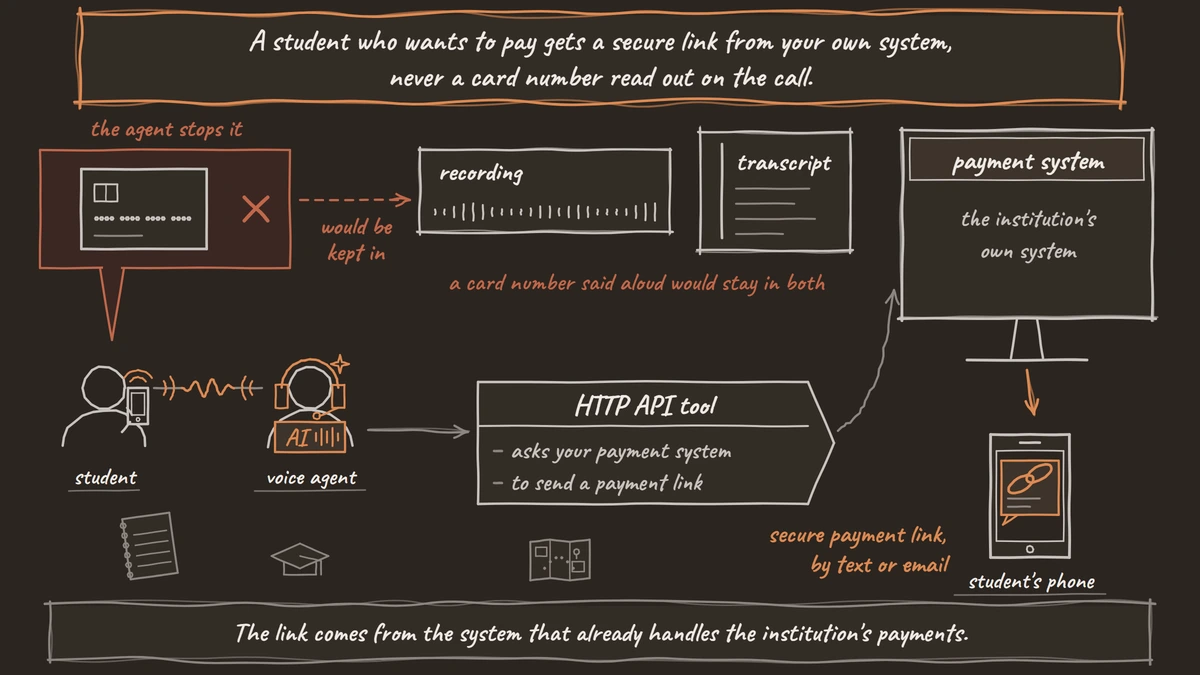
Card numbers are never taken on the call, and the prompt tells the agent to stop a caller who starts reading one out. Calls are recorded and transcribed by default, and Dograh has no retention setting or automatic deletion. On a self-hosted server, recording can only be switched off for the whole server, and transcripts are still saved. A card number spoken into the call would sit in both.
The agent records the outcome as the student stated it: will pay by the due date, wants a payment plan, disputes the amount, or cannot pay. A webhook writes that answer and the transcript link to the finance system when the call ends.
Hardship and payment-plan requests go to a person
Any request that changes what a student owes or when it is due goes to the bursar's office, and so does a dispute about the amount. The agent never agrees to a payment plan, a waiver, a late-fee reversal or a new due date, even when the student's reason sounds clear.
Transfer Call puts the student through to bursar staff. It works on Twilio only and passes no summary, so the agent writes the request to the finance system first. If nobody answers within the timeout, 30 seconds by default, the student stays with the agent, which takes a callback request and writes it through an HTTP API tool. Students who call in later with their own questions about a balance belong on the inbound line covered in AI voice agents for student support.
Join the Dograh Community
Dograh is an OSS alternative to Vapi. Join our Slack community for queries, releases, best practices & community interactions.
Scheduling the reminders
How often to remind, and when to stop, is the institution's decision, and Dograh enforces only the settings you give it. A common pattern is a call some days before the due date and one closer to it, for students who have not paid. Campaigns runs the list with max retries from 0 to 10 (default 2), a retry delay from 30 seconds to an hour (default 2 minutes), switches for busy, no answer and voicemail, and calling hours by weekday.
Campaigns has no per-student cap, so the finance system's export enforces one and drops anyone who asked not to be called. Pre-Call Data Fetch, set to "Outbound calls only", pulls the balance again at connect, so a student who paid after the export ran hears a thank-you and nothing more. The consent these outbound AI-voice calls rely on is covered in the guide's consent section, and the same reminder pattern at public-sector scale is in AI Voice Agents for Benefit and Payment Reminders at Any Scale.
Edtech companies selling courses in instalments run the same call, with their own billing system holding every balance and the learner as the verified payer. An enrollment deposit before the student starts belongs to AI voice agents for application follow-up, where it is mentioned as a next step only.
Self-hosted Dograh has no per-minute platform fee, though servers, any paid model keys and phone minutes still cost money. Dograh Cloud has a 1¢-a-minute platform fee.
Glossary
- Eligible student
- FERPA's term for a student who has reached 18 or attends a postsecondary institution. The rights over education records move from the parents to that student.
- Title IV
- The federal student aid programs under the Higher Education Act. Institutions that take part agree to rules in 34 CFR 668.14, including limits on withholding transcripts over certain balances.
- First-party creditor
- A business collecting a debt owed to itself, such as a college collecting its own tuition. It generally falls outside the FDCPA's debt collector definition unless it uses a name suggesting a third party is collecting.
- Secure payment link
- A link generated by the institution's own payment system that lets a student pay online. During a call, an HTTP API tool asks that system to send it by text or email.