
AI voice agents for admissions and enrollment answer prospective students' calls from the admissions office's own published documents, record each caller's program and contact details in the admissions CRM during the call, and book counsellor calls or campus visits. They never predict or hint at an admission decision, and questions about a caller's chances go to a counsellor.
Key Takeaways
- Answer only from documents your office publishes, loaded in the Knowledge Base.
- Send every caller's details to the admissions CRM before the call ends.
- The agent never predicts admission; questions about chances go to a counsellor.
This post is part of our guide to AI voice agents for edtech and universities. The guide's section on the time before the application calls the inbound admissions line the call that fixes the unanswered inquiry. Here is how to build that line with Dograh, an open-source, self-hostable voice agent platform, so it answers from your own documents and logs every caller in your admissions customer relationship management (CRM) system.
Most inquiries stall before anyone answers
The first job of an admissions line is to answer, because many prospective students never hear back on any channel. In UPCEA's 2025 secret shopper study, researchers from the online and professional education association sent 1,000 inquiries to member programs between July and September 2025. Only 30% got a reply the same day. The study counted business hours only and ignored automated replies.
The channel made a large difference. Inquiries sent by email went unanswered 50% of the time, against 37% for inquiries sent through a program's request for information (RFI) form. Only 2% of the email inquiries received any promotional email in the next 30 days, which the researchers read as a sign that almost none reached the institution's CRM. For inquiries sent through an RFI form the figure was 78%.
A phone call is even less structured than an email. If nobody logs it while it happens, it ends up like those emails: possibly answered, and missing from the CRM.
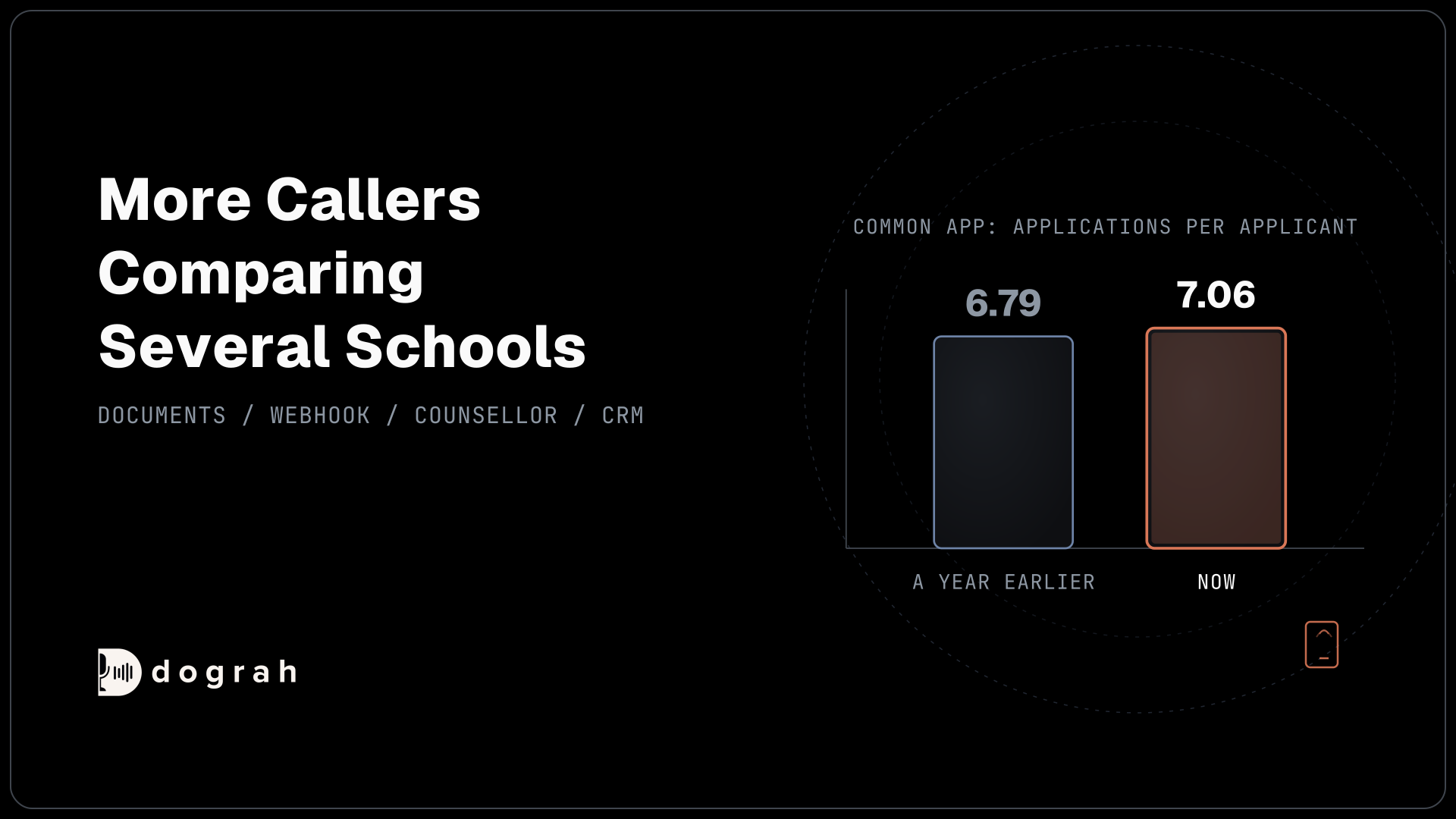
The callers are also spread thinner. Common App's 2025-26 end-of-season report shows applications per applicant rising from 6.79 to 7.06 in one year, while first-generation applicants grew 6%. More of your callers are comparing several schools, and more of them have nobody at home who has been through admissions before.
Answer from the admissions office's own documents
The agent should know exactly what your office publishes and nothing more. In Dograh, you load program pages, entry requirements, deadlines, fee schedules and the international admissions page into the agent's Knowledge Base. It accepts PDF, DOCX, DOC, TXT and JSON files, up to 5 MB each. Chunked Search looks up the relevant passages across your files and needs an embedding key; Full Document mode does not need one.
Write the prompt so the agent answers only from those files. When the files do not cover a question, the agent says it does not have that answer and offers to book a counsellor. Whoever updates the website also replaces the file, so the deadline the agent reads out is this year's.
Scholarship questions get the same treatment. The agent can read out the published criteria and deadline for a named scholarship. Whether this particular caller would qualify is the office's decision. The same answer-from-your-documents pattern runs a hospital's phone line in AI Voice Agents for Patient Support Lines: Answer From Your Own Documents.
Log every caller in the admissions CRM
Every call should end as a record your admissions team can work the next morning. During the call, the agent gathers the caller's name, the program of interest, the start term, a phone number or email address, and whether the caller is happy to be contacted again. Gathering is an AI step, so the agent records each answer as the caller stated it, and the transcript and recording stay the exact record.
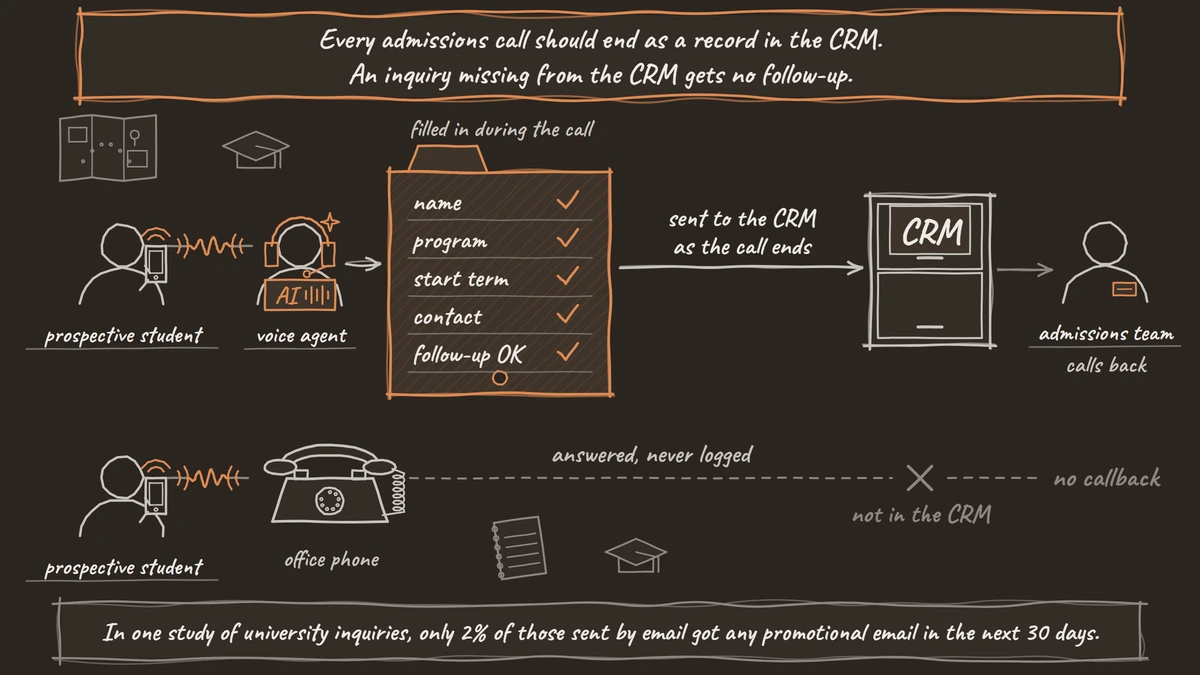
When the call ends, a webhook node posts those fields to the CRM. Its Payload Template can carry each gathered value, such as {{gathered_context.program}}, along with the call duration and a transcript link. If the CRM times out or returns a server error, Dograh retries automatically, up to 5 attempts spaced from about 30 seconds to 10 minutes apart. A wrong URL or credential is not retried, so test the webhook against the real CRM before launch.
The answer about follow-up matters later. If the caller agrees to a callback, the agent records that as said, and your team checks it before anyone calls back. Those outbound calls are covered in AI voice agents for application follow-up.
Some callers want a person or a visit. An HTTP API tool can book a counsellor call or a campus visit during the conversation, against your calendar or your CRM's booking API, since Dograh has no built-in calendar integration. Add a Preset Parameter named workflow_run_id with the value {{initial_context.workflow_run_id}}, so the booking system can ignore a duplicate if a request is retried. The first build steps for an inbound line are in How to Build an AI Receptionist.

Open Source Alternative to Vapi / Retell
Self-hosted voice agent platform — no per-minute fees
dograh-hq/dograh
Star on GitHub
What the agent never says about admission
The agent never tells a caller whether they will get in, and it never hints. A caller who asks "Will I get in with a 3.2?" hears the published minimum, if there is one, and an offer to book a counsellor. It does not compare the caller's grades with past admits or call a profile strong. A prediction from the phone line sounds like a promise from the institution, and a wrong one is hard to take back.
When a caller wants a person, Transfer Call puts them through to the admissions team. It works on Twilio only and passes no summary, so the agent writes the caller's details to your system first. If nobody answers within the timeout, 30 seconds by default, the caller stays with the agent, which takes a callback request and writes it to the CRM through an HTTP API tool.
Callers who have already applied ask a different kind of question. "Did you get my transcript?" is about a file, and a file holds personal details. Before it reads anything from the application checklist, the agent asks for the student ID the application issued plus the date of birth. A phone number finds the record; it never proves who is calling. The guide's rules section explains why the same check applies to applicants and enrolled students.
International and multilingual callers
International applicants call with questions the Knowledge Base should not answer. The Institute of International Education's Fall 2025 Snapshot, with 828 institutions responding, found new international enrollment down 17%, and 72% of institutions offered admitted international students a deferral to spring 2026. Visa timing and deferral decisions depend on the applicant's own file and current policy, so the agent records the question and books or transfers the caller to the international admissions team.
Many of these callers would rather speak another language. Dograh supports 70+ languages. In the agent's Model tab, the speech-to-text Language dropdown can be set to "Multilingual (Auto-detect)", and the Language Hints checkboxes below it point detection at the languages you expect, for languages the Flux multilingual model supports. The Greeting Text plays the moment the call connects, before any detection, so for a bilingual line, write it in both languages.
Detection can still be wrong. When the agent is unsure of the language, it offers the two likeliest ones and switches only after the caller confirms. If it does not handle that language well, the safest step is a transfer to a person who speaks it, or a callback request in that language.
Join the Dograh Community
Dograh is an OSS alternative to Vapi. Join our Slack community for queries, releases, best practices & community interactions.
Before the line goes live
Start small and let the transcripts show you what is missing. Write the Greeting Text as fixed words that name the institution. If you want to tell callers they're speaking with an automated assistant, or your location requires it by law, write that there too.
Test on a real phone number too. Most phone calls still reach the agent as 8 kHz audio, while a browser demo runs at 16 kHz, so a program name the agent heard clearly in the browser can come through wrong on the phone. Add program and campus names to the agent's Dictionary, in its Settings, which works with Deepgram and Dograh speech-to-text. Then run QA on a sample of live calls and read every call where the agent said it had no answer. Those calls name the files your Knowledge Base still needs.
Self-hosted Dograh has no per-minute platform fee, though servers, any paid model keys and phone minutes still cost money. Dograh Cloud has a 1¢-a-minute platform fee.
Glossary
- RFI form
- A program's request for information form, where a prospective student leaves contact details and a question. UPCEA's 2025 study found inquiries sent this way reached institutional CRMs far more often than emails did.
- Knowledge Base
- The set of your own files a Dograh agent answers from, such as program pages and deadlines. It accepts PDF, DOCX, DOC, TXT and JSON files up to 5 MB each.
- Chunked Search
- The Knowledge Base mode that looks up the relevant passages across your files during a call. It needs an embedding key; Full Document mode does not.
- Language Hints
- The checkboxes under the speech-to-text Language dropdown in Dograh's Model tab that point automatic language detection at the languages you expect, for languages the Flux multilingual model supports.