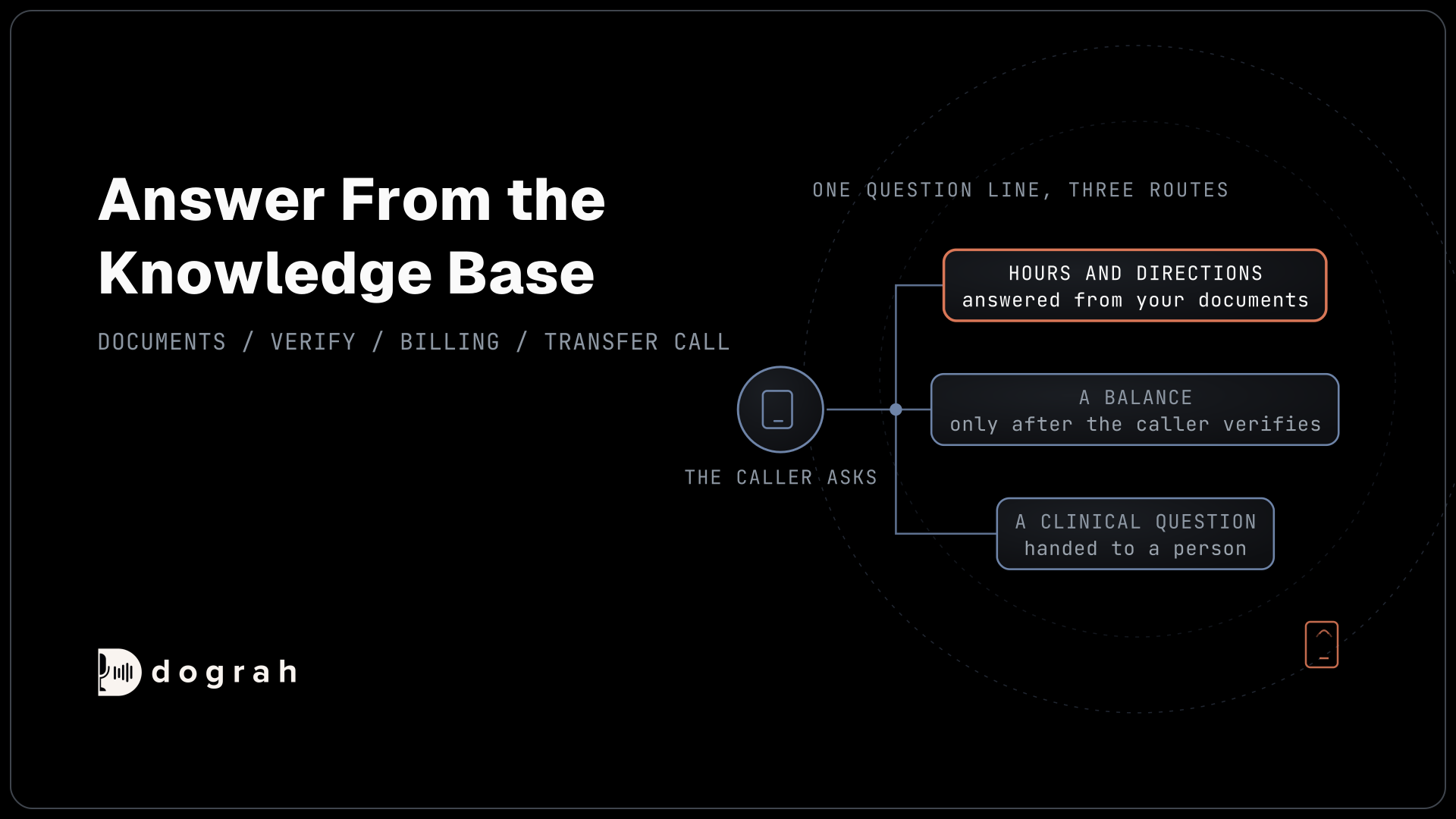

AI voice agents for patient support lines answer a clinic's or hospital's non-clinical questions, such as opening hours, directions, parking, visit preparation and billing basics, from a Knowledge Base of your own documents. The agent verifies the caller before any account detail, reads a balance only on an inbound call after verification, and sends every clinical question to a person.
Key Takeaways
- Answer from your own documents, never from the model's memory.
- Verify the caller before any balance or account detail.
- Tell callers early how to reach a person, and keep that route open.
This post is part of our guide to AI voice agents for hospitals and health systems. The guide's section on calls during care separates a single site's question line from the contact center behind a large health system, and this post takes the first of the two. It shows how to run that line in Dograh, an open-source, self-hostable voice agent platform, with answers drawn from your own documents and a person always one request away.
What a patient support line is for
A support line answers the questions that are not about a visit at all. Callers want the Saturday opening hours, the parking for the imaging center, the entrance that takes a wheelchair, what to bring to a first appointment, or why the bill looks the way it does. None of these needs a nurse, and all of them sit in the same phone queue as the calls that do.
Most practices still answer every one of them by hand. In an April 2025 poll by the Medical Group Management Association (MGMA), only 19% of medical group practices used some version of a chatbot or virtual assistant for patient communication, across 375 responses. The front desk is still the knowledge base, and it is busy.
This post covers one site's line. Queues, staffing models and routing across a contact center are covered in AI Voice Agents for Healthcare Call Centers: Patients Still Call. Booking, rescheduling and cancelling are their own call, set out in AI voice agents for patient appointment scheduling.
Answer from the Knowledge Base, never from memory
Every answer the agent gives should come from a document you control. Dograh's Knowledge Base takes PDF, DOCX, DOC, TXT and JSON files up to 5 MB each, so the visitor guide and the billing FAQ the front desk already uses can go straight in. There are two ways to search it. Chunked Search finds the relevant passage in a large document and needs an embedding model key. Full Document needs no embedding key, which makes it the simpler start for a short visitor guide.
Tell the agent in its prompt to answer only from the Knowledge Base. If the answer is not there, it says so and offers a person, never a best guess. A wrong parking answer can cost a patient their appointment, and a wrong billing answer costs trust that is slow to earn back.
Documents go stale faster than anyone expects. Holiday hours change, and a parking garage closes for repairs with a week's notice. Give one person the job of updating the files, and put the date each one was last checked inside the file itself.
Callers often ask for directions by text. Dograh has no SMS tool and sends no texts itself. During the call, the agent can call your messaging provider's endpoint through an HTTP API tool so your provider sends the text, or your own system can send it after the call.

Open Source Alternative to Vapi / Retell
Self-hosted voice agent platform — no per-minute fees
dograh-hq/dograh
Star on GitHub
Verify the caller before any account detail
Hours and parking need no verification. A balance or anything from the patient's record does. Dograh's Pre-Call Data Fetch sits at the bottom of the Start Call node, and set to Inbound calls only, it looks up the caller's number in your system as the call connects. That finds a record. It does not prove who is calling.
Before any account detail, the agent asks for the date of birth plus one more item from the record, such as the address or part of the medical record number. It never asks for a Social Security number. The Health Insurance Portability and Accountability Act (HIPAA) Privacy Rule at 45 CFR 164.514(h) requires a provider to verify the identity of a person requesting protected health information (PHI) when that person is not known to it. A caller who cannot verify still gets every general answer, just nothing from the record. A parent or carer calling for someone else is handled the same way: general answers at once, and account details only when your own policy on who may act for the patient is met.
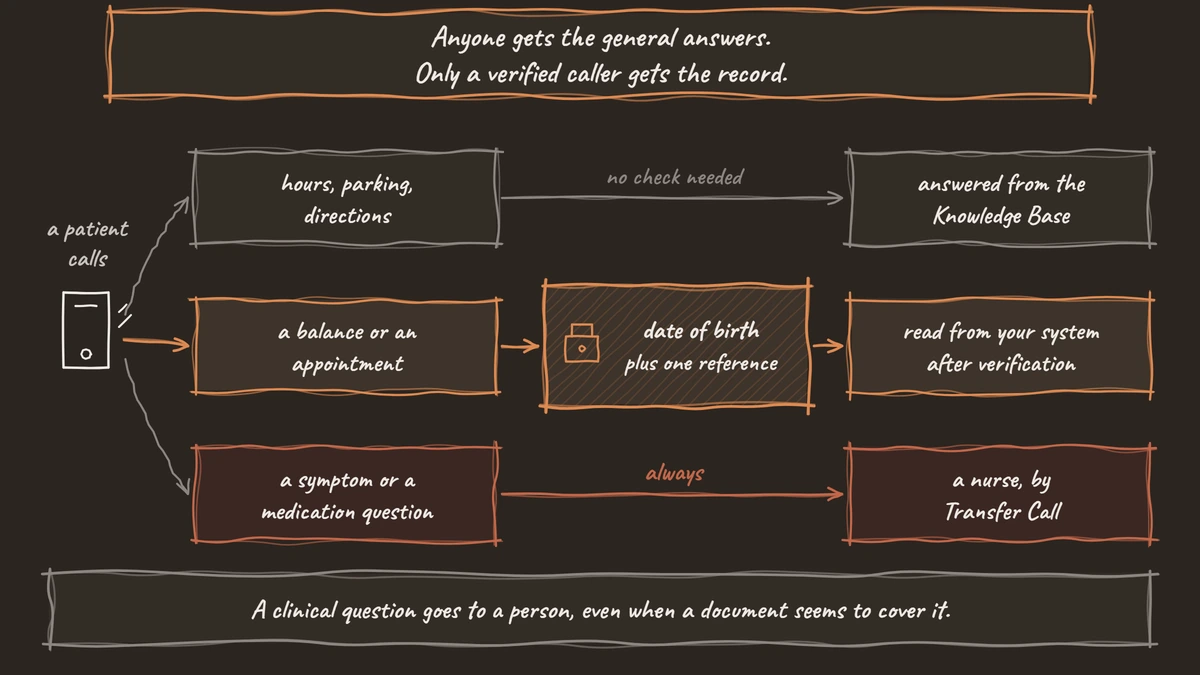
Billing basics stay basic. After verification, on an inbound call, the agent can read a balance from your billing system through an HTTP API tool and explain how to pay. A dispute or a payment plan goes to the billing team. An outbound call made under the Federal Communications Commission (FCC) healthcare exemption never carries billing content at all, so this part belongs only on the inbound line.
Clinical questions go to a person, and callers should know how
Patients find health calls hard enough without an agent in the way. A survey of more than 2,000 US adults by Answering Service Care, reported by Medical Economics, found three in four Americans say a call about their health is stressful. Among people who had dealt with AI on a health-related call, not all callers, nearly a quarter gave up without getting the help they needed, and roughly 1 in 6 left feeling worse. Answering Service Care sells live answering services, so read the numbers with that in mind. The design lesson holds anyway: a line that hides the person loses the callers who need one most.
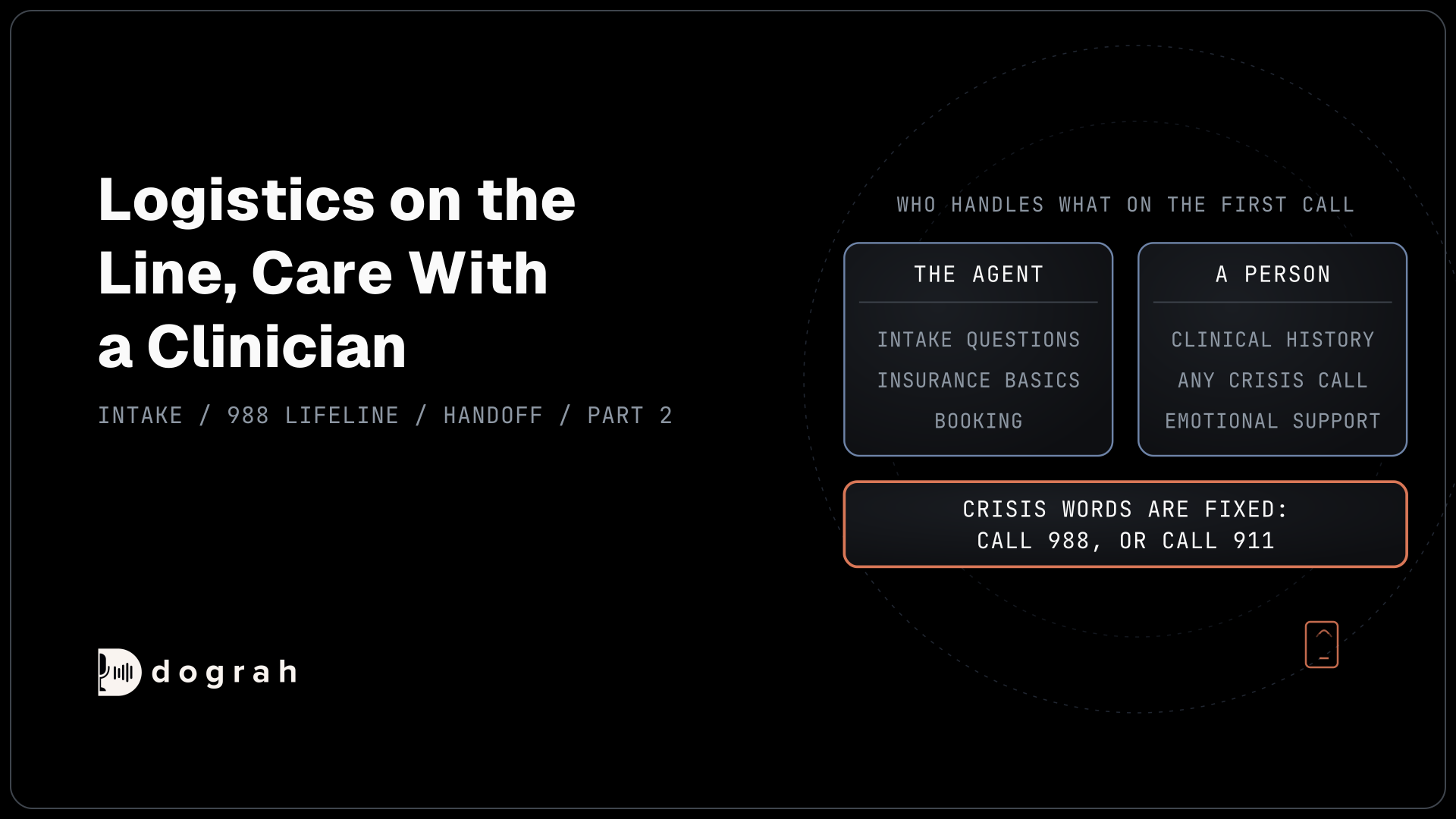
So write the Greeting Text to say, early, that the caller is speaking with an automated assistant and can ask for a person at any time; Dograh plays exactly what you write. Any symptom or medication question goes to a nurse or clinician, even when a document seems to cover it. The agent collects, reminds and routes, and it never gives medical advice.
Dograh's Transfer Call hands the caller to the nurse line or the front desk. It works on Twilio only and passes no summary, so the agent writes the reason for the call to your system first. The transfer rings for 30 seconds by default, settable from 5 to 120. If nobody answers, the caller stays with the agent, which offers a callback and writes the request through an HTTP API tool. An emergency gets an instruction to hang up and call 911, in fixed wording once the emergency pathway is chosen, played by a pathway's Transition Speech as fixed text or a recorded clip.
Join the Dograh Community
Dograh is an OSS alternative to Vapi. Join our Slack community for queries, releases, best practices & community interactions.
Keep the questions and recordings on your own servers
A question about parking is harmless, but the same call can turn to a balance or a diagnosis within a minute, and then the recording holds PHI. Self-hosting Dograh runs the platform on your own servers, so the recordings and transcripts stay there too. No business associate agreement (BAA) with Dograh is needed in that setup, because Dograh never receives the PHI. Each model provider you use through an API key still hears the audio, so each needs its own BAA. The phone carrier may need one too, depending on what it stores. A BAA delegates duties and never transfers your liability. The audio stays inside your infrastructure only when the speech and language models also run on your servers.
There is no retention setting and no automatic deletion, so your own policy decides how long recordings and transcripts are kept. On a self-hosted server, recording can be switched off for the whole server, and transcripts are still saved. Self-hosted Dograh has no per-minute platform fee, though servers, any paid model keys and phone minutes still cost money. Dograh Cloud has a 1¢-a-minute platform fee.
Start with the questions that need no verification, such as hours and directions. Add billing basics once the transcripts show the verification step holding up on real calls.
Glossary
- Knowledge Base
- The set of your own documents a Dograh agent answers from, uploaded as PDF, DOCX, DOC, TXT or JSON files up to 5 MB each. It keeps answers tied to text you control.
- Chunked Search
- A Knowledge Base search mode that finds the relevant passage inside a large document. It needs an embedding model key, which the Full Document mode does not.
- Pre-Call Data Fetch
- A Dograh setting at the bottom of the Start Call node that looks up the caller's number in your system as the call connects. It finds a record but does not prove who is calling.
- Transfer Call
- Dograh's tool for handing a live call to a person. It works on Twilio only and passes no summary, so the agent writes the reason for the call to your system first.