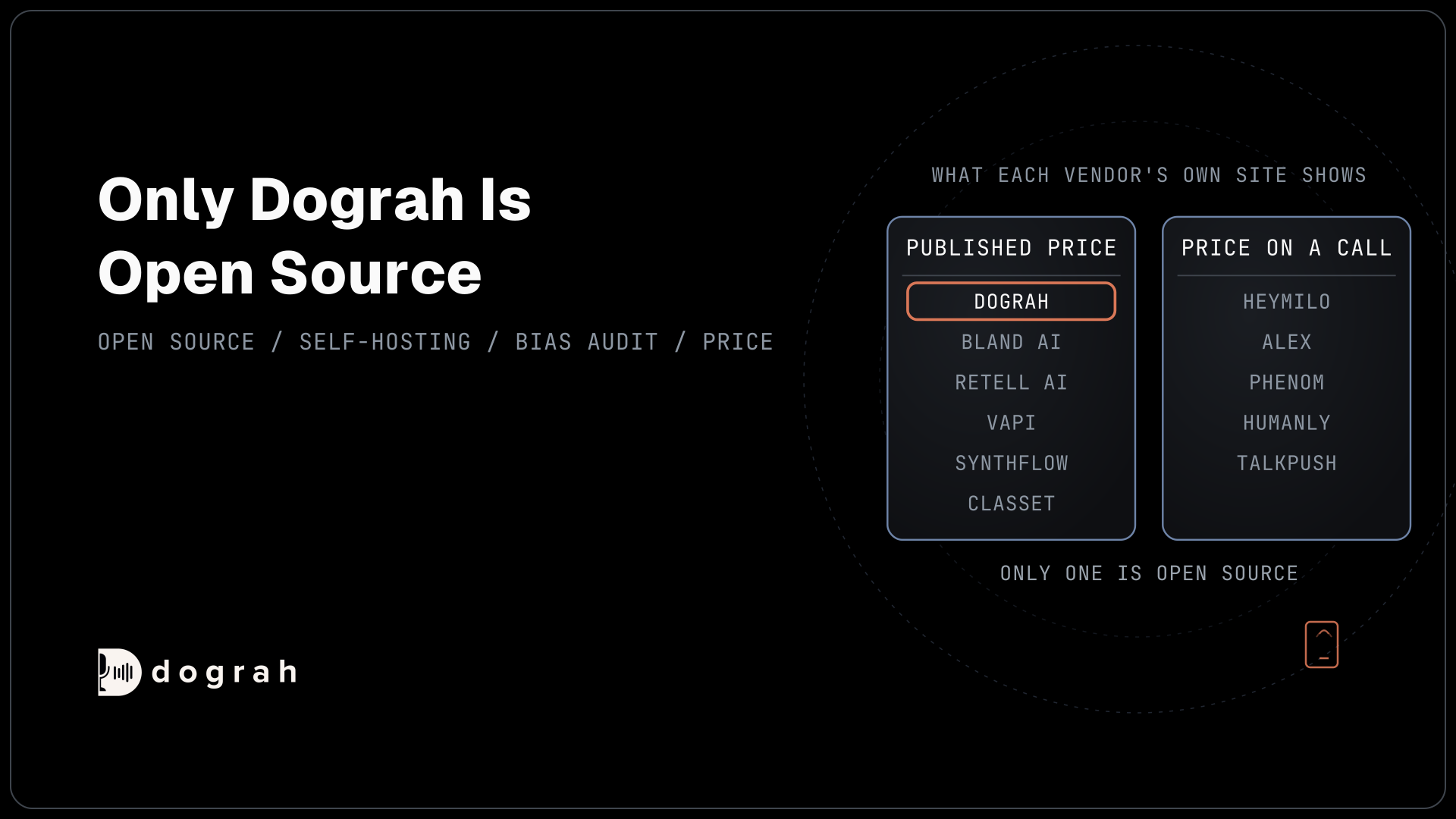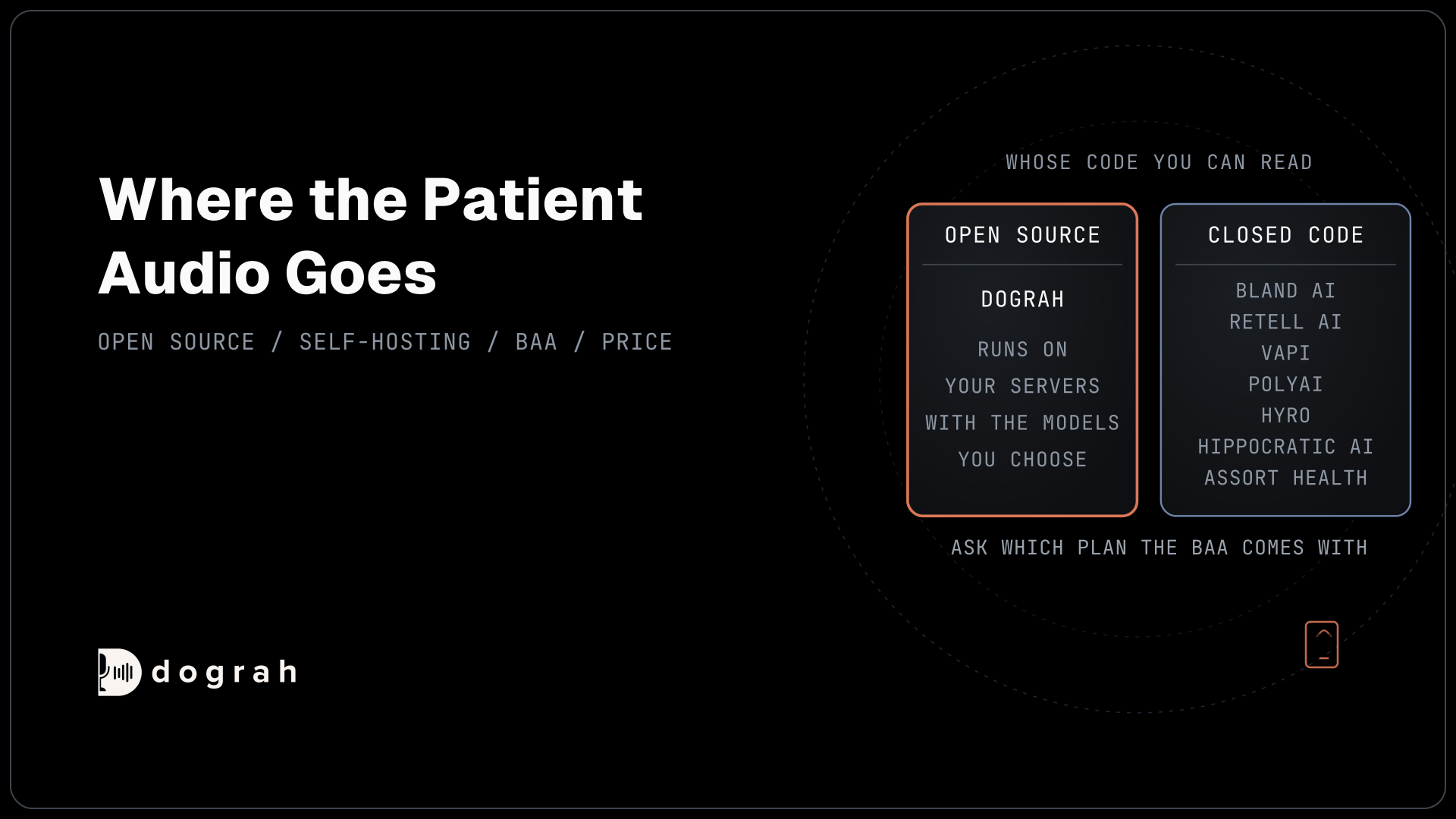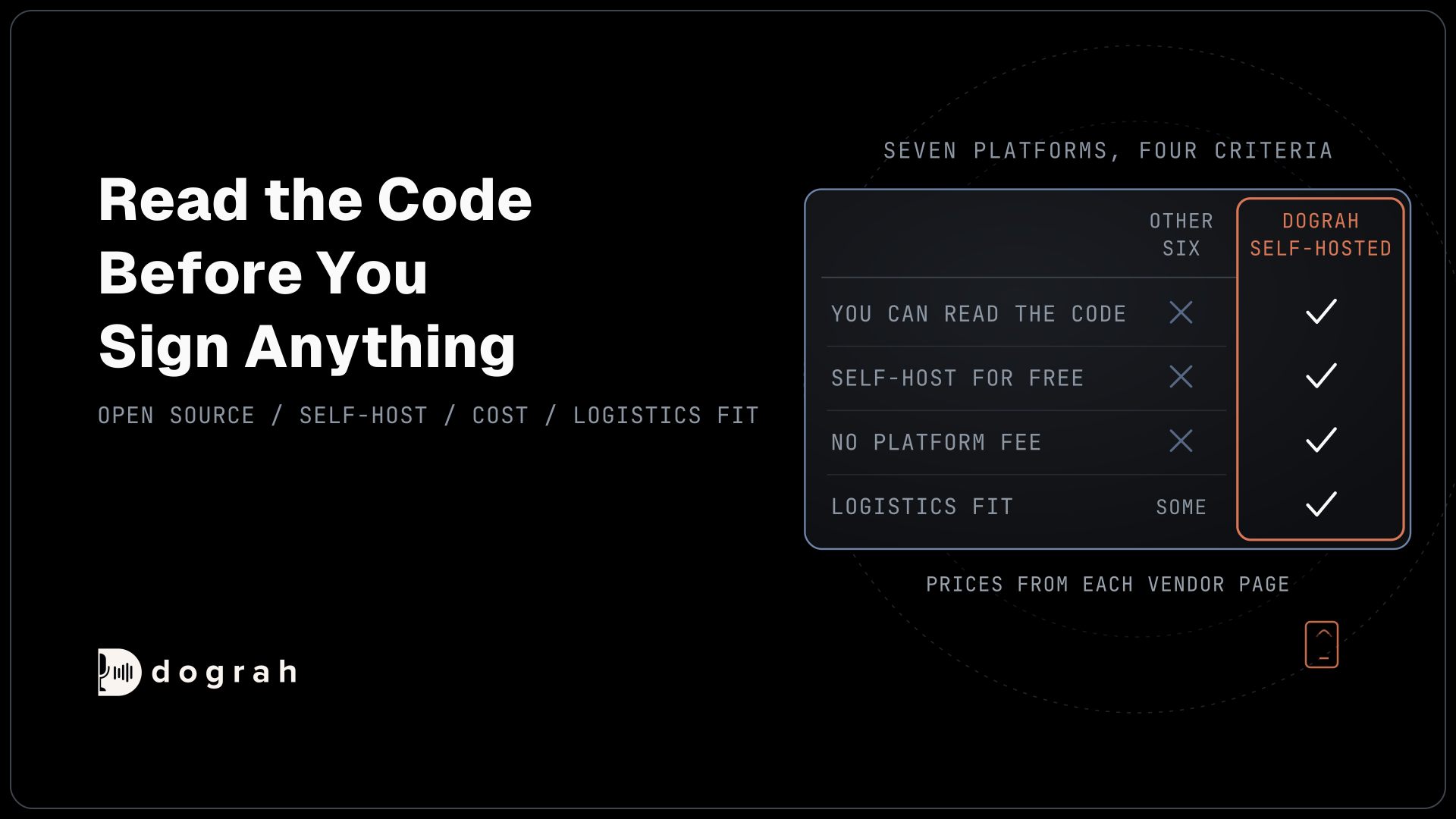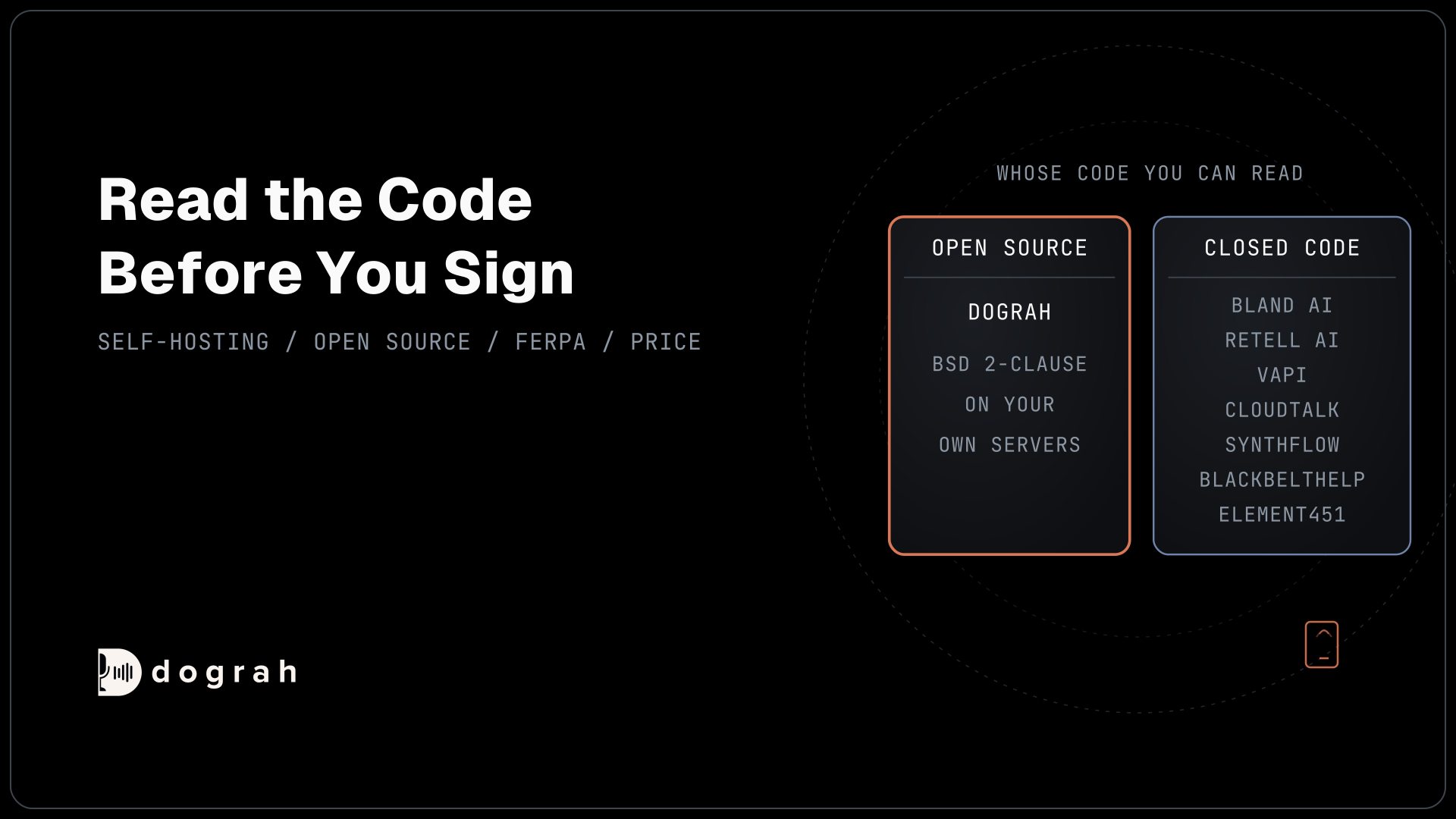

The best AI voice agents for education, ranked on where student calls can run, open source, who else hears the call and price, are Dograh, Bland AI, Retell AI, Vapi, CloudTalk, Synthflow, BlackBeltHelp and Element451. Dograh is the only one a university can run from open code on its own servers without an Enterprise contract.
Key Takeaways
- Only Dograh is open source and free to run on campus servers.
- Element451 calls can reach ElevenLabs, Deepgram and, in beta, OpenAI.
- "FERPA compliant" on a vendor page is the vendor's own description.
This post is part of our guide to AI voice agents for edtech and universities. The guide's section on choosing a platform by where student records go sorts education voice tools into four types without naming any. This roundup names eight of them, and Dograh, an open-source, self-hostable voice agent platform, is one of the eight, judged on the same criteria as the rest.
The four criteria we used to rank the tools
Four criteria decide the order, and every tool is judged on all four, in this order of weight.
The first is where calls and records can run: whether the tool allows self-hosting on servers the institution controls, and if not, what its own pages say about where the vendor hosts the call. The second is open source, meaning whether the IT and security team can read the code before it touches a student's call. The third is who else hears the call: the speech and language model companies a vendor names, since each one receives the student's voice. The fourth is price, meaning what a buyer pays and whether the rate is listed or quoted by sales.
The first criterion carries the most weight because of how FERPA, the Family Educational Rights and Privacy Act, treats vendors. A vendor that handles education records for a college generally has to be under the college's "direct control" for those records, and every outside party that hears a call is one more party that test has to cover. The FERPA section below quotes the rule.
The set is phone agents only. Each tool's own current pages describe answering or placing calls. Chat-first and SMS-first student engagement tools are different purchases and are left out. Every price and hosting line below comes from the vendor's own site.
How the eight tools compare
Dograh is first because it is the only tool that meets all four criteria without a sales conversation. The rest are ordered by the first criterion, then by how much of the other three a buyer can read on the vendor's own site.
| Tool | Where calls and records can run | Open source | Who else hears the call | Price | What you get, and what's missing |
|---|---|---|---|---|---|
| Dograh | Your own servers, free; or Dograh Cloud; Enterprise adds on-prem or private cloud | Yes, BSD 2-Clause | Your choice: Dograh's models, any provider by key, or self-hosted models (then no one outside) | Self-hosted: no per-minute platform fee. Dograh Cloud: 1¢/min platform fee | Visual builder, Knowledge Base, HTTP API tools, webhooks, any model. But no prebuilt student information system (SIS) or customer relationship management (CRM) connector, so you connect your own APIs |
| Bland AI | Vendor's infrastructure; on-prem or virtual private cloud (VPC) on Enterprise only | No | Bland's own models only, per its homepage | Start $0.14/min; Build $0.12/min plus $299/month | One price covers the model and both speech layers. But running it on your servers needs an Enterprise contract |
| Retell AI | Vendor cloud | No | The models you pick, billed per minute | $0.055/min voice infra; $0.07 to $0.31/min all-in | Per-agent retention from 1 day to 2 years. But closed code, and calls run in its cloud |
| Vapi | Vendor's fully managed platform | No | The model providers you pick, passed through at cost | $0.05/min hosting, before models and phone | Wide model choice for developers. But every call runs through its cloud |
| CloudTalk | AWS and Google Cloud data centres in 9 locations | No | - | Per-user phone plans from €19/month; AI agent from $99/month for 200 minutes | A full business phone system with dialers. But the AI agent is an add-on to a phone plan |
| Synthflow | Vendor-hosted, with EU and US hosting badges | No | - | Enterprise contracts from $30,000 a year | Enterprise phone agents, per its homepage. But contracts start at $30,000 a year |
| BlackBeltHelp | Hosted on AWS, US data residency | No | - | Through sales | Campus helpdesk voice for password resets, front desk, advising and admissions, in English and Spanish. But closed, hosted and priced through sales |
| Element451 | Vendor-hosted inside its higher-ed CRM | No | Named speech providers ElevenLabs and Deepgram; an OpenAI realtime model in open beta | Usage-based, quoted through sales | Inbound and outbound calls tied to the CRM record. But the newest voice model is still in beta |
Dograh: open source you can run on campus servers
Dograh is the only entry whose code a university's security team can read before anyone signs anything. It is released under the BSD 2-Clause licence and has more than 5,800 stars on GitHub. Dograh is the orchestration layer: it runs the call flow, tools and telephony, and the speech and language models are a separate layer you choose. You can use Dograh's own models, bring a key for a supported provider, or run open-weight models on your own servers.
That choice decides the answer to the third criterion. With self-hosted Dograh and self-hosted open-weight models, the call audio and transcript stay on the institution's servers, and so do the record lookups. With a hosted model used through your own API key, the audio still reaches that provider, so it becomes one more party your contracts have to cover. Our guide to running voice AI on local, self-hosted models covers the model side.
For a student call, the features that matter are the ones that keep the agent inside its job. The Knowledge Base answers general questions from files the institution loads. An HTTP API tool sends the student ID and date of birth to the institution's own endpoint for a match, so the expected answers never enter the agent, and a second tool reads the record. A pathway's Transition Speech plays fixed handoff words for a student in distress, and a QA node scores a sample of live calls step by step.
On cost, self-hosted Dograh has no per-minute platform fee; you pay for servers, any paid model keys and phone minutes. Dograh Cloud has a 1¢-a-minute platform fee with 10 concurrent calls included. Enterprise adds on-premise or private-cloud deployment with data residency, plus single sign-on and audit logs.
What's missing is worth saying plainly. Dograh ships no prebuilt connector for Banner, PeopleSoft or a higher-ed CRM. Your student system connects through HTTP API tools, MCP tools, the Webhook node, Pre-Call Data Fetch or the API Trigger (n8n and similar tools connect through these), which your team configures. Transfer Call, the tool that hands a call to a person, works on Twilio only. There is no retention setting, so your own policy decides when recordings and transcripts are deleted.

Open Source Alternative to Vapi / Retell
Self-hosted voice agent platform — no per-minute fees
dograh-hq/dograh
Star on GitHub
Bland AI, Retell AI, Vapi and Synthflow: general voice platforms
These four sell phone agents to every industry, so the student-record question is answered by their hosting and model lines.
Bland AI. Start costs $0.14 a minute with no platform fee, and Build costs $0.12 a minute plus $299 a month, per Bland's pricing page. The per-minute rate includes the language model and both speech layers. Bland's homepage says it "runs entirely on its own models", so no outside model company hears the call. On-prem or VPC deployment and data residency are listed under Enterprise only. That makes Bland the one closed product here that can sit on a university's servers, through a negotiated contract.
Retell AI. Retell's voice infra fee is $0.055 a minute, and its own all-in range runs $0.07 to $0.31 a minute, per Retell's pricing page. Every account includes 20 concurrent calls. Its compliance page offers per-agent retention for transcripts, recordings and logs from 1 day up to 2 years, which a records office will want. The same page says Retell does not currently operate services within the European Union. The full breakdown is in Retell AI Pricing Explained.
Vapi. Vapi charges a hosting fee of $0.05 a minute, with models passed through at cost and phone transport charged by the provider, per Vapi's pricing page. It describes itself as a fully managed platform, so every student call runs through its cloud and the model companies you pick. The arithmetic is in Vapi Pricing Explained.
Synthflow. Synthflow's pricing page lists one plan: "Enterprise contracts start at $30,000 annually". It shows EU and US hosting badges. For a smaller college that wants to pilot one call type, that contract is the entry price.
BlackBeltHelp and Element451: built for campuses
These two are the only education-specific tools in the set, and both run the call in their own cloud.
BlackBeltHelp sells itself as "The Only AI + Human Helpdesk for Higher Education". Its homepage shows voice agents for password and MFA resets, a campus-wide front desk, advising, and admissions and financial aid, and says the voice agent switches between English and Spanish. It names Banner, Entra, Duo, Canvas and Salesforce among its connections, which suits a campus already running them. On data, it says it is "Hosted on AWS" with "US data residency", the clearest location statement among the hosted tools here. Its FERPA line reads "Aligned, with FERPA-trained agents on every shift". It runs as a hosted service, priced through sales.
Element451 calls itself "The AI-Driven CRM and Agent Platform for Higher Ed". Its help centre describes Advanced Voice Mode for its Bolt agents: they handle inbound calls on an assigned number and place outbound calls through Bolt Jobs, tied to the student's record in the CRM. Voice is "subject to Element451's usage-based pricing". The same article names "ElevenLabs and Deepgram speech providers", and a July 2026 release puts an OpenAI realtime model in open beta for its voice agents. So a student's call can reach Element451, its named speech providers and, when the realtime model is used, OpenAI. Element451 also states that the institution is responsible for complying with phone and call-recording laws.
CloudTalk: a business phone system with AI agents
CloudTalk describes itself as an "AI business phone system for sales and support", so the voice agent is an add-on to a full calling platform. Its pricing page lists per-user phone plans from €19 a month billed annually, with AI agent minutes on top, from $99 a month for 200 minutes in its comparison table. Its security page says data sits in "Amazon AWS and Google Cloud Platform" data centres "across 9 locations globally", and lists SOC 2 Type 2 and ISO 27001. FERPA appears in CloudTalk's own enrollment roundup, which claims "native FERPA compliance tools". For an admissions office that already wants dialers and call routing, it is a phone system first.
Join the Dograh Community
Dograh is an OSS alternative to Vapi. Join our Slack community for queries, releases, best practices & community interactions.
What FERPA asks of any tool on this list
FERPA's duties generally fall on the institution, so a vendor's "FERPA compliant" badge is the vendor describing itself. This section is general information, not legal advice.
Under 34 CFR 99.31(a)(1)(i)(B), a contractor may be treated as a school official only if, among other conditions, it "Is under the direct control of the agency or institution with respect to the use and maintenance of education records". For a voice tool, that generally means the contract has to cover the vendor and every party the vendor passes the call to. A tool that names two speech providers and a model company can add three parties to that list. A tool running on the institution's own servers, with the models on those servers too, adds none.
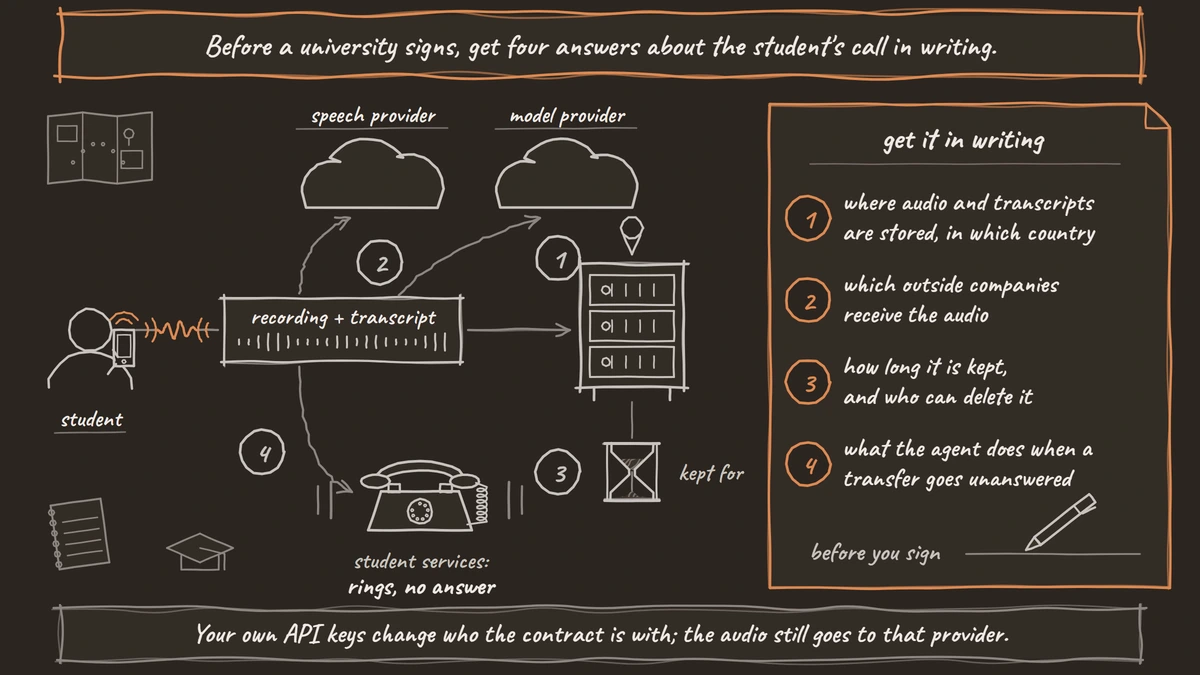
Your own API keys do not change this. Using your own keys (bring your own key, BYOK) changes who your contract is with, but the audio still goes to that provider. Whatever you pick, the agent should verify the student before any record detail, as our post on AI voice agents for student support sets out. Confirm your own position with counsel before any tool hears a student's call.
Picking the right tool for your institution
The right tool depends on what your security review asks first.
A campus that wants a vendor to run an IT and front-desk line, with staff behind it, will look at BlackBeltHelp and should ask for the price and the full list of companies that receive call audio. An admissions team already on Element451 will look at its voice mode first, and should ask which speech and model providers each call reaches and what the usage-based price comes to. A team that wants to start this term on a per-minute price will compare Bland, Retell and Vapi, and should put the model and phone lines into the spreadsheet before comparing.
A university whose first question is where the student's call goes has a shorter list. Only Dograh lets the answer be "our servers" without an Enterprise contract, and only when the models run there too. Bland can get there through Enterprise.
Whichever way you lean, get four answers in writing before you sign. Ask where the call audio and transcripts are stored, and in which country. Ask for the list of outside companies that receive the audio, such as speech and model providers. Ask how long recordings and transcripts are kept and who can delete them. And ask what the agent does when a transfer to a person goes unanswered. Whichever tool you choose, every answer should come from and go back to the student information system.
Glossary
- School official
- FERPA's term for the people who may see education records without the student's consent. A contractor counts only when it does work staff would otherwise do, is under the institution's direct control for the records, and follows the redisclosure limits.
- Self-hosting
- Running the platform's code on servers the institution controls rather than in a vendor's cloud. Of the eight tools here, only Dograh can be self-hosted without an Enterprise contract.
- Platform fee
- The per-minute charge for running the agent itself, billed before the speech models, the language model and the phone line. Self-hosted Dograh has none.
- Usage-based pricing
- A price that depends on how much the tool is used. The buyer learns the rate in a sales quote.