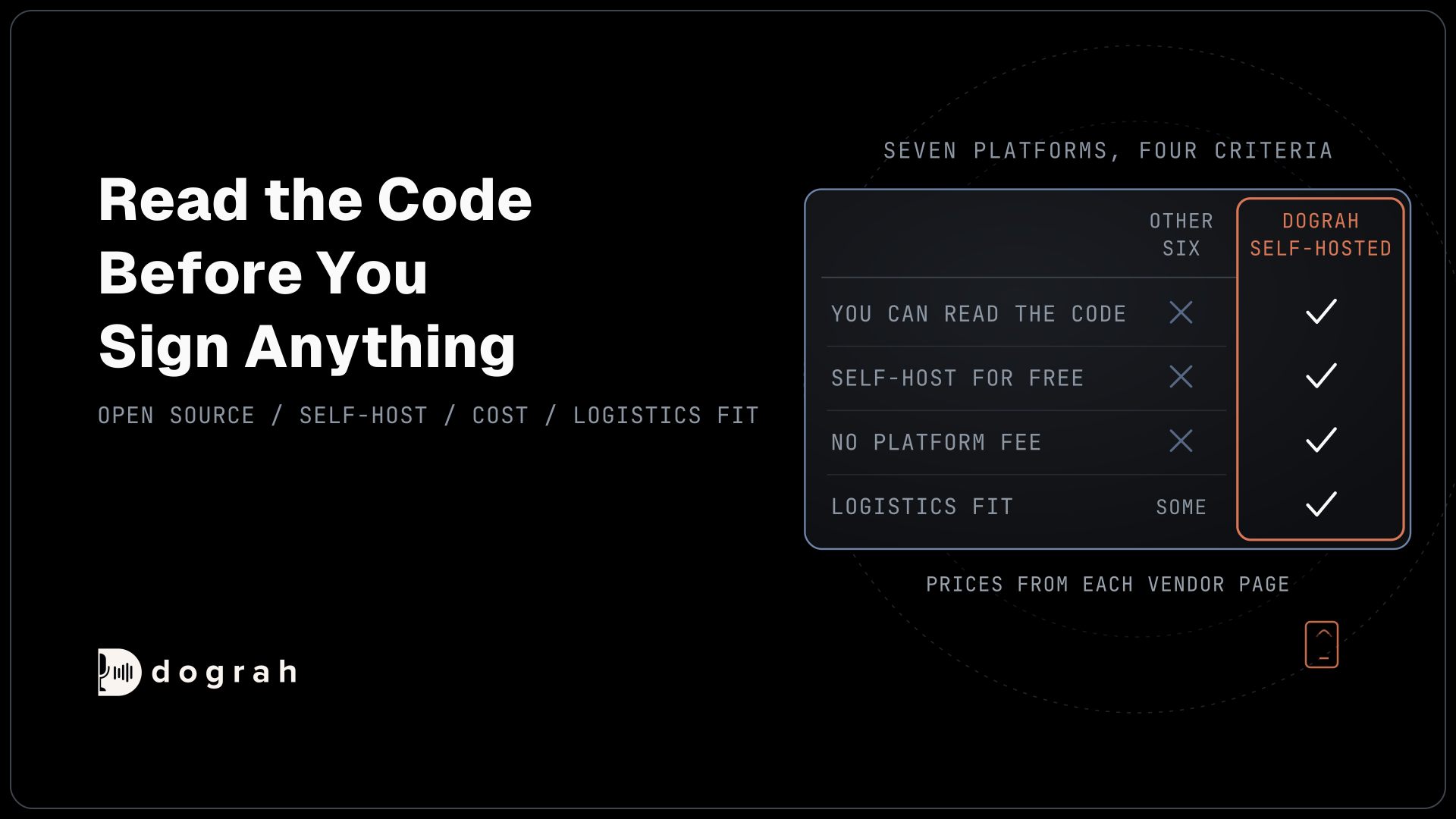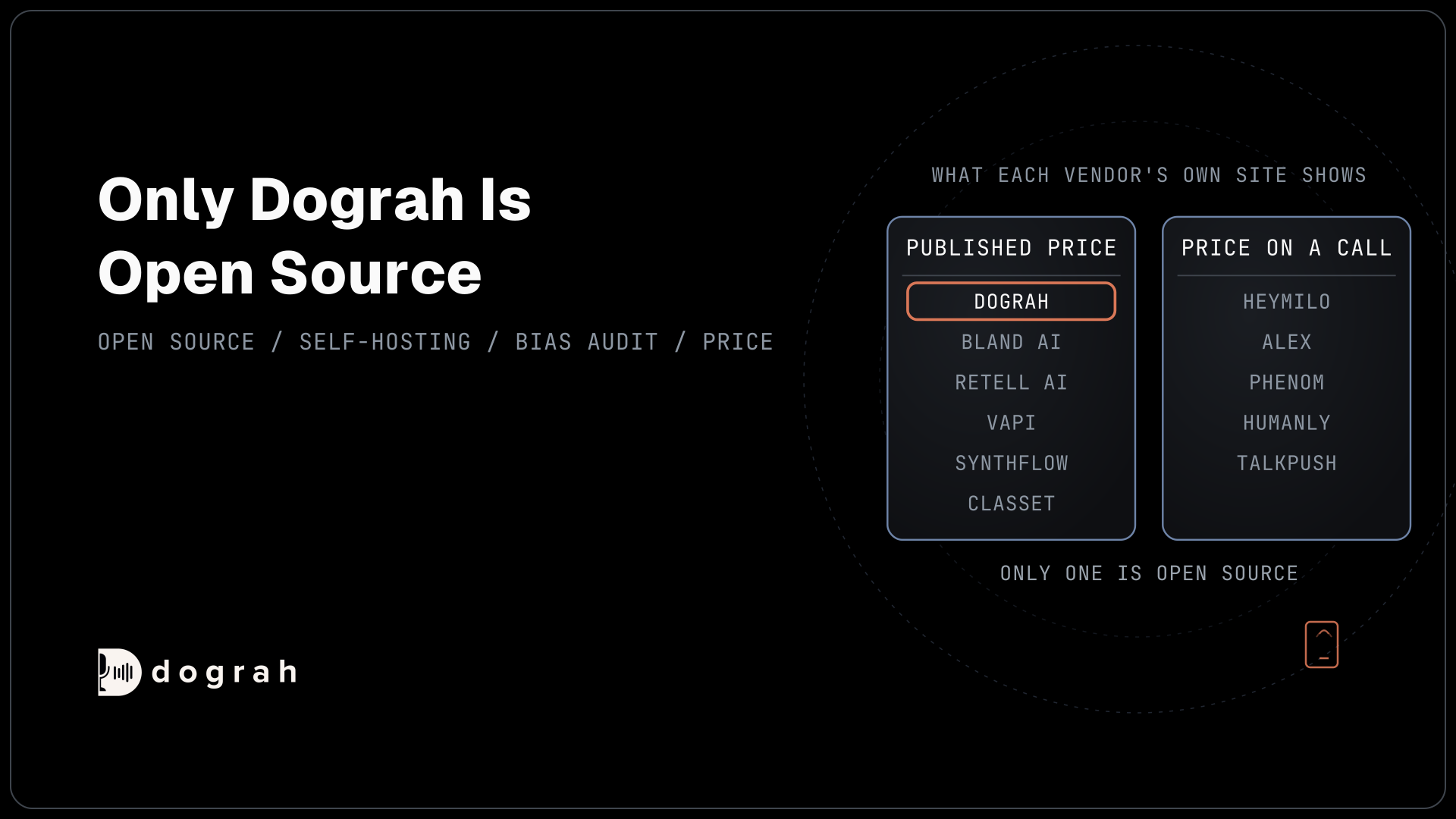

The best AI voice agents for recruitment, ranked on open source, self-hosting, whether they score candidates and price, are Dograh, Bland AI, Retell AI, Vapi, Synthflow, Classet, HeyMilo, Alex, Phenom, Humanly and Talkpush. Dograh is the only one you can self-host from open code. The six recruiting specialists all score or rank candidates.
Key Takeaways
- Six of the eleven tools score or rank candidates, which brings legal duties.
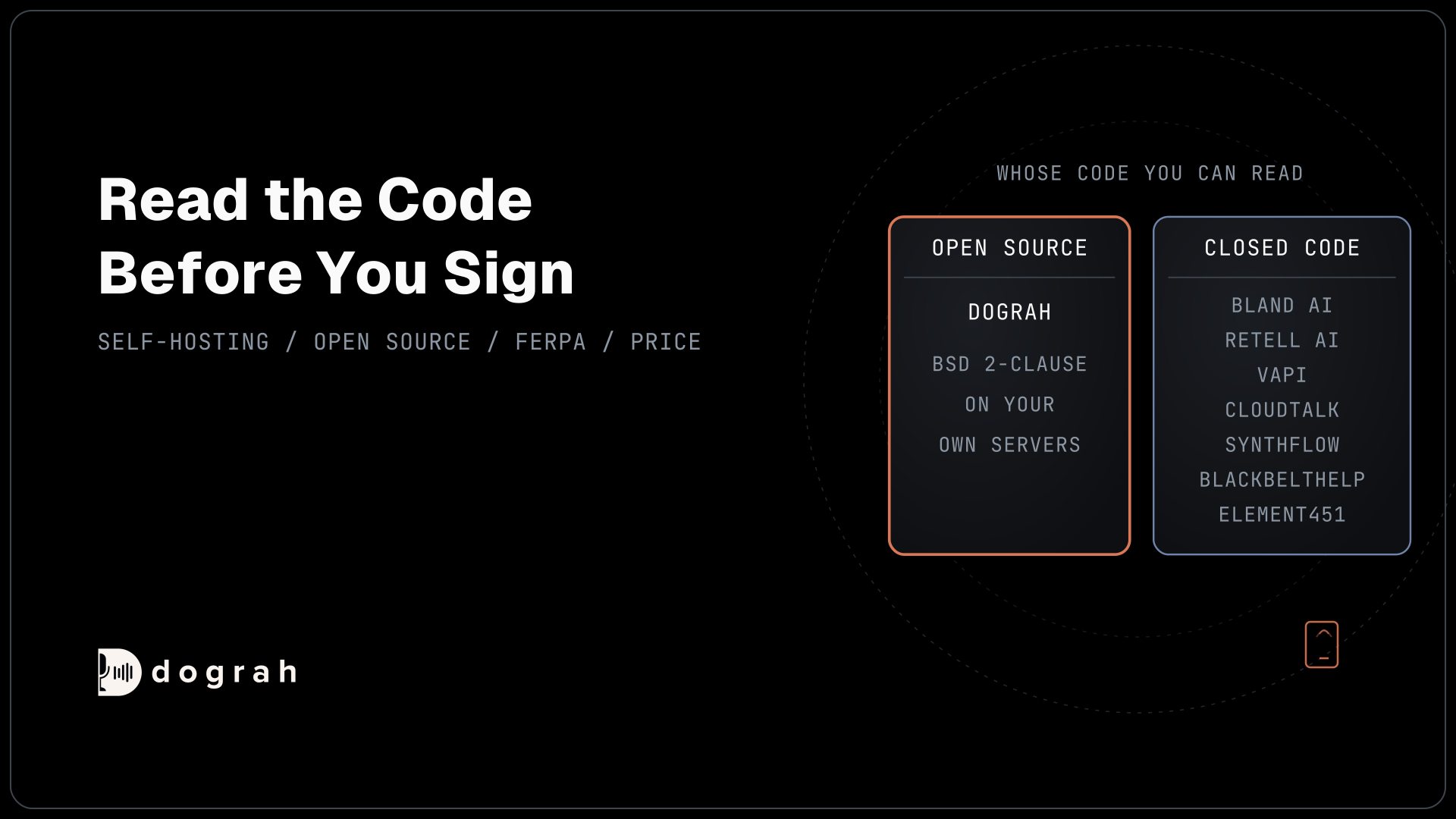
- Only Dograh is open source and free to run on your own servers.
- Classet scores fit from Strong to Weak but never rejects anyone.
This post is part of our guide to AI voice agents for staffing and recruitment. The guide's section on choosing a tool splits the market in two, tools that ask and record and tools that score or rank candidates, and points here for the comparison. Dograh, an open-source, self-hostable voice agent platform, is one of the eleven, judged on the same criteria as the rest.
How we ranked the eleven tools
Four criteria decide the order, applied in this sequence to every tool.
The first is open source: whether you can read the code and run it without asking anyone. The second is self-hosting: whether the tool can run on servers your agency controls, so the recordings and transcripts of every candidate call stay with you. The third is whether the tool only asks and records, leaving the decision to a recruiter, or scores and ranks candidates itself. Tools that only ask and record rank ahead of tools that score, for the legal reason in the next section. The fourth is price: whether the vendor lists a plan price or quotes through sales.
The set is voice tools a recruiter can put in front of candidates today. Two of them, Humanly and Talkpush, name voice beside chat. Four are general voice platforms that recruiters build a screening agent on, six are recruiting specialists, and Dograh is an open-source platform. Video-only interview tools and sourcing tools are left out. So is Paradox, now part of Workday: its own site describes screening "through chat or text". Every claim about a vendor below comes from that vendor's own current page.
Why it matters whether a tool asks or scores
Scoring is a real feature, and some buyers want it. An agency with 3,000 applicants for 40 warehouse roles may want the tool to sort them, and several vendors here back their scores with bias audits. But a score brings duties that a recorded answer does not. This section is general information, not legal advice.
New York City is the clearest example. The city's page on automated employment decision tools says Local Law 144 "prohibits employers and employment agencies from using an automated employment decision tool" unless it has had a bias audit "within one year of the use of the tool", information about the audit "is publicly available", and notice goes to candidates "10 business days prior to use". The law names employment agencies, so staffing firms are in scope. Colorado's SB26-189, whose duties start on 1 January 2027, adds notice and explanation duties for automated tools in decisions about employment.
Candidates feel the difference too. In the Greenhouse 2026 Candidate AI Interview Report, a vendor survey by a company that sells hiring software, 21% of US job seekers surveyed (1,200 of 2,950 across five countries) found out an AI was involved only once the interview had started.
Generally, a tool that records answers, with your applicant tracking system (ATS) applying knock-out rules and a recruiter deciding, keeps an agency on the simpler side of these rules. A tool that scores can still be the right choice, as long as you budget for the audit and the notices. How a screening call that produces no score is built is covered in AI voice agents for candidate screening. The rules differ by city and state, so confirm your own position with counsel.
How the eleven tools compare
Dograh is first because it is the only tool that meets the first three criteria without a sales conversation. Bland comes next because it offers on-prem deployment, on its Enterprise plan. The other general platforms follow by price, then the scoring tools: Classet first because it publishes a price, then HeyMilo because it states a third-party bias audit on its site, then the rest by whether their site names a phone channel.
| Tool | Open source | Self-host or on-prem | Asks or scores | Channels | Price | What you get, and what's missing |
|---|---|---|---|---|---|---|
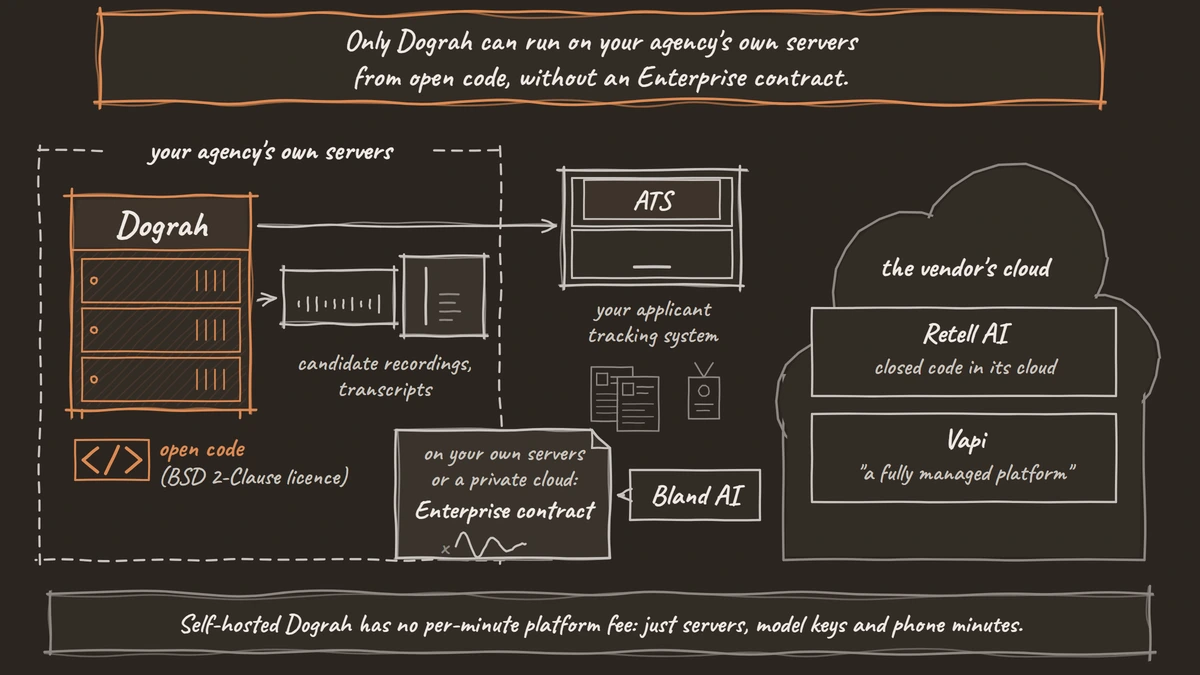
| Dograh | Yes, BSD 2-Clause | Self-host the full platform free; Enterprise adds on-prem or private cloud | Asks and records what you configure | Phone, web widget | Self-hosted: no per-minute platform fee. Dograh Cloud: 1¢/min platform fee | Visual builder, HTTP API tools, webhooks, any model by key or self-hosted. But no prebuilt ATS connector or scoring |
| Bland AI | No | On-prem or VPC on Enterprise only | General platform: you build it | Phone | Start $0.14/min; Build $0.12/min plus $299/month | One rate covers the model and both speech layers. But on-prem needs an Enterprise contract |
| Retell AI | No | Vendor cloud | General platform: you build it | Phone | $0.055/min voice infra; $0.07 to $0.31/min all-in | 20 concurrent calls included. But closed code in its cloud |
| Vapi | No | Vendor cloud; "a fully managed platform" | General platform: you build it | Phone | $0.05/min hosting, before models and phone | Wide model choice for developers. But every model and phone cost sits on top |
| Synthflow | No | - | General platform: you build it | Phone | Enterprise contracts from $30,000 a year | Enterprise telephony options. But contracts start at $30,000 a year |
| Classet | No | - | Scores fit (Strong to Weak), never rejects | Phone, inbound call-to-apply, text | From $249/month billed annually | Monthly third-party bias audit stated. But scoring brings audit and notice duties |
| HeyMilo | No | - | Fit scores and ranked shortlist | Phone, video, SMS, forms | Through a demo | Staffing ATS connections such as Bullhorn and Avionte. But fit scores bring audit and notice duties |
| Alex | No | - | Rubrics; fraud-risk scores | Phone, video, SMS, WhatsApp | Through sales | More than 33 ATS integrations. But its rubric and fraud-risk scores bring audit duties |
| Phenom | No | - | Screens "score onto the same record" | Phone | Through sales | Part of a wider talent platform, SOC 2 Type II. But bought as part of that platform |
| Humanly | No | - | Scores and ranks with reasoning | Chat, voice, video | Through sales | Sells its own ATS too. But voice is one channel among three |
| Talkpush | No | - | Scores, sorts and recommends | Chat or voice, WhatsApp, SMS | Through sales | An ATS and CRM in one, every conversation recorded. But voice sits beside chat, not first |
Dograh: open source, on your servers, and you write the questions
Dograh is the only tool here whose code you can read before you sign anything. It is released under the BSD 2-Clause licence and has more than 5,800 stars on GitHub. Dograh is the orchestration layer: it runs the call flow, tools and telephony, and the speech and language models are a separate layer you choose, from Dograh's own models, a provider you bring by key, or open-weight models on your own servers.
For a recruiting call, that means you build the agent the way the pillar describes. The Greeting Text is a fixed first line with the agency's name, and it can say the call is from an automated assistant, as the law requires in some places. Each answer lands in an extraction variable, recorded as the candidate stated it. An HTTP API tool reads interview slots or writes an opt-out during the call, and a webhook writes the answers, the recording link and the transcript link to your ATS afterwards. Dograh has no candidate-scoring feature. If you asked an extraction variable for a rating, you would move your agent into the scoring group, with its duties.
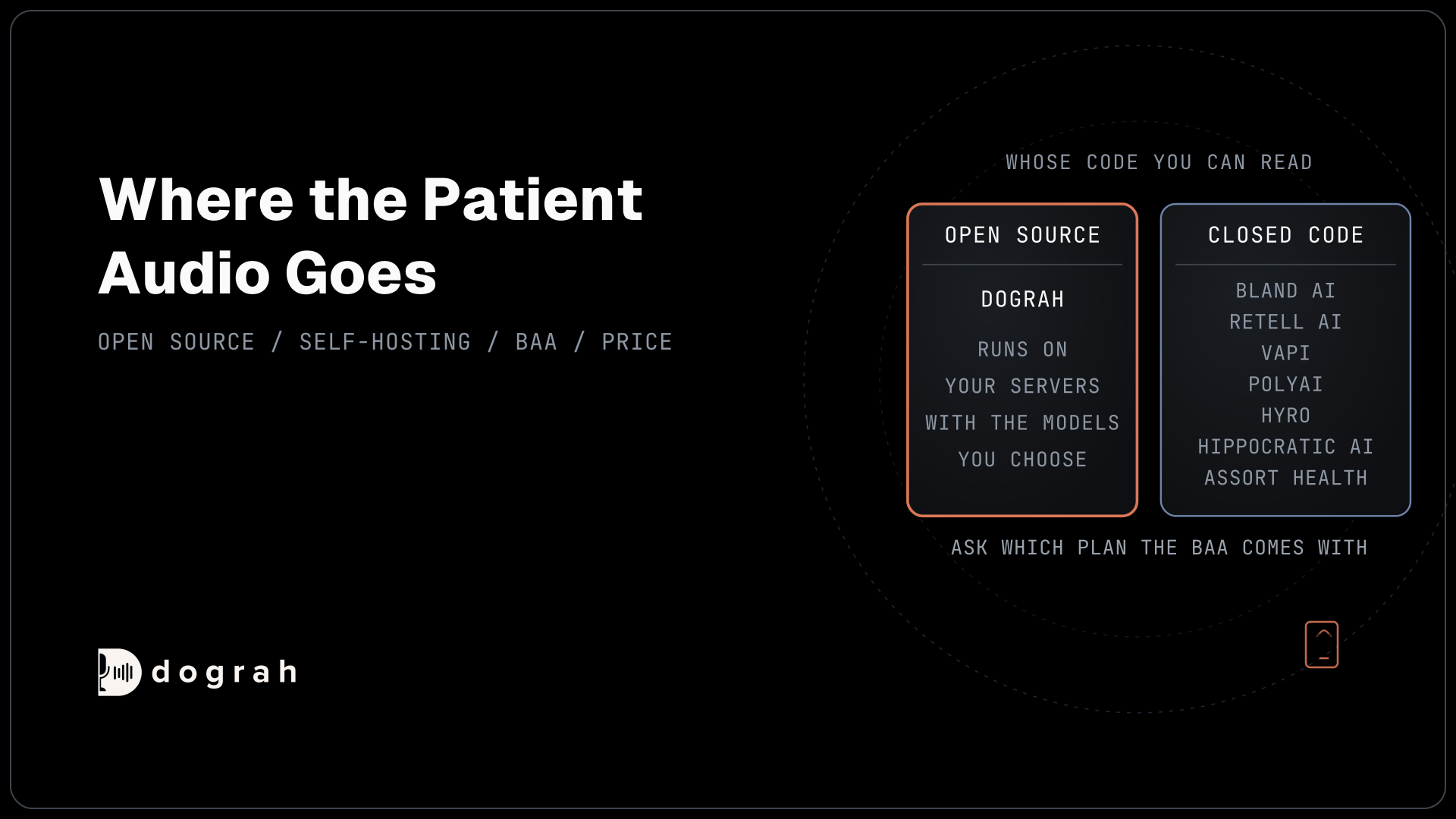
On cost, self-hosted Dograh has no per-minute platform fee; you pay for servers, any paid model keys and phone minutes. Dograh Cloud has a 1¢-a-minute platform fee with 10 concurrent calls included, and a self-hosted install runs 10 concurrent calls by default, which you can raise. The recordings and transcripts stay on your servers when you self-host, and the audio stays inside your infrastructure only when the models run there too.
What's missing is worth saying plainly. Dograh ships no prebuilt ATS connector, so Bullhorn, Greenhouse or any other system is reached through HTTP API tools, MCP tools, webhooks or tools like n8n that you configure. It has no SMS tool, so texts come from your own messaging provider. Transfer Call, which hands a candidate to a recruiter, works on Twilio only. The free version comes with community support.

Open Source Alternative to Vapi / Retell
Self-hosted voice agent platform — no per-minute fees
dograh-hq/dograh
Star on GitHub
Bland, Retell AI, Vapi and Synthflow: voice platforms you build a recruiter on
These four sell to every industry. None is a recruiting product, so you write the questions and the flow, and whether the agent scores anyone is your decision, the same as on Dograh. The differences are price and where the platform runs.
Bland AI. Bland describes itself as an "Enterprise Voice AI Platform for Phone Agents". Its Start plan costs $0.14 a minute with no platform fee, and Build costs $0.12 a minute plus $299 a month, per Bland's pricing page. The per-minute rate includes the language model, speech-to-text and text-to-speech, and phone minutes are billed separately. On-prem or virtual private cloud (VPC) deployment is on Enterprise only, which is why Bland ranks second.
Retell AI. Retell's voice infra fee is $0.055 a minute, and its own all-in range runs $0.07 to $0.31 a minute, with Retell's own voices at $0.015 a minute, per Retell's pricing page. Every account includes 20 concurrent calls. The full breakdown is in Retell AI Pricing Explained.
Vapi. Vapi charges $0.05 a minute for hosting before any model, voice or phone cost, per Vapi's pricing page, and calls itself "a fully managed platform". A Core plan costs $29 a month. The arithmetic is in Vapi Pricing Explained.
Synthflow. Synthflow sells one Enterprise plan, and its pricing page says contracts "start at $30,000 annually", scoped by call volume and integrations, among other things. That makes it the hardest of the four for a small agency to trial.
Classet: a scoring tool with a published price
Classet is the one recruiting specialist that prints its price. Its AI recruiter, Joy, runs phone interviews for high-volume roles and answers a call-to-apply line around the clock. Classet's pricing page lists Starter at $249 a month billed annually, with 50 completed interviews, Scale at $999 a month billed annually, with 250, and Enterprise with ATS Sync from $1,995 a month.
Classet scores, and it says so openly. Its Fast-track feature checks each call against the criteria you set and "gives a fit of Strong, Good, Borderline, or Weak". It also states that "Fast-track never rejects or moves anyone; a person decides", and that a third party, Warden AI, audits the system for bias every month. For a buyer who wants a sorted list and is ready for the duties that come with one, that is the most complete answer in the set. It is still a score, so the New York City audit and notice rules apply to its use there.
HeyMilo, Alex, Phenom, Humanly and Talkpush: scoring suites priced through sales
These five all score or rank candidates, and all five quote prices through sales.
HeyMilo screens by phone, video, SMS and forms, and offers "configurable fit scores with plain-language rationale" and a "ranked shortlist in ATS". It says it runs "3rd party bias audit checks", and its integrations include staffing systems such as Bullhorn and Avionte, which matters to an agency.
Alex, formerly Apriora, calls candidates by phone and also interviews over video, SMS and WhatsApp. It describes "standardized questions and objective rubrics", and its Verify product "scores every application for fraud risk". It lists more than 33 ATS integrations.
Phenom's Voice Screening Agent is part of Phenom's wider talent platform. Its page says "every screening format scores onto the same record" and lists SOC 2 Type II. In Phenom's own press release, a customer calls it an "AI phone interview agent", and Phenom says it connects with candidates "the moment they apply".
Humanly works across "chat, voice, and video" and "delivers ranked candidates with transcripts and clear reasoning". It sells its own ATS as well as connecting to Workday, iCIMS and others.
Talkpush is "the AI-powered ATS and recruitment CRM built for high-volume hiring". Its agents talk with candidates "via chat or voice to sort, filter and recommend who is best suited for each open role", and every conversation is recorded and transcribed.
All five suit a team that wants the vendor to sort candidates and run the software. None lets an agency read the code or run it on its own servers, and each is priced through sales.
Join the Dograh Community
Dograh is an OSS alternative to Vapi. Join our Slack community for queries, releases, best practices & community interactions.
Picking the right tool for your agency
The right pick depends on whether you want a sorted list or a set of recorded answers, and on where the recordings must live.
An agency that wants the tool to sort applicants, and has a compliance owner for the audit and the notices, will shortlist Classet first for its published price and stated audits, then take demos from HeyMilo, Alex, Phenom, Humanly and Talkpush. An agency that wants recorded answers and a recruiter deciding, on a published per-minute price, will look at Bland, Retell AI or Vapi and build the agent itself. An agency whose security review asks where candidate recordings are stored has a shorter list. Only Dograh lets the answer be "our own servers" without an Enterprise contract, and fully so only when the models run there too.
Whichever way you lean, get four answers in writing. Ask whether the tool outputs a score, rank or recommendation, and if it does, ask for its latest bias audit. Ask which speech, model and phone companies hear the candidate's audio. Ask how long recordings and transcripts are kept, and who can delete them. And ask what the agent says in its first sentence, and whether it can tell candidates they are talking to an automated assistant where your location requires it. The same buyer questions for a different industry are worked through in Best AI Voice Agents for Healthcare. Whichever tool you choose, the agent should read from your ATS and write every answer back to it.
Glossary
- Automated employment decision tool
- NYC Local Law 144's term for a tool whose output, such as a score, classification or recommendation, substantially assists a hiring decision. Employers and employment agencies may use one in New York City only after a bias audit within one year and notice to candidates.
- Fit score
- A rating a recruiting tool gives a candidate against the role's criteria, such as Strong to Weak. It is useful for sorting, and it is the kind of output that brings bias-audit and notice duties.
- Platform fee
- The per-minute charge for running the agent itself, before the speech models, the language model and the phone line. Self-hosted Dograh has none.
- Self-hosting
- Running the tool's code on servers you control rather than in the vendor's cloud. Of the eleven tools here, only Dograh can be self-hosted without an Enterprise contract.