
AI voice agents for quote follow-up in insurance call people who asked for a quote and have not bought. Because the call encourages a purchase, it generally needs prior express written consent first. After verifying the person who was quoted, the agent reads the quote and its expiry date from your rating system and offers a licensed producer.
Key Takeaways
- A quote follow-up generally needs prior express written consent before the AI dials.
- A recent quote request does not replace that written consent.
- Read the quote only after verifying the person who asked for it.
This post is part of our guide to AI voice agents for insurance. The guide's section "Winning the policy: leads and quote follow-ups" says a quote follow-up is a sales call, so it needs written consent before the agent dials. Here is that call in full, run in Dograh, an open-source, self-hostable voice agent platform.
Why this call needs written consent
A quote follow-up asks someone to buy, and that is what makes it telemarketing. The FCC's rules at 47 CFR 64.1200 define telemarketing as "the initiation of a telephone call or message for the purpose of encouraging the purchase or rental of, or investment in, property, goods, or services, which is transmitted to any person." Under paragraph (a)(2), such a call made with "an artificial or prerecorded voice" to a mobile needs "the prior express written consent of the called party".
An AI voice is an artificial voice. In its February 2024 declaratory ruling, the Federal Communications Commission (FCC) confirmed that "the TCPA's restrictions on the use of 'artificial or prerecorded voice' encompass current AI technologies that generate human voices." The TCPA is the Telephone Consumer Protection Act.
The rule defines that consent as "an agreement, in writing, bearing the signature of the person called that clearly authorizes the seller to deliver or cause to be delivered to the person called advertisements or telemarketing messages using an automatic telephone dialing system or an artificial or prerecorded voice", together with the phone number. An electronic signature counts. So check that your quote form's consent line names your agency and the number you will call.
Generally, a recent quote request does not replace written consent for an AI call to a mobile. An established business relationship can rest on "the subscriber's inquiry or application regarding products or services offered by the entity within the three months immediately preceding the date of the call". That relationship generally lifts only the do-not-call registry rule for telephone solicitations; it does not cover an artificial-voice sales call to a mobile. Confirm your own position with counsel.
Insurers do get sued over these calls. PossibleNOW's review of TCPA litigation counted 214 cases against insurance defendants in 2025, up 52.9% from 140 in 2024, which is why the consent check below runs before every call. Our post on AI voice agents for insurance in the US covers the full rule.
The same reasoning applies outside insurance, and our post on quote follow-up in home services runs it for repair and installation quotes.
Which quotes get a call, and when
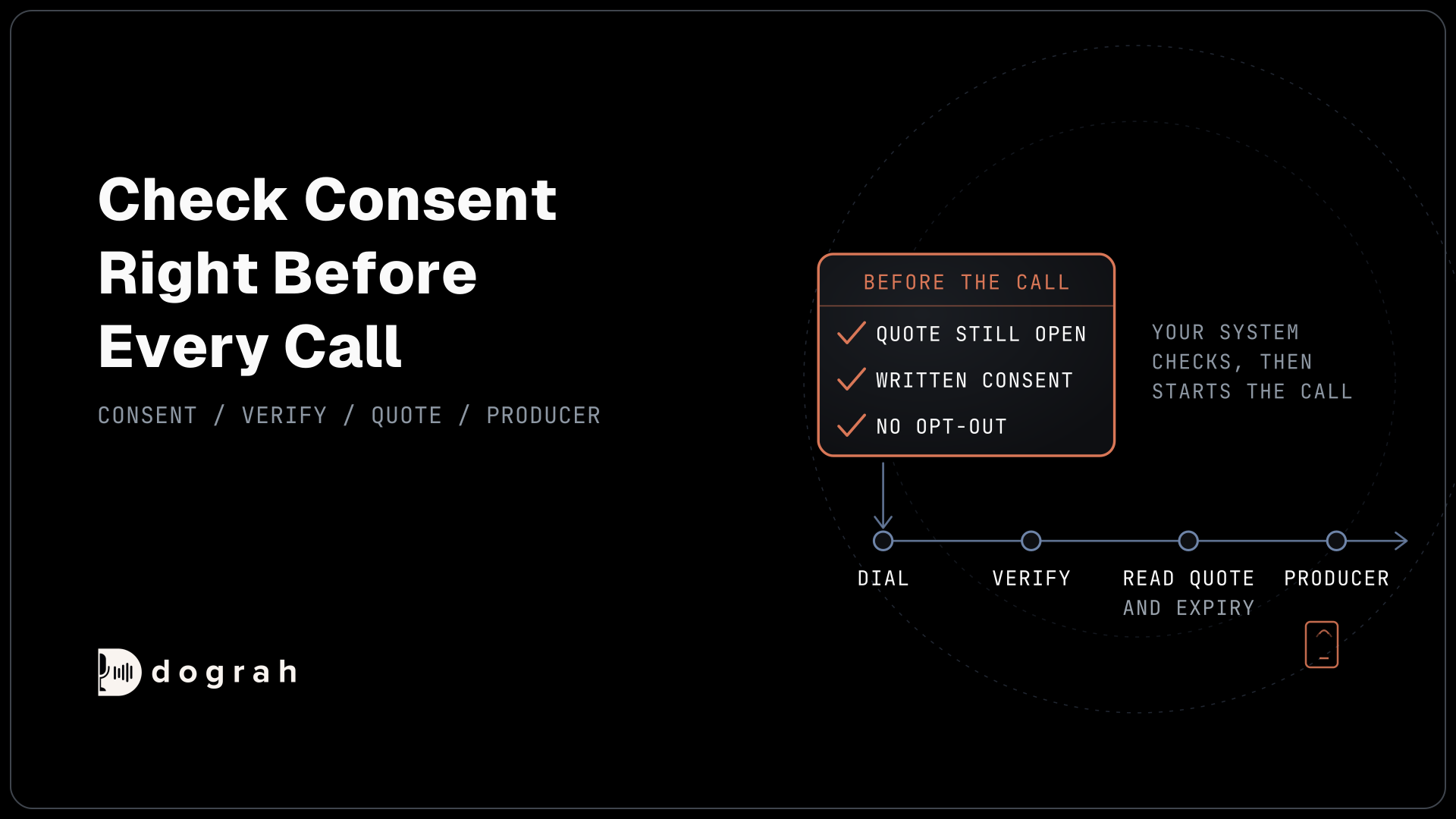
Your rating or agency system decides who is called, not the voice agent. Before each call, it checks that the quote is still open, neither bound nor declined, and that written consent is on file with no opt-out since.
Then it starts the call with the API Trigger, which dials at once and can pass the person's first name and a quote ID. Your system decides when to fire it, inside the hours you allow. A quote that bound overnight never gets a call, because the check runs right before the trigger.
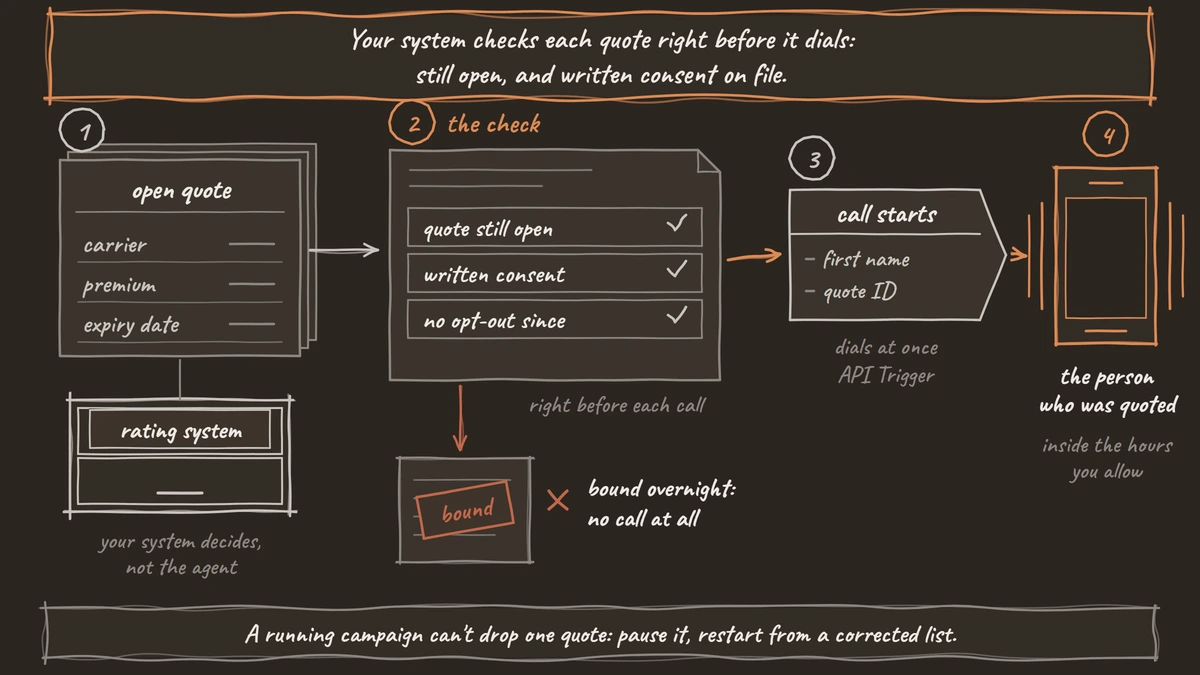
A batch of open quotes can go to Campaigns instead. Calling hours are set by weekday in one time zone per campaign, so split a national list by time zone. Retries run from 0 to 10, 2 by default, so set them to how often you are willing to call one person. To stop calling someone mid-campaign, pause the campaign and start a new one from a corrected list.
Stopping matters as much as starting. Under 47 CFR 64.1200(a)(10), a called party may revoke consent "by using any reasonable method to clearly express a desire not to receive further calls or text messages", and the request must be honoured "within a reasonable time not to exceed ten business days from receipt of such request." Dograh keeps no do-not-call list. When a caller opts out, an HTTP API tool writes it to your own list, and you remove those numbers before the next campaign upload. The do_not_call call tag records the request but never blocks a later call.

Open Source Alternative to Vapi / Retell
Self-hosted voice agent platform — no per-minute fees
dograh-hq/dograh
Star on GitHub
The follow-up call: verify, then read the quote
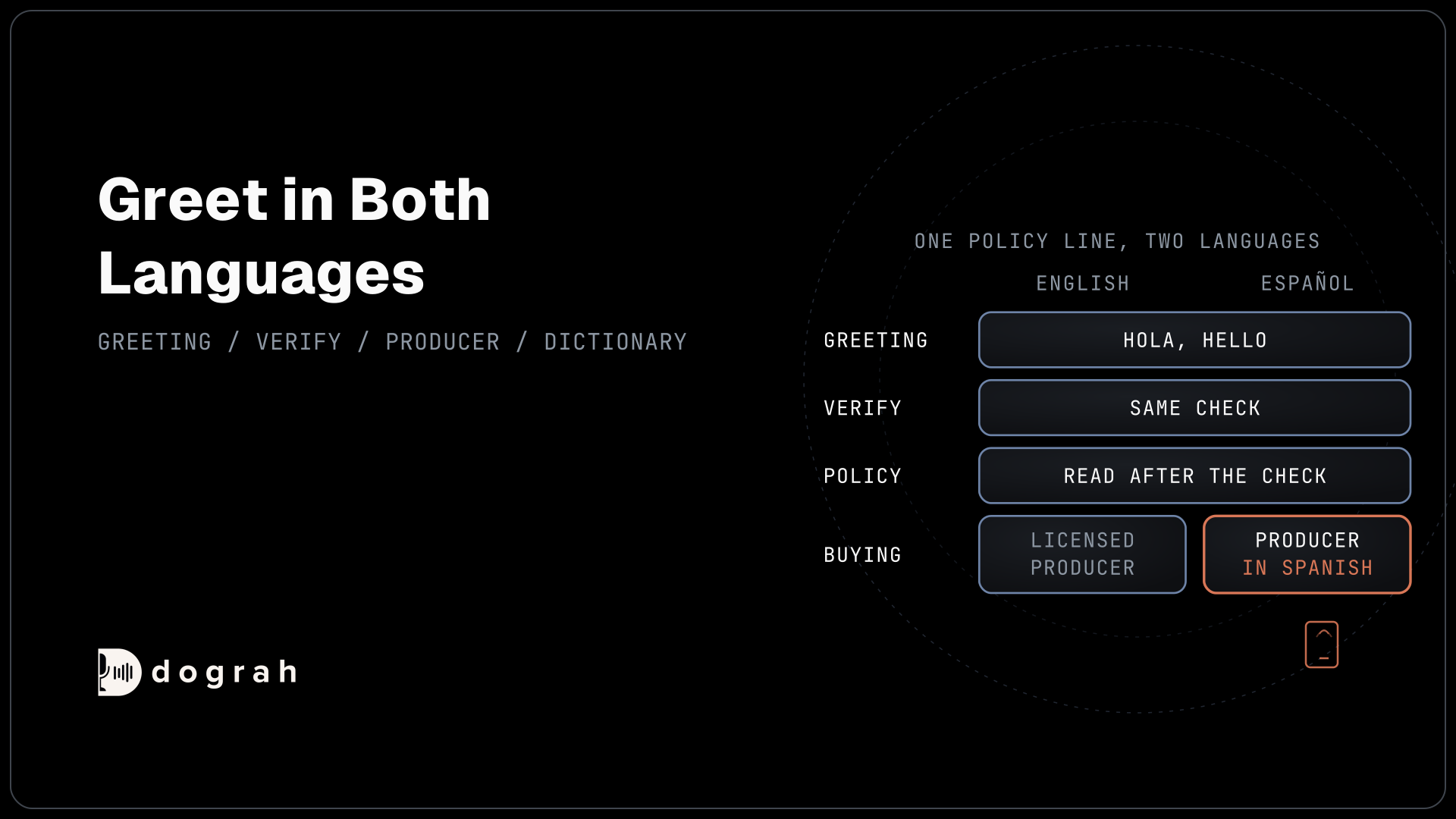
The agent says nothing about the quote until it knows it is talking to the person who asked for it. The Greeting Text names the agency exactly as the quote does and may include the person's first name, never the quote. If you want to tell people they're speaking with an automated assistant, or your location requires it by law, write it in the Greeting Text along with the business's name.
Next comes verification. A name finds the right person, but it does not prove who is speaking. The agent asks for an approved check, such as date of birth plus the ZIP code on the quote, and an HTTP API tool sends the answers to your system. Only after the check passes does another HTTP API tool read the quote from your rating system: the carrier, the premium as the system returned it, and the expiry date. The quote is never loaded with Pre-Call Data Fetch, so nothing about it sits in the call before the check.
The agent reads those as facts from the record and asks one question: would they like to go over it with a licensed producer, now or at a time they choose? It never quotes a new price, changes a deductible, compares carriers or binds.
The licence sets that limit. The NAIC Producer Licensing Model Act counts "offering advice directly to a purchaser or prospective purchaser of a particular contract of insurance concerning any of the substantive benefits, terms or conditions of the contract" as negotiating. We work to one plain rule. Selling, advising on or binding a policy generally needs a state producer licence, so the agent qualifies, reads the record and hands the caller to a licensed person; confirm your own position with counsel.
Questions about cover or terms take a pathway whose Transition Speech plays fixed words, such as "A licensed agent can walk you through that, so let me connect you," because a node prompt cannot guarantee wording. Transfer Call works on Twilio, Telnyx and Asterisk ARI. It passes no summary by default; on Twilio it can play a short spoken introduction to both people. Write the details to your system with an HTTP API tool before the transfer, and Context Mapping can send the caller to a producer licensed in their state. If nobody answers, the caller stays with the agent; tell it in the prompt to offer a callback.
Voicemail, outcomes and the next call
With voicemail handling switched on in the agent's Settings ("Enable voicemail and screening handling"), a detected voicemail hangs up by default. If you choose "Leave a message" under "When voicemail is detected", keep it to the agency's name and a number to call back. Never leave the carrier or the premium, because anyone in the household can play it.
A booked time is written by an HTTP API tool to the producer's calendar or your CRM, since Dograh has no built-in calendar integration. A Webhook node sends the outcome and the transcript link after the call, so your system updates the quote and the call list in one place.
Self-hosted Dograh has no per-minute platform fee (servers, model keys and phone minutes still cost); Dograh Cloud has a 1¢-a-minute platform fee.
Former customers who let a policy go get a different call, covered in AI voice agents for win-back in insurance. Leads with no quote yet start with AI voice agents for insurance lead qualification.
Join the Dograh Community
Dograh is an OSS alternative to Vapi. Join our Slack community for queries, releases, best practices & community interactions.
Glossary
- Telemarketing (TCPA)
- Under 47 CFR 64.1200, a call made to encourage the purchase of property, goods or services. A quote follow-up that asks someone to buy is generally telemarketing, so an AI-voice call to a mobile generally needs prior express written consent.
- Established business relationship
- A relationship the rule allows to rest on an inquiry or application within the previous three months. It generally lifts only the do-not-call registry rule for telephone solicitations, not the written-consent rule for an artificial-voice call to a mobile.
- Revoking consent
- A called party withdrawing consent by any reasonable method, such as saying stop on the call. The rule requires it to be honoured within ten business days; the agency writes it to its own list.
- Rating system
- The software that produced the quote and holds its carrier, premium and expiry date. The agent reads those fields from it after verification and never calculates a new price.