
In the US, AI voice agents for insurance generally need the person's prior express consent for service calls such as premium reminders, and prior express written consent for any call that sells to a mobile. Selling, soliciting or negotiating a policy generally needs a producer licence, so the agent collects facts and hands the caller to a licensed producer.
Key Takeaways
- Service calls need prior express consent; sales calls to mobiles need written consent.
- The agent collects facts, and a producer licensed in the caller's state sells.
- Dograh keeps no do-not-call list, so opt-outs go to your own list.
This post is part of our guide to AI voice agents for insurance. The guide's section "Calling rules: US, UK and Spanish-speaking callers" gives the US rule in one line: a premium reminder or a plain renewal reminder generally needs prior express consent, and a quote follow-up, a win-back call or a reminder with an offer needs the written kind. Here is the rule text behind that line, and how to build for it in Dograh, an open-source, self-hostable voice agent platform.
Three insurance call types, three consent levels
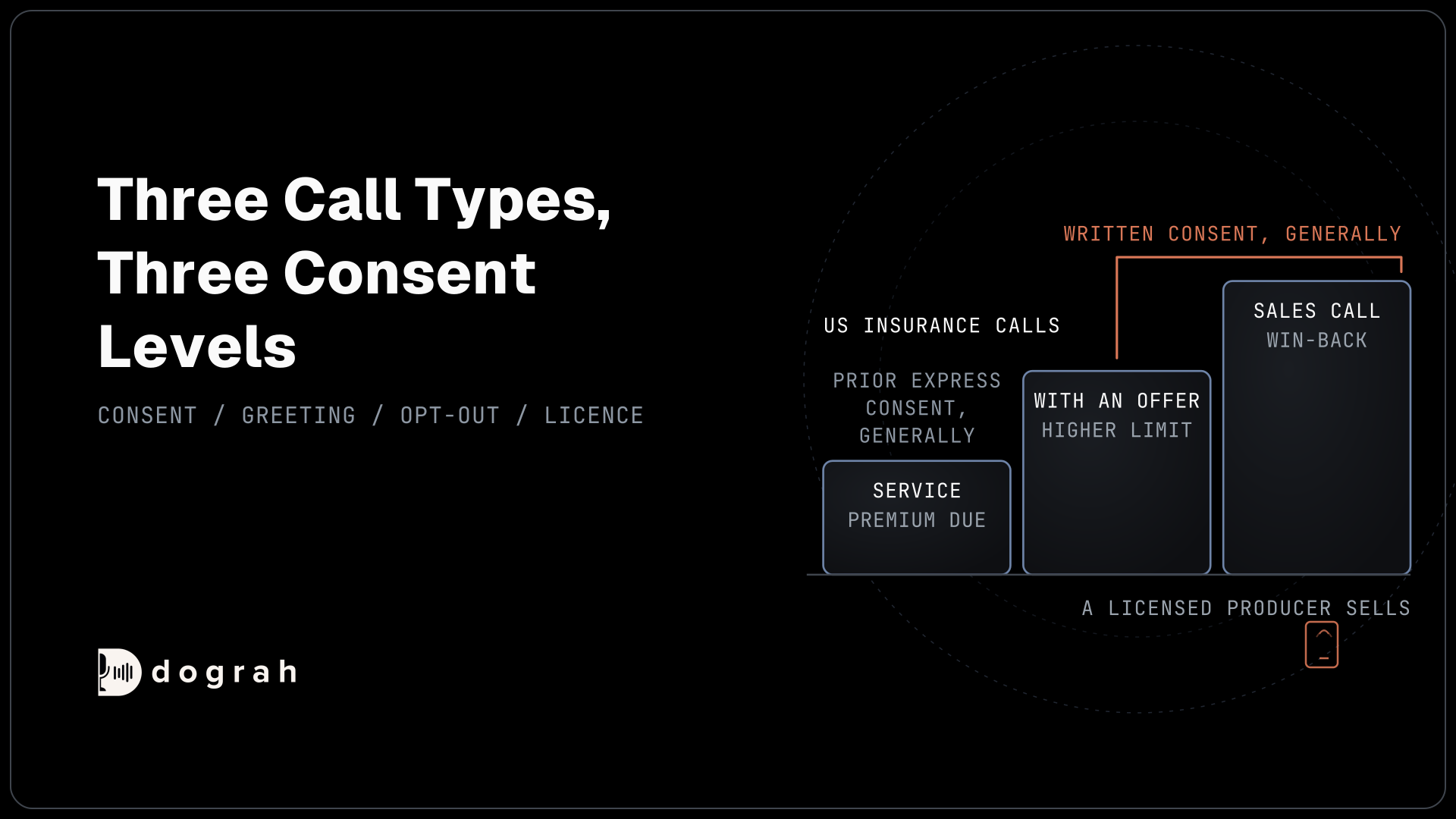
The consent an insurance call needs depends on what the call says, so sort every call before you build it. In its February 2024 ruling, the Federal Communications Commission (FCC) confirmed that the Telephone Consumer Protection Act (TCPA) covers AI-generated voices as "artificial or prerecorded voice". Such calls "require the prior express consent of the called party to initiate such calls absent an emergency purpose or exemption."
Selling raises the bar. Under 47 CFR 64.1200(a)(2), an artificial-voice call to a mobile that "includes or introduces an advertisement or constitutes telemarketing" needs "the prior express written consent of the called party". For landlines, under (a)(3)(iii), a commercial call with no advertisement needs no consent if "the caller makes no more than three calls within any consecutive 30-day period to the residential line and honors the called party's request to opt out of future calls".
| Insurance call | Example | Consent it generally needs |
|---|---|---|
| Service, no offer | Premium due, renewal date read from the notice | Prior express consent on a mobile; on a landline, up to three calls in 30 days with an opt-out |
| Service that adds an offer | A renewal reminder that suggests a higher limit | Prior express written consent |
| Sales | Quote follow-up, new-lead call, win-back | Prior express written consent |
Written consent is a signed agreement that authorises the seller to make telemarketing calls with an artificial voice and names the number. Under 64.1200(f)(9)(i)(B), it must also tell the person that signing is not a condition of buying anything. A quote request or a past policy is not that agreement. For a new-lead call, the web form is usually where it is captured; AI voice agents for insurance lead qualification covers that call.
PossibleNOW's review of TCPA litigation counted 214 cases against insurance companies in 2025, 8.1% of all 2,628 TCPA cases and up 52.9% on the year before. So the consent check runs in your own system, before any number reaches the agent.
The opening line, calling hours and do-not-call
The rule fixes who the caller says they are. Under 64.1200(b)(1), an artificial-voice message must "state clearly the identity of the business, individual, or other entity that is responsible for initiating the call", and a business must use the name it is registered under with the state.
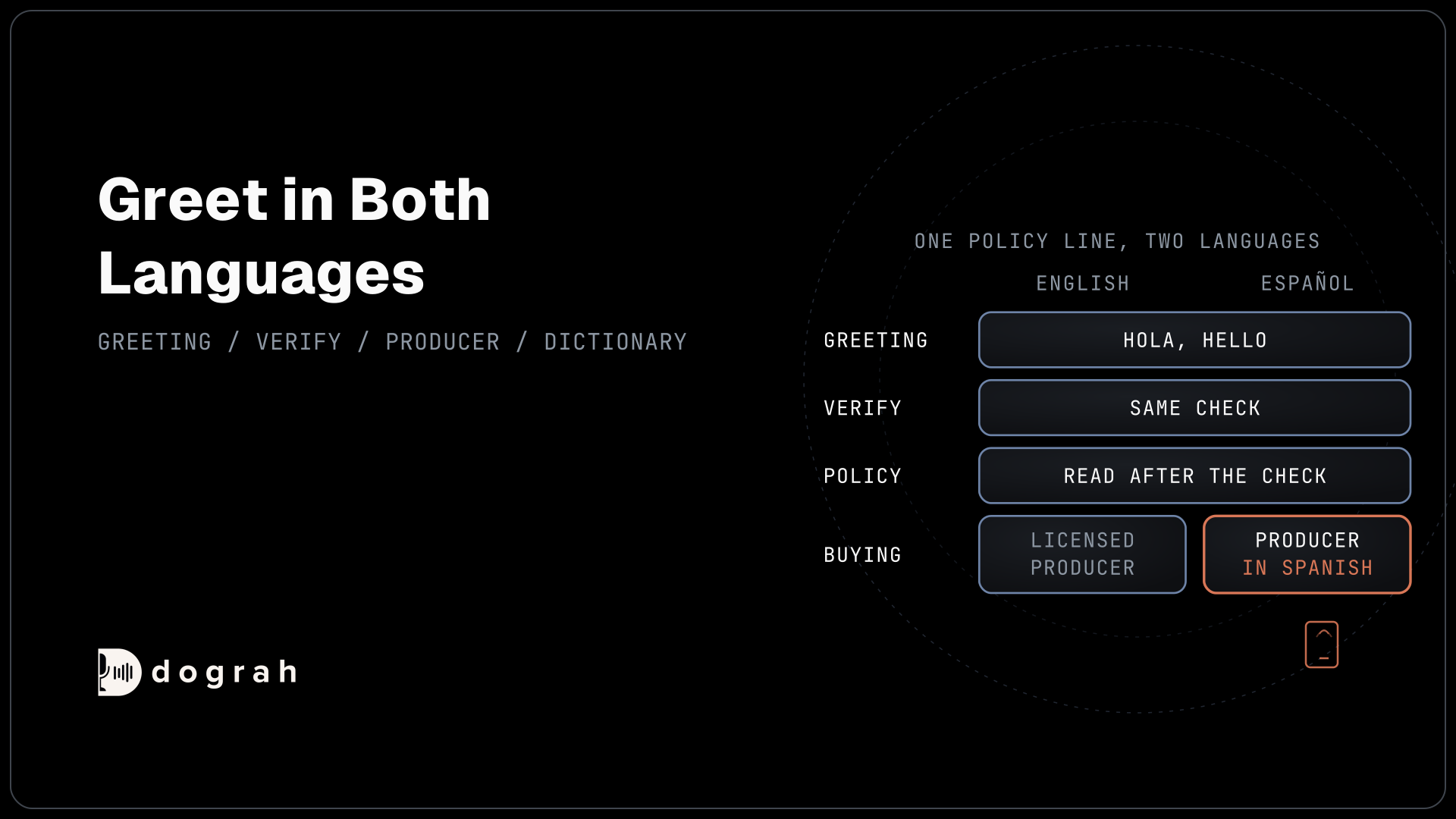
Put that name and a callback number in the Greeting Text, the optional fixed line Dograh speaks word for word as the call connects, and write the agency's registered name exactly. If you want to tell callers they're speaking with an automated assistant, or your location requires it by law, write it in the Greeting Text along with the business's name.
Sales calls also have hours. Under 64.1200(c), no one may make a telephone solicitation to a residential subscriber "before the hour of 8 a.m. or after 9 p.m. (local time at the called party's location)", or to a number on the national do-not-call registry. Campaigns set calling hours by weekday in one time zone per campaign, so split a national book into one campaign per time zone, and scrub sales lists against the registry before upload.
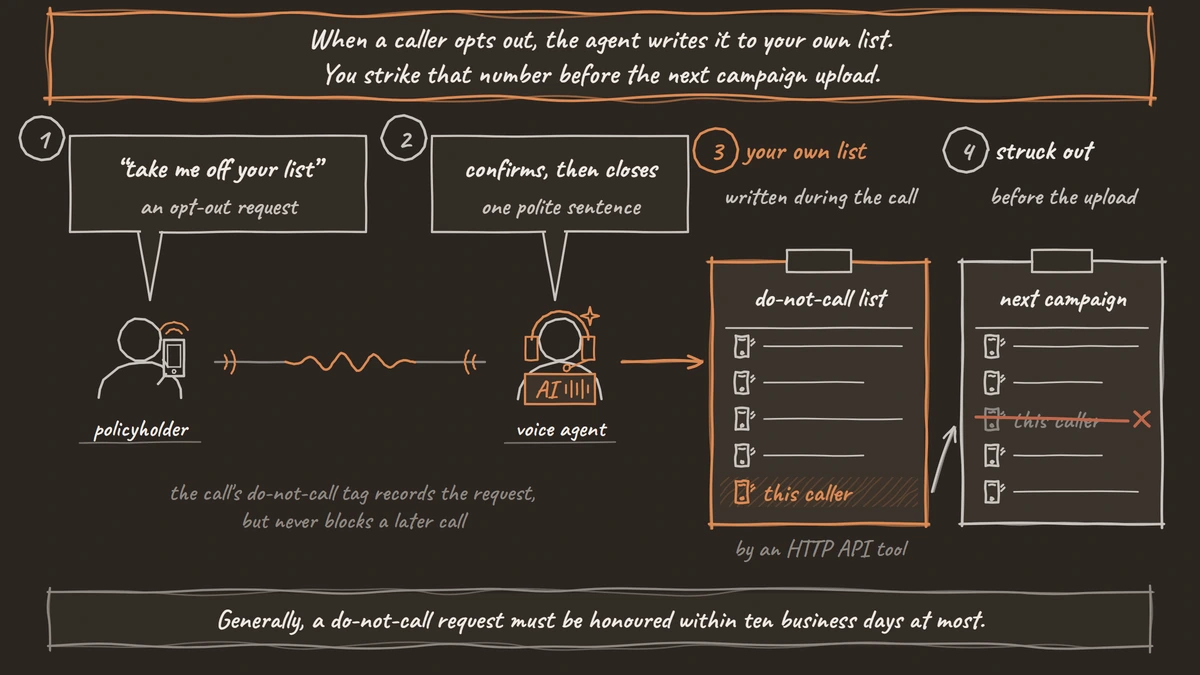
Every agency also needs its own do-not-call list. Section (d) bars these calls unless the caller "has instituted procedures for maintaining a list of persons who request not to receive such calls". A request must be honoured within a reasonable time that "may not exceed ten (10) business days".
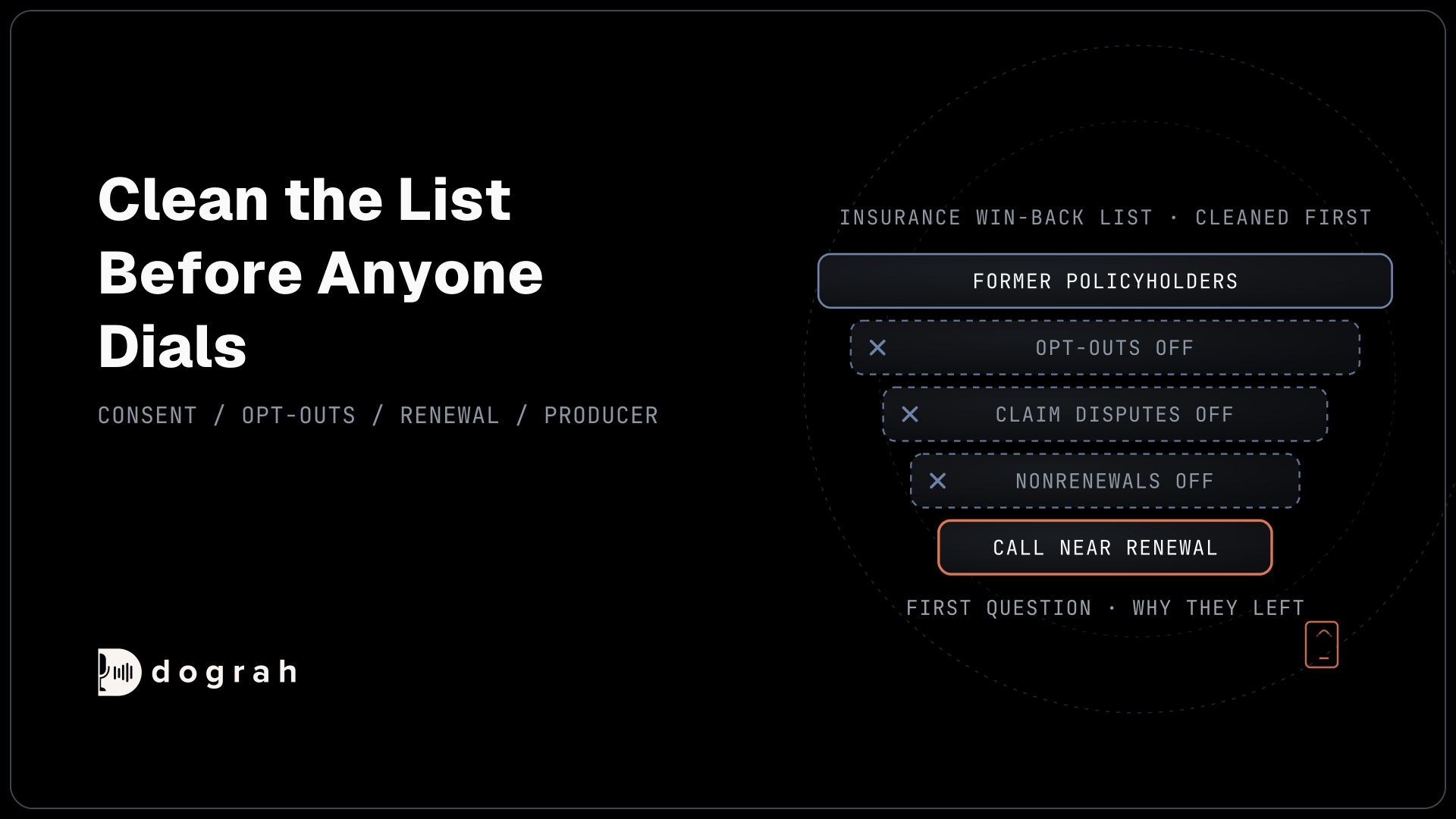
Dograh keeps no do-not-call list. When a caller opts out, an HTTP API tool writes it to your own list, and you remove those numbers before the next campaign upload. The do_not_call call tag records the request but never blocks a later call. To stop calling someone mid-campaign, pause the campaign and start a new one from a corrected list. For lists that change daily, start calls from your own system with the API Trigger, so your system decides who is called.

Open Source Alternative to Vapi / Retell
Self-hosted voice agent platform — no per-minute fees
dograh-hq/dograh
Star on GitHub
When a caller says "stop"
A spoken request counts as an opt-out. Under 64.1200(a)(10), a person may revoke consent, written consent included, "by using any reasonable method to clearly express a desire not to receive further calls or text messages from the caller or sender."
Give the agent an extraction variable for an opt-out, and tell it in the prompt to confirm the request in one sentence and close politely. The HTTP API tool writes it to your list during the call.
The FCC has adopted a change to how far one opt-out reaches. FCC 26-67, adopted on 30 September 2026, says: "Revocation requests made in response to robocalls that contain an advertisement or constitute telemarketing revoke consent to all future robocalls containing an advertisement or that constitute telemarketing from that caller." It is not yet in effect. It starts 30 days after publication in the Federal Register. Generally, then, a "stop" on one sales call will end all of that agency's AI-voice sales calls. The simplest build treats every opt-out as covering every call type. This is general information, not legal advice; confirm your position with counsel.
The licence line: collect facts, then hand over
Consent decides whether you may call. The licence decides what the agent may say. In most states, selling, soliciting or negotiating a policy needs a producer licence for that line, so the agent collects facts and hands the caller to a licensed producer. Explaining what a quoted policy covers is generally negotiating.
Florida shows how a state writes it. Section 626.112(1)(a) says: "No person may be, act as, or advertise or hold himself or herself out to be an insurance agent, insurance adjuster, or customer representative unless he or she is currently licensed by the department and appointed by an appropriate appointing entity or person." So the greeting never presents the agent as an agent or adviser. Florida's separate rule for automated sales calls is covered in AI Voice Agents for Logistics and Delivery (US).
The agent asks fact questions: who needs cover, what is insured and where, the current carrier and the renewal date. It never says which policy suits the caller and never explains a quote's terms. A question like "would this cover my boat?" takes a pathway whose Transition Speech, fixed text Dograh plays word for word, says: "That's a question for one of our licensed agents, so let me connect you." A prompt alone cannot guarantee that wording.
Transfer Call works on Twilio, Telnyx and Asterisk ARI. It passes no summary by default; on Twilio it can play a short spoken introduction to both people. Write the details to your agency system with an HTTP API tool before the transfer. Its Context Mapping picks the number from a value the agent recorded, such as caller_state, so a Texas caller reaches a producer licensed in Texas. Set a Fallback Destination for states with no rule. If nobody answers within the 30-second default, the caller stays with the agent; tell it in the prompt to offer a callback and write the request to your system.
What to set up before the first call
Keep consent records and opt-outs in systems your compliance team controls. Some states require every party's consent to record a call; call-recording consent laws has the detail. Recording starts as the call connects, so any recording notice goes in the Greeting Text, the first thing the caller hears.
Recordings and transcripts keep whatever is said, so the call never asks for a full account, card or Social Security number; use a short check such as the last four digits, and send payment links by text or email from your own system. Self-hosted Dograh has no per-minute platform fee (servers, model keys and phone minutes still cost); Dograh Cloud has a 1¢-a-minute platform fee.
UK policyholders fall under different rules, set out in AI voice agents for insurance in the UK. This post is general information, not legal advice; confirm your own position with counsel.
Join the Dograh Community
Dograh is an OSS alternative to Vapi. Join our Slack community for queries, releases, best practices & community interactions.
Glossary
- Prior express written consent
- A signed agreement that authorises a seller to make telemarketing calls with an artificial or AI voice to a named number. Under 47 CFR 64.1200(a)(2) it is generally needed before any AI-voice sales call to a mobile.
- Telephone solicitation
- A call made to encourage the purchase of goods or services. Under 64.1200(c), these calls are limited to 8 a.m. to 9 p.m. at the called person's local time and may not reach numbers on the national do-not-call registry.
- Internal do-not-call list
- The list of people who asked a business not to call them, which 64.1200(d) requires the business to keep. Dograh keeps none, so opt-outs are written to the agency's own list.
- Context Mapping
- A Transfer Call setting in Dograh that picks the destination from a value the agent recorded, such as the caller's state, so each caller reaches a producer licensed there.