
AI voice agents for insurance lead qualification answer inbound callers and call back web leads who gave written consent. They ask the agency's fact list, such as what to insure, the state and the current carrier, record each answer as stated, and hand the lead to a producer licensed in that state. They never quote, recommend or bind.
Key Takeaways
- Call a web lead only with written consent that names your agency.
- Ask facts only, because a price, a recommendation or a named carrier crosses into selling.
- Route each lead to a producer licensed in the caller's own state.
This post is part of our guide to AI voice agents for insurance. The guide's section "Winning the policy: leads and quote follow-ups" says a new lead gets fact questions only, and the scoring stays in the CRM, where your team already set the rules. Here is that call in full, run in Dograh, an open-source, self-hostable voice agent platform.
Who may be called, and on what consent
An inbound caller and a web-form lead look the same in a CRM, but the law treats them differently. Someone who rings your agency generally needs no prior consent to be answered. An outbound call back to a form lead is generally a sales call, and our post on solar lead qualification runs the same consent check for the same reason.
Under 47 CFR 64.1200(a)(2), a call that "includes or introduces an advertisement or constitutes telemarketing, using an automatic telephone dialing system or an artificial or prerecorded voice" to a mobile is barred "other than a call made with the prior express written consent of the called party". In its February 2024 declaratory ruling, the Federal Communications Commission (FCC) confirmed, for the Telephone Consumer Protection Act (TCPA), that "the TCPA's restrictions on the use of 'artificial or prerecorded voice' encompass current AI technologies that generate human voices."
So a lead call that sells generally needs prior express written consent before the agent dials. Comparison sites add one wrinkle. In Insurance Marketing Coalition v. FCC, brought by an insurance lead-generation trade group, the Eleventh Circuit vacated the FCC's one-to-one consent rule in January 2025. A form can still name several sellers, but it generally has to name your agency and the phone number you will call. Confirm your own position with counsel.
Insurance agencies do get sued over this. PossibleNOW's review of TCPA litigation counted 214 cases against insurance defendants in 2025, up 52.9% from 140 in 2024, out of 2,628 TCPA cases in all, so have your own system check consent before every call. Our post on AI voice agents for insurance in the US covers the full rule.
The lead qualification questions the agent asks
The agent asks facts, and the licence line decides which facts. The NAIC Producer Licensing Model Act, which each state enacts in its own version, says "A person shall not sell, solicit or negotiate insurance in this state for any class or classes of insurance unless the person is licensed for that line of authority". It defines "solicit" as "attempting to sell insurance or asking or urging a person to apply for a particular kind of insurance from a particular company."
We work to one plain rule. Selling, advising on or binding a policy generally needs a state producer licence, so the agent qualifies, reads the record and hands the caller to a licensed person; confirm your own position with counsel.
So the agency writes its fact list, and the prompt keeps to it: who needs cover and what they want to insure, the state they live in, their current carrier and renewal date, a few basic risk facts such as the number of drivers or the home's age, their timeline, and the best time for a producer to call. It never names a price, and it never steers the caller toward a policy or a carrier.
Questions about price or cover get one fixed reply, played as a pathway's Transition Speech: "That's a question for one of our licensed agents, and I can connect you now." Choosing a pathway is the language model reading a written condition, so it is never a hard rule. Test it with the way callers really ask, such as "roughly what would that cost me?"
Turn on variable extraction on the qualifying node, with a String, Number or Boolean type for each answer. It records each answer as the caller stated it, and the transcript and recording stay the exact record.

Open Source Alternative to Vapi / Retell
Self-hosted voice agent platform — no per-minute fees
dograh-hq/dograh
Star on GitHub
Routing to a producer licensed in that state
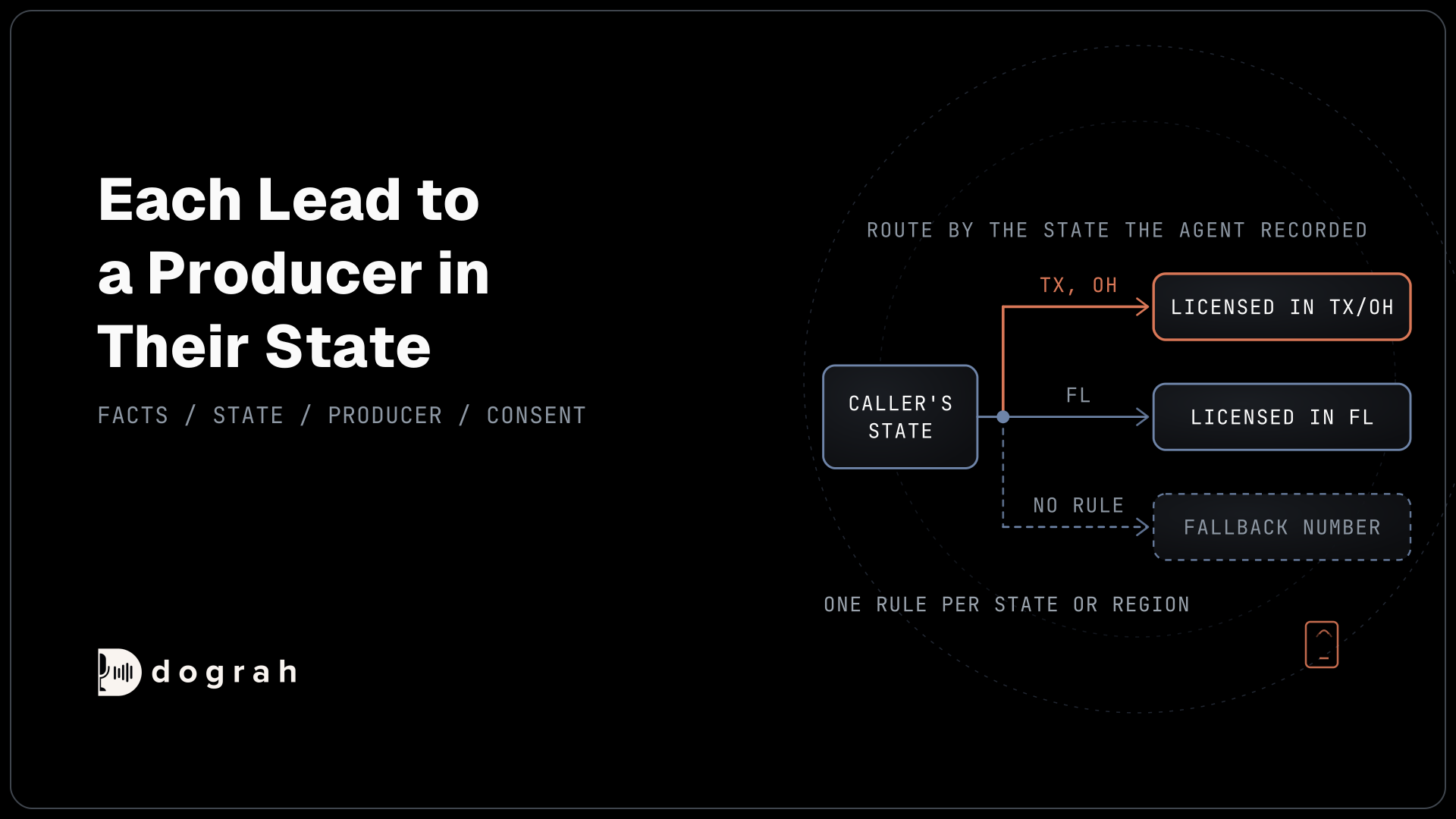
Each lead should reach a producer licensed where the caller lives, and the transfer tool can choose by state. Transfer Call works on Twilio, Telnyx and Asterisk ARI. It passes no summary by default; on Twilio it can play a short spoken introduction to both people.
Its Context Mapping destination picks the number from a value the agent recorded. Ask for the state in the qualifying node, so the value exists before the call reaches the transfer, then add one rule per state or region with that producer's number, plus a fallback number for states with no rule. Matching ignores case, but "Texas" and "TX" are still different values, so tell the agent in the prompt to record the two-letter code.
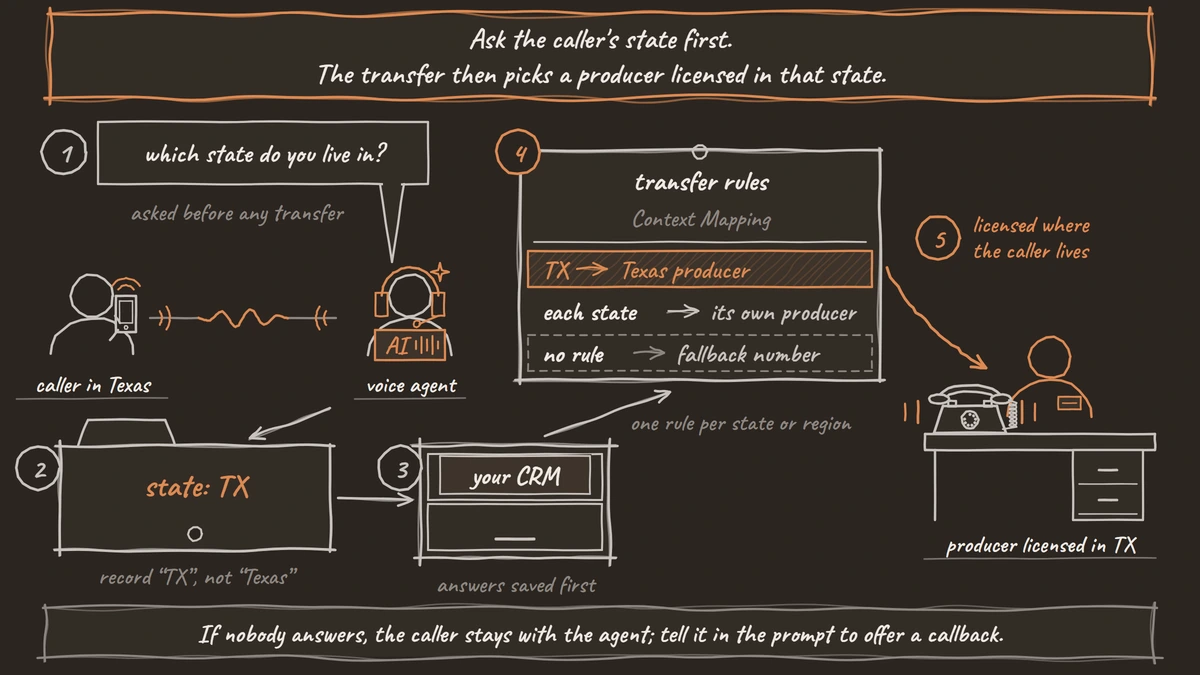
Write the details to your system with an HTTP API tool before the transfer, so the producer opens a CRM record that already holds the answers. Dograh has no built-in agency management connector, so the tool calls the API your system already has. If nobody answers, the caller stays with the agent; tell it in the prompt to offer a callback.
Each call also gets an outcome tag. Dograh's default dispositions include qualified, not_interested, callback_requested and do_not_call, and your organisation can map its own codes.
Scoring, opt-outs and old leads
Scoring stays in your CRM, where your team already set the rules. A Webhook node sends the answers, the outcome and the transcript link after the call, and the CRM scores and assigns the lead. Leads from every source then meet one set of rules.
Dograh keeps no do-not-call list. When a caller opts out, an HTTP API tool writes it to your own list, and you remove those numbers before the next campaign upload. The do_not_call call tag records the request but never blocks a later call.
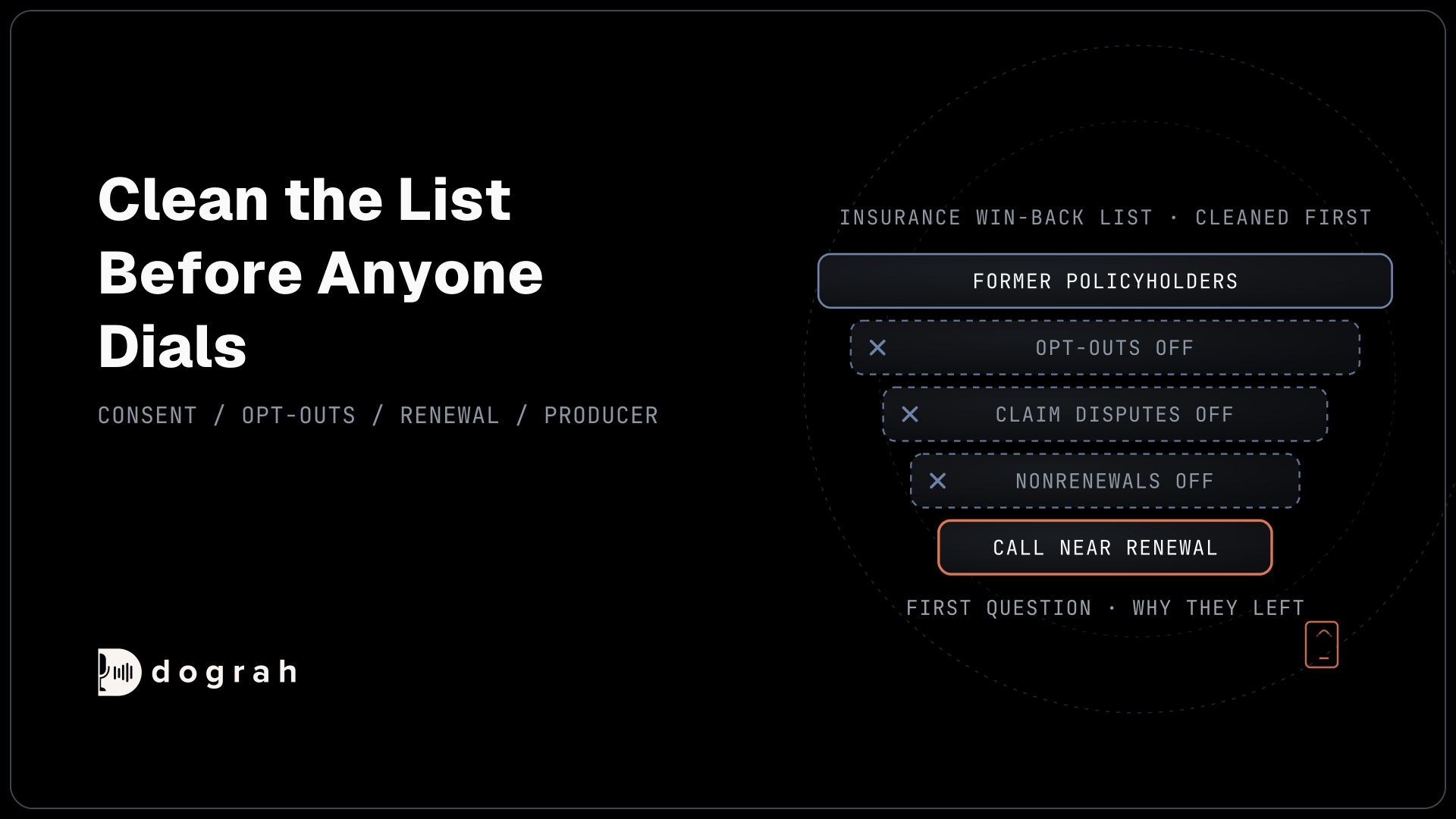
Old and purchased leads need the same consent check as new ones, because a lead that is months old still gets a sales call. Upload consented lists to Campaigns, with calling hours by weekday in one time zone per campaign, and split a national list by time zone. For leads that arrive all day, start each call from your CRM with the API Trigger, which dials at once, after your system has checked consent.
Self-hosted Dograh has no per-minute platform fee (servers, model keys and phone minutes still cost); Dograh Cloud has a 1¢-a-minute platform fee.
Once a quote exists, the call changes, and AI voice agents for quote follow-up in insurance picks it up. The same pattern across other industries is in AI voice agents for lead qualification.
Join the Dograh Community
Dograh is an OSS alternative to Vapi. Join our Slack community for queries, releases, best practices & community interactions.
Glossary
- Soliciting (insurance)
- Under the NAIC Producer Licensing Model Act, attempting to sell insurance or asking or urging a person to apply for a particular kind of insurance from a particular company. It generally needs a producer licence, so the voice agent asks facts and hands over.
- Prior express written consent
- The signed agreement 47 CFR 64.1200 generally requires before a telemarketing call using an artificial voice to a mobile. AI voices count as artificial voices, so an outbound call back to a web lead generally needs it.
- Context Mapping
- A Transfer Call destination setting that picks the number from a value recorded on the call, such as the caller's state, with a fallback number when no rule matches.
- Call disposition
- The outcome tag Dograh gives each call, such as qualified, callback_requested or do_not_call. It records what happened; the do_not_call tag never blocks a later call by itself.