
AI voice agents for insurance answer and place the policy calls an agency or carrier handles every day: new leads, quote follow-ups, premium reminders, renewals, win-back and service questions. They verify the caller before reading any policy detail, read and write the policy system during the call, and hand selling, advice and binding to a licensed person.
Key Takeaways
- Verify the caller before any policy detail, since a phone number only finds the record.
- The agent qualifies, reads the record and books, while licensed people sell, advise and bind.
- A reminder that adds an offer becomes a sales call and needs written consent.
This guide covers the policy side of insurance phone work and how each call runs in Dograh, an open-source voice agent platform that reads and writes your policy administration or agency management system during the call.
Policy calls, and where claims calls go
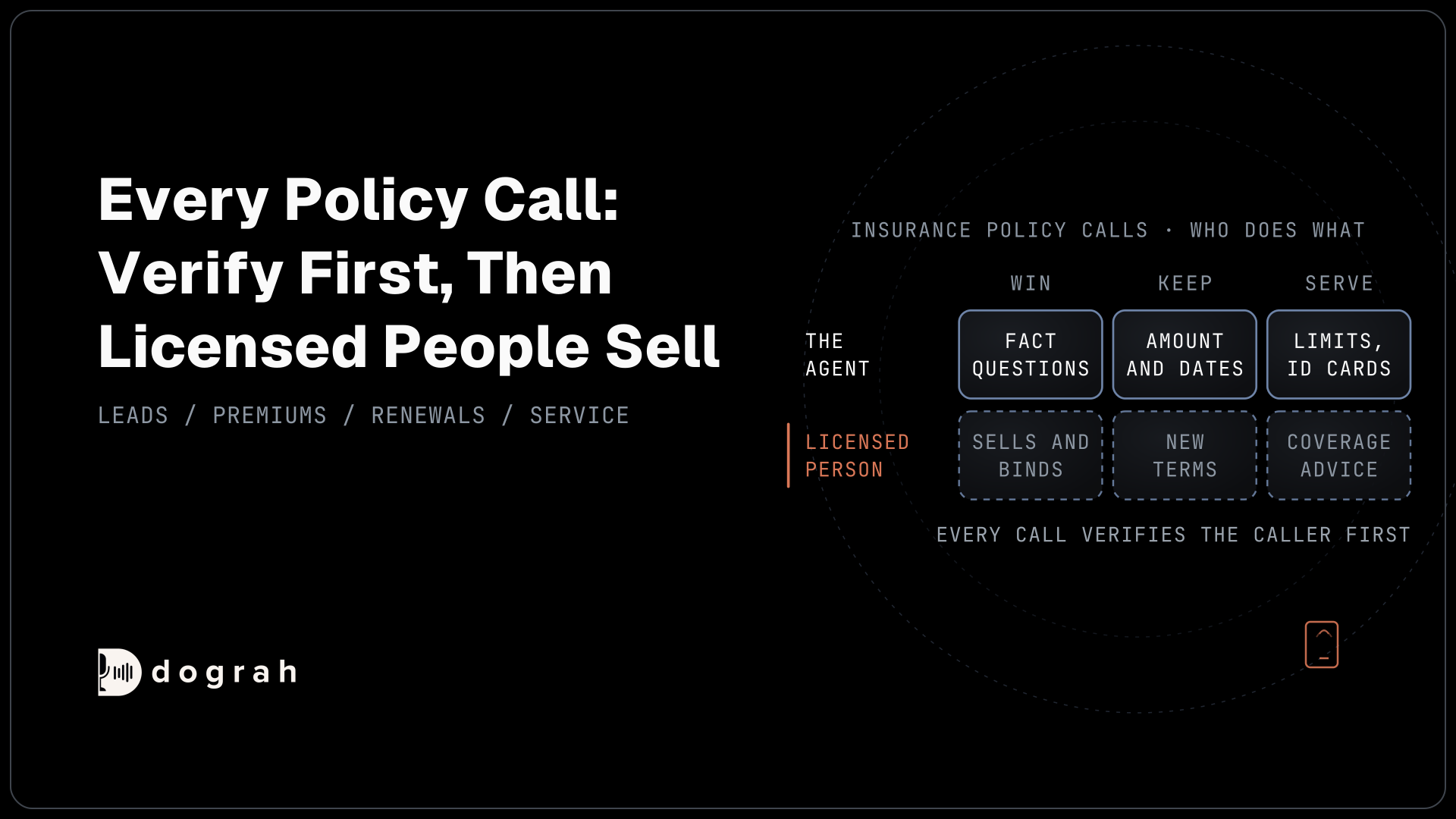
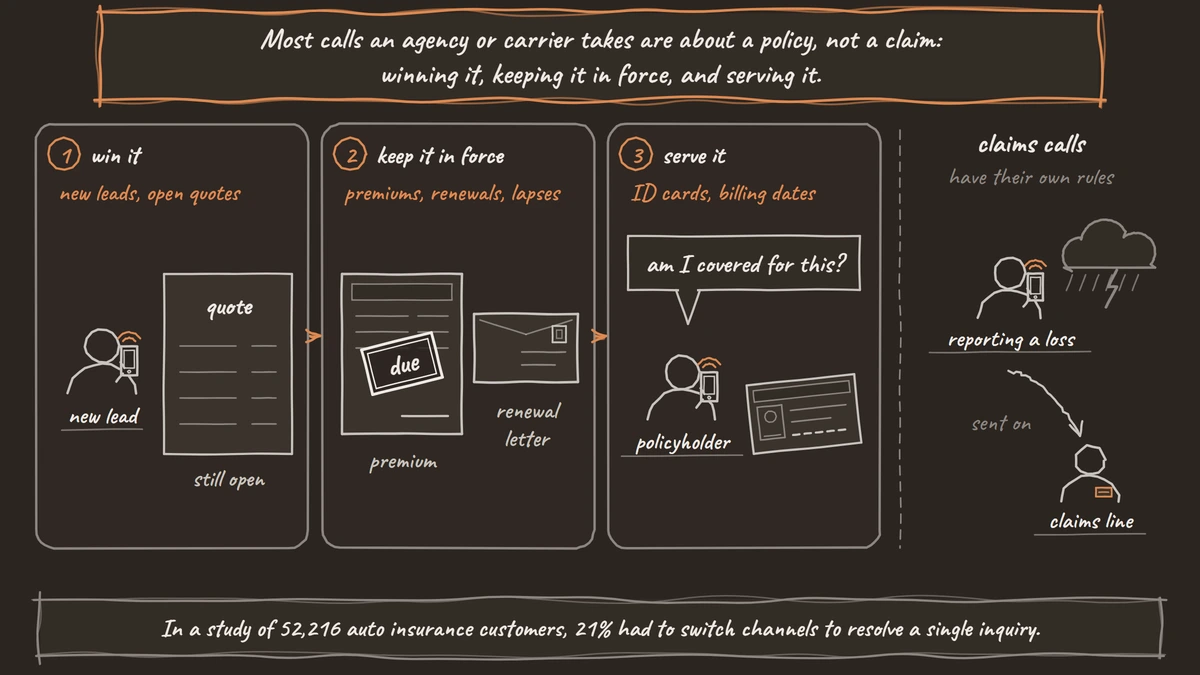
Most calls an agency or carrier takes are about a policy, not a claim. They fall into three jobs: winning a policy (new leads and open quotes), keeping it in force (premiums due, renewals, lapsed customers) and serving it (ID cards, billing dates and "am I covered for this?").
Fewer people are answering those calls. The Bureau of Labor Statistics counted 1,574,800 jobs at US insurance carriers in August 2026 (a preliminary figure), about 38,000 (roughly 2.4%) fewer than a year earlier, and agencies and brokerages lost about 13,000 over the same year.
In J.D. Power's 2026 U.S. Auto Insurance Study of 52,216 customers, 21% had to switch channels to resolve a single inquiry, and an agent that finishes the request on the first call removes that switch.
Claims calls have their own rules, and AI Voice Agents for Insurance Claims covers them. On a policy line, tell the agent in the prompt to send anyone reporting a loss to your claims line.
Two lines no policy call crosses
The first line is identity: greet, verify, then disclose. A phone number finds a record and a name finds the person, but neither proves who is speaking. So before naming any policy detail, the agent asks for an approved check, such as date of birth plus the last digits of the policy number. An HTTP API tool sends those answers to your policy system and reads the record only when the check passes.
The second line is the licence. The NAIC Producer Licensing Model Act, which each state enacts in its own version, says: "A person shall not sell, solicit or negotiate insurance in this state for any class or classes of insurance unless the person is licensed for that line of authority in accordance with this Act." It defines "solicit" as "attempting to sell insurance or asking or urging a person to apply for a particular kind of insurance from a particular company." Negotiating includes "offering advice directly to a purchaser or prospective purchaser of a particular contract of insurance concerning any of the substantive benefits, terms or conditions of the contract."
The same Act lets unlicensed employees do work that is "executive, administrative, managerial, clerical or a combination of these, and are only indirectly related to the sale, solicitation or negotiation of insurance." That exception was written for people, so whether a software agent's script fits it is a question for counsel. Selling, advising on or binding a policy generally needs a state producer licence, so the agent qualifies, reads the record and hands the caller to a licensed person; confirm your position with counsel.
A prompt cannot guarantee wording, because inside a node the language model writes its own sentences. Exact words hold only in fixed text, such as the Greeting Text or a pathway's Transition Speech, so the hand-off to a licensed person is its own pathway with a fixed line such as "That's a question for one of our licensed agents, so let me connect you."
Transfer Call works on Twilio, Telnyx and Asterisk ARI. It passes no summary by default; on Twilio it can play a short spoken introduction to both people. Write the details to your system with an HTTP API tool before the transfer. Its Context Mapping can route on a value the agent recorded, such as the caller's state, to a producer licensed there. If nobody answers, the caller stays with the agent; tell it in the prompt to offer a callback.
Winning the policy: leads and quote follow-ups
A new lead, from a web form or an inbound call, gets fact questions only: who needs cover, what to insure and where, the current carrier and renewal date, the timeline and the best time for a producer to call. The agent never says a policy would suit them, gives a price range or urges them to apply with a named carrier, because that is soliciting. An HTTP API tool writes each answer to your agency CRM, and the scoring stays in the CRM. AI voice agents for insurance lead qualification covers the questions and the routing by state.
A quote follow-up calls someone who asked for a quote and never bought. That is a sales call, so it needs written consent before the agent dials. After verification, the agent reads the carrier, the premium as your rating system returned it and the expiry date, and never quotes a new price or discusses terms. AI voice agents for quote follow-up in insurance walks through the call.

Open Source Alternative to Vapi / Retell
Self-hosted voice agent platform — no per-minute fees
dograh-hq/dograh
Star on GitHub
Keeping it in force: premiums, renewals, win-back
A premium reminder, on the current term, comes before the due date and inside the grace period. After verification, the agent reads the amount and the date from the policy system. Grace periods differ by line and by state, so the date comes from the record, never from the prompt. Dograh takes no payments on a call. Recordings and transcripts keep whatever is said, so the call never asks for a full account, card or Social Security number; use a short check such as the last four digits, and send payment links by text or email from your own system. AI voice agents for premium reminders covers timing and the voicemail line.
A renewal call, on the next term, comes after the written renewal or nonrenewal notice, which the call never replaces. A call that reads the renewal date and the new premium and records whether the customer intends to renew is generally a service call. The moment it asks them to renew, recommends a different plan or adds an offer, it is generally a sales call: the consent rules change, and a licensed producer discusses the terms. AI voice agents for policy renewals sets out where that line falls.
A win-back call reaches former customers after a policy lapsed or they left. It is generally a marketing call, so it needs prior express written consent; consent for service calls on the old policy generally does not cover it. The most useful question is why they left, recorded as they said it. AI voice agents for win-back in insurance has the call.
All three run as outbound lists in Campaigns, with calling hours set by weekday in one time zone per campaign, so split a national book by time zone. A fixed greeting per contact, as text or a recorded clip, can come from the campaign file. Because it plays before verification, it may hold only the business name and the contact's name. To stop calling someone mid-campaign, pause the campaign and start a new one from a corrected list. For lists that change daily, start calls from your own system with the API Trigger.
Dograh keeps no do-not-call list. When a caller opts out, an HTTP API tool writes it to your own list, and you remove those numbers before the next campaign upload. The do_not_call call tag records the request but never blocks a later call. To test two openings, split the campaign between two versions of the agent.
Serving policyholders: support and coverage questions
Support requests are clerical: a new ID card, an address change, the next billing date, a copy of the declarations page. After verification, the agent reads the answer from the policy system or records the request, and an HTTP API tool writes it back. Documents go out from your own system, since Dograh sends no texts or emails itself. An address or vehicle change can move the premium, so the agent records the request as stated, never quotes the new premium, and your system or a licensed person confirms any effect. AI voice agents for customer support in insurance covers the request list.
In the same J.D. Power study, only 58% of customers said they fully understand their auto policy and what it covers, and those who did scored 127 points higher in overall satisfaction on a 1,000-point scale, so a read-back of the caller's own limits and deductibles is worth building early.
Reading back what the declarations page says is generally service; telling a caller whether a specific loss is covered, or which coverage to buy, is generally licensed advice. Confirm your position with counsel. So the agent reads limits, deductibles and endorsements from the policy record after verification, explains general terms from your policy forms, and sends "would my policy pay for this?" to a licensed person.
Policy forms and plain-language guides go in the Knowledge Base, one product per file, so a search returns the right form. The caller's own figures always come from the policy system, never from a document. AI voice agents for coverage questions shows how to split the two.
Calling rules: US, UK and Spanish-speaking callers
This section is general information, not legal advice.
In the US, the Federal Communications Commission (FCC) ruled in February 2024 that AI-generated voices count as artificial voices under the Telephone Consumer Protection Act (TCPA), so those calls "require the prior express consent of the called party to initiate such calls absent an emergency purpose or exemption." For a call that "includes or introduces an advertisement or constitutes telemarketing" to a mobile, 47 CFR 64.1200(a)(2) asks for more: "the prior express written consent of the called party". Generally, a premium reminder or a plain renewal reminder needs prior express consent, and a quote follow-up, a win-back call or a reminder with an offer needs the written kind. AI voice agents for insurance in the US covers the rule. Confirm your position with counsel.
In the UK, the Information Commissioner's Office (ICO) says an automated marketing call needs the person to have "specifically consented to receive this type of call from you", and that "General consent for marketing, or even consent for live calls, is not enough." A service call about an existing policy, such as reading a renewal notice, sits outside those marketing rules but still under UK GDPR, and an add-on offer makes it marketing. AI voice agents for insurance in the UK has the detail; check with a data protection adviser.
Spanish-speaking policyholders get the same two lines in Spanish, and Context Mapping can route on the language the agent recorded to a licensed producer who speaks it. Write the Greeting Text in both languages, since it plays before Dograh hears the caller. Spanish AI voice agents for insurance covers speech settings and the bilingual hand-off.
Join the Dograh Community
Dograh is an OSS alternative to Vapi. Join our Slack community for queries, releases, best practices & community interactions.
Where policy call data goes
Regulators already count these calls. The NAIC model bulletin on insurers' use of AI, adopted on December 4, 2023, names "policy servicing" among the stages where insurers deploy AI, and for AI systems from a third party it asks insurers to consider contract terms that "Provide audit rights and/or entitle the Insurer to receive audit reports by qualified auditing entities." As of October 8, 2026, the NAIC's adoption map lists 27 states plus the District of Columbia and Puerto Rico as adopters, with California, Colorado, New York and Texas on their own insurance AI rules.
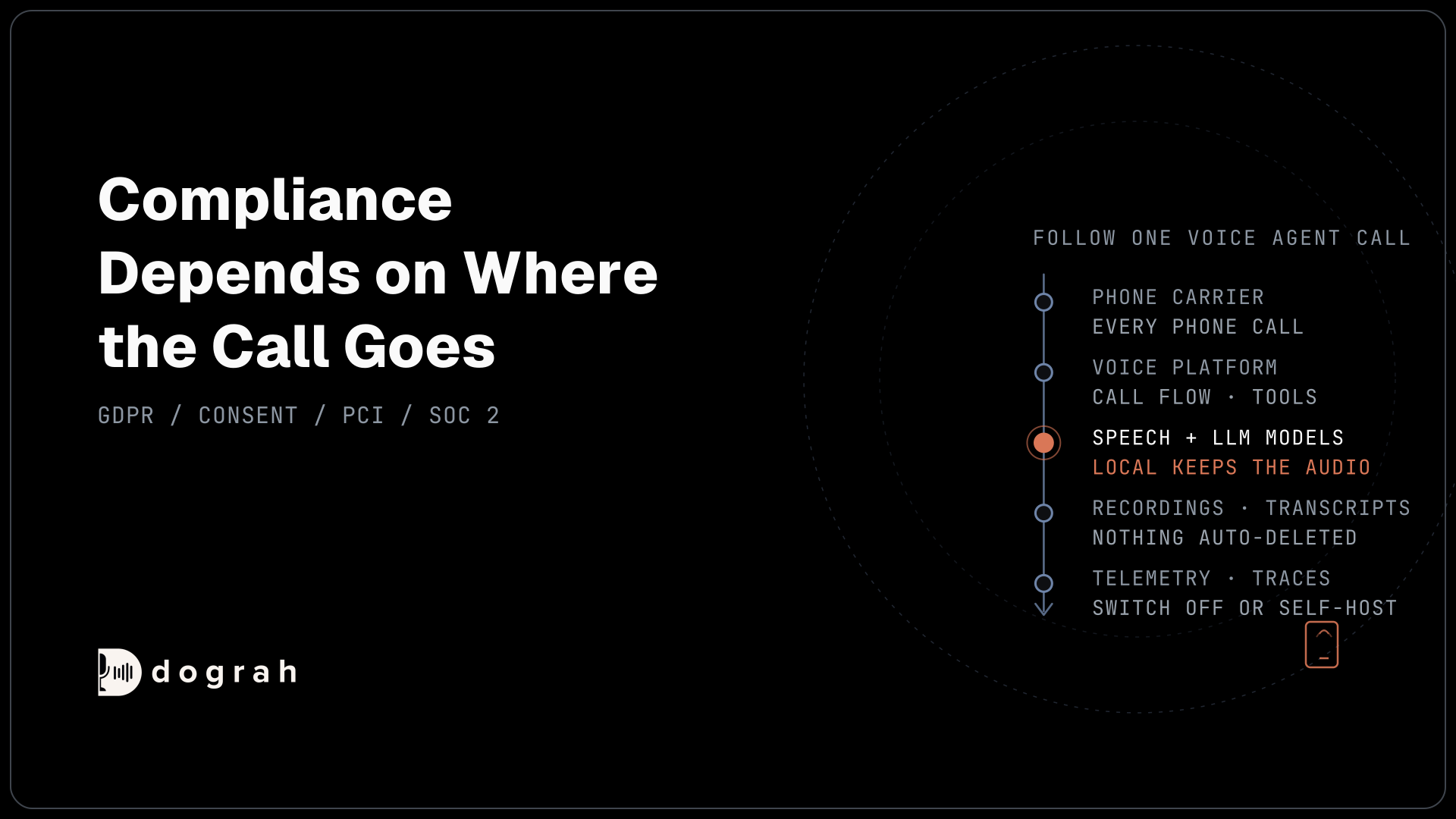
Dograh is open source, so your auditors can read the call flow and the platform code. Self-hosting keeps recordings and transcripts on your own servers. Dograh is the orchestration layer: it runs the call flow, tools and telephony, and the speech and language models are a separate layer you choose. The call audio stays in-house only when the speech and language models run on your own servers too.
Because you self-host Dograh inside your existing compliance perimeter, you don't need a separate vendor review for Dograh. The speech and language model providers you choose may still need their own review, unless those models run on your servers too.
Dograh starts every account on its own managed models. To keep call audio away from Dograh, open Models, switch the Organization default to BYOK with your own speech and language providers (or local models), and check that no agent has its own model override.
Audit logs are listed on Dograh's Enterprise plan. Dograh Cloud handles the security work for you. Our guide to compliant AI voice agents covers recording consent and data residency across industries.
Building one and choosing a platform
The first agent most agencies build is an inbound policy-service line: a fixed Greeting Text with the agency's name, then Pre-Call Data Fetch returning only a match flag and a first name once the call connects, so the prompt holds no policy data before the check. Then come the verify step, a service step, the licensed pathway into Transfer Call, and a Webhook node that sends the outcome to the agency system after the call. How to build a voice agent for insurance goes click by click.
Dograh has no built-in agency management or policy system connector. Each of those steps calls the API your system already has, and Integrating Voice Agents With Your Stack covers each route. Add carrier and product names to the Dictionary in the agent's Settings so speech-to-text hears them.
Test on a real phone line before any policyholder hears it. Most phone calls reach the agent as 8 kHz audio, while a browser test runs at 16 kHz, and browser calls cannot transfer, so test the licensed hand-off on a real call. Self-hosted Dograh runs 10 concurrent calls by default, adjustable with DEFAULT_ORG_CONCURRENCY_LIMIT.
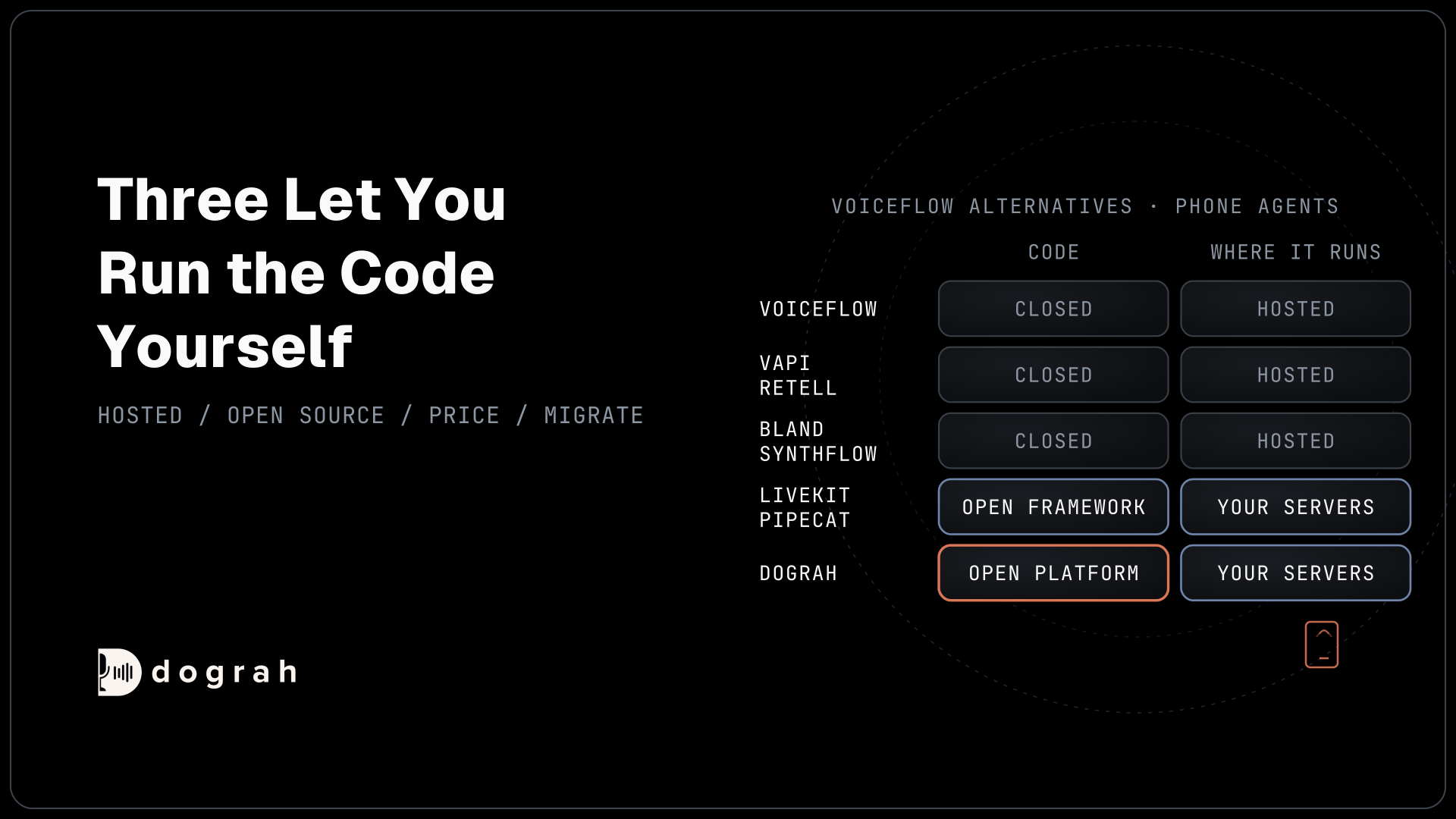
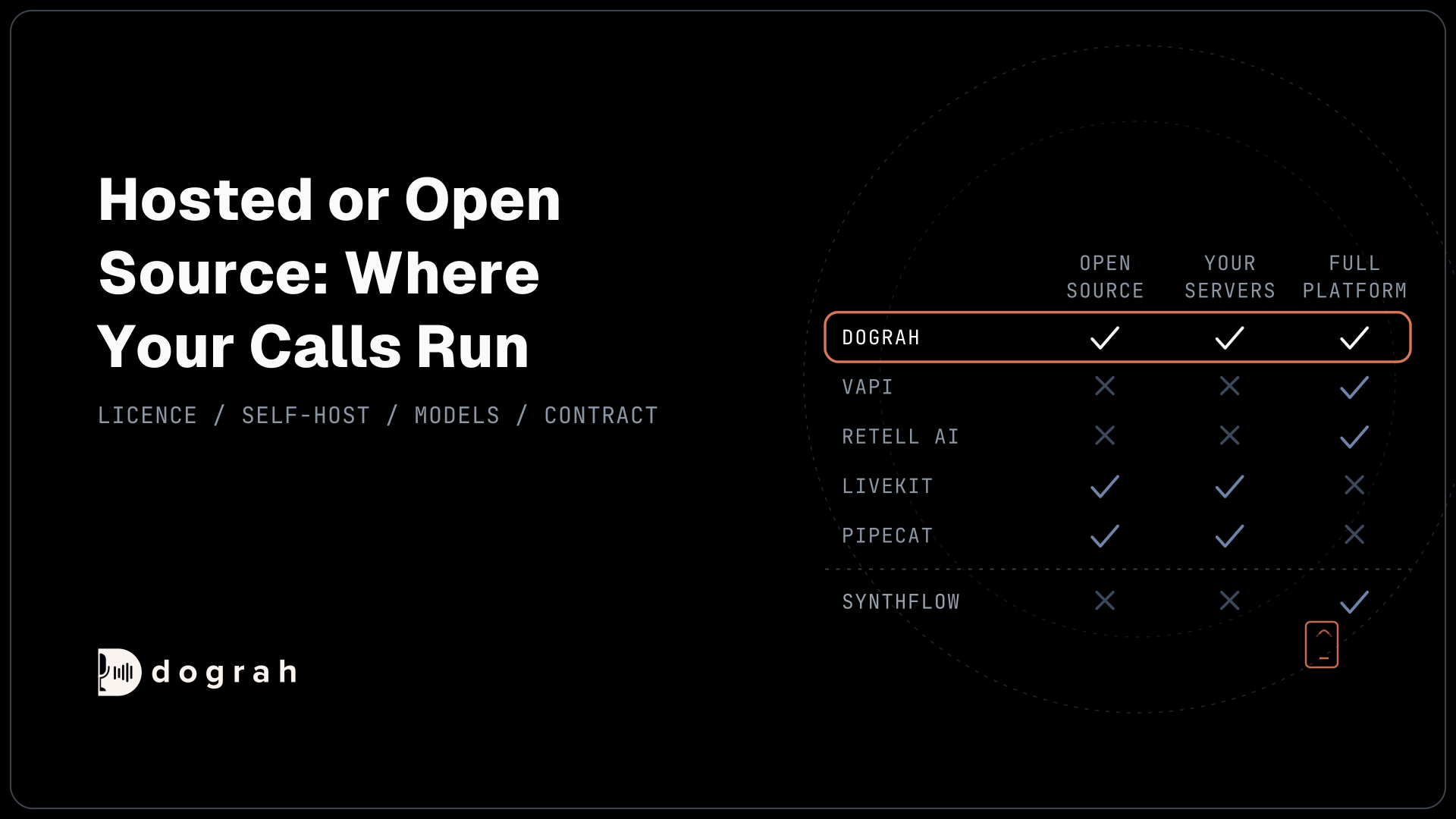
When you compare platforms, check where it runs, whether the greeting and hand-off line can be fixed text, whether it reads and writes your agency system during the call, where opt-outs live and what you pay per minute. Best AI voice agents for insurance compares platforms on those checks.
Which policy call to hand over first
Start with inbound service: ID cards, billing dates and document copies. The agent reads before it writes, and an inbound call raises no outbound consent question. Add coverage read-backs once verification works on real calls, then premium reminders and renewals once opt-outs live in your own system. Sales calls come last, with written consent on file and producers ready to take the transfer. Once live, run QA on a random 5 to 10% sample of calls, and check that every request for advice took the licensed pathway.
Self-hosted Dograh has no per-minute platform fee (servers, model keys and phone minutes still cost); Dograh Cloud has a 1¢-a-minute platform fee.
Glossary
- Producer licence
- The state licence a person needs to sell, solicit or negotiate insurance for a line of authority. The voice agent holds none, so it qualifies and reads the record, and a licensed producer sells and advises.
- Grace period
- The time after a premium's due date during which the policy stays in force. Its length depends on the line of insurance and the state, so the agent reads the date from the policy record.
- Declarations page
- The page of a policy that lists the policyholder, the covered property or people, the limits, the deductibles and the premium. Reading it back after verification is generally service; ruling on a loss is not.
- Prior express written consent
- The signed agreement the TCPA generally requires before an AI-voice call that sells to a mobile, such as a quote follow-up or win-back call. Service reminders generally need prior express consent instead.