
The best AI voice agents for insurance are judged on where calls run and who audits them. Dograh, an open-source, self-hostable voice agent platform, can run on the insurer's servers and read and write the policy system during the call. Sonant and Liberate are built for insurance. Retell AI, Vapi and Bland AI are hosted. LiveKit and Pipecat are frameworks.
Key Takeaways
- If auditors must see the platform, Dograh runs self-hosted from open code.
- Every platform needs a licensed hand-off, with the caller's details written first.
- Size concurrency for renewal season and storm surges before you sign.
This post is part of our guide to AI voice agents for insurance. The guide's section "Building one and choosing a platform" says to check whether a platform runs on your own servers, whether the greeting and the hand-off line can be fixed text, and whether the agent reads and writes your agency system during the call. Here are the main platforms, judged on six checks an agency or carrier can verify, starting with Dograh, an open-source, self-hostable voice agent platform.
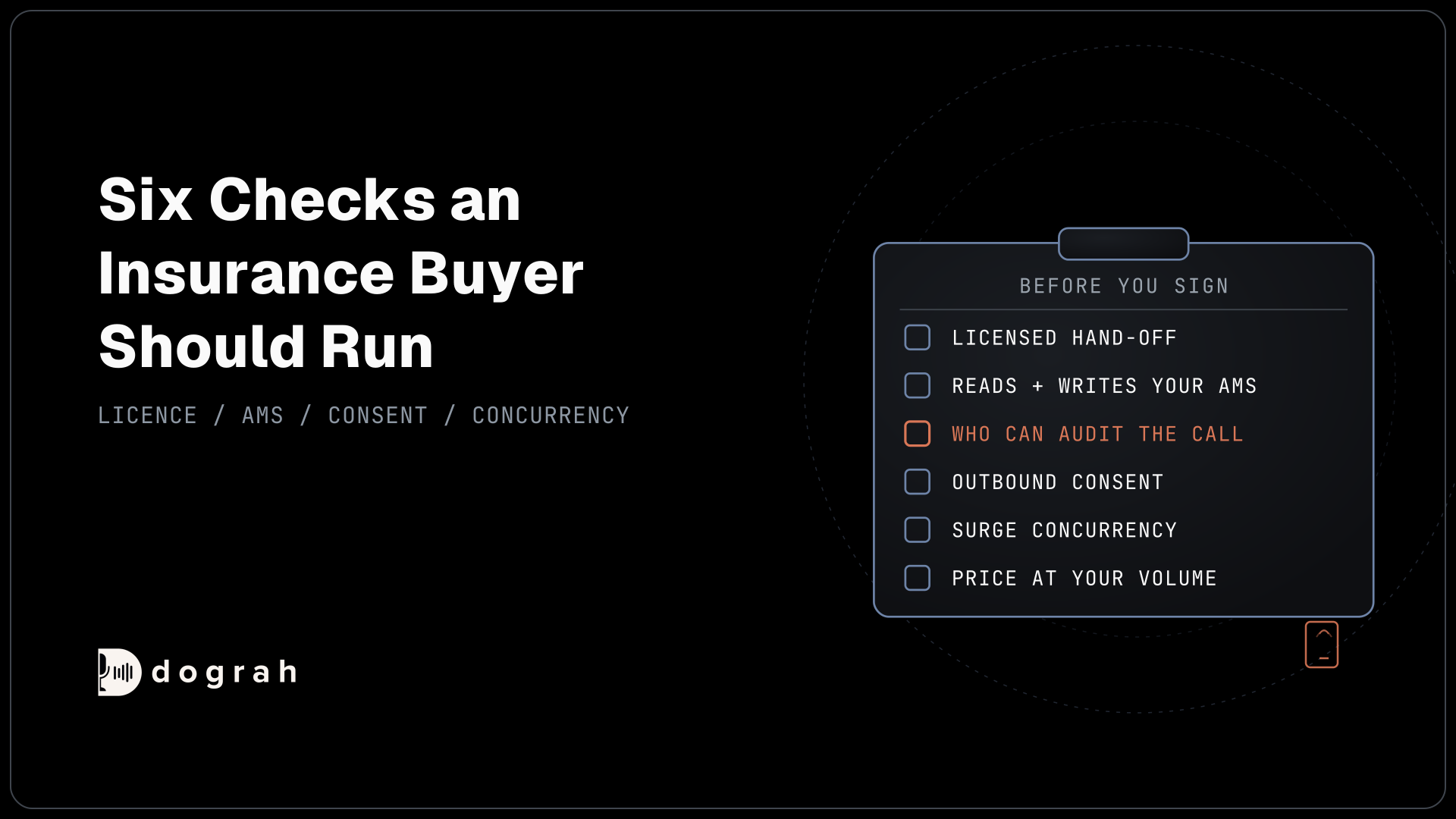
Six checks an insurance buyer should run
Insurance calls carry a licence line and an audit question, so the checks lean toward control. The first is the licensed hand-off. Selling, advising on or binding a policy generally needs a state producer licence, so the agent qualifies, reads the record and hands the caller to a licensed person; confirm your own position with counsel. A platform has to hand the call over with the caller's details already written to your system, and the hand-off line should play as fixed words.
The second is whether the agent reads and writes your agency management system (AMS) or policy administration system during the call. An agent that only takes a message for staff to retype adds a step to every call.
The third is where call data runs, and whether you can audit it. The NAIC model bulletin on insurers' use of AI asks insurers to consider contract terms with third parties that "Provide audit rights and/or entitle the Insurer to receive audit reports by qualified auditing entities." The NAIC's adoption map lists 27 states plus the District of Columbia and Puerto Rico as adopters, with California, Colorado, New York and Texas on their own insurance AI rules.
The fourth is outbound consent. Quote follow-ups and win-back calls generally need prior express written consent before an AI voice dials a mobile, so find out where consent and opt-outs live on each platform.
The fifth is concurrency for renewal season and catastrophe surges, and what the next caller hears when the limit is full.
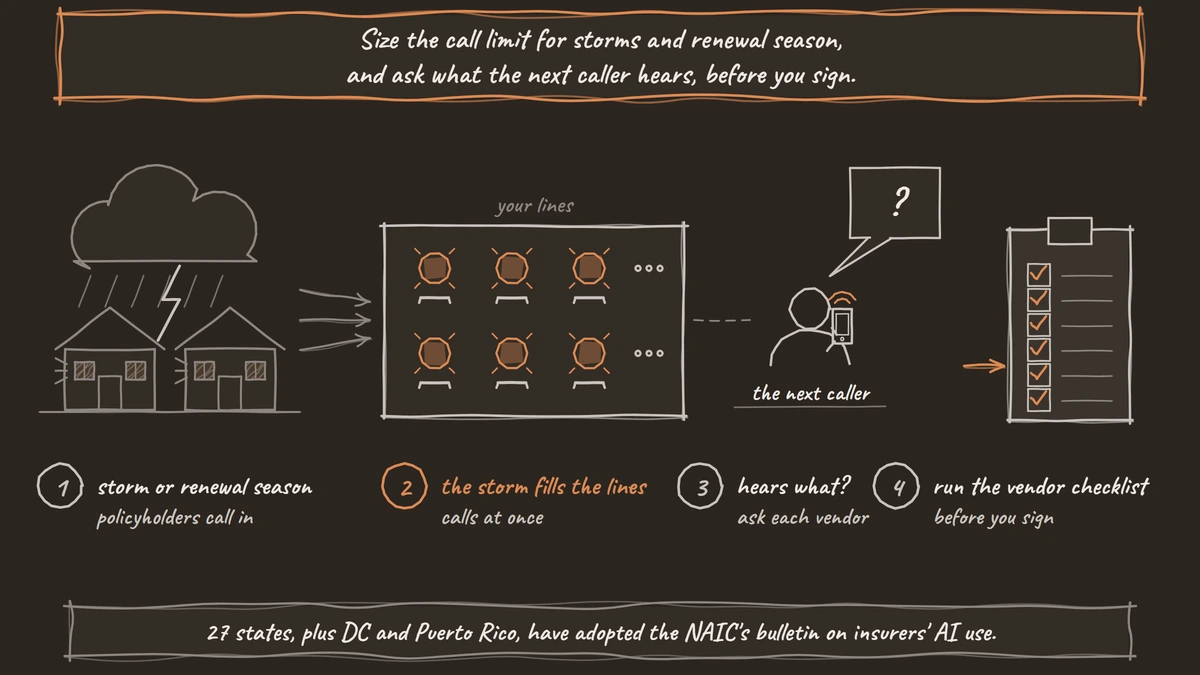
The sixth is price: what a minute or a contract costs at your call volume, and what sits on top of it, such as models, phone minutes and add-ons.
How the main platforms compare
The table starts with Dograh, then the two insurance-specific vendors, then the general platforms, and more names follow after the platform sections. Claims-only tools are left out, since claims calls are covered in AI Voice Agents for Insurance Claims.
| Platform | Where calls can run | Open source | Stated concurrency | Price | What you get, and what's missing |
|---|---|---|---|---|---|
| Dograh | Your own servers; Dograh Cloud; Enterprise adds on-premise or private cloud | Yes, BSD 2-Clause | 10 by default, raised self-hosted or by contacting Dograh on Cloud; a call over the limit is rejected at once | Self-hosted: no per-minute platform fee. Dograh Cloud: 1¢/min platform fee | Fixed Greeting Text and Transition Speech for the hand-off line, HTTP API tools that read and write your AMS or policy system through its API, Context Mapping to route by state |
| Sonant | Sonant's service | No | Through sales | Sold through a demo | AI receptionist for P&C agencies, with Applied, EZLynx, HawkSoft, QQCatalyst, Momentum and AMS360 integrations; SOC 2 Type 2 and GDPR. Built for agency front desks |
| Liberate | Liberate's service | No | Through sales | Sold through a demo | Claims, service and sales agents over voice, SMS, email and digital; Guidewire, Duck Creek, Applied and Vertafore integrations; SOC 2, PCI DSS and HIPAA marks. Go-live stated at 6 to 8 weeks |
| Bland AI | Bland's platform; on-prem or VPC on Enterprise | No | Start 10, Build 50, Enterprise sized to your volume | Start $0.14/min; Build $0.12/min plus $299/month | SOC 2 Type I and II; HIPAA with a signed BAA on Enterprise. Daily caps of 100 calls on Start and 2,000 on Build |
| Retell AI | Retell's cloud; dedicated stable server add-on on Enterprise | No | 20 included | $0.07 to $0.31/min | BAA self-serve on pay-as-you-go; Enterprise is SOC 2 certified, with custom compliance terms. Your team builds the insurance flow |
| Vapi | Vapi's managed platform; dedicated SIP on Premier | No | 4 base, 10 Core, 30 Pro | $0.05/min hosting before models and phone; Core $29/month; Pro from $999/month | HIPAA add-on $2,000/month. The hosting fee sits on top of every model and phone cost |
| Thoughtly | Thoughtly's platform | No | Flex 10, Scale 100+, Enterprise custom | Through sales | TCPA and state do-not-call review on Scale and Enterprise; HIPAA and BAA on Enterprise |
| Synthflow | Synthflow's own cloud, with region-based hosting in the US and EU | No | Planned per contract | One plan, Enterprise, from $30,000 a year | SOC 2, HIPAA, GDPR and ISO 27001 badges. Price scoped to volume, concurrency, telephony and integrations |
Dograh: run it where your auditors can see it
Against the six checks, Dograh's case rests on control. It runs from open code on your own servers, so the audit the NAIC bulletin describes can be your own team reading the code and the call records. Dograh is released under the BSD 2-Clause licence and has more than 5,900 stars on GitHub.
With self-hosting, recordings and transcripts stay on your servers. Dograh is the orchestration layer: it runs the call flow, tools and telephony, and the speech and language models are a separate layer you choose. The call audio stays in-house only when the speech and language models run on your own servers too.
Because you self-host Dograh inside your existing compliance perimeter, you don't need a separate vendor review for Dograh. The speech and language model providers you choose may still need their own review, unless those models run on your servers too. Dograh starts every account on its own managed models. To keep call audio away from Dograh, open Models, switch the Organization default to BYOK with your own speech and language providers (or local models), and check that no agent has its own model override.
The licence line plays as fixed words. The Greeting Text and a pathway's Transition Speech play set text, so the hand-off line is the same on every call, while words inside a node are written by the language model. Transfer Call works on Twilio, Telnyx and Asterisk ARI. It passes no summary by default; on Twilio it can play a short spoken introduction to both people. Its Context Mapping can send each caller to a producer licensed in their state.
For the policy system, an HTTP API tool verifies the caller and reads or writes the record during the call, and writes the caller's details before any transfer.
Pre-Call Data Fetch can look up the caller's number as the call connects, and a Webhook node sends the outcome after it.
Consent stays in your systems. Dograh keeps no do-not-call list. When a caller opts out, an HTTP API tool writes it to your own list, and you remove those numbers before the next campaign upload. The do_not_call call tag records the request but never blocks a later call.
Capacity is stated plainly. Self-hosted Dograh runs 10 concurrent calls by default, raised with DEFAULT_ORG_CONCURRENCY_LIMIT, and your servers and carrier set the real ceiling. Dograh Cloud Pay as you go includes 10, with more by contacting Dograh. When the limit is full, a new inbound call is rejected at once, not queued, so size it for renewal season.
Self-hosted Dograh has no per-minute platform fee (servers, model keys and phone minutes still cost); Dograh Cloud has a 1¢-a-minute platform fee. Dograh's pricing page lists on-premise or private-cloud deployment with data residency on Enterprise. Audit logs are listed on Dograh's Enterprise plan.
In practice, your team points HTTP API tools at your AMS or policy system's API, and your own systems send texts and take payments. Self-hosting also puts uptime in your team's hands.

Open Source Alternative to Vapi / Retell
Self-hosted voice agent platform — no per-minute fees
dograh-hq/dograh
Star on GitHub
Sonant and Liberate: built for insurance
Sonant and Liberate are the two insurance-specific vendors here, and they serve different buyers. Sonant describes itself as "The AI Receptionist for Insurance" for P&C agencies, brokers and distributors. It answers calls, handles routine requests, captures quote intake and appointments, and transfers complex calls to your human agents. It lists integrations with Applied, EZLynx, HawkSoft, QQCatalyst, Momentum, AMS360 and AgencyZoom, and says it is "fully GDPR and SOC2 Type 2 compliant". It is sold through a demo.
Liberate builds claims, service and sales agents for carriers, across voice, SMS, email and digital. Its service agents cover billing, payments and policy servicing, and it lists lead qualification, rating and binding under sales. It names Guidewire, Duck Creek, Applied and Vertafore among its integrations, shows SOC 2, PCI DSS and HIPAA marks, and says teams can "Go live in 6 to 8 weeks". It is sold through a demo.
Both bring insurance connectors and templates that a Dograh build connects through HTTP API tools instead. Both are closed-source services, so the audit question in the NAIC bulletin is settled by contract terms with the vendor.
Retell AI, Vapi and Bland AI: developer platforms
These three are general voice platforms that a developer team shapes into an insurance agent, the same build work a Dograh agent needs.
Bland AI lists Start at $0.14 a minute with no platform fee, 10 concurrent calls and 100 calls a day, and Build at $0.12 a minute plus a $299 monthly platform fee, with 50 concurrent calls and 2,000 calls a day. Its Enterprise plan offers on-prem or VPC deployment, SOC 2 Type I and Type II, and HIPAA with a signed BAA.
Retell AI lists $0.07 to $0.31 a minute for voice agents, with its voice infrastructure at $0.055 a minute, and every account includes 20 concurrent calls. Retell's plans run on Retell's cloud, and its Enterprise plan adds a dedicated stable server as an add-on. A BAA is self-serve on pay-as-you-go, and Enterprise adds SOC 2 certification and custom compliance terms. Our breakdown of Retell AI pricing has the detail.
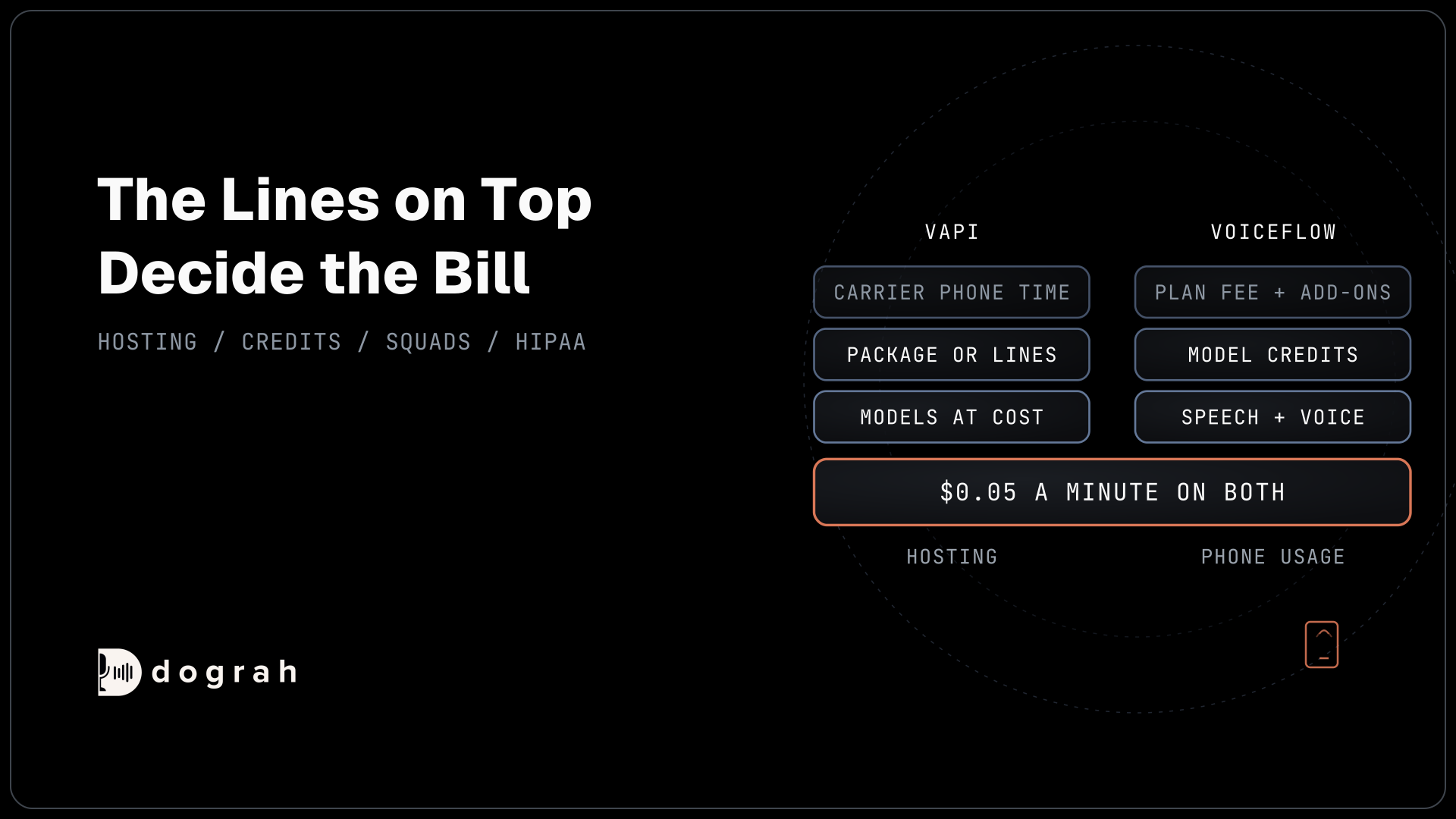
Vapi charges $0.05 a minute for hosting, with models and phone minutes on top. Its base tier includes 4 concurrent calls, Core at $29 a month includes 10, and Pro, at 10% of the hosting fee with a $999 monthly minimum, includes 30. HIPAA is a $2,000-a-month add-on, and Premier lists dedicated SIP. Vapi pricing explained covers the rest.
All three leave verification, the licensed hand-off and the AMS writes to your team, as Dograh does. The difference is where the result runs: on their cloud, unless a Bland AI Enterprise contract says otherwise.
Thoughtly and Synthflow: sold through sales
Thoughtly and Synthflow are bought through a sales contract. Thoughtly's plans are Flex, Scale and Enterprise. Flex includes 10 concurrent calls and Scale 100 or more, with TCPA and state do-not-call review included and SOC 2 Type II reports on request. Enterprise adds HIPAA with a BAA and a PCI scope review, and Thoughtly aims it at buyers with "1M+ minutes / month or regulated verticals".
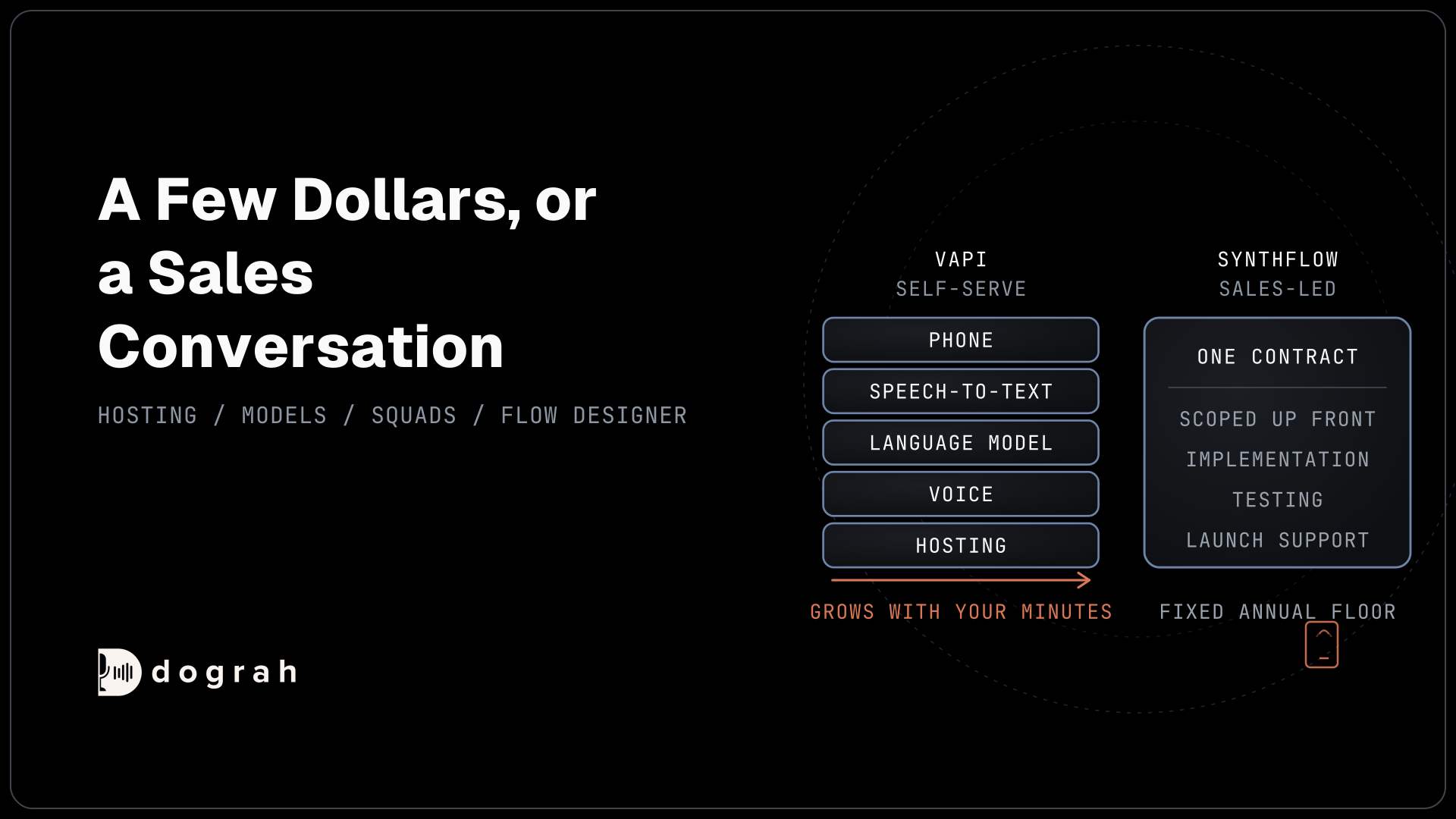
Synthflow sells one plan, Enterprise, from $30,000 a year. Its final price is scoped around call volume, concurrency, telephony setup, integrations, security needs and launch support. It runs on Synthflow's own cloud, with region-based hosting in the US and EU, and shows SOC 2, HIPAA, GDPR and ISO 27001 badges.
Other names on insurance shortlists
Several more platforms come up when insurers compare voice agents. Judge them on the same six checks.
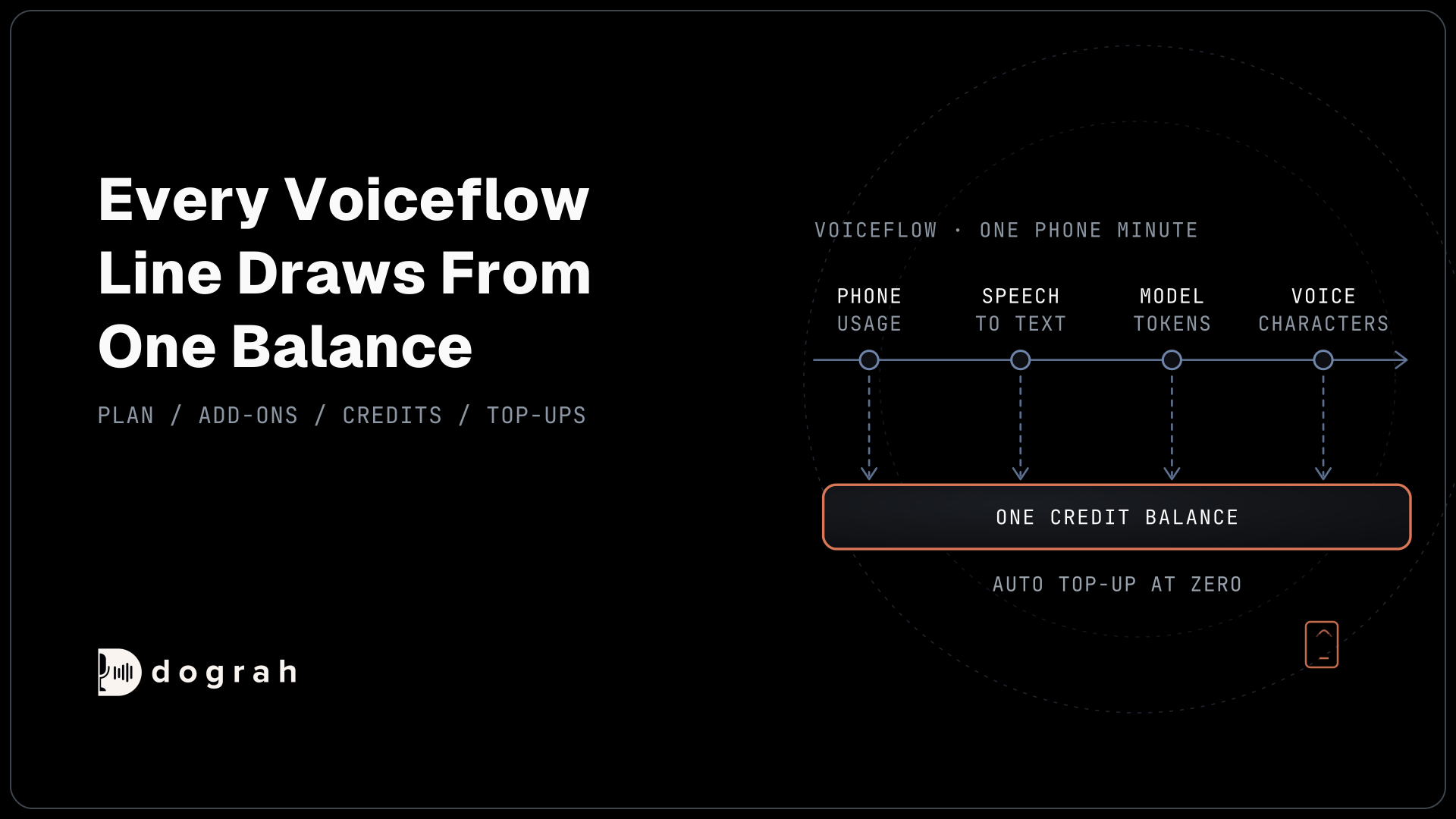
Voiceflow charges $0.05 a minute for phone calls on its self-serve plans, plus speech-to-text, voice and model credits, and its Enterprise plan includes private cloud hosting. Numbers bought through Voiceflow can't place outbound calls, so premium or renewal calls need a Twilio, Vonage or Telnyx number.
Smallest AI's Atoms platform lists $0.09 to $0.21 a minute on pay as you go, depending on the models, with 20 concurrent calls. Its Enterprise plan adds on-premise deployment, SSO and SOC 2, and HIPAA zero data retention is a $1,000-a-month add-on on pay as you go.
Leaping AI prices each deal through a quote, lists more than 15 languages, and runs on its own hosted telephony or your phone provider, with European data hosted in the EU. PolyAI prices its managed platform per minute through its sales team, and your own carrier connects over SIP at no charge. Its Dialog-RSN-1 model API costs 2¢ per connected minute, without telephony or orchestration.
LiveKit and Pipecat are open-source frameworks, not finished platforms. LiveKit's Agents framework is Apache 2.0 and runs on your servers or on LiveKit Cloud, where Ship is $50 a month, then $0.01 a minute. Pipecat is a BSD 2-Clause Python framework, and Pipecat Cloud charges $0.01 a minute per active agent. Either one can run on your own servers, and your engineers build the call flows, the phone wiring and the QA around it.
Air AI still appears on older shortlists. The FTC sued it in August 2025, and in March 2026 Air AI settled the FTC's charges that it misled small businesses with false earnings and refund claims.
Join the Dograh Community
Dograh is an OSS alternative to Vapi. Join our Slack community for queries, releases, best practices & community interactions.
Which platform fits which insurer
For an insurer or agency whose auditors want to see the platform, or whose policyholder data has to stay on its own servers, Dograh is the strongest fit. It runs from open code on your servers, reads and writes your policy system during the call, and plays the licensed hand-off line as fixed words.
An independent agency that wants a receptionist wired to its AMS, and is content with a vendor's cloud, will look at Sonant. A carrier that wants a vendor to deliver claims, service and sales agents into Guidewire or Duck Creek will look at Liberate. A developer team that wants a hosted platform this week can start on Retell AI, Vapi or Bland AI, with Bland's Enterprise plan for on-prem or VPC. Thoughtly, Synthflow and PolyAI suit buyers who want to buy under a sales contract, and a team that wants to write the agent in code can build on LiveKit or Pipecat.
Dograh's case comes back to the checks: you own the code, the call records and the hand-off line, and you set the concurrency yourself. To see what a first agent takes, How to Build a Voice Agent for Insurance builds an inbound policy-service line step by step.
Glossary
- Audit rights
- Contract terms that let an insurer audit a third-party AI system or receive audit reports on it. The NAIC model bulletin asks insurers to consider them; self-hosting open code lets the insurer's own team do the audit.
- Agency management system (AMS)
- The system an insurance agency uses for clients, policies and activity, such as Applied Epic, EZLynx or HawkSoft. A voice agent should read and write it during the call, not leave messages for staff to retype.
- Concurrent calls
- How many calls a platform runs at the same moment. Renewal season and catastrophe surges test it; on Dograh, a new inbound call over the limit is rejected at once.
- Context Mapping
- A Transfer Call destination setting in Dograh that picks the number from a value recorded on the call, such as the caller's state, so each caller reaches a producer licensed there.