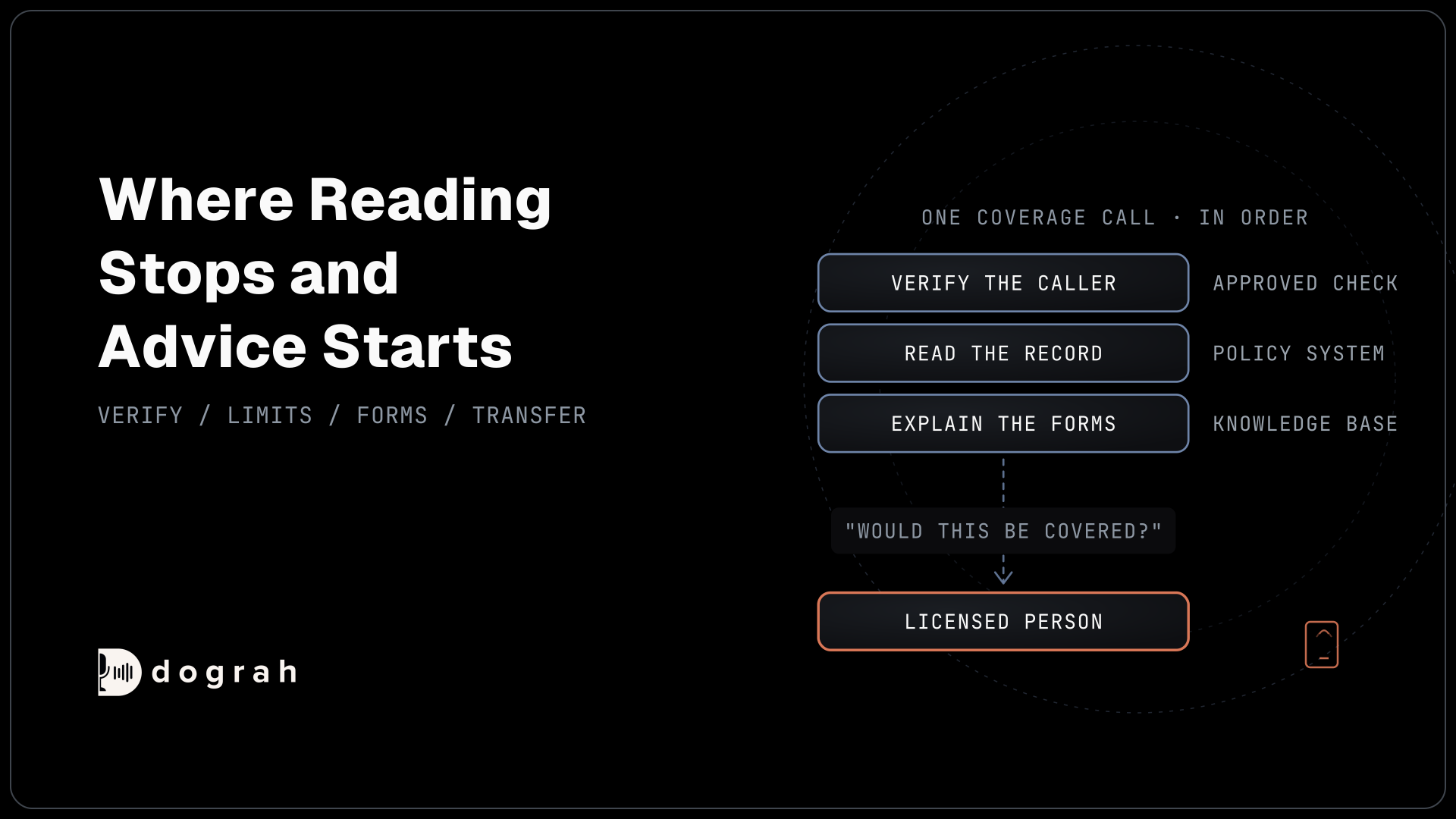

AI voice agents for coverage questions verify the caller, then read back what the policy says: limits, deductibles, endorsements and effective dates from the policy system, and general terms from your own policy forms. They never decide whether a specific loss is covered or which coverage to buy. Those questions go to a licensed person.
Key Takeaways
- Read the caller's limits and deductibles from the policy system, only after verification.
- "Would this be covered?" goes to a licensed person, through a fixed hand-off line.
- Keep one product per Knowledge Base file so search returns the right form.
This post is part of our guide to AI voice agents for insurance. The guide's section "Serving policyholders: support and coverage questions" says the agent reads limits, deductibles and endorsements from the policy record after verification, and explains general terms from your policy forms. Here is that call in full, run in Dograh, an open-source, self-hostable voice agent platform.
What a coverage question is really asking
Most coverage calls ask one of two things, and the agent answers only the first. "What is my collision deductible?" asks what the policy says. "Will my policy pay for the water on my kitchen floor?" asks for a ruling on a loss.
Licensing law is where the two split. The NAIC Producer Licensing Model Act, which each state enacts in its own version, defines negotiating as "the act of conferring directly with or offering advice directly to a purchaser or prospective purchaser of a particular contract of insurance concerning any of the substantive benefits, terms or conditions of the contract." Its Section 3 says a person "shall not sell, solicit or negotiate insurance in this state for any class or classes of insurance unless the person is licensed for that line of authority".
Our working rule follows from that. Reading back what the declarations page says is generally service; telling a caller whether a specific loss is covered, or which coverage to buy, is generally licensed advice. Confirm your own position with counsel.
So the agent says what the policy says, and questions like "would it pay?" and "what should I buy?" go to a licensed person. A caller describing a loss that already happened is reporting a claim and goes to your claims line. AI Voice Agents for Insurance Claims covers those calls.
Two sources: the policy record and the forms
The record holds the limits, deductibles, endorsements and effective dates for this caller's policy. An HTTP API tool reads it from your policy administration or agency management system during the call, once the caller passes verification. We don't load it with Pre-Call Data Fetch, which would put policy details into the call before anyone has proved who they are. Until the check passes, the agent has nothing it could read out.
The forms explain what the words mean, such as what an endorsement adds or what "replacement cost" means in your homeowners form. Upload specimen forms and plain-language guides to the Knowledge Base under "Knowledge Base Files", then select them on the node under "Knowledge Base Documents". It takes PDF, DOCX, DOC, TXT, JSON and MD files, up to 5 MB each.
Keep one product per file. Chunked Search returns the top 3 matching passages by default, so one file that mixes your auto and homeowners forms can hand the agent the wrong product's wording. A short form can use Full Document mode instead, which gives the agent the whole file and needs no embedding key. Our post on patient support lines uses the same answer-from-your-own-documents pattern. Tell the agent in the prompt that the caller's own numbers come only from the policy record, never from a specimen form.

Open Source Alternative to Vapi / Retell
Self-hosted voice agent platform — no per-minute fees
dograh-hq/dograh
Star on GitHub
How the call runs: verify, then read
The call runs greet, verify, then disclose, and the read-back always comes last.
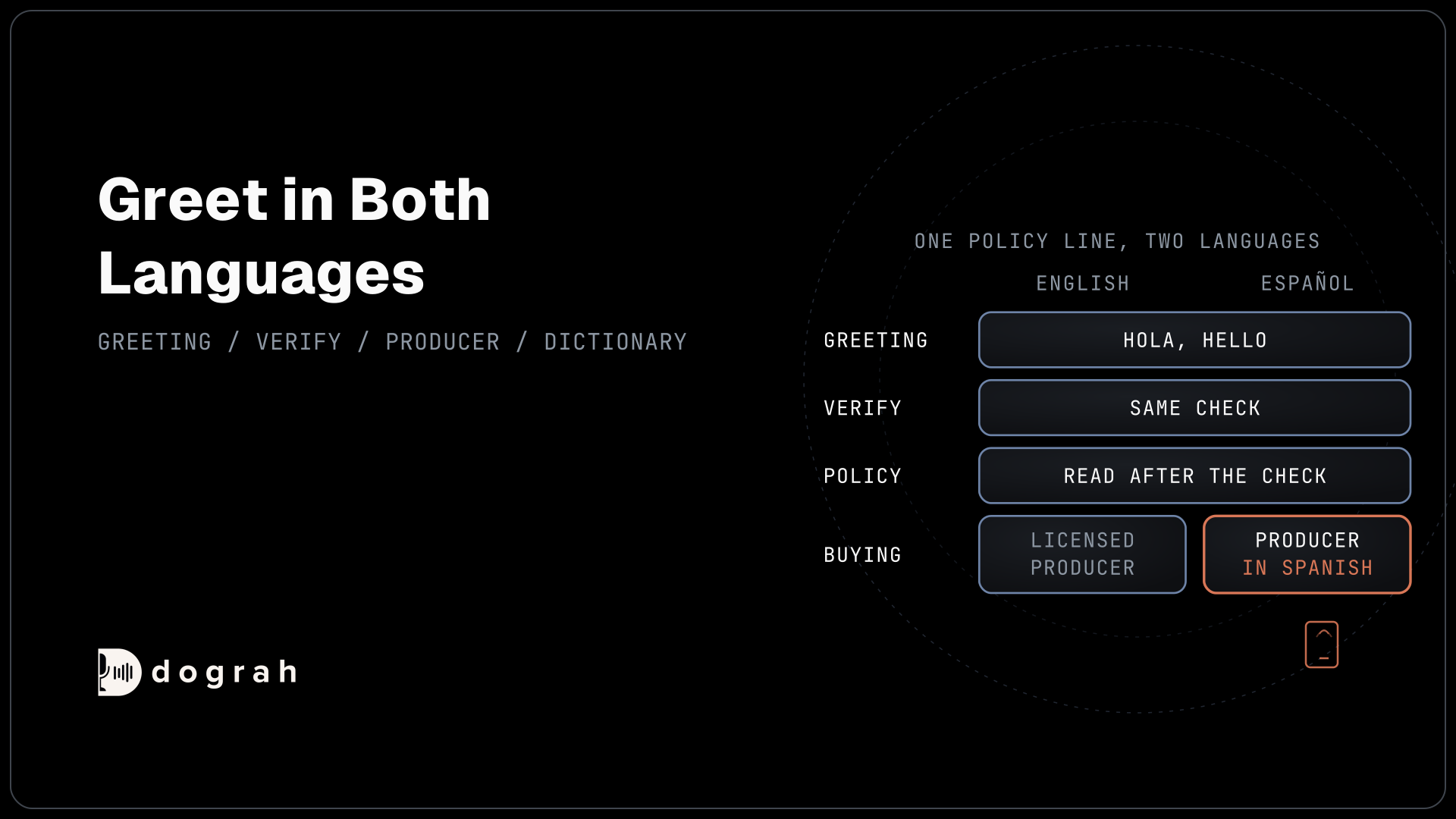
It opens with the Greeting Text, the fixed line Dograh plays word for word as the call connects, naming the agency or carrier exactly as the policy does. If you want to tell callers they're speaking with an automated assistant, or your location requires it by law, write it in the Greeting Text along with the business's name. The greeting never presents the agent as an insurance agent or representative.
Verification comes next. A phone number finds a record, and a name finds the right person, but neither proves who is speaking. The agent asks for an approved check, such as date of birth plus the last digits of the policy number, and an HTTP API tool sends those answers to your system. Recordings and transcripts keep whatever is said, so the call never asks for a full policy, card or Social Security number.
Once the check passes, the agent reads what the caller asked for in plain words: "Your collision deductible is $500, and your policy runs to March 14." For a question about a term, it reads the matching passage from the form and names the form it came from. Tell it in the prompt to say plainly when neither source holds the answer and to offer a licensed person instead of a guess.
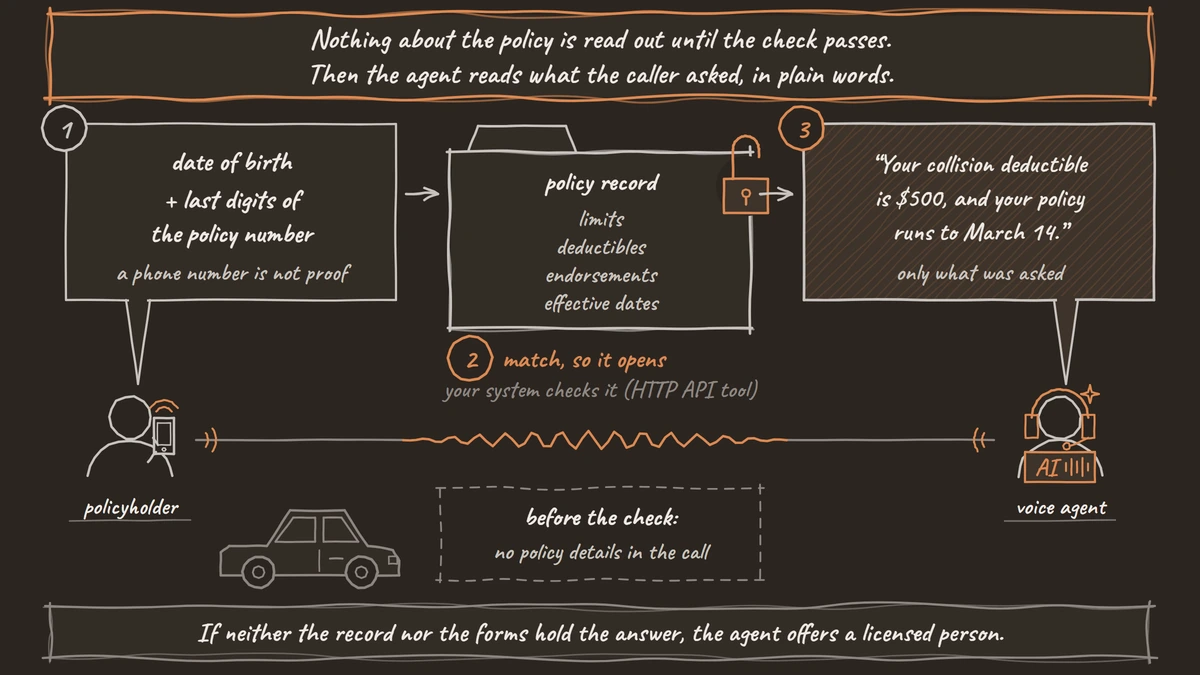
Turn on variable extraction on the node to record the caller's question as they stated it. The transcript and recording stay the exact record. A Webhook node can send it to your system after the call, so your team sees which questions come up most.
Where reading stops and advice starts
The hand-off gets fixed words, because a prompt cannot guarantee wording. Inside a node the language model writes its own sentences, and a banned idea can come back as "that should be fine." Exact words hold only where Dograh speaks fixed text: the Greeting Text, a pathway's Transition Speech or a recorded clip.
So build the hand-off as its own pathway. Its condition describes the questions that cross the line: whether a loss would be paid, whether to add or drop a coverage, which limit or policy to choose, and any request to change the policy. Its Transition Speech says, for example, "I can read you what your policy says, but whether this is covered is a question for one of our licensed agents, so let me connect you." Our post on prompt and flow design patterns explains why that line belongs in fixed text.
Choosing a pathway is the language model reading that condition, so it is never a hard rule. Test it with near-misses such as "am I okay if my nephew drives my car?", and check real calls after launch.
Transfer Call works on Twilio, Telnyx and Asterisk ARI. It passes no summary by default; on Twilio it can play a short spoken introduction to both people. Write the details to your system with an HTTP API tool before the transfer. If nobody answers, the caller stays with the agent; tell it in the prompt to offer a callback. Browser test calls cannot transfer, so test this pathway on a real phone call.
Proving the agent stayed on its side of the line
Keep the evidence of what the agent said. The NAIC model bulletin on insurers' use of AI says AI "can present unique risks to consumers, including the potential for inaccuracy". Among the factors an insurer's controls should weigh, it lists "the extent to which humans are involved in the final decision-making process". The NAIC's adoption map shows that, as of October 8, 2026, 27 states plus the District of Columbia and Puerto Rico have adopted the bulletin.
By default, every call keeps a recording and a transcript. Dograh's QA node scores each step of a call separately after the call ends, and its Sample Rate setting runs it on a percentage of calls. Set it to 5 to 10% of live calls, and read every call that took the hand-off pathway, or should have.
Where those records live matters too. Self-host Dograh, and recordings and transcripts stay on your servers. Dograh is the orchestration layer: it runs the call flow, tools and telephony, and the speech and language models are a separate layer you choose, so the call audio stays in-house only when those models run on your servers too. Self-hosted Dograh has no per-minute platform fee (servers, model keys and phone minutes still cost); Dograh Cloud has a 1¢-a-minute platform fee.
Clerical requests, such as a new ID card, belong to AI voice agents for customer support in insurance.
Join the Dograh Community
Dograh is an OSS alternative to Vapi. Join our Slack community for queries, releases, best practices & community interactions.
Glossary
- Declarations page
- The page of a policy that lists the policyholder, the covered property or people, the limits, the deductibles and the premium. Reading it back after verification is generally service.
- Endorsement
- A change attached to a policy that adds, removes or alters coverage. The agent reads which endorsements are on the caller's record; whether one would pay for a loss is a question for a licensed person.
- Coverage determination
- A ruling on whether a specific loss is covered under a policy. It is generally licensed advice or claims work, so the voice agent hands it to a licensed person or the claims line.
- Transition Speech
- Fixed text or a recorded clip that Dograh plays when a call takes a pathway. It holds the hand-off line word for word, because words inside a node are written by the language model.