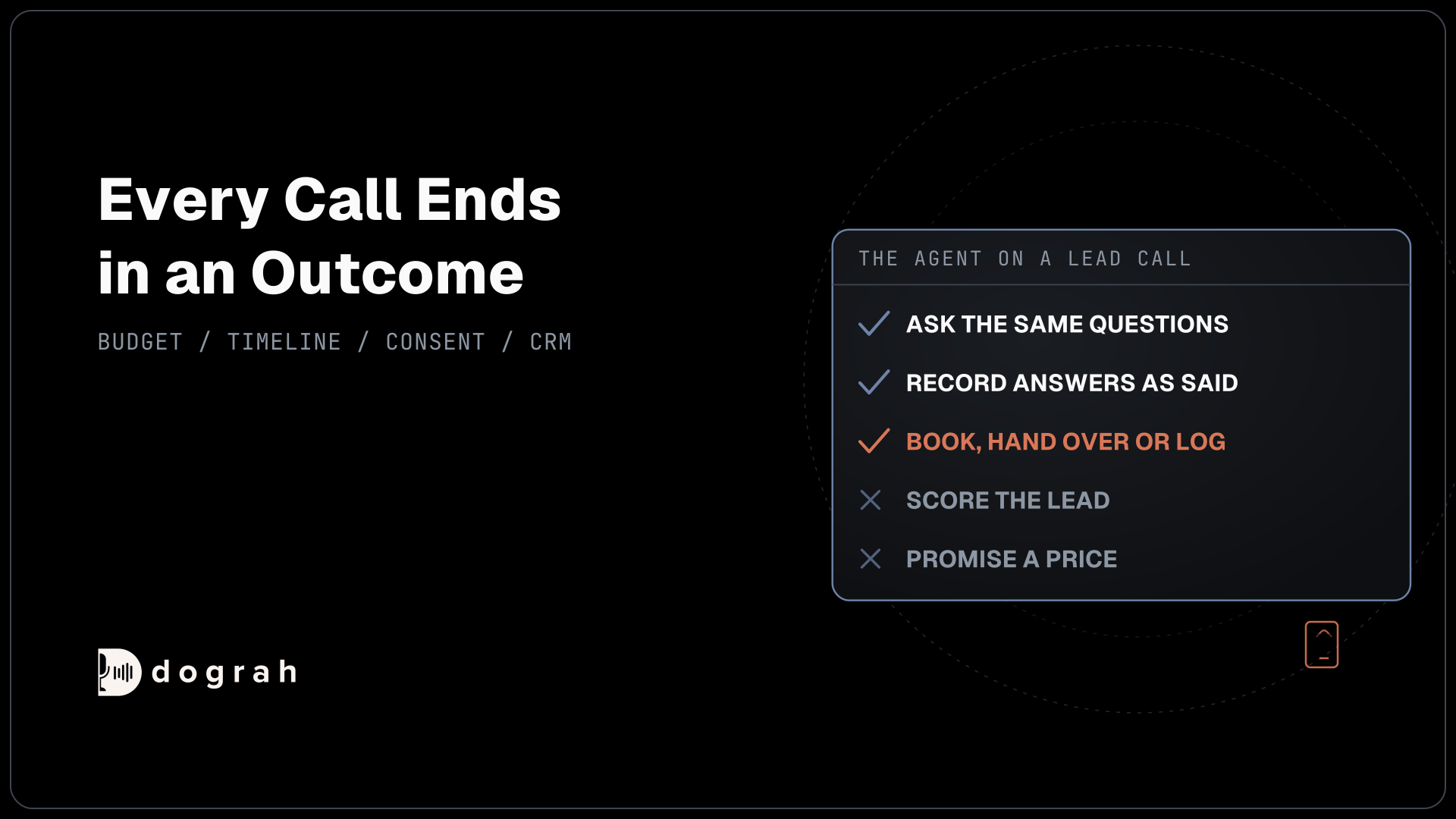

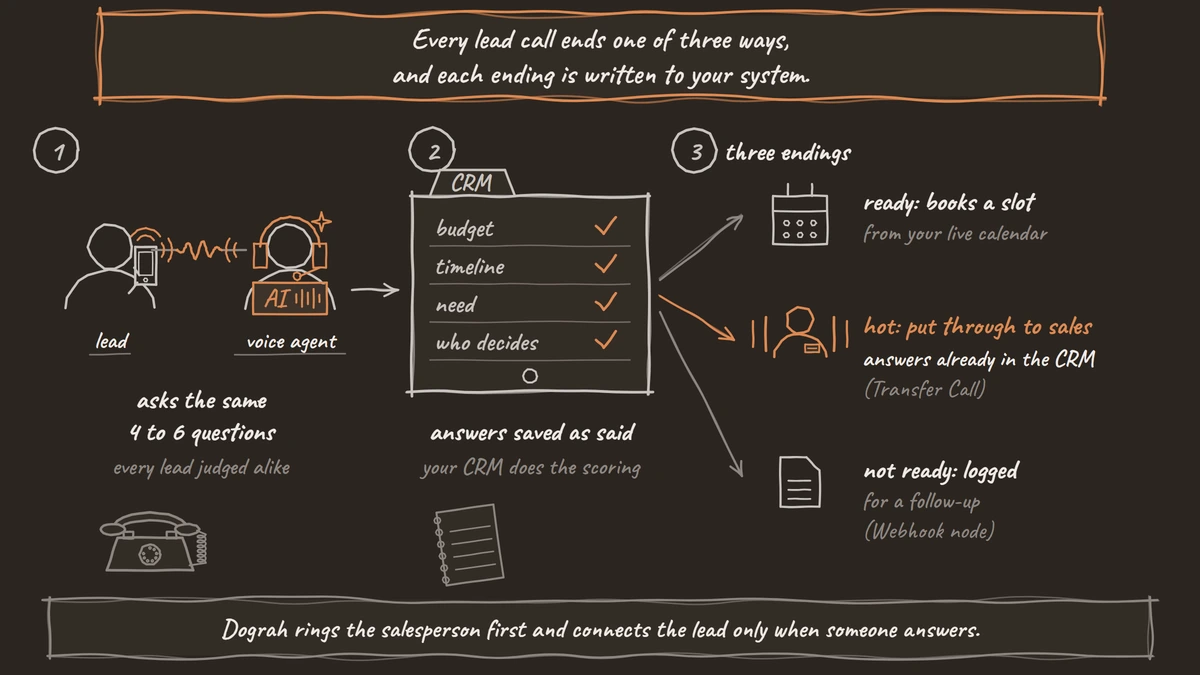
AI voice agents for lead qualification answer new leads who call in, or call back a fresh form fill, and ask every lead the same questions. They record each answer as the lead stated it, never score the lead or promise a price, and end the call with a booked meeting, a handover to sales or a logged lead.
Key Takeaways
- Ask every lead the same questions. Record answers as said and let your CRM score.
- A callback to a form fill rests on the consent that form captured.
- When a lead is not ready to book, log it to your CRM for follow-up.
This post is part of our guide to AI voice agents by use case. Lead qualification is the one call type that guide splits across two sections: a new lead who calls in sits under "Inbound calls: support, booking and new leads", and a callback to a form fill sits under "Outbound sales calls: leads, upsell and win-back". This post covers both halves for any business, as they run in Dograh, an open-source, self-hostable voice agent platform.
Two ways a lead reaches the agent
A lead either calls you, or fills in a form and waits for your call. The questions are the same, but the rules differ.
An inbound lead has already chosen to talk, so the risk is that nobody answers. In CallRail's survey of 1,000 US consumers, 78% said they have abandoned a business after an unanswered call, and 82% said they will call a competitor if you don't answer. An agent answers every ring, so the lead is qualified while the interest is fresh.
An outbound lead is a callback to a form fill. The speed comes from your own system: when the form is submitted, your website or CRM starts the call through the API Trigger, which dials at once. The form's fields travel with the call, so the agent opens by naming what the lead asked about. This half is a call you place, so consent comes first. The opening seconds decide whether the lead stays. Our post on the first 15 seconds of AI outbound calls covers the opening.
The questions, recorded as the lead said them
Qualification is a short, fixed list of questions, asked the same way to every lead. The classic set covers budget, timeline, need and who makes the decision. Most businesses add one or two of their own, such as location. Keep it to four to six questions, because each extra one is another chance for the lead to hang up.
The answers become fields through variable extraction on the Agent node. Switch on "Enable Variable Extraction" and list each variable with a name, a type and a hint, such as budget_range (string): the budget the lead stated. When the node finishes, the values go into gathered_context. Extraction is an AI step, so the agent records each answer as the lead stated it, and the transcript and recording stay the exact record.
The agent never scores the lead. Send the raw answers to your CRM and let your CRM apply your rule, such as "timeline under three months goes to sales today". The rule then lives in one place, and every lead is judged the same way.
Tell the agent in the prompt never to promise a price, an eligibility or an approval. A lead who asks "will I qualify?" hears that a person will confirm it. If the call reads details from an existing account, the agent first verifies the person with an approved check, such as the last four digits of an account number. A name or a phone number only finds the record.

Open Source Alternative to Vapi / Retell
Self-hosted voice agent platform — no per-minute fees
dograh-hq/dograh
Star on GitHub
How a qualification call ends
Every call ends in an outcome written to your system. A ready lead books. The agent reads live slots from your calendar through an HTTP API tool during the call and writes the chosen slot back. The booking loop, including how to stop a retried request from booking twice, is covered in AI voice agents for appointment scheduling.
A hot lead, or one with questions only sales can answer, goes to a person. Transfer Call works on Twilio, Telnyx and Asterisk ARI. It passes no summary by default; on Twilio it can play a short spoken introduction to both people. Write the details to your system with an HTTP API tool before the transfer, so the lead's answers are in your CRM when sales picks up. Dograh calls the salesperson first and connects the lead only when someone answers. If nobody answers within the 30-second default, the lead stays with the agent; tell it in the prompt to offer a callback.
A lead who is not ready is logged. A Webhook node sends the call's results once it ends, with each answer in the payload as {{gathered_context.budget_range}} and so on, plus the recording and transcript links. A temporary failure is retried automatically.
Self-hosted Dograh has no per-minute platform fee (servers, model keys and phone minutes still cost); Dograh Cloud has a 1¢-a-minute platform fee.
Consent before an outbound lead call
An inbound lead call generally needs no consent under the robocall rules, because the lead placed it. A callback is different. This is general information, not legal advice.
Under the FCC's rule, 47 CFR 64.1200, a call that "includes or introduces an advertisement or constitutes telemarketing, using an automatic telephone dialing system or an artificial or prerecorded voice" to a mobile number needs "the prior express written consent of the called party". That consent is "an agreement, in writing, bearing the signature of the person called", and it names the number. A qualification call that pitches your product is generally telemarketing.
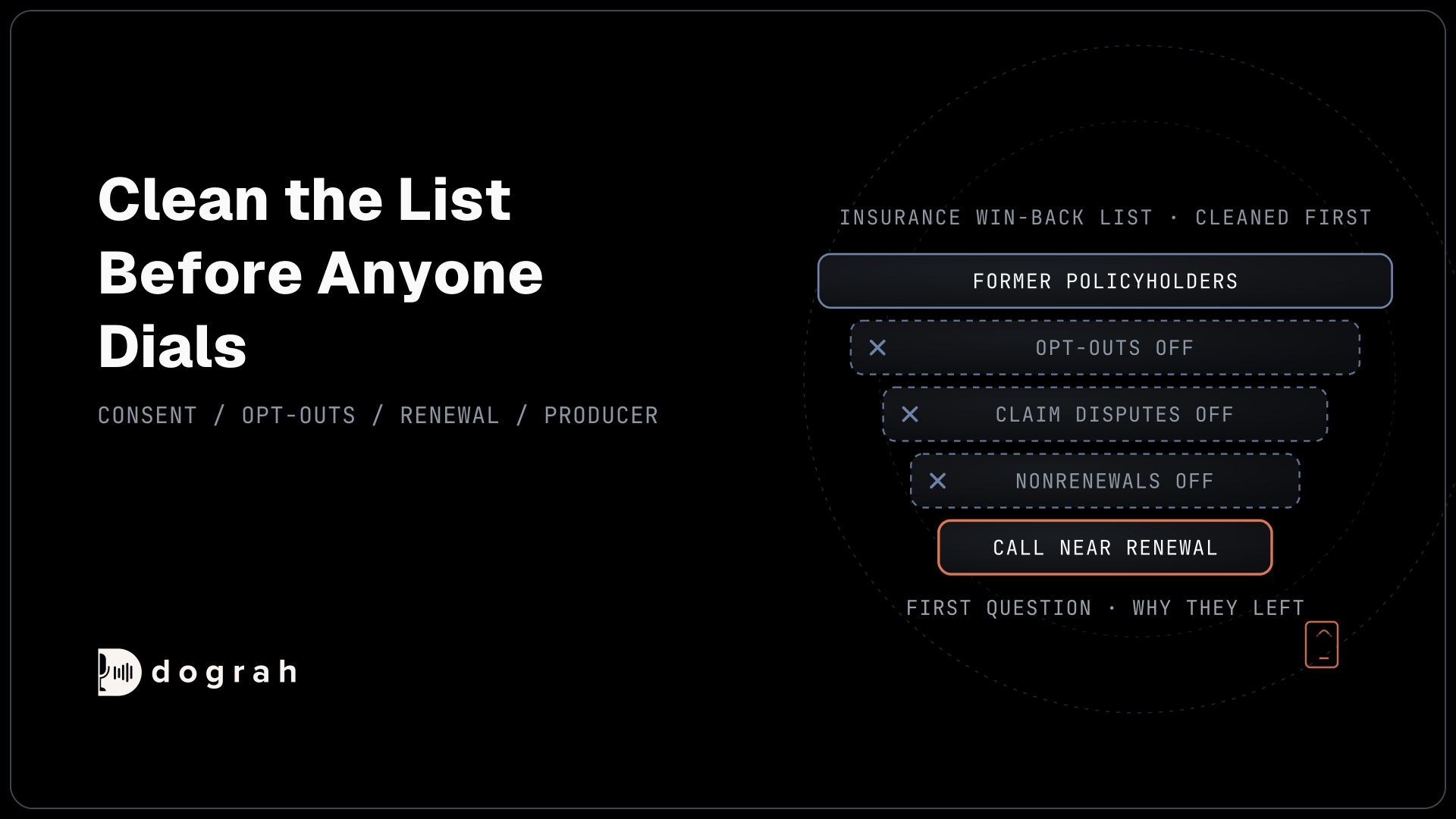
So a callback to a fresh form fill generally rests on the consent that form captured: written consent that names your business and the number. A bought, shared or old lead list is different: an AI-voice call to it that pitches generally needs written consent from a form that names your business. Check the wording in your own system before a number reaches the API Trigger or a campaign.
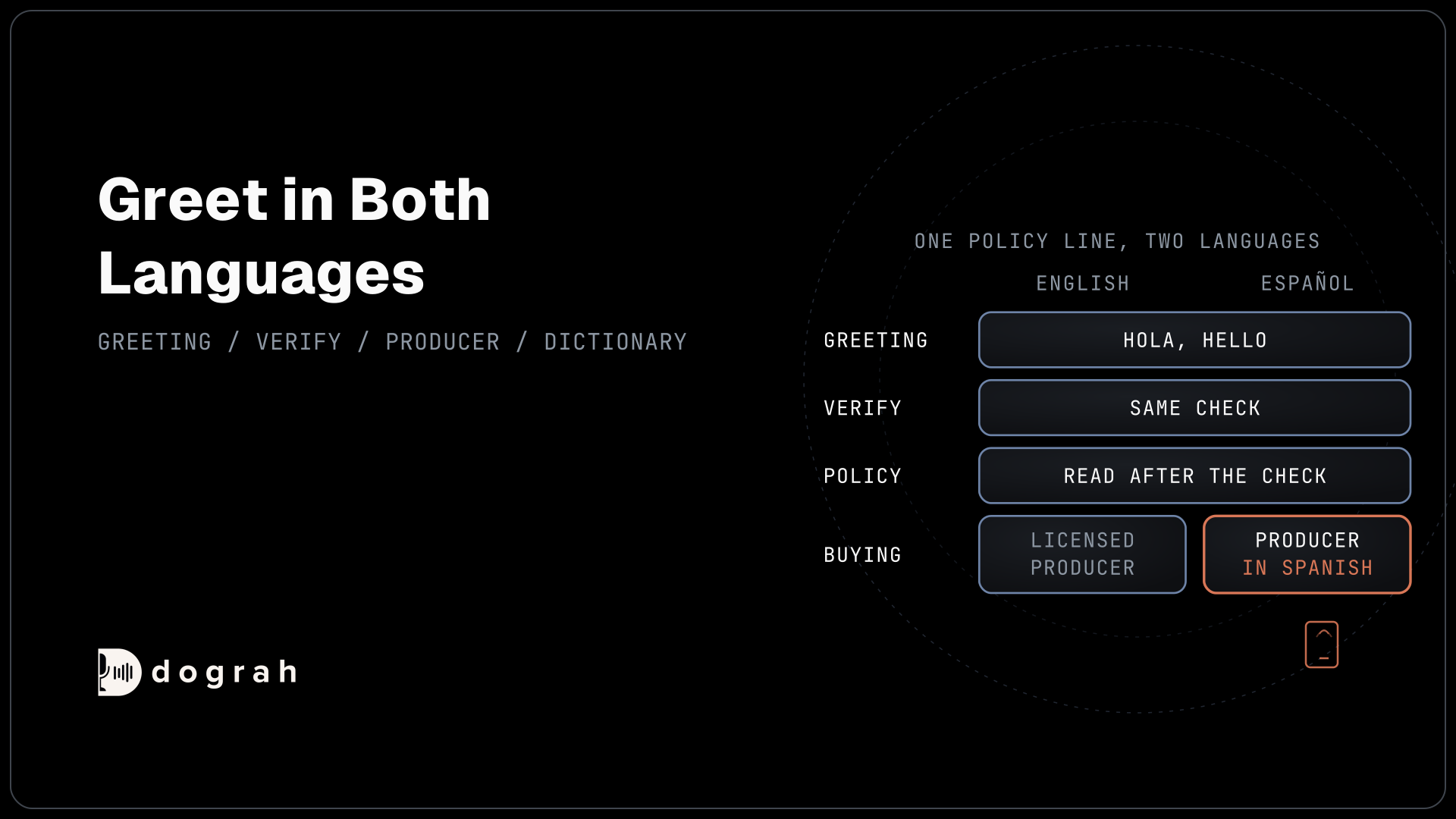
The same rule asks a call like this to identify the business first and offer an automated opt-out "within two (2) seconds of providing the identification information". Put both in the Greeting Text, the fixed line Dograh speaks word for word as the call connects. Telephone solicitations also may not reach a home "before the hour of 8 a.m. or after 9 p.m. (local time at the called party's location)". A campaign's calling hours use one time zone, so split the list by time zone.
When a lead says stop, tell the agent in the prompt to write the opt-out first, then end the call with the End Call tool. Its goodbye line is fixed text or a recorded clip, played exactly as saved. Dograh keeps no do-not-call list. When a caller opts out, an HTTP API tool writes it to your own list, and you remove those numbers before the next campaign upload. The do_not_call call tag records the request but never blocks a later call.
The FCC has also adopted FCC 26-67, which is not yet in effect. It says: "Revocation requests made in response to robocalls that contain an advertisement or constitute telemarketing revoke consent to all future robocalls containing an advertisement or that constitute telemarketing from that caller." Read plainly, one "stop" on a sales call generally ends all of your AI-voice sales calls to that person. Our guide to compliant AI voice agents covers the rest. Confirm your position with counsel.
Join the Dograh Community
Dograh is an OSS alternative to Vapi. Join our Slack community for queries, releases, best practices & community interactions.
Lead qualification by industry
Each industry adds its own questions and limits, such as fair housing in leasing or privilege in legal intake. These posts cover them:
- AI Voice Agents for Real Estate Lead Qualification: buyer and seller leads from web forms and portals.
- AI Voice Agents for Solar Lead Qualification: homeowner leads and site surveys.
- AI Voice Agents for Leasing Inquiries: rental prospects, with no screening by voice.
- AI Voice Agents for Inbound Property Inquiries: callers asking about one listing.
- AI Voice Agents for Catering Inquiries: event leads for a restaurant's events team.
- AI Voice Agents for Law Firm Intake: new matters, where confidentiality starts at hello.
- AI Voice Agents for Admissions and Enrollment: prospective students.
- AI Voice Agents for Insurance Lead Qualification: insurance shoppers.
- AI Voice Agents for Mortgage Lead Qualification: home-loan leads.
- AI Voice Agents for Free-Trial and Tour Booking at Gyms: gym prospects booking a first visit.
- AI Voice Agents for Trial-to-Paid Conversion Calls: SaaS trial users.
Glossary
- Variable extraction
- An Agent node setting in Dograh that turns what the caller said into named fields once the node finishes, stored in gathered_context. It is an AI step, so the transcript and recording remain the exact record.
- Prior express written consent
- Under 47 CFR 64.1200, a signed written agreement that authorises a business to make AI-voice or prerecorded sales calls to a named phone number. An outbound qualification call that pitches generally needs it.
- Telemarketing
- In the FCC's rule, a call made to encourage the purchase or rental of, or investment in, property, goods or services. A lead call that pitches your product generally counts.
- API Trigger
- A Dograh endpoint your own system calls to start an outbound call at once, passing details such as the lead's form fields so the agent can use them from the first line.