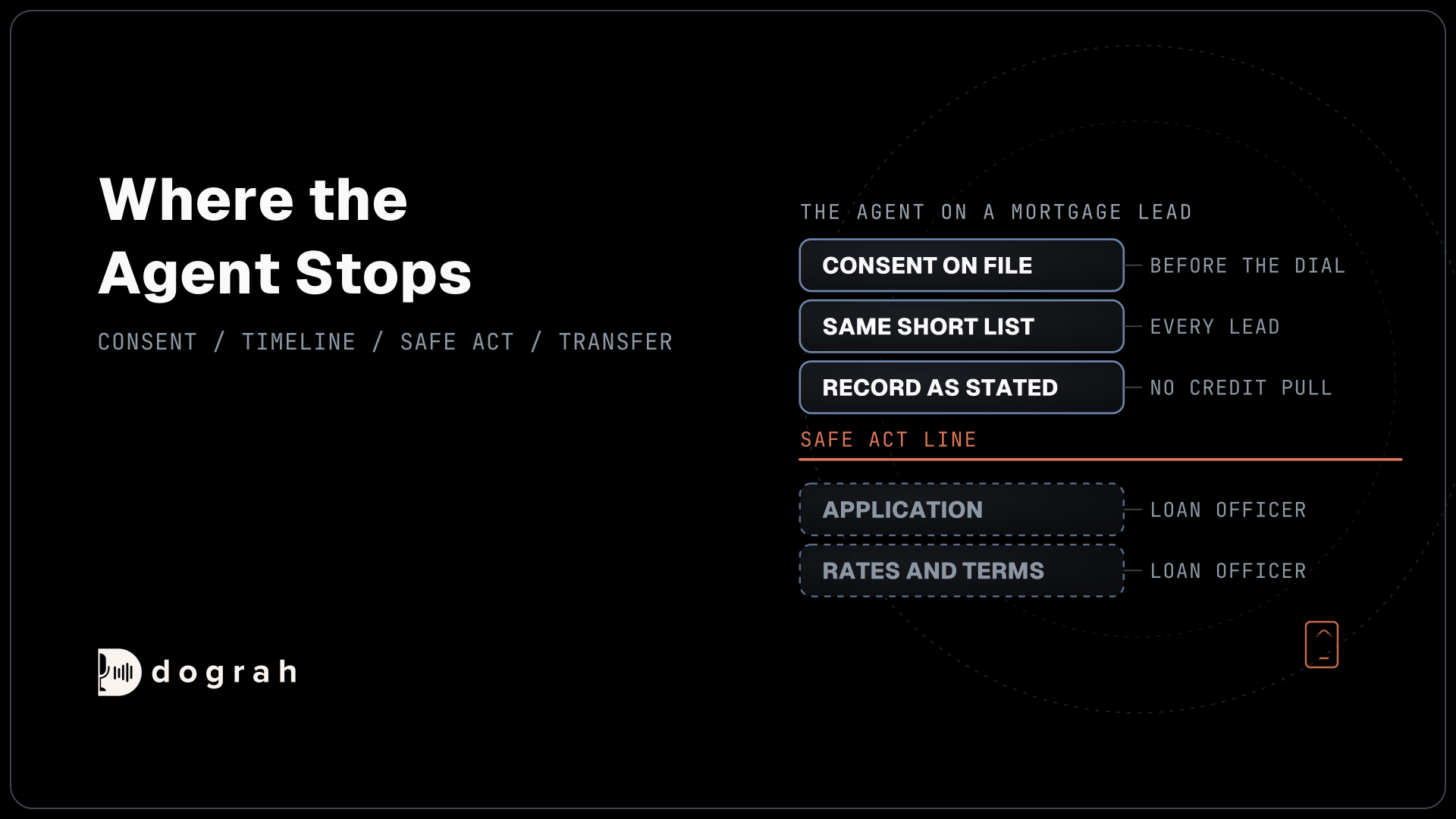

AI voice agents for mortgage lead qualification call or answer new leads once consent is on file, ask every lead the same short list of facts and record each answer as stated. They never say a lead qualifies and never quote a rate or payment. A licensed loan officer takes the lead by transfer or a booked call.
Key Takeaways
- Check written consent in your own list before any outbound AI-voice sales call.
- Ask every lead the same facts and record answers as stated, with no credit pull.
- The agent never says "you qualify". A licensed loan officer offers terms.
This post is part of our guide to AI voice agents for mortgage and home loans. The guide's section "Before the application: leads and rate questions" sums up this call in one line: it checks consent first, asks every lead the same short list of facts and hands the lead to a licensed loan officer. Here is that call in full, run in Dograh, an open-source, self-hostable voice agent platform.
Why lenders hand the first lead call to an agent
A new lead wants a call back while they are still thinking about the house, and a loan officer cannot be on the phone at every hour. Volume is back. ICE's Mortgage Monitor estimated 1.44 million mortgage originations in the fourth quarter of 2025, the highest level in three and a half years, with refinances making up nearly 40% of lending. More loans mean more web forms and calls, many in the evening.
The agent makes the first call or answers it, asks a few plain questions and writes the answers down. The loan officer then starts from a record instead of a name and a number. The same pattern runs across industries in AI voice agents for lead qualification; a mortgage lead adds a consent rule and a licensing rule, and both shape the call.
Check consent before the dial, not on the call
An outbound call to talk a lead into a mortgage is generally telemarketing, so consent is checked in your own list before the agent dials. Asking "is it OK that I called?" once the call is live is too late. This section is general information, not legal advice.
The FCC's rule at 47 CFR 64.1200 defines telemarketing as "the initiation of a telephone call or message for the purpose of encouraging the purchase or rental of, or investment in, property, goods, or services". Paragraph (a)(2) bars such a call to a mobile number "using an automatic telephone dialing system or an artificial or prerecorded voice" unless it is "made with the prior express written consent of the called party". Paragraph (f)(9) describes that consent as "an agreement, in writing, bearing the signature of the person called that clearly authorizes the seller" to make the call.
An AI voice counts. In its February 2024 declaratory ruling, the FCC said the limits on "artificial or prerecorded voice" calls "encompass current AI technologies that generate human voices". Generally, then, an AI-voiced call to a web lead needs written consent that names your company. A lead who calls you is different: that call is generally not telemarketing by your dial. Confirm your position with counsel.
So the consent check runs in your CRM before the API Trigger fires or the number goes into a campaign file. Leads with no consent on file go to a loan officer's list instead. Solicitation calls also stay out of the hours "before the hour of 8 a.m. or after 9 p.m. (local time at the called party's location)", under paragraph (c)(1).
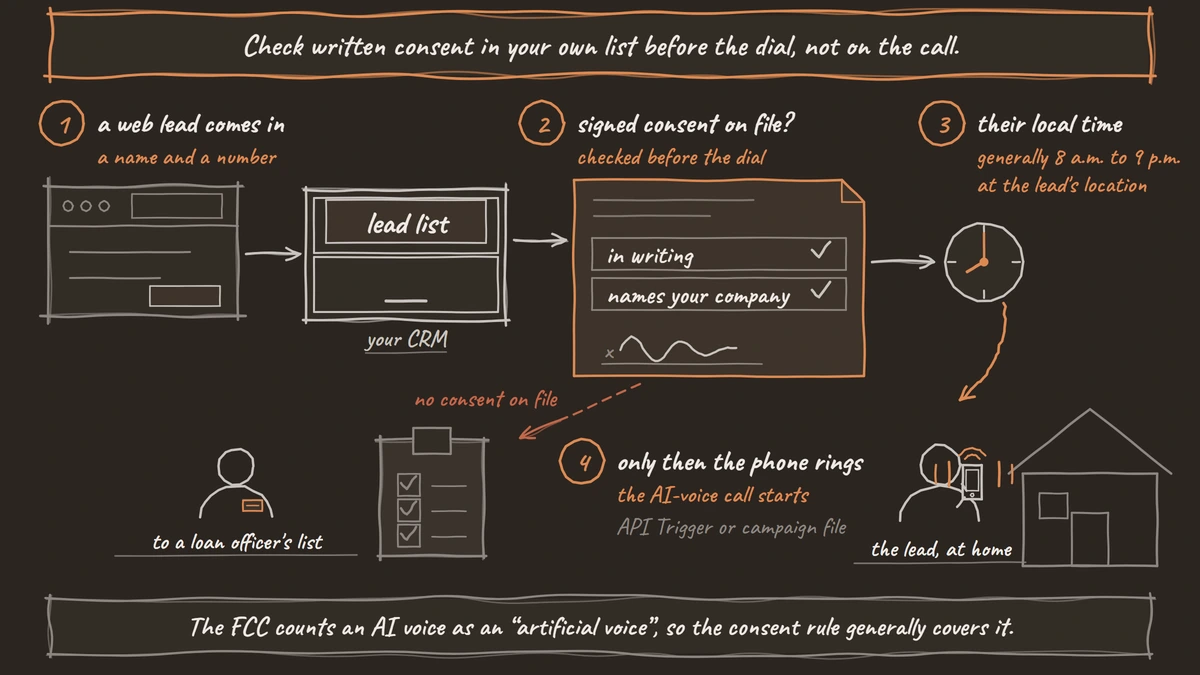
Campaigns run their calling hours in one time zone per campaign, so split a multi-state lead file into one campaign per zone. The API Trigger dials as soon as your system calls it, so your system checks the lead's local time first. Our post on real estate lead qualification runs the same consent check for agencies.

Open Source Alternative to Vapi / Retell
Self-hosted voice agent platform — no per-minute fees
dograh-hq/dograh
Star on GitHub
Ask every lead the same short list
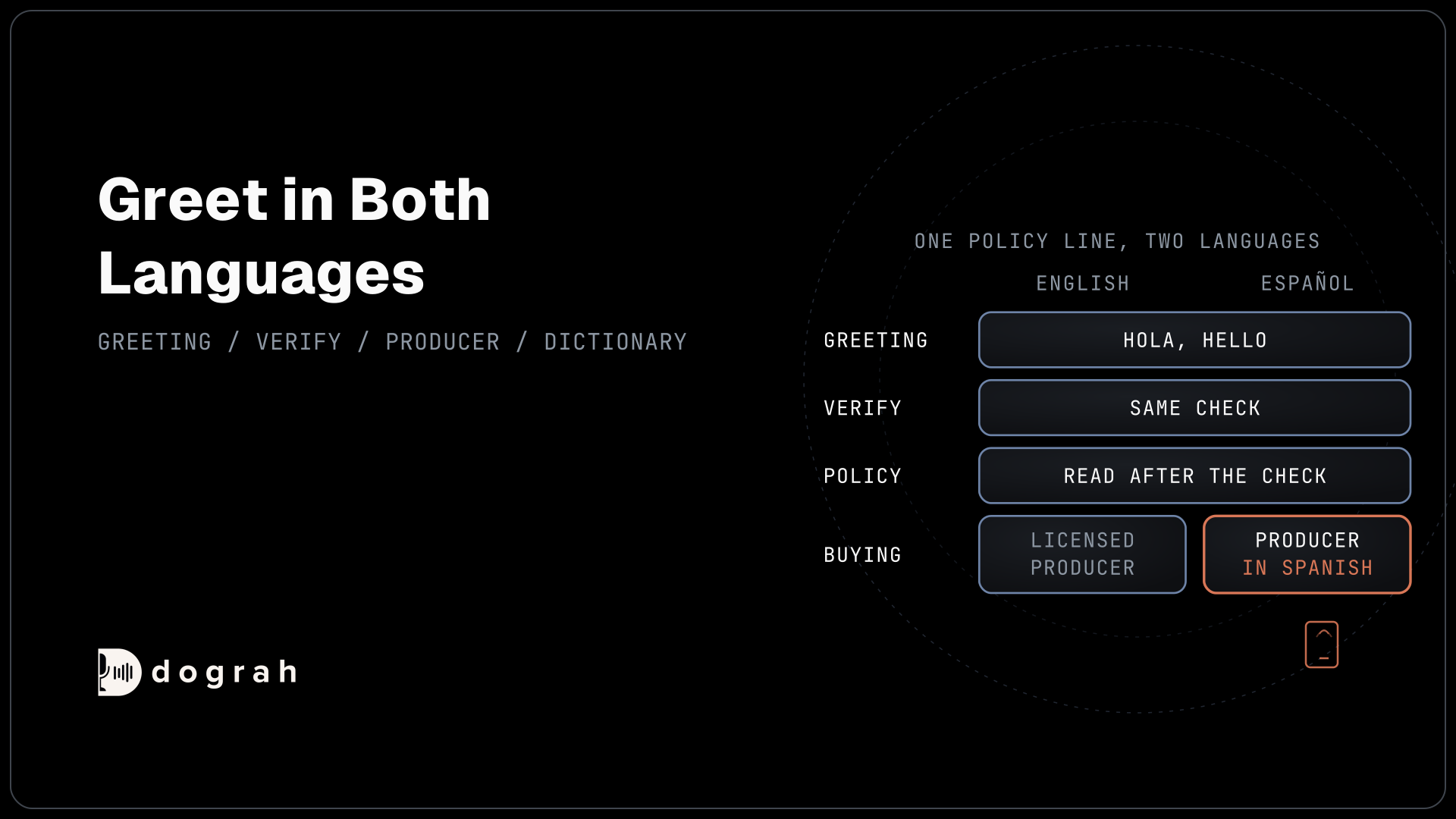
The call opens with Greeting Text, the fixed line Dograh plays word for word as the call connects. It names the lender exactly as your licence does. If you want to tell leads they're speaking with an automated assistant, or your location requires it by law, write it in the Greeting Text along with the lender's name.
Then the agent asks a short list: purchase or refinance, the property type and state, the timeline, a rough price or loan amount, and a self-reported credit range if you use one. It records each answer as the lead stated it, with no credit pull. Recordings and transcripts keep whatever is said, so the call never asks for a full account, card or Social Security number.
Every lead hears the same questions, in the same order. Tell the agent in the prompt to keep to that order and to send anything outside the list to a loan officer. Regulation B says "A creditor shall not discriminate against an applicant on a prohibited basis regarding any aspect of a credit transaction", and it bars statements that would discourage a reasonable person from applying on a prohibited basis. A fixed list is the simplest way to show that every caller got the same call.
The agent never asks about traits Regulation B protects, and never comments on the neighbourhood or on how likely the lead is to be approved. Tell it in the prompt to move politely past anything sensitive a lead volunteers.
Where the agent stops: the SAFE Act line
The agent collects facts but never takes the application or talks terms.
The SAFE Act's definition of a loan originator covers an individual who "takes a residential mortgage loan application" and "offers or negotiates terms of a residential mortgage loan for compensation or gain". It excludes "purely administrative or clerical tasks", which include "communication with a consumer to obtain information necessary for the processing or underwriting of a residential mortgage loan." Generally, collecting the facts a loan officer needs is clerical work under the SAFE Act; taking the application and offering terms is the loan officer's job. Confirm your position with counsel.
In practice the agent never says "you qualify" or "you're pre-approved", and never quotes a rate or a payment. When a lead asks "what rate would I get?", the agent says a licensed loan officer will go through rates and offers to book that call. A prompt cannot guarantee wording, because the model writes each sentence, so check the transcripts for any line that sounds like an approval or a quote. Rate questions from past clients belong to AI voice agents for mortgage rate and refinance callbacks.
Handing the lead to a licensed loan officer
The answers go to your system first, so the loan officer never asks the lead to repeat them. An HTTP API tool writes the list to your CRM or loan origination system (LOS) during the call. A second HTTP API tool can read open slots from the loan officers' calendar and book one. Tell the agent in the prompt to read the time back before it confirms.
A lead who wants to talk now goes to a person. Transfer Call works on Twilio, Telnyx and Asterisk ARI. It passes no summary by default; on Twilio it can play a short spoken introduction to both people. Write the details to your system with an HTTP API tool before the transfer. Loan officers are licensed state by state, so the tool's Dynamic HTTP Resolver can ask your system which officer licensed in the lead's state is free and dial that number. Have your system always return a number, falling back to a fixed one when no one is free, because a failed lookup means a failed transfer.
If nobody answers within the 30-second default, the lead stays with the agent; tell it in the prompt to offer a callback and write the request through an HTTP API tool. Web calls cannot transfer, so test the handoff on a real phone line.
A lead who says "stop calling me" is opting out. Dograh keeps no do-not-call list. When a caller opts out, an HTTP API tool writes it to your own list, and you remove those numbers before the next campaign upload. The do_not_call call tag records the request but never blocks a later call.
Self-hosted Dograh has no per-minute platform fee (servers, model keys and phone minutes still cost); Dograh Cloud has a 1¢-a-minute platform fee.
Join the Dograh Community
Dograh is an OSS alternative to Vapi. Join our Slack community for queries, releases, best practices & community interactions.
Glossary
- Prior express written consent
- Under 47 CFR 64.1200(f)(9), a signed written agreement that clearly authorizes the seller to make telemarketing calls with an artificial voice to a named number. An AI-voiced sales call to a mortgage lead generally needs it on file before the dial.
- Telemarketing (TCPA)
- A call made to encourage the purchase of property, goods or services, under 47 CFR 64.1200(f)(13). An outbound call that pitches a mortgage generally fits; a lead calling the lender generally does not, because the lender did not start it.
- Prohibited basis (Regulation B)
- A trait, such as race, national origin, sex or age, on which a creditor may not treat applicants differently under 12 CFR 1002.4. It is why every lead hears the same questions and the agent never asks about such traits.
- Loan originator (SAFE Act)
- Under 12 U.S.C. 5102, an individual who takes a residential mortgage loan application and offers or negotiates its terms for compensation. Clerical collection of facts is excluded, which is where the lead agent generally stays.