
AI voice agents for mortgage rate and refinance callbacks answer rate questions and call consented past clients when rates move. After verifying the borrower, they read only the quote the lender's pricing engine returns during the call, with its APR, or book a licensed loan officer. They never estimate a rate or a saving.
Key Takeaways
- Every rate the agent says comes from your pricing engine during the call.
- Read the APR with the rate, or leave rates to the loan officer.
- Rate-drop calls to past clients generally need prior express written consent.
This post is part of our guide to AI voice agents for mortgage and home loans. The guide's section "Before the application: leads and rate questions" sums up this call in one line: it answers rate questions and rate-drop callbacks with a quote the agent fetched, or with a loan officer. Here is that call in full, run in Dograh, an open-source, self-hostable voice agent platform.
Why rate-drop callbacks are worth automating
When rates fall, past clients start shopping, and a call from their own lender with a real quote gives them a reason to stay. An agent can make those calls the morning rates move.
The pool is large and it moves fast. ICE's Mortgage Monitor for March 2026 counted 5.4 million borrowers who could cut their rate by at least 75 basis points. In the fourth quarter of 2025, servicers kept only one in three of their borrowers who refinanced, so two in three went to another lender.
Rates also drive how borrowers feel about the lender they have. In J.D. Power's 2026 mortgage servicer study, a survey of 14,118 borrowers, high interest rates were the second most common reason to consider switching, named by 33%. A call from the lender with a live quote answers that reason directly. Rates move daily, so the agent never repeats a rate it heard yesterday. It asks the pricing engine on every call.
Two calls: rate questions and rate-drop callbacks
This post covers two calls: a past client calling in to ask about rates, and the agent calling past clients after a rate drop. New leads belong to AI voice agents for mortgage lead qualification.
The outbound call needs consent first. A call that encourages a refinance fits the definition of telemarketing in 47 CFR 64.1200: "the initiation of a telephone call or message for the purpose of encouraging the purchase or rental of, or investment in, property, goods, or services". So a rate-drop call to past clients is generally telemarketing, and with an AI voice it generally needs prior express written consent on file. This is general information, not legal advice; confirm your position with counsel.
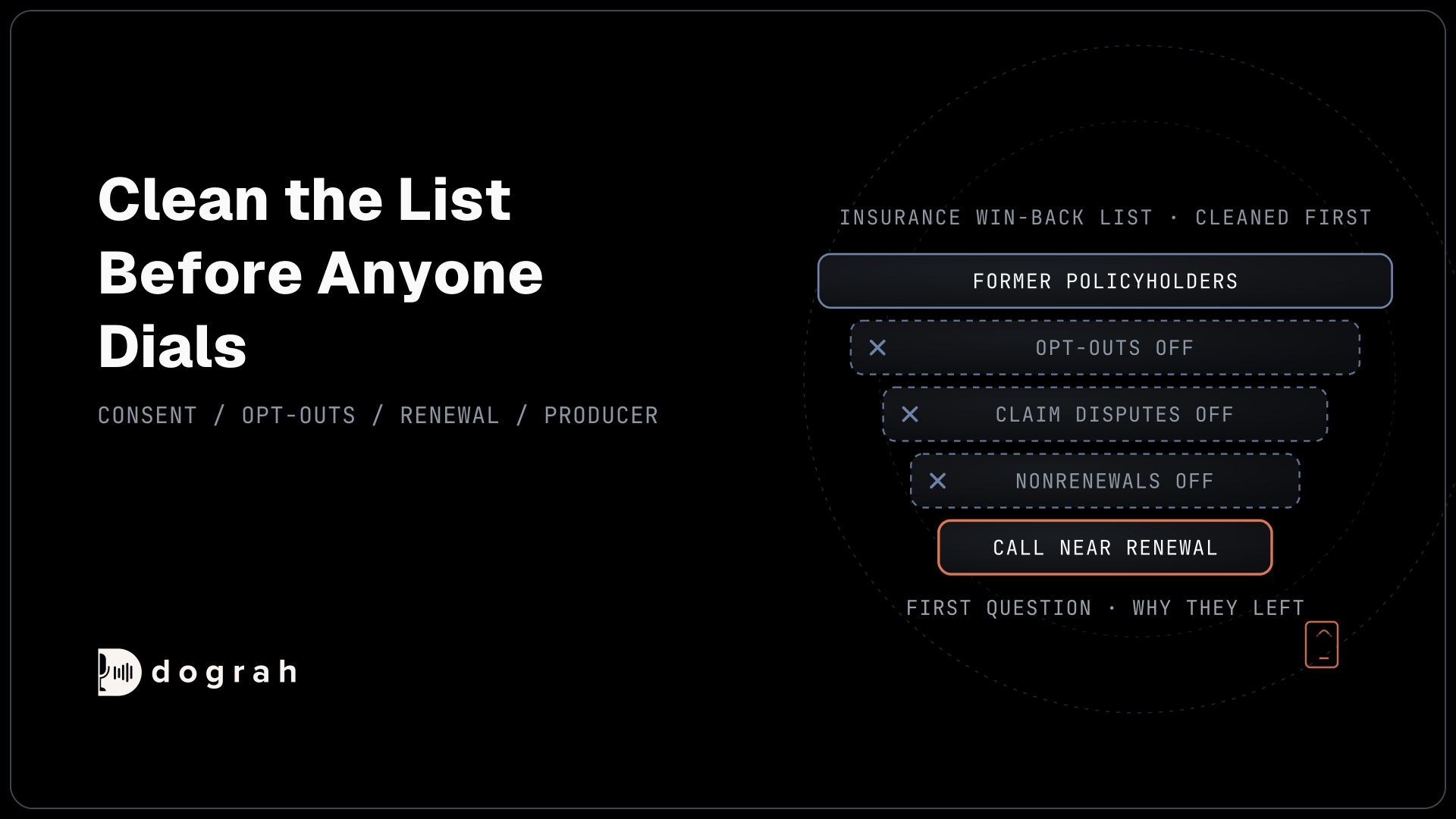
Build the list in your own system: past clients with that consent on file, opt-outs removed. Upload it to Campaigns, one campaign per time zone, since calling hours run in one time zone per campaign. Or start each call from your system with the API Trigger.
Both calls verify before anything about the loan. A phone number finds a loan, but it does not prove who is calling. The agent asks for an approved check, such as date of birth or the last four digits of the loan number. On voicemail, the message names only the lender and a number to call back, never a rate.

Open Source Alternative to Vapi / Retell
Self-hosted voice agent platform — no per-minute fees
dograh-hq/dograh
Star on GitHub
Read only the quote your pricing engine returns
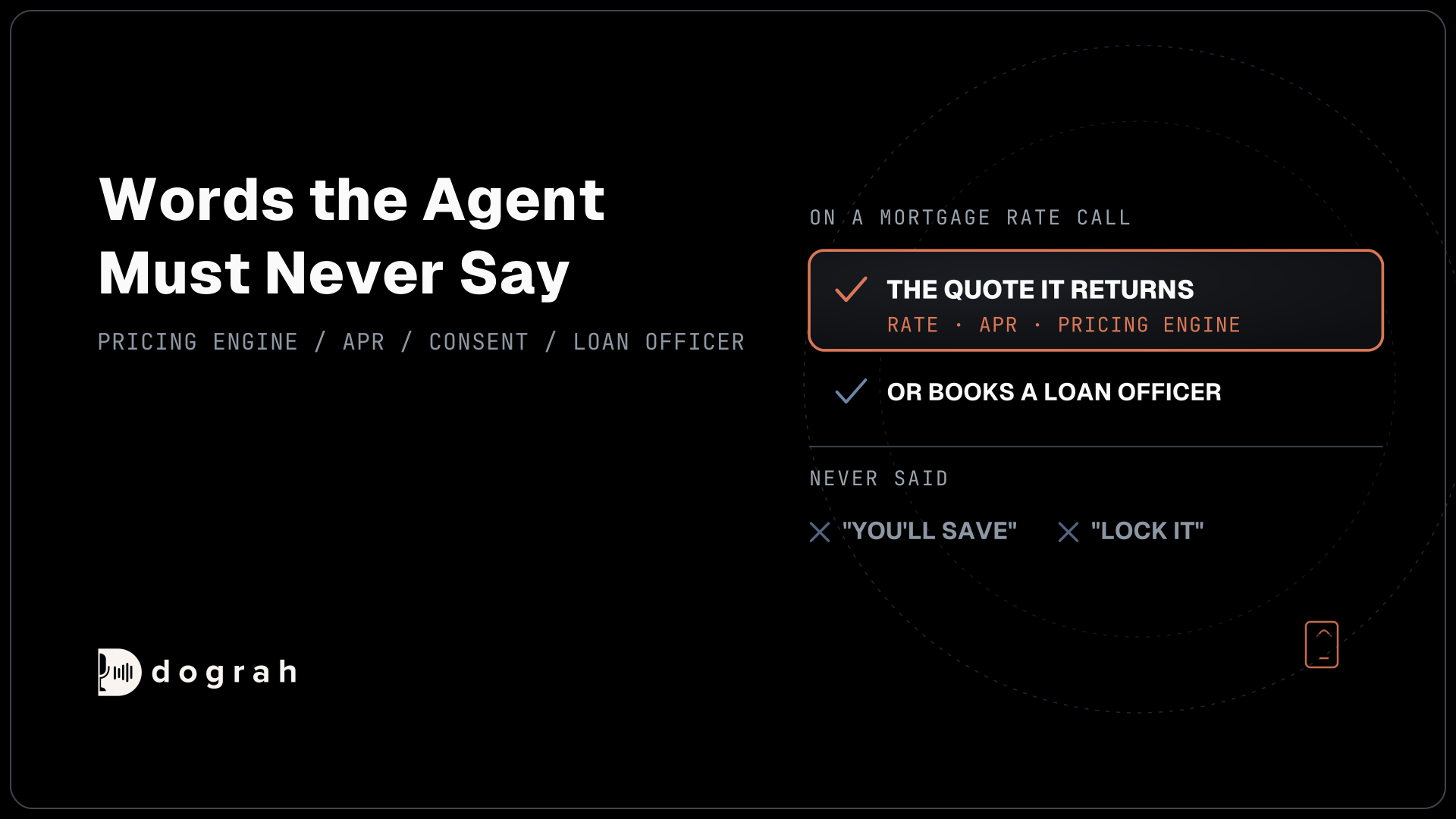
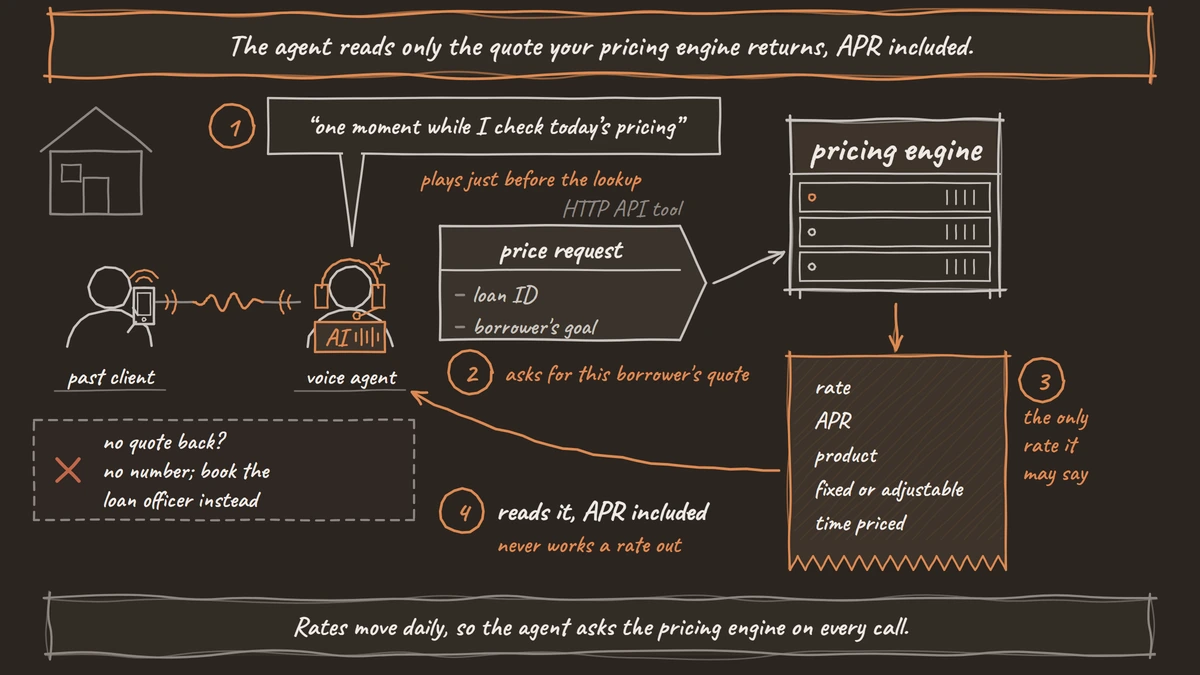
The agent never works out a rate. It asks your pricing engine for this borrower's quote during the call and says only what comes back.
An HTTP API tool sends the loan ID and the borrower's goal, such as a lower payment or cash out, to your pricing engine. The engine returns the quote as a short sentence: the rate, the APR, the product, whether the rate is fixed or adjustable and the time it was priced. The tool waits 5 seconds by default and does not retry. Its Custom Message (text or a recorded clip) plays once, just before the tool runs, so the borrower hears "one moment while I check today's pricing". If the tool errors or times out, tell the agent in the prompt to give no number at all and book the loan officer instead.
Pre-Call Data Fetch can load the borrower's current loan once the call connects, and on outbound calls it runs after the person answers. Write the prompt so the agent uses none of it until the borrower is verified.
How the rate is said matters too. Regulation Z's advertising rule says that when an advertisement states a rate of finance charge, "it shall state the rate as an "annual percentage rate," using that term", and "If the annual percentage rate may be increased after consummation, the advertisement shall state that fact." If the agent states a rate on a promotional call, Regulation Z generally expects it as an APR; the simplest design is that the agent reads only the quote your pricing engine returns, APR included, or leaves rates to the loan officer. Confirm your position with counsel.
The SAFE Act adds a second line: a loan originator "offers or negotiates terms of a residential mortgage loan". Reading a priced quote to a named borrower sits close to that, so the safer design lets the agent read the quote as information and keeps any negotiation, and every lock, with the loan officer. Confirm your position with counsel.
Words the agent must never say
A prompt cannot guarantee wording, because the model writes each sentence, so the risky words are banned in the prompt and then checked in the transcripts.
Tell the agent in the prompt never to say "you'll save", never to offer to "lock" a rate and never to call a rate fixed unless the quote says so. Regulation Z restricts "Using the word "fixed" to refer to rates, payments, or the credit transaction" in an advertisement for variable-rate loans, and the amount of any payment is a triggering term that brings more disclosures with it. The agent therefore states no monthly payment and no savings figure. A borrower who asks "what would my payment be?" gets the loan officer.
Then prove it. Read transcripts for any number that did not come from the tool, and run automated QA on a random 5 to 10% sample of calls once live, as set out in Automated QA for Voice Agents.
A rate-drop call is also a call borrowers are trained to distrust. Recordings and transcripts keep whatever is said, so the call never asks for a full account, card or Social Security number; use a short check such as the last four digits. Tell the agent in the prompt to offer the number on the borrower's statement for a call back, the same rule as in AI Voice Agents for Fraud-Alert Callbacks.
Booking the loan officer and keeping opt-outs
A borrower who wants to go ahead talks to a licensed loan officer, and the agent's job is to make that easy. An HTTP API tool writes the borrower's goal and the quote they heard to your CRM or loan origination system, then a second tool books a slot from the loan officer's live calendar.
A borrower who wants to talk now goes to a person. Transfer Call works on Twilio, Telnyx and Asterisk ARI. It passes no summary by default; on Twilio it can play a short spoken introduction to both people. Write the details to your system with an HTTP API tool before the transfer. If nobody answers within the 30-second default, the borrower stays with the agent; tell it in the prompt to offer a callback and write the request through an HTTP API tool. Web calls cannot transfer, so test this on a real phone line.
To test two openings, split the campaign between two versions of the agent. Dograh then shows each version's share of calls and outcomes.
Dograh keeps no do-not-call list. When a caller opts out, an HTTP API tool writes it to your own list, and you remove those numbers before the next campaign upload. The do_not_call call tag records the request but never blocks a later call.
Self-hosted Dograh has no per-minute platform fee (servers, model keys and phone minutes still cost); Dograh Cloud has a 1¢-a-minute platform fee.
Join the Dograh Community
Dograh is an OSS alternative to Vapi. Join our Slack community for queries, releases, best practices & community interactions.
Glossary
- Annual percentage rate (APR)
- The yearly cost of credit, including certain fees, stated as a rate. Under Regulation Z, an advertisement that states a rate states it as an APR, which is why the agent reads the APR with any quote.
- Triggering term (Regulation Z)
- A detail, such as the amount of any payment, that brings further required disclosures when it appears in an advertisement under 12 CFR 1026.24(d). It is why the agent states no monthly payment.
- Pricing engine
- The lender's system that prices a loan for a given borrower and moment. The agent reaches it through an HTTP API tool during the call and reads back only the quote it returns.
- Rate-drop callback
- An outbound call to a past client after rates fall, offering a refinance conversation. It is generally telemarketing, so it needs consent on file before the dial.