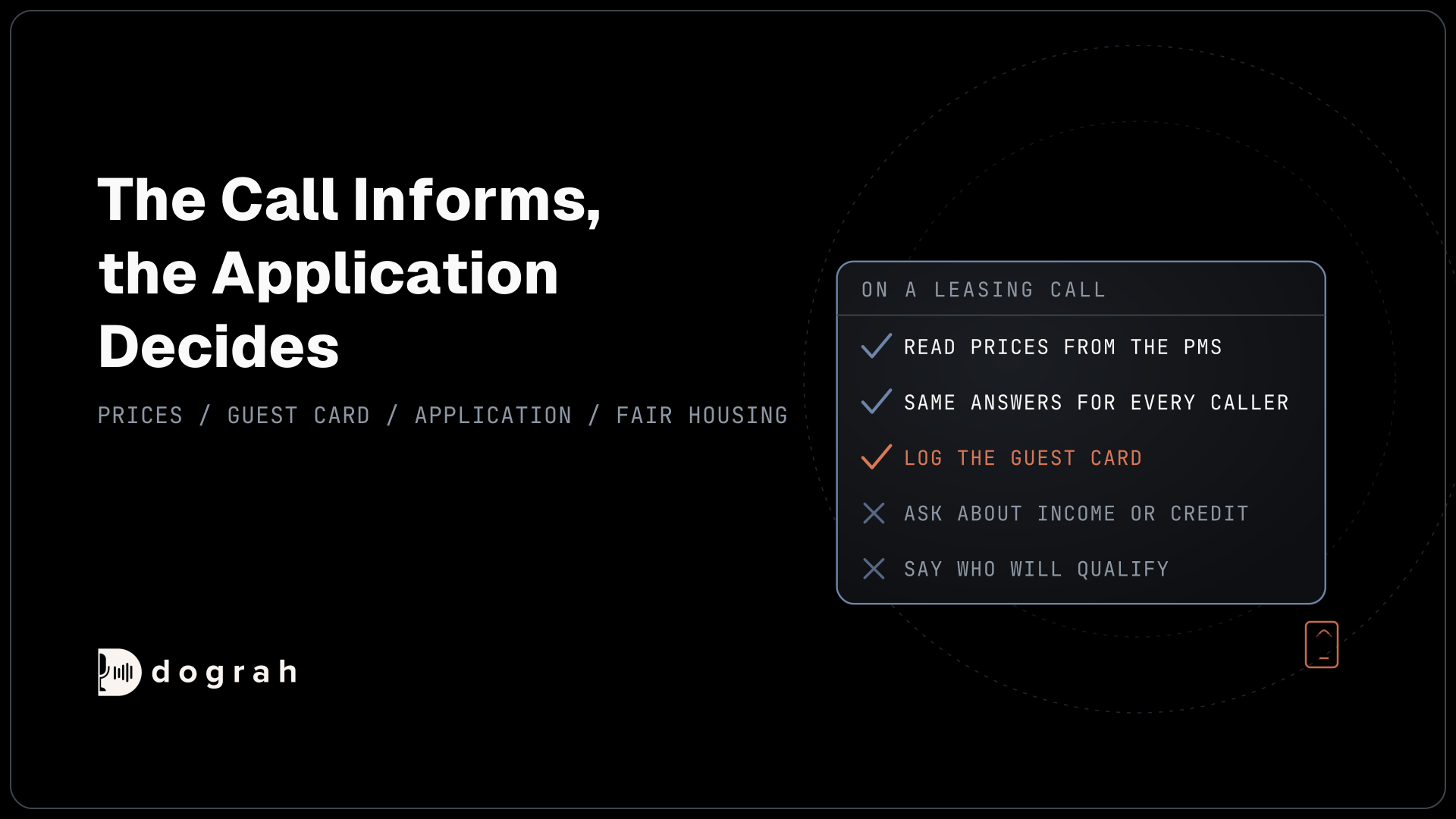

AI voice agents for leasing inquiries answer prospect calls with live prices, availability, fees and policies read from the property management system during the call. They log a guest card with what the prospect said, hand the tour booking on, give every caller the same answers and never screen applicants by voice.
Key Takeaways
- Read prices, availability, fees and policy from the PMS during every call.
- Log the guest card as the prospect said it; screen in the application.
- Fair housing questions get one fixed reply and an offer of a person.
This post is part of our guide to AI voice agents for property management and leasing. The guide's section "Prospects: leasing inquiries and rental tours" sums up this call in one line: answer a prospect from live listing and PMS data and log a guest card, without screening anyone. Here is that call in full, run in Dograh, an open-source, self-hostable voice agent platform.
What prospects ask on a leasing call
A leasing call is a short list of factual questions, and almost every answer already sits in the property management system (PMS). Prospects ask what a unit costs, when it is free, whether their dog is allowed, which fees apply and how to apply. A few ask about move-in specials or parking.
Those answers change weekly. A price moves or a unit gets leased. An agent that answers from a prompt written last month will be wrong by the next lease-up. In AppFolio's 2026 Property Management Benchmark Report, a survey of 1,617 US property managers in late 2025, 78% said they cannot yet rely on the AI features in their legacy property management software. Our reading: trust grows when the agent reads your own live data and says nothing else.
Answers come from live PMS data
The leasing agent reads every figure from the PMS while the prospect is on the line. An HTTP API tool sends the property, unit size and move-in date to the PMS and gets back open units, prices, fees and move-in specials. The agent offers only what comes back. If nothing fits, it asks about another size or date and runs the lookup again.
Written policies sit in the Knowledge Base: the pet policy, the fee schedule, parking rules and the application steps. It accepts PDF, DOCX, DOC, TXT and JSON files up to 5 MB each. When a prospect asks about a 40-pound dog, the agent reads the property's pet document, not general knowledge.
One agent can answer for many properties. Several phone numbers can point at the same agent, and Pre-Call Data Fetch receives the dialled number as to_number. Your endpoint returns that community's name and office hours, so the Greeting Text names the right building. If you want to tell callers they're speaking with an automated assistant, or your location requires it by law, write that in the Greeting Text along with the property's name.
A prospect has no account yet, so general listing questions need no verification. The agent still never reads out anyone else's details, such as who lives in a unit or when a resident's lease ends.
The guest card holds what the prospect said
A guest card is the PMS record of a prospect, and the call ends by writing one. During the call the agent extracts name, phone number, move-in date, unit size, pets and the questions asked. Extraction is an AI step, so it records each answer as the prospect stated it; the transcript and recording are the exact record.
A second HTTP API tool writes the guest card to the PMS. To stop a retried request from creating two cards, add a Preset Parameter named workflow_run_id with the value {{initial_context.workflow_run_id}}, and let the PMS ignore a duplicate. When the call ends, a Webhook node sends the outcome and transcript link to your system and retries automatically on a temporary failure.
If the prospect wants to see the unit, the call moves to booking. That part, with tour types, open slots, reminders and reschedules, is in AI voice agents for rental tour scheduling.

Open Source Alternative to Vapi / Retell
Self-hosted voice agent platform — no per-minute fees
dograh-hq/dograh
Star on GitHub
The agent never screens
The leasing call informs; the application decides. If a prospect asks about the income requirement, the agent reads the property's written criteria, in the same words for every caller. It does not ask about income, credit, rental history or criminal records, and it never says whether someone is likely to qualify.
There is a practical reason too. In the same AppFolio survey, 56% of managers reported facing application fraud in the last year. A voice call is a weak place to check identity or documents, so identity checks and screening stay in the written application, where your screening provider runs them. The agent can send prospects there: an HTTP API tool asks your system to text or email the application link.
One fixed reply for fair housing questions
Some questions sound harmless and are not. This section is general information, not legal advice. Section 3604(c) of the Fair Housing Act makes it unlawful to make any statement about the rental of a dwelling "that indicates any preference, limitation, or discrimination based on race, color, religion, sex, handicap, familial status, or national origin."
"Is the building good for kids?", "Who lives on that floor?", "Is the area safe?" and "How are the schools?" can all lead a generative answer into that territory. So they get one fixed reply, the same for everyone: the agent can share facts about the unit and the building's written policies, and a leasing agent will follow up on anything else. Exact wording only holds where Dograh speaks fixed text: the Greeting Text at the start of the call, a pathway's Transition Speech (text or a pre-recorded clip) and the Transfer Call tool's Pre-Transfer Message. So put that reply in a pathway's Transition Speech or a recorded clip. Choosing that pathway is the model reading its written condition, never a hard rule, so test it with real questions and read the transcripts.
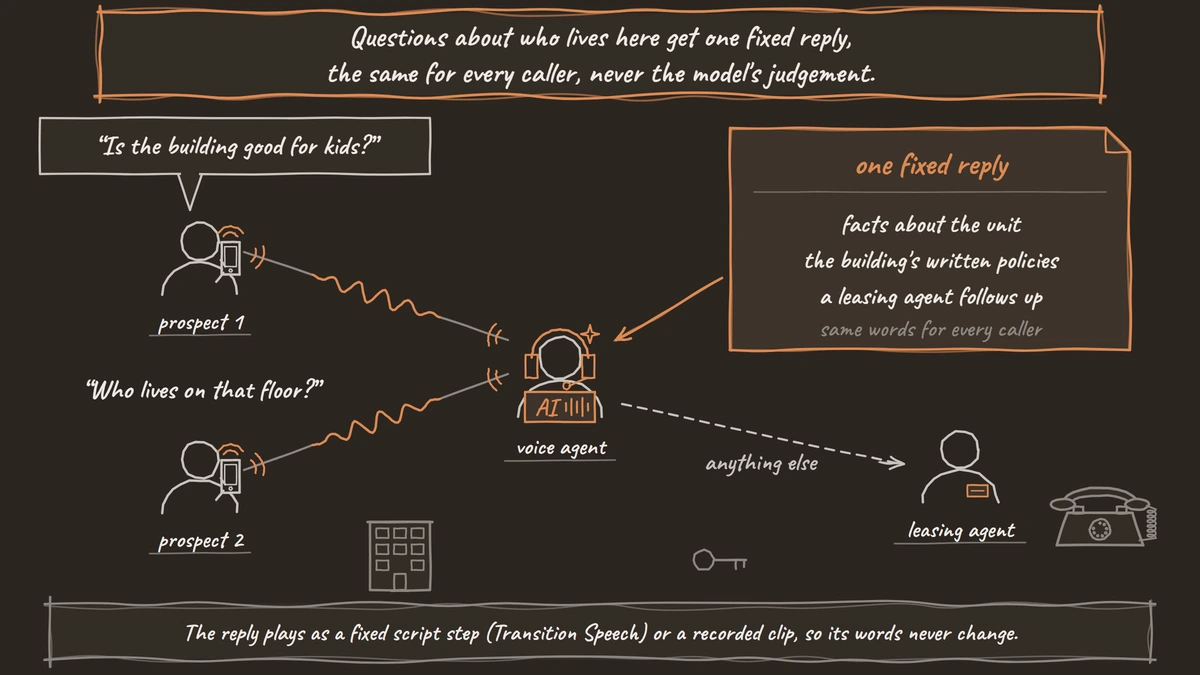
HUD withdrew several fair housing guidance documents in a September 2025 memo, including its 2024 guidance on housing advertising, as LeadingAge reported. The statute still reads as quoted above, so build the script to the statute. Many states and cities also protect more characteristics, for example source of income. Our post on inbound property inquiries applies the same rule to buyers. Confirm your own position with counsel.
When a person takes over
The agent answers and logs; a leasing agent negotiates. A request for a lower rent or a concession goes to a person. So does any complaint.
Transfer Call hands the prospect over. It works on Twilio only and passes no summary by default, so the agent first writes the guest card and the request through an HTTP API tool. If nobody answers within the 30-second default, the prospect stays with the agent; tell it in the prompt to offer a callback and write the request to your system through an HTTP API tool.
That callback is an outbound call. The Federal Communications Commission's February 2024 ruling treats AI voices as artificial voices under the Telephone Consumer Protection Act, so a callback generally needs the prospect's consent first; ask for it before the agent calls back and confirm your position with counsel. Our post on real estate lead qualification covers outbound lead calls, and The Ultimate Guide to AI Receptionists covers an agent that takes every call at the office.
Self-hosting keeps recordings and transcripts on your own servers; the audio stays in-house only when the speech and language models run there too. Self-hosted Dograh has no per-minute platform fee (servers, model keys and phone minutes still cost); Dograh Cloud has a 1¢-a-minute platform fee.
Join the Dograh Community
Dograh is an OSS alternative to Vapi. Join our Slack community for queries, releases, best practices & community interactions.
Glossary
- Guest card
- The PMS record of a prospect: name, contact details, move-in date and what they asked about. The leasing agent writes one at the end of every inquiry call, with each answer recorded as the prospect stated it.
- Section 3604(c)
- The part of the Fair Housing Act that bars statements about renting a dwelling that indicate a preference, limitation or discrimination on a protected basis. It is why questions about who lives in a building get one fixed reply.
- Transition Speech
- Fixed text or a recorded clip that Dograh plays when a call moves into a pathway. It is the place to put a reply that must never change wording, such as the fair housing reply.
- Source of income
- How a renter pays rent, such as with a housing voucher. Many states and cities bar refusing a renter because of it, which is one reason the leasing agent never asks about income on the call.