
AI voice agents for property management and leasing answer and place routine calls: leasing inquiries, tour bookings, resident questions, maintenance requests, rent reminders and renewal outreach. They read prices, open slots, balances and work orders from the property management system during the call and write every change back. People keep negotiation, disputes, accommodation requests and anything in default.
Key Takeaways
- Every answer comes from the PMS, read during the call and written back.
- Verify the resident before naming any account detail from the PMS.
- Negotiation, disputes, accommodation requests and anything in default stay with people.
This guide follows the lease from the first prospect call to the renewal, then sets out the rules for every call and how each one runs in Dograh, an open-source voice agent platform that reads and writes your property management system during the call. You can self-host it or run it on Dograh Cloud.
What a property management phone line hears
A property management line takes calls from people who want to rent and from people who already do. A voice agent has to fit both, because the same number usually carries them all.
Vacancy is the worry that drives most of this. In AppFolio's 2026 Property Management Benchmark Report, a survey of 1,617 US residential property managers fielded in late 2025, 55% named elevated vacancy as their top threat. In the same survey, 78% said they cannot yet rely on the AI features in their legacy property management software. Vacancy is where an agent helps first: it answers every rental inquiry and books the tour, day or night, as the prospects section below shows. The 78% is why this guide connects the agent to your system through its API instead of waiting for built-in features.
Residents matter as much as prospects. AppFolio's 2026 Renter Preferences Report, a survey of 3,002 US renters in January and February 2026, found that residents happy with their repairs are 81% more likely to renew. That puts the maintenance line next to the leasing line in importance. So the agent takes repair requests at any hour and writes them straight into your system, as the resident section below shows.
Our reading is simple. An agent earns its place on calls with a clear answer that lives in your systems: what a unit costs, when a tour is open, what a verified resident owes or whether a repair is booked. It should not decide anything that needs judgement, and the guide says at each call where that line falls.
Every answer comes from the property management system
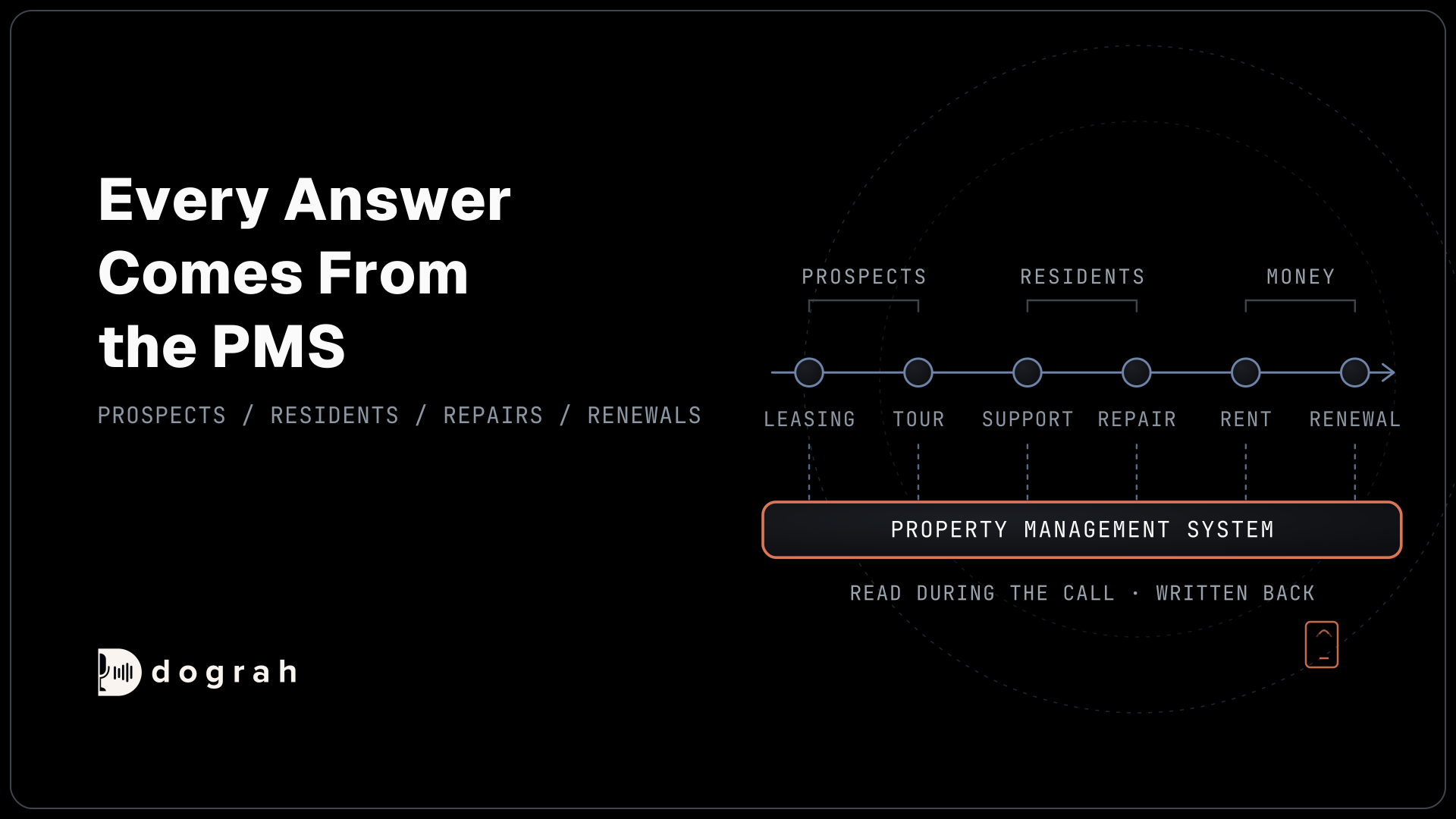
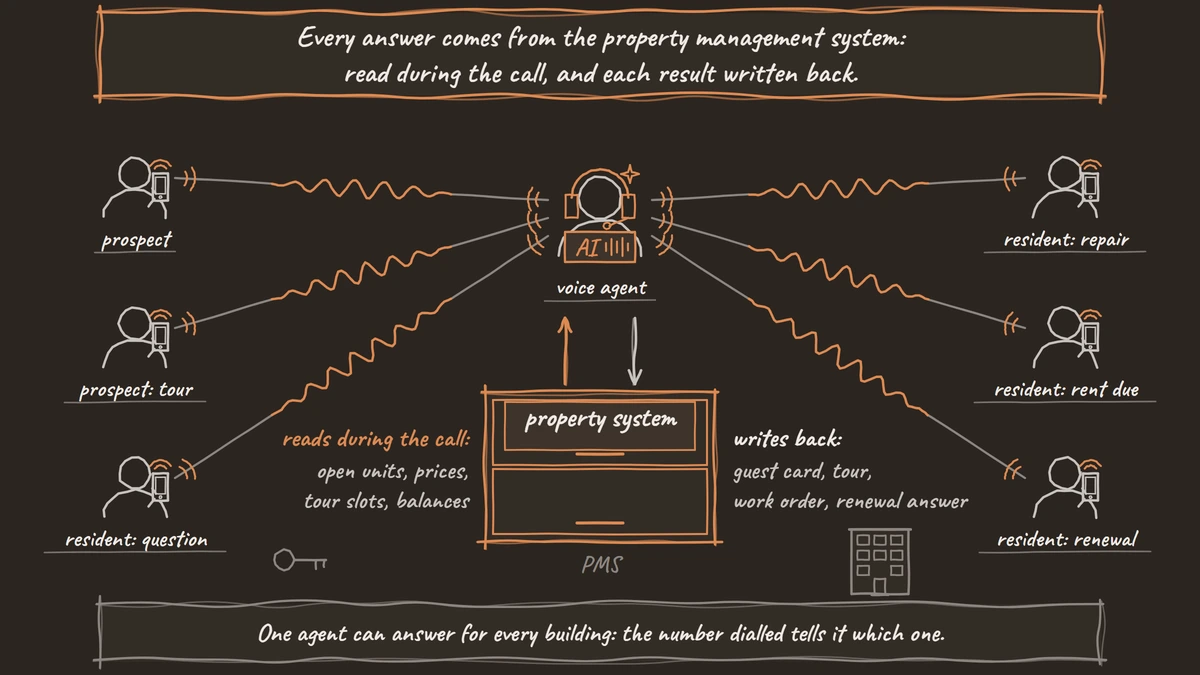
Every call in this guide reads from the property management system (PMS) and writes back to it, and the agent never keeps its own copy of a unit, a lease or a balance.
Dograh runs each call as a flow you draw in its visual workflow builder. During the call, an HTTP API tool asks the PMS for whatever the call needs: open units and prices, tour slots, a resident's balance or an open work order. The agent offers only what comes back. When the caller agrees to something, a second HTTP API tool writes it: a guest card, a booked tour, a work order or a renewal answer. After the call, a Webhook node sends the outcome and transcript link to your system and retries automatically on a temporary failure.
Dograh has no built-in PMS integration. Every connection is an HTTP API tool, a Model Context Protocol (MCP) tool, the Webhook node, Pre-Call Data Fetch or the API Trigger pointed at your PMS's own API. Our guide to Integrating Voice Agents With Your Stack covers those routes.
One agent can serve a whole portfolio. Several phone numbers can point at the same agent, and Pre-Call Data Fetch, at the bottom of the Start Call node, receives the dialled number as to_number. Your endpoint returns that property's name, office hours, policies and maintenance number, so the agent answers for the right building.
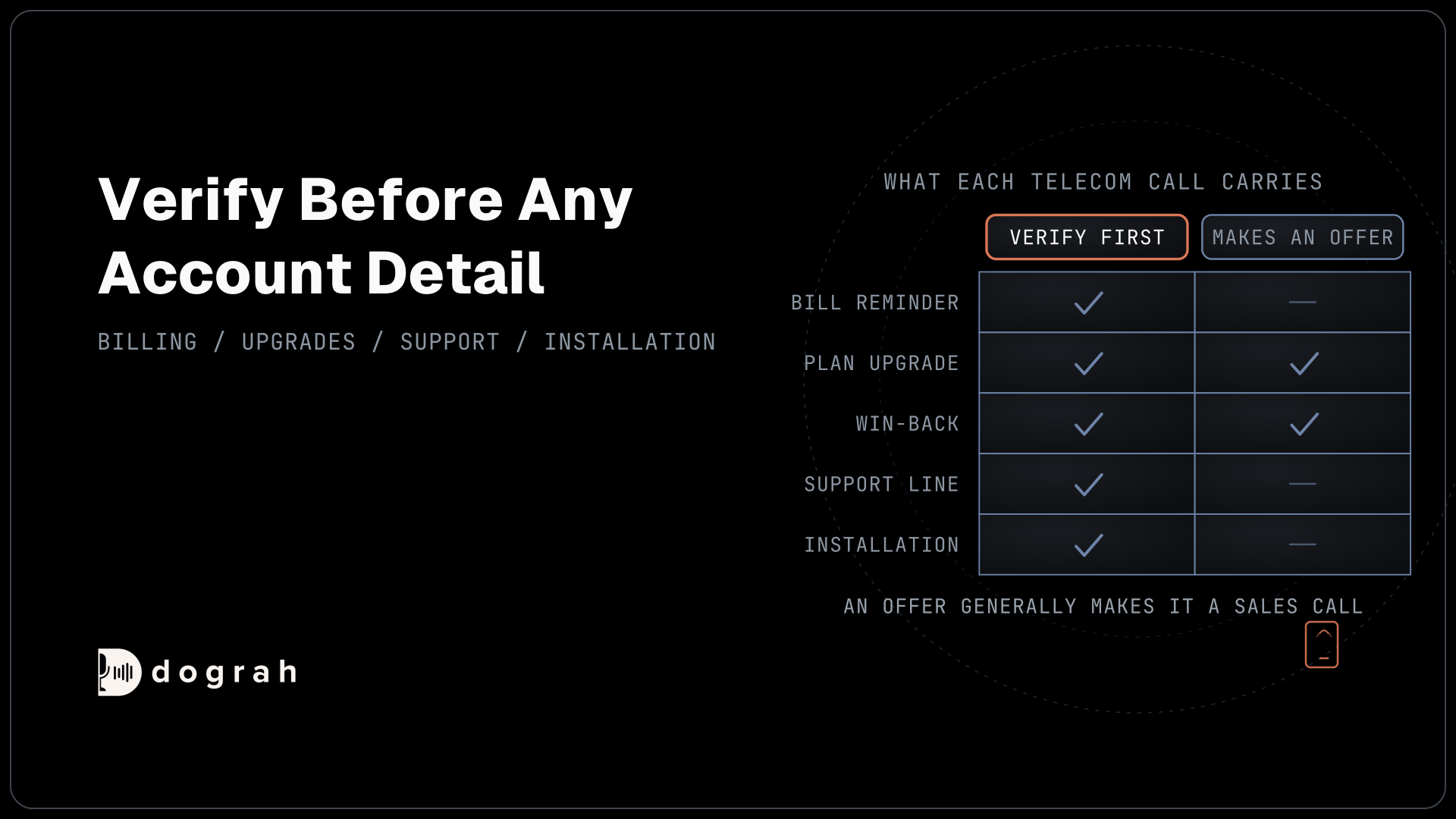
Every call with a resident runs greet, verify, then disclose. A phone number can find a lease, but it does not prove who is calling. Before the agent names a balance, a lease date, a work order or a renewal offer, it asks for the unit and name to find the record, then an approved check such as date of birth or the last digits of the account number. Never ask a caller to speak a password or a card number, because transcripts keep everything said.
Transfer Call hands the caller to a person. It works on Twilio only and passes no summary by default, so the agent writes the details to your system first. If nobody answers within the 30-second default, the caller stays with the agent; tell it in the prompt to offer a callback and write the request through an HTTP API tool. For on-call staff, the tool's Dynamic HTTP Resolver asks your rota system which number to dial at that moment.
Prospects: leasing inquiries and rental tours
Prospect calls come first in the lease cycle, and both are about one thing: what is open, and when the caller can see it.
Leasing inquiries
The leasing inquiry call answers a prospect from live listing and PMS data and logs a guest card, without screening anyone. The agent reads price, availability, pet policy, fees and application steps through an HTTP API tool, and reads written policies from the Knowledge Base. It records what the prospect says about move-in date and unit size as stated. Income, credit, rental history and identity checks stay in the written application. Questions about who lives in the building, the neighbourhood, schools or safety get one fixed reply and an offer of a person. AI voice agents for leasing inquiries covers the call in full.
Rental tours
The tour call books a unit tour from the leasing calendar and writes it to the PMS. The agent offers the tour types the property allows, such as self-guided or agent-led tours, and only slots the calendar returns. Before moving or cancelling a booked tour, it verifies the caller. It never reads out a lockbox or door code; the tour system releases access after its own ID check. AI voice agents for rental tour scheduling covers booking and rescheduling by phone.
These are leasing-office tours of rental units. Sale-side viewings, with seller windows and a listing agent, are covered in AI Voice Agents for Real Estate.

Open Source Alternative to Vapi / Retell
Self-hosted voice agent platform — no per-minute fees
dograh-hq/dograh
Star on GitHub
Living there: resident questions and maintenance requests
Once someone has signed, the calls change: residents ask about the building and their own account, and they report repairs.
Resident support
The resident support call answers general questions from the property's own documents and account questions only after verification. Office hours, parking, packages, guest and amenity rules come from documents in the Knowledge Base, so the agent does not invent policy. A balance, a lease end date, an open work order or a renewal offer is read live from the PMS once the resident is verified. Four requests always go to a person with the details written first: a reasonable accommodation request, a dispute or complaint about a neighbour, anything about an eviction or legal notice, and a payment arrangement. AI voice agents for resident support shows the full line.
Maintenance requests
The maintenance call sorts each report by how fast it needs a person, and only a routine repair ends as a plain ticket. A gas smell gets one fixed instruction: hang up and leave the unit now, then call 911 from well away from the leak. That line plays as Transition Speech or a recorded clip, so the words never drift, and the on-call person is alerted through your system. An active leak or no heat in cold weather goes to the on-call technician, with the details written to the PMS first. A routine repair becomes a work order with access notes, pets, preferred times and permission to enter recorded as stated. AI voice agents for maintenance-request intake covers the three paths.
Night calls are where this line earns most of its value. AI voice agents for after-hours coverage covers what happens when the on-call person does not pick up.
Money and the lease: rent reminders and renewals
The last two calls are outbound and touch money, so the agent reads every figure from the PMS and decides none of them.
Falling behind is common. The Federal Reserve's report on household finances in 2025 found that 23% of renters had been behind on their rent at some point in the past year, up from 21% in 2024. A reminder before the due date helps the tenant who simply forgot.
The rent reminder call goes out before or on the due date, verifies the tenant, then reads the amount and date from the PMS. It records a promise-to-pay date as the tenant stated it, and the PMS or payment provider sends its own payment link by text or email. Once rent is in default, staff take over. AI voice agents for rent reminders covers the call and where collection law starts.
The renewal call reads the offer the PMS returns and asks whether the resident plans to renew, recording the answer as stated. It never negotiates. A request for a lower rent, a concession, a payment plan or hardship help goes to the leasing manager, and the written renewal notice still comes from the PMS. AI voice agents for lease renewal outreach covers timing and the offer.
Join the Dograh Community
Dograh is an OSS alternative to Vapi. Join our Slack community for queries, releases, best practices & community interactions.
Fair housing on every call
A voice agent speaks for the property, so the Fair Housing Act generally applies to what it says as it would to a leasing agent. This section is general information, not legal advice.
Section 3604 of the Fair Housing Act makes it unlawful to make any statement about the rental of a dwelling "that indicates any preference, limitation, or discrimination based on race, color, religion, sex, handicap, familial status, or national origin". It also bars telling a person, on those grounds, "that any dwelling is not available for inspection, sale, or rental when such dwelling is in fact so available."
Two design rules follow. Every caller hears the same answers from the same PMS data and is offered the same open tour slots. Questions such as "is it good for kids?" or "who lives on that floor?" get one fixed reply and an offer of a person, never a judgement from the model.
The same section counts a refusal to make reasonable accommodations for a disability as discrimination. A caller asking for an exception, such as an assistance animal under a no-pets rule, has made a request. The agent records it as stated and routes it to a person. It never answers with the policy.
Many states and cities protect more characteristics than the federal list, for example source of income. Confirm your own position with counsel before the agent takes its first call.
Consent and payments: what the agent never does
Outbound calls need consent, and no call takes a payment. This is general information, not legal advice.
Under the Telephone Consumer Protection Act (TCPA), calls made with an artificial voice need consent. In its February 2024 declaratory ruling, the Federal Communications Commission (FCC) confirmed that "the TCPA's restrictions on the use of 'artificial or prerecorded voice' encompass current AI technologies that generate human voices". Those calls "require the prior express consent of the called party to initiate such calls absent an emergency purpose or exemption." So a rent reminder or renewal call generally needs consent on record, captured in the lease or the resident portal. An offer, such as a move-in special or a paid add-on, generally makes the call telemarketing, which needs prior express written consent. Confirm your position with counsel before the first outbound campaign.
Dograh keeps no do-not-call list. It can tag a call do_not_call, but that never blocks a future call, so opt-outs live in your own system: an HTTP API tool or the webhook writes them there, and you remove those numbers before each Campaigns upload. A contact cannot be removed from a running campaign; the campaign itself can only be paused and resumed. To skip residents who already paid or signed, start calls from your system with the API Trigger, or upload smaller, fresh lists.
No call takes a payment. Dograh has no payment feature and no keypad (DTMF) tool. An HTTP API tool asks the PMS or payment provider to send its secure link by text or email. The agent also never decides money, eligibility, approvals or other outcomes: fees, waivers, approvals and lease terms come from the PMS or a person.
Which call to hand over first
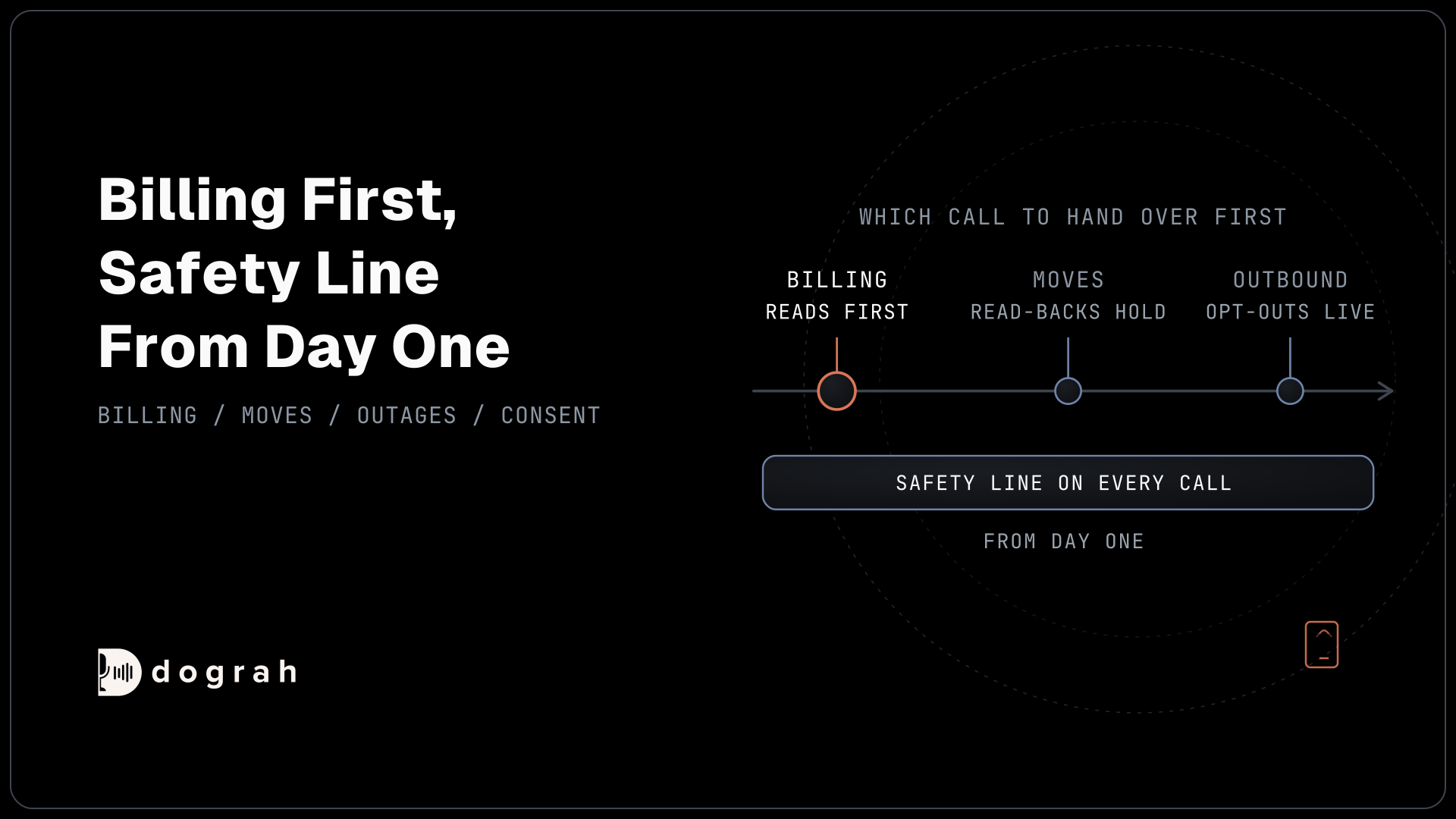
Start with inbound leasing calls, because they read before they write and raise no outbound consent questions. After-hours maintenance comes next, once the gas line and on-call routing are tested. Rent and renewal campaigns come last, once consent is recorded in your own system.
Put the agent on a real phone number before any resident hears it: most phone calls reach the agent as 8 kHz audio, while a browser test runs at 16 kHz. Testing Voice Agents Before You Go Live sets the order. Once live, run quality assurance (QA) on a random 5 to 10% sample of calls and fix what the transcripts show. For one agent answering every call at the office, The Ultimate Guide to AI Receptionists is the wider view.
Self-hosting keeps recordings and transcripts on your own servers; the audio stays in-house only when the speech and language models run there too. Self-hosted Dograh has no per-minute platform fee (servers, model keys and phone minutes still cost); Dograh Cloud has a 1¢-a-minute platform fee. Our self-hosted AI leasing agent for apartment communities shows the leasing call running on your own servers.
Each call above has its own deep dive:
- AI Voice Agents for Leasing Inquiries
- AI Voice Agents for Rental Tour Scheduling
- AI Voice Agents for Resident Support
- AI Voice Agents for Maintenance-Request Intake
- AI Voice Agents for Rent Reminders
- AI Voice Agents for Lease Renewal Outreach
Glossary
- Promise to pay
- A date the tenant gives for paying rent that is due or late, recorded in the PMS as the tenant stated it. The agent logs it but never agrees a payment plan or waives a fee; those go to a person.
- Guest card
- The PMS record of a prospect: name, contact details, move-in date and what they asked about. The leasing inquiry call creates one with what the prospect said, as stated.
- Reasonable accommodation
- A change to a rule, policy or service that a person with a disability may need to use and enjoy a home, such as an assistance animal under a no-pets rule. Refusing one can be discrimination under the Fair Housing Act, so the agent routes every request to a person.
- Prior express consent
- The called party's permission, given before the call, that the TCPA generally requires for calls made with an artificial voice, including AI voices. Rent reminder and renewal calls generally need it on record.