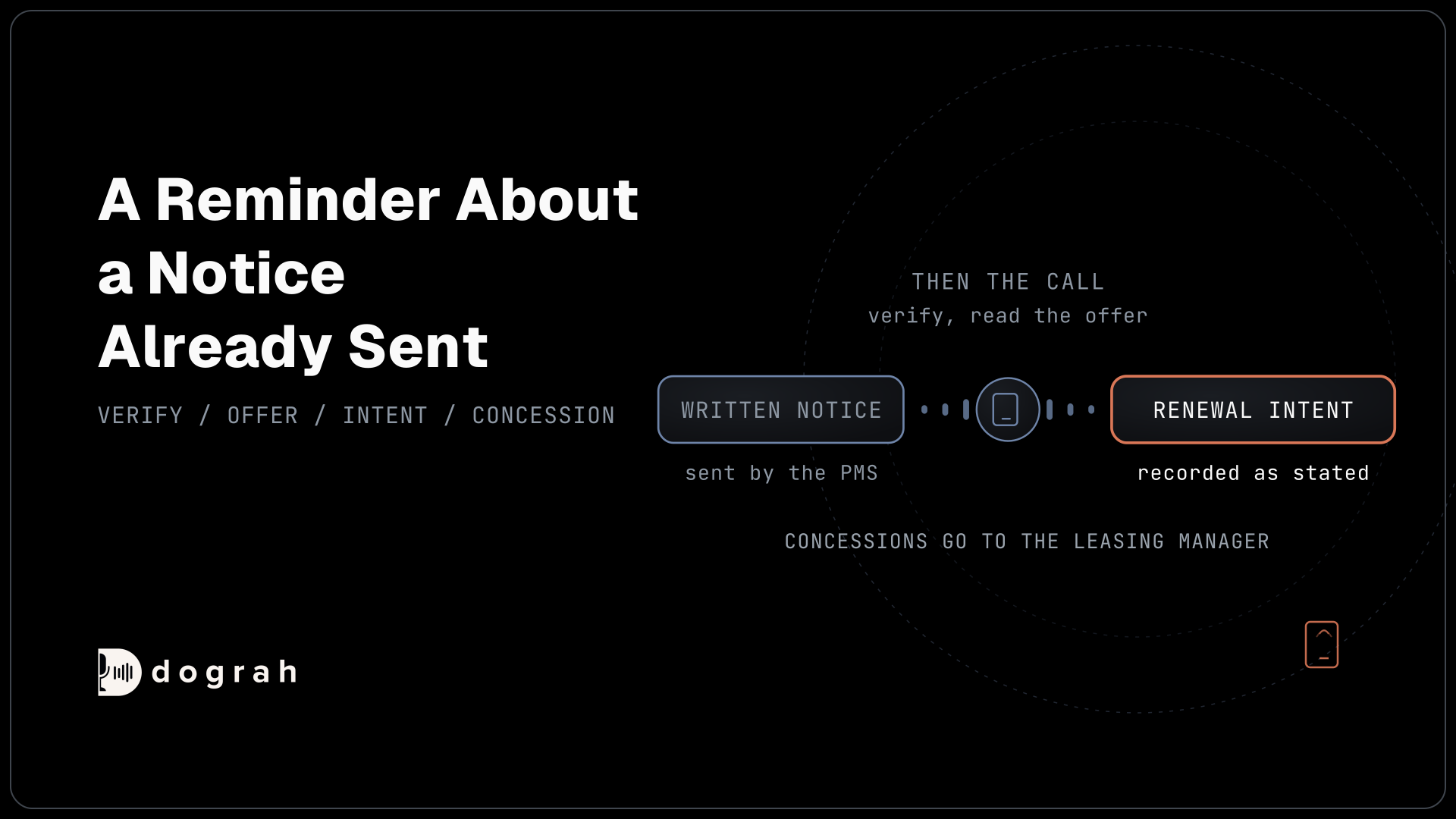

AI voice agents for lease renewal outreach call residents after the written renewal notice has gone out. They verify the resident, read the renewal offer exactly as the property management system returns it, ask whether the resident plans to renew and record the answer as stated. They never negotiate; concessions and hardship requests go to the leasing manager.
Key Takeaways
- The PMS sends the written notice; the call follows it, never replaces it.
- Read the offer exactly as the PMS returns it, after verification.
- Lower rent, concessions, payment plans and hardship go to the leasing manager.
This post is part of our guide to AI voice agents for property management and leasing. The guide's section "Money and the lease: rent reminders and renewals" sums up this call in one line: it reads the offer the PMS returns and asks whether the resident plans to renew, recording the answer as stated. Here is that call in full, run in Dograh, an open-source, self-hostable voice agent platform.
Why renewal calls are worth making
A renewal call finds out early which residents plan to stay. Roughly half of them do: RealPage's lease transaction data show that 56% of market-rate apartment residents with leases expiring in the first half of 2026 signed renewal leases, as LeaseLock's chief economist reported. Knowing which half you are dealing with, months before move-out, changes how the leasing team spends its time.
Satisfaction drives the answer. AppFolio's 2026 Renter Preferences Report, a survey of 3,002 US renters in early 2026, found that satisfied residents are 72% more likely to renew and 34% less likely to plan a move. A renewal call that also asks about open problems gives the team a chance to fix the reason someone might leave.
The written notice comes first
The renewal offer and any rent increase notice reach the resident in writing, from the property management system (PMS), on the timeline the law sets. The call is a reminder about a notice already sent. It never replaces one.
Notice rules vary by state and city, and by the type of tenancy. One example, for month-to-month tenancies: California Civil Code section 827 says that if a proposed increase "is greater than 10 percent of the rental amount charged to that tenant" in the prior 12 months, "the notice shall be delivered at least 90 days before the effective date of the increase." Rent control and local ordinances can add more. This is general information, not legal advice, so set the notice timeline with counsel and let the call follow it.
In practice, the PMS sends the notice and the e-signature link, and your system starts calls for residents who have not answered after a set number of days.
Building the call list
The list comes from your PMS: residents whose notice went out, who have not signed or given notice, with consent to calls on file and no opt-out. Upload it as a CSV to Campaigns. Each extra column, such as the property name or the lease end month, becomes a variable the agent can use. Keep the offer itself out of the file; the agent reads it live after verification, so a changed offer is never read from a stale list.
Outbound calls generally need consent. In its February 2024 declaratory ruling, the Federal Communications Commission (FCC) said calls using AI-generated voices "require the prior express consent of the called party to initiate such calls absent an emergency purpose or exemption." Capture it in the lease or resident portal, and confirm your position with counsel. Dograh keeps no do-not-call list, so opt-outs go to your own system through an HTTP API tool or the webhook, and you remove them before each upload.
Residents sign while a campaign runs. A contact cannot be removed from a running campaign; the campaign itself can only be paused and resumed. Upload smaller, fresh lists, or start each call from your system with the API Trigger after checking that the lease is still unsigned. Calling hours use one time zone per campaign.

Open Source Alternative to Vapi / Retell
Self-hosted voice agent platform — no per-minute fees
dograh-hq/dograh
Star on GitHub
How the call runs: verify, read the offer, record intent
The opening line matters on an outbound call, so put it in Greeting Text, which Dograh plays word for word. It names the property and asks for the resident, using a variable with a fallback such as {{first_name | there}} so a missing name is never read aloud as a placeholder. Our post on the first 15 seconds of AI outbound calls explains why that line decides the rest.
Asking for the resident by name only finds the right person. Before naming the offer, the agent asks for an approved check, such as date of birth or the last digits of the account number. Then an HTTP API tool reads the renewal offer from the PMS: the term options and the rent for each, exactly as written. The agent reads them out and offers nothing else.
Next it asks whether the resident plans to renew, and records the answer as stated, including "not sure yet". It also asks whether anything in the home needs fixing. A broken appliance becomes a work order through the flow in AI voice agents for maintenance-request intake. A second HTTP API tool writes the renewal intent back to the PMS, and if the resident is ready to sign, another asks the PMS to resend its e-signature link by text or email, since Dograh sends no texts itself.
Run the QA node on a random sample of calls to catch any call where the agent strayed from the offer.
The agent never negotiates
Price decisions stay with the leasing team. A request for a lower rent, a concession, a payment plan or hardship help goes to the leasing manager. The agent records the request as the resident stated it and does not hint at what the answer might be.
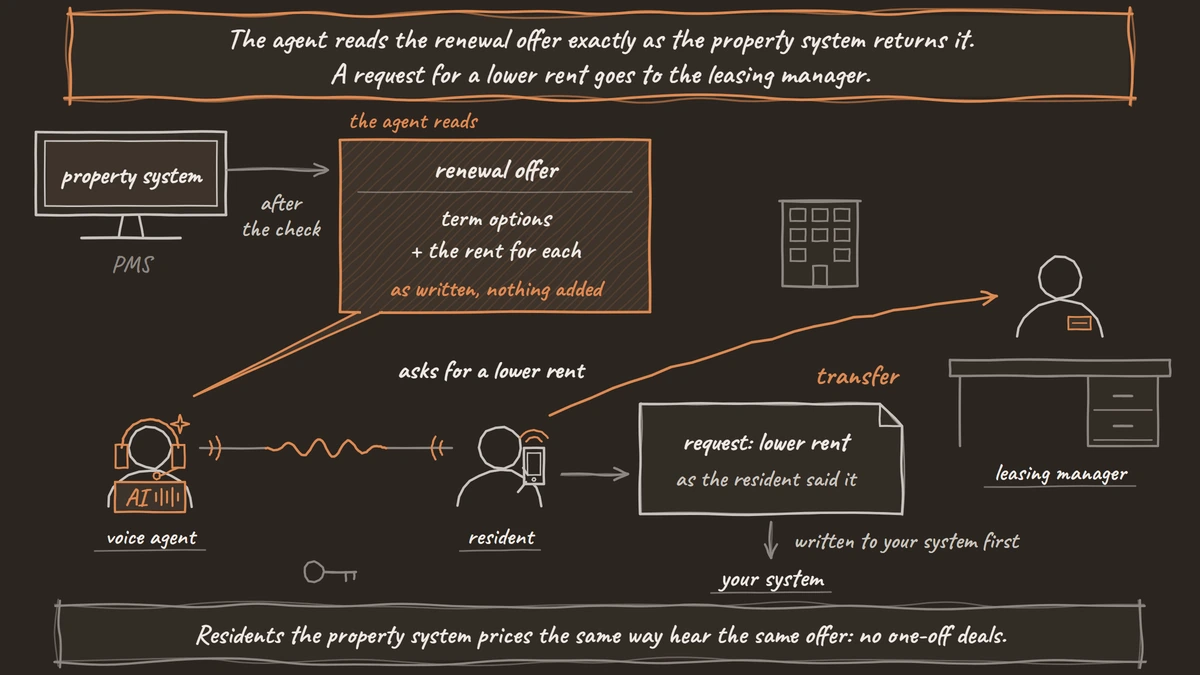
This also keeps fair housing simple. Residents the PMS prices the same way hear the same offer, and no one gets an ad hoc deal because of how a call went.
Transfer Call hands the resident to the leasing manager. It works on Twilio only and passes no summary by default, so the agent writes the request to your system first. If nobody answers within the 30-second default, the resident stays with the agent; tell it in the prompt to offer a callback and write the request through an HTTP API tool.
A resident who will not renew gets a polite close: the agent records the reason as stated and explains that the written move-out steps come from the office. The call carries no add-on offers. An offer on a call such as this generally makes it telemarketing, with stricter consent rules; our post on service reminders in automotive makes the same split. Confirm your position with counsel before the first outbound campaign.
Self-hosted Dograh has no per-minute platform fee (servers, model keys and phone minutes still cost); Dograh Cloud has a 1¢-a-minute platform fee.
Join the Dograh Community
Dograh is an OSS alternative to Vapi. Join our Slack community for queries, releases, best practices & community interactions.
Glossary
- Renewal offer
- The term options and rent for each that the PMS sets for a resident's next lease. The voice agent reads it exactly as the PMS returns it, after verifying the resident.
- Renewal intent
- The resident's answer on whether they plan to renew, including "not sure yet". The agent records it as stated and writes it to the PMS so the leasing team can act early.
- Rent increase notice
- The written notice of a new rent that state or local law may require a set number of days before it takes effect. In California, a month-to-month tenancy needs at least 90 days' notice of an increase over 10%. The call never replaces it.
- Concession
- A discount or incentive offered to keep or win a resident, such as a free month. Only the leasing team grants one; the voice agent records the request and passes it on.