
AI voice agents for maintenance-request intake answer repair calls at any hour and sort them by urgency. A gas smell, smoke, fire or a carbon monoxide alarm gets one fixed instruction to leave and call 911. Urgent repairs go to the on-call technician; routine ones become work orders in the property management system, with permission to enter recorded as stated.
Key Takeaways
- A gas smell gets one fixed line: leave now, then call 911 outside.
- Your rota system picks the on-call number; details are written first.
- Verify the tenant before reading back any open work order.
This post is part of our guide to AI voice agents for property management and leasing. The guide's section "Living there: resident questions and maintenance requests" sums up this call in one line: it sorts each report by how fast it needs a person, and only a routine repair ends as a plain ticket. Here is that call in full, run in Dograh, an open-source, self-hostable voice agent platform.
Why the maintenance line deserves care
Repairs shape whether residents stay. AppFolio's 2026 Renter Preferences Report, a survey of 3,002 US renters in January and February 2026, found that residents happy with their repairs are 81% more likely to renew. So the maintenance line is part of renewal as well as a cost.
Most repair calls are routine: a dripping tap, a stuck window, a slow drain or a dead outlet. The rare emergency carries the real risk, and it tends to arrive at night, when the office is closed. An agent on this line has to handle the routine call well and the rare one without a single wrong word. Our post on after-hours coverage covers the night shift around it.
Sort the call by how fast a person is needed
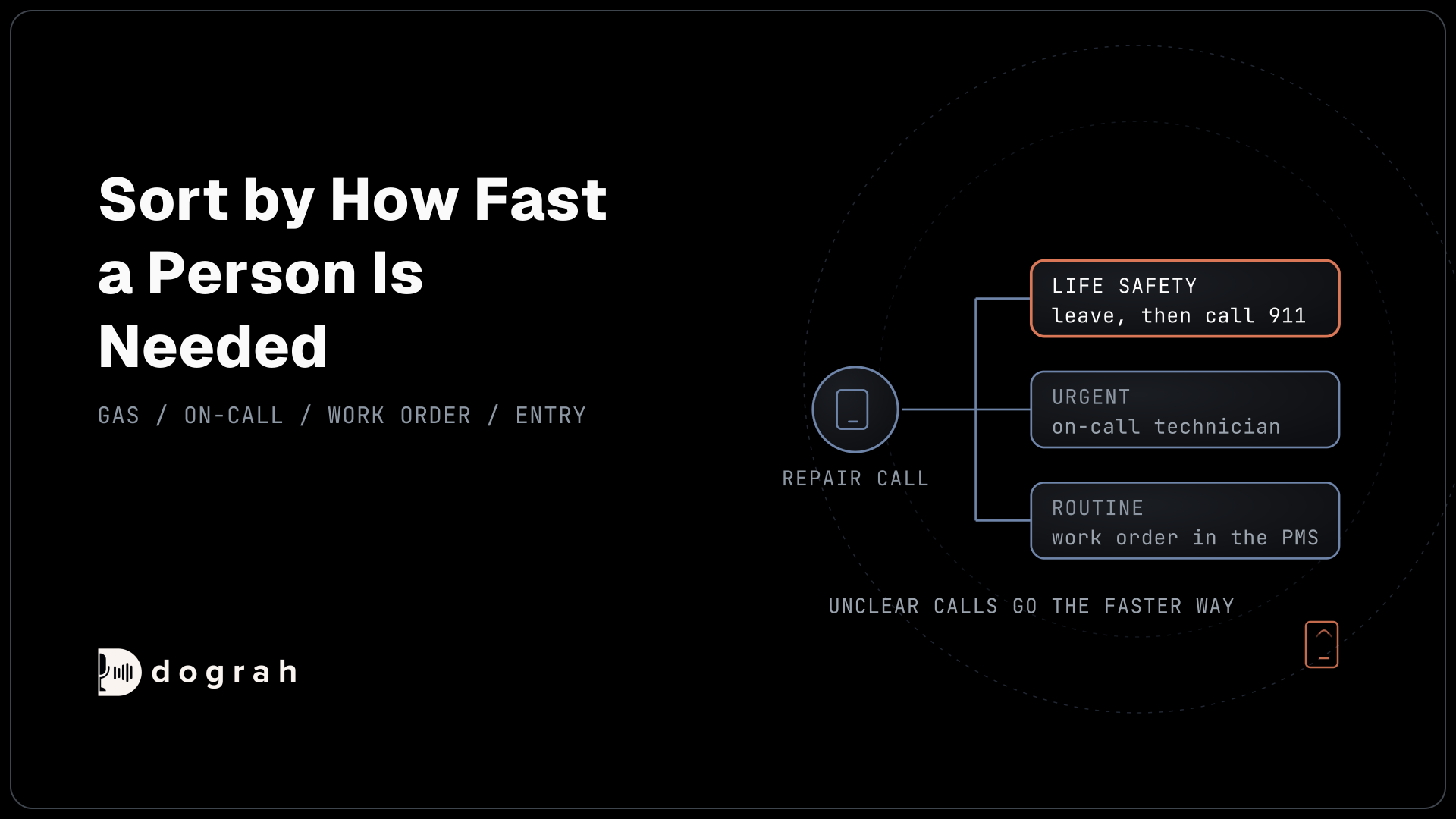
The agent asks what is wrong and where, then sends the call down one of three pathways in the flow. Life-safety calls leave the triage at once. Urgent repairs go to a person tonight. Routine repairs become a work order for business hours.
Write each pathway's condition plainly, with examples from your own call history: "gas smell, burning smell, smoke, carbon monoxide alarm, sparking outlet" for life safety; "water coming through the ceiling, no heat when it is freezing, no water at all, locked out" for urgent. Choosing a pathway is the language model reading those conditions, never a hard rule. So test it with the phrases residents really use, read the transcripts, and when a call could be either, send it the faster way.
Write your own list with your maintenance lead. Local rules differ, and so does the weather: no heat in a northern winter is urgent in a way it is not elsewhere.
Life-safety calls: one fixed line, then the call ends
A life-safety call gets one instruction, word for word, and then the call ends. The Pipeline and Hazardous Materials Safety Administration's guidance on natural gas emergencies in your home or workplace tells people not to "Use a telephone or cell phone (these can ignite airborne gases)" when they suspect a leak. It says to "Leave the area" and "Telephone 911 from a neighbor's house or other location well away from the gas leak."
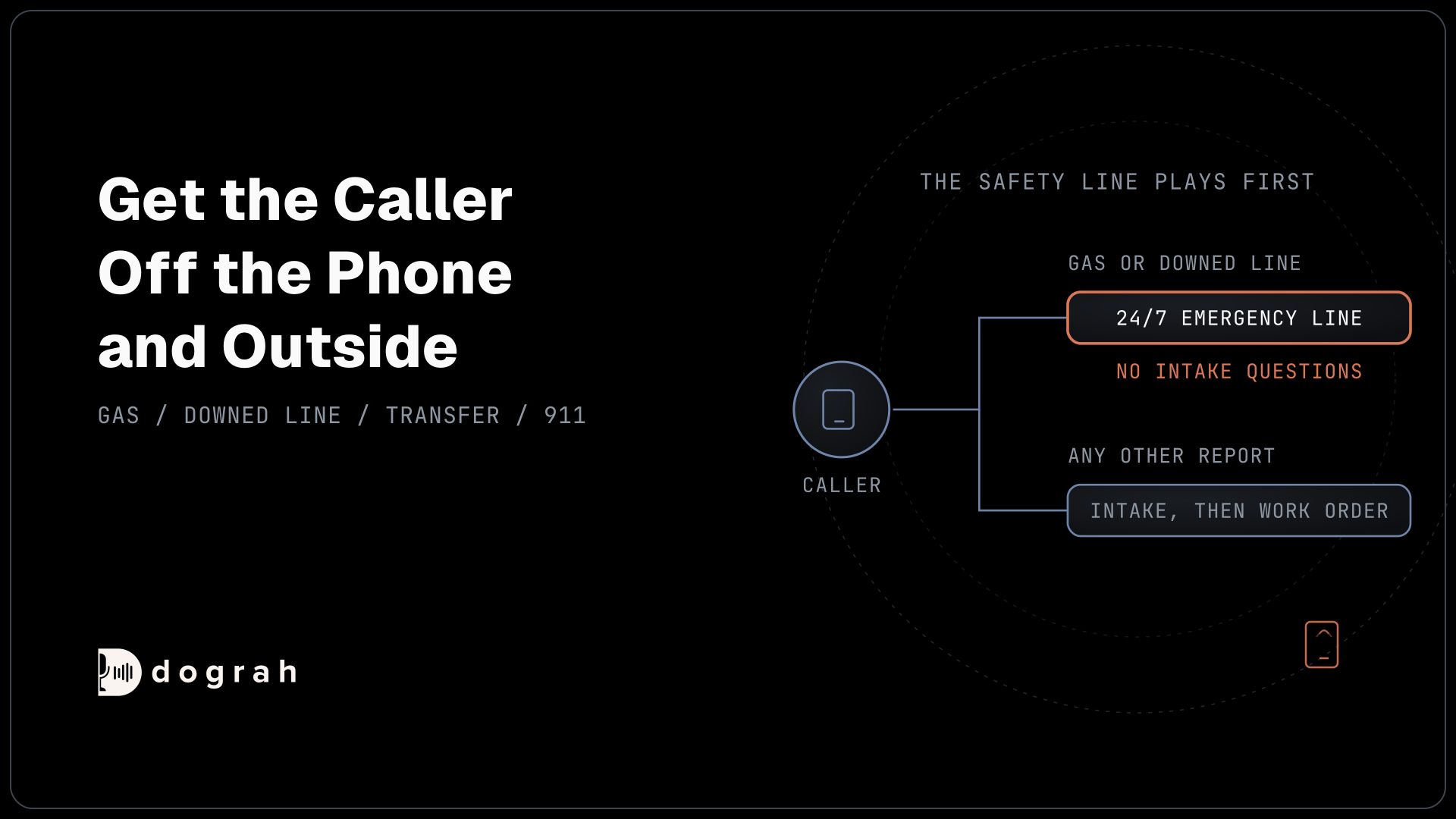
So the agent does not keep a resident talking inside a unit that smells of gas. The fixed line tells them to hang up, leave the unit now without touching any light switches, then call 911 from well away from the leak. Fire and a sounding carbon monoxide alarm get the same shape: leave, then call 911. The agent never asks follow-up questions first and never tries to judge how bad the leak is.
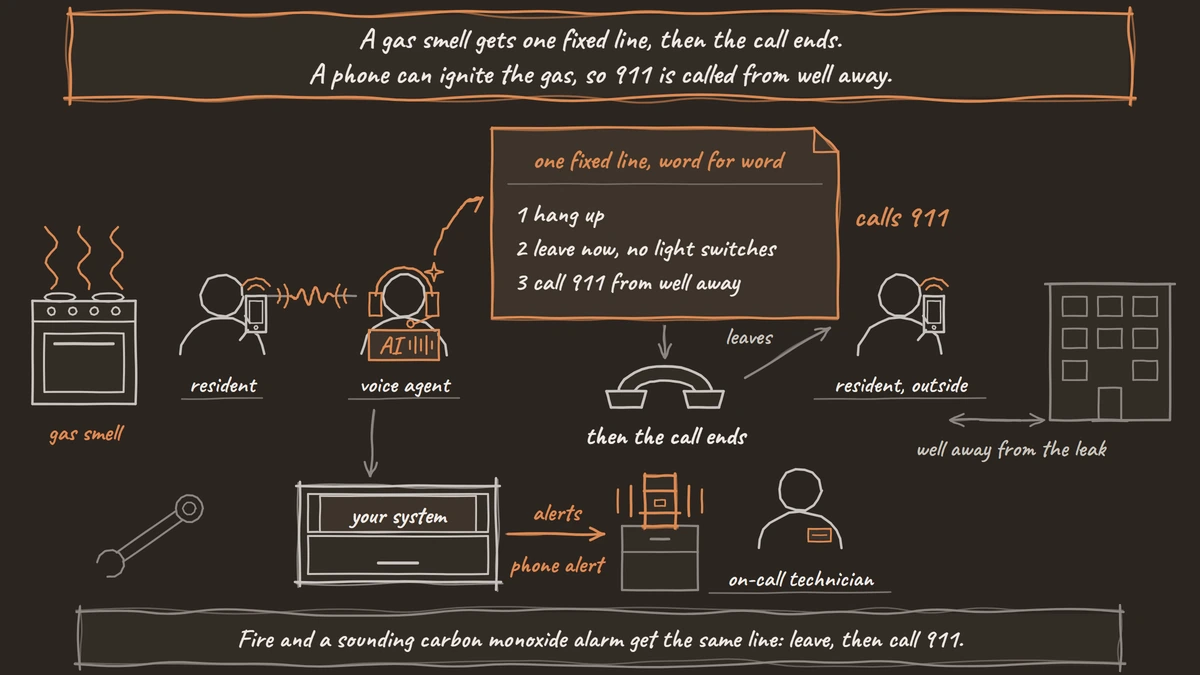
Exact wording only holds where Dograh speaks fixed text: the Greeting Text at the start of the call, a pathway's Transition Speech (text or a pre-recorded clip) and the Transfer Call tool's Pre-Transfer Message. So the line plays as the pathway's Transition Speech or a recorded clip. Text transition speech does not play on speech-to-speech models, so run this agent on a cascade setup or use a recording. After the line plays, the call ends, and an HTTP API tool or the Webhook node alerts the on-call person through your own system. The government version of this pattern is in our post on emergency and incident intake.

Open Source Alternative to Vapi / Retell
Self-hosted voice agent platform — no per-minute fees
dograh-hq/dograh
Star on GitHub
Urgent repairs go to the on-call technician
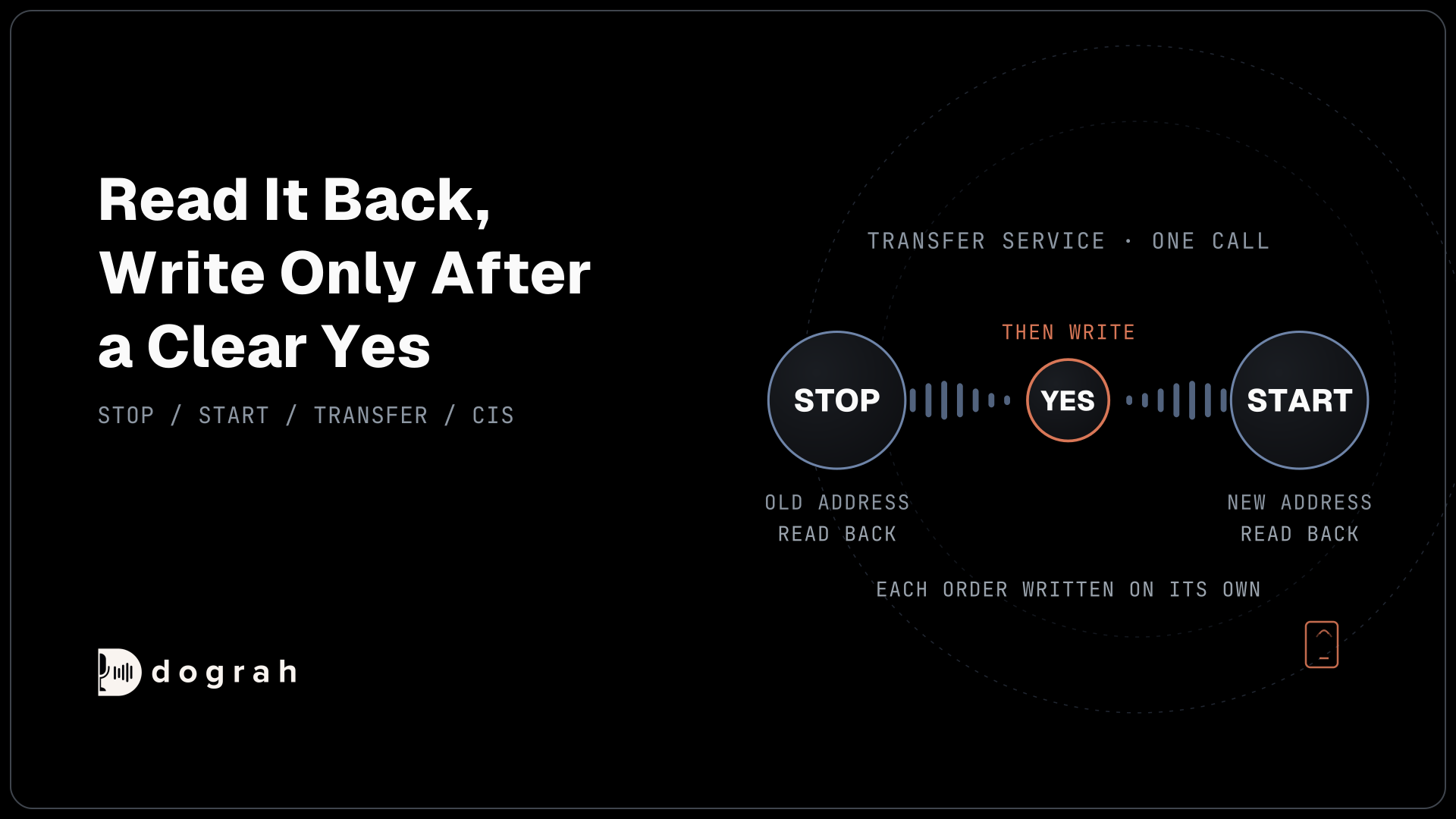
An urgent repair needs a person tonight, so the agent collects the basics and transfers the call. It records the unit, the problem, when it started and anything the resident has already done, then writes them to the property management system (PMS) through an HTTP API tool. Transfer Call passes no summary by default, so the technician reads the details there.
The number to dial changes every night. Transfer Call's Dynamic HTTP Resolver handles that: Dograh posts to your endpoint, and your rota system returns the number of whoever is on call at that moment. A Resolver Wait Message plays during the lookup, which times out at 3,000 ms by default and 5,000 ms at most. Transfer Call works on Twilio only.
If the technician does not answer within the 30-second default, the resident stays with the agent, and Dograh hands the failure back to the model, which writes its own reply. There are no fixed words at that moment. So put any safety advice before the transfer, in the tool's Pre-Transfer Message, in words your maintenance lead writes. For a leak, that might be: turn off the water at the valve if you know where it is and it is safe to reach. Then tell the agent in the prompt to offer a callback and write the request to your system through an HTTP API tool, so your system can page the backup.
Routine repairs become a work order
A routine call ends with a work order in the PMS and its number read back to the resident. The agent collects the unit, what is wrong, where in the home, since when, pets, the best times to visit and permission to enter. Extraction is an AI step, so it records each answer as the resident stated it, including the exact terms of entry; the transcript and recording are the exact record.
Photos help the technician. An HTTP API tool asks the PMS to text or email the resident its own upload link, since Dograh sends no texts itself. A second HTTP API tool writes the work order, with a Preset Parameter named workflow_run_id set to {{initial_context.workflow_run_id}} so a retried request does not create two. Our post on webhook-driven voice agents covers sending the outcome onward after the call.
Anyone can report a leak, including a neighbour. Reading back an open work order is different: it names a unit's details. Before the agent says anything about an existing request, it verifies the caller is the tenant on the lease. The unit and name find the record; an approved check, such as date of birth or the last digits of the account number, confirms the person.
Accommodation requests and what stays with people
Some maintenance calls are really requests for a change because of a disability. This part is general information, not legal advice. Section 3604(f)(3) of the Fair Housing Act counts as discrimination "a refusal to permit, at the expense of the handicapped person, reasonable modifications of existing premises" and "a refusal to make reasonable accommodations in rules, policies, practices, or services." A resident asking for a grab bar, or for entry only with notice, has made a request.
The agent writes the request to your system as stated and tells the resident a person will follow up. It does not approve or refuse. The same goes for a dispute about a repair charge and any complaint about a technician. The agent also never diagnoses a fault or promises a repair date the PMS did not return. Questions about rent or the lease go to AI voice agents for resident support.
Self-hosted Dograh has no per-minute platform fee (servers, model keys and phone minutes still cost); Dograh Cloud has a 1¢-a-minute platform fee. Confirm your own position on accommodation handling with counsel.
Join the Dograh Community
Dograh is an OSS alternative to Vapi. Join our Slack community for queries, releases, best practices & community interactions.
Glossary
- Life-safety call
- A report that puts people at risk if it waits, such as a gas smell, smoke, fire or a carbon monoxide alarm. The agent plays one fixed instruction to leave and call 911, then ends the call and alerts on-call staff.
- Dynamic HTTP Resolver
- A Transfer Call setting in Dograh where your endpoint returns the number to dial at the moment of transfer. A rota system uses it to send urgent repairs to whoever is on call.
- Permission to enter
- The resident's answer on whether a technician may enter the home when nobody is in, and on what terms. The agent records it as the resident stated it on the work order.
- Reasonable modification
- A physical change to a home that a resident with a disability may need, such as a grab bar. The Fair Housing Act bars refusing reasonable ones, so the agent routes every request to a person.