
US federal law generally lets a call be recorded when one party consents, while states such as California, Florida, Illinois and Washington generally require the consent of everyone on the call. If your agent records by default with no consent step, put a fixed recording notice first in its greeting and plan for callers who say no.
Key Takeaways
- Quote the statute for each state your callers are in, and ignore state counts.
- Put "this call is recorded" first in the Greeting Text, in fixed words.
- Recording cannot stop for one call, so a caller who says no needs another way.
This post is part of our guide to compliant AI voice agents. The guide's section "Recording consent and AI disclosure" puts the rule in one line: "When callers can be in an all-party state, the simplest course is generally to announce recording on every call, before anything else is said." Here is what the statutes say, and how to set that up in Dograh, an open-source, self-hostable voice agent platform.
Recording consent laws: federal and three states
Recording law turns on who agreed to the recording, and the answer changes at the state line. This section is general information, not legal advice.
Federal law sets the floor. Under 18 U.S.C. 2511(2)(d), "It shall not be unlawful under this chapter for a person not acting under color of law to intercept a wire, oral, or electronic communication where such person is a party to the communication or where one of the parties to the communication has given prior consent to such interception". So a business recording its own calls is generally covered under federal law alone.
Some states ask for more. California Penal Code 632(a) covers anyone who records "without the consent of all parties to a confidential communication". A separate section, 632.7(a), covers calls involving a cellular or cordless phone, and it asks for "the consent of all of the parties to a communication" with no confidential-communication test.
Florida reads the same way. Florida Statutes 934.03(2)(d) makes recording lawful "when all of the parties to the communication have given prior consent to such interception."
Illinois adds a word that matters for voice agents. Under 720 ILCS 5/14-2(a)(2), a person commits eavesdropping by recording "in a surreptitious manner" a private conversation they are part of, "unless he or she does so with the consent of all other parties to the private conversation." A recording announced at the start of the call is generally not surreptitious.
These three states are examples, and other states have their own rules. Look up the statute for each state your callers are in.
Washington's rule: announce it, record the notice
Washington spells out what a valid notice looks like, and its rule makes a good design for any all-party state.
RCW 9.73.030(3) says consent "shall be considered obtained whenever one party has announced to all other parties engaged in the communication or conversation, in any reasonably effective manner, that such communication or conversation is about to be recorded or transmitted: PROVIDED, That if the conversation is to be recorded that said announcement shall also be recorded."
Two design rules follow. The notice comes at the start of the call, before the conversation gets going. And the notice must be on the recording itself, so the recording proves it was given. Generally, a short fixed notice at the start of every call, kept on the recording, fits the all-party rules quoted above. Confirm your position with counsel.

Open Source Alternative to Vapi / Retell
Self-hosted voice agent platform — no per-minute fees
dograh-hq/dograh
Star on GitHub
Why the notice belongs in the Greeting Text
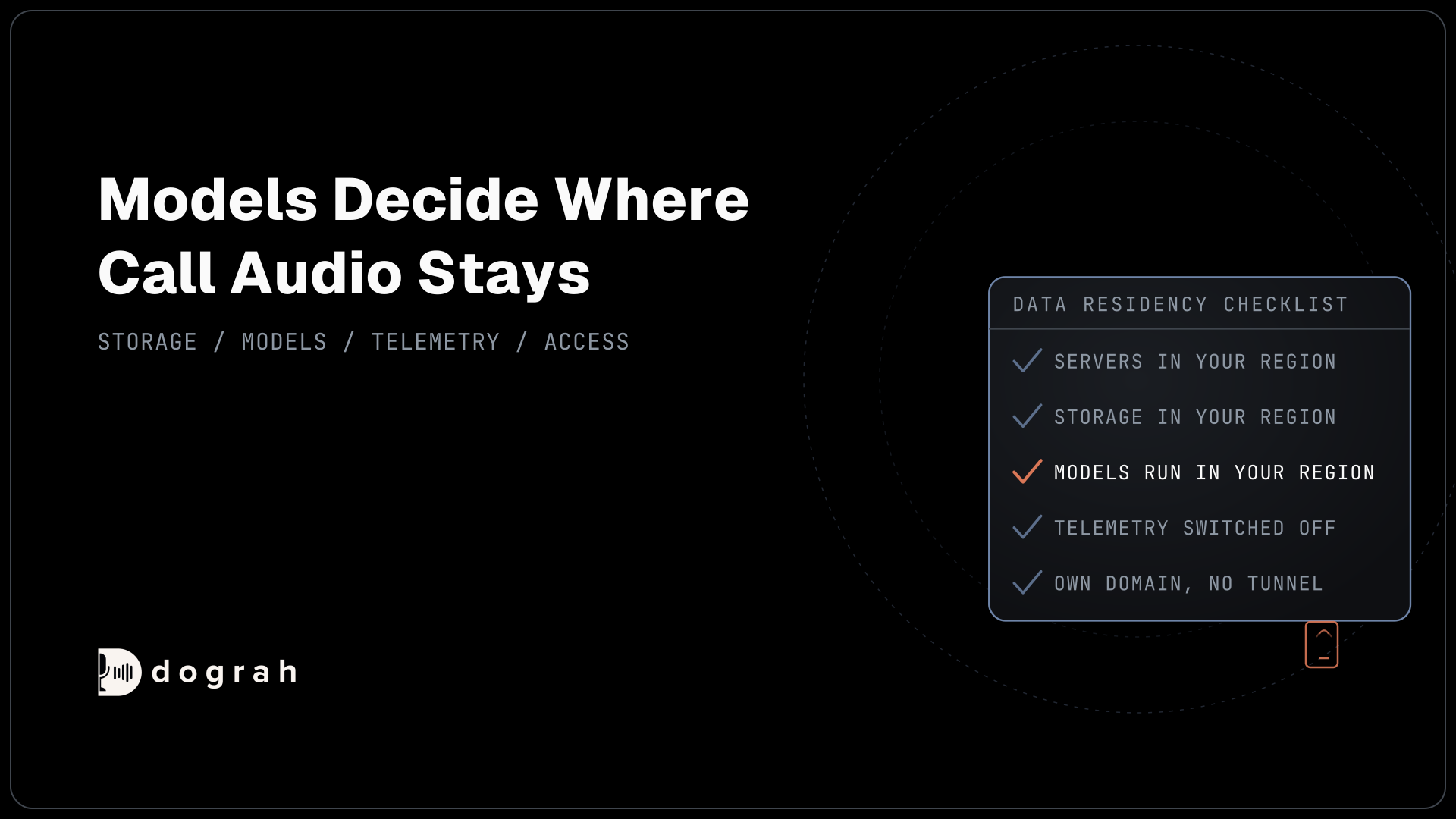
Dograh has no built-in consent step and no recording-disclosure node, so the notice has to be part of what the agent says. In a self-hosted install, recording upload is on by default. It can be switched off only for the whole server, with ENABLE_CALL_RECORDING_UPLOAD=false, and transcripts are still saved.
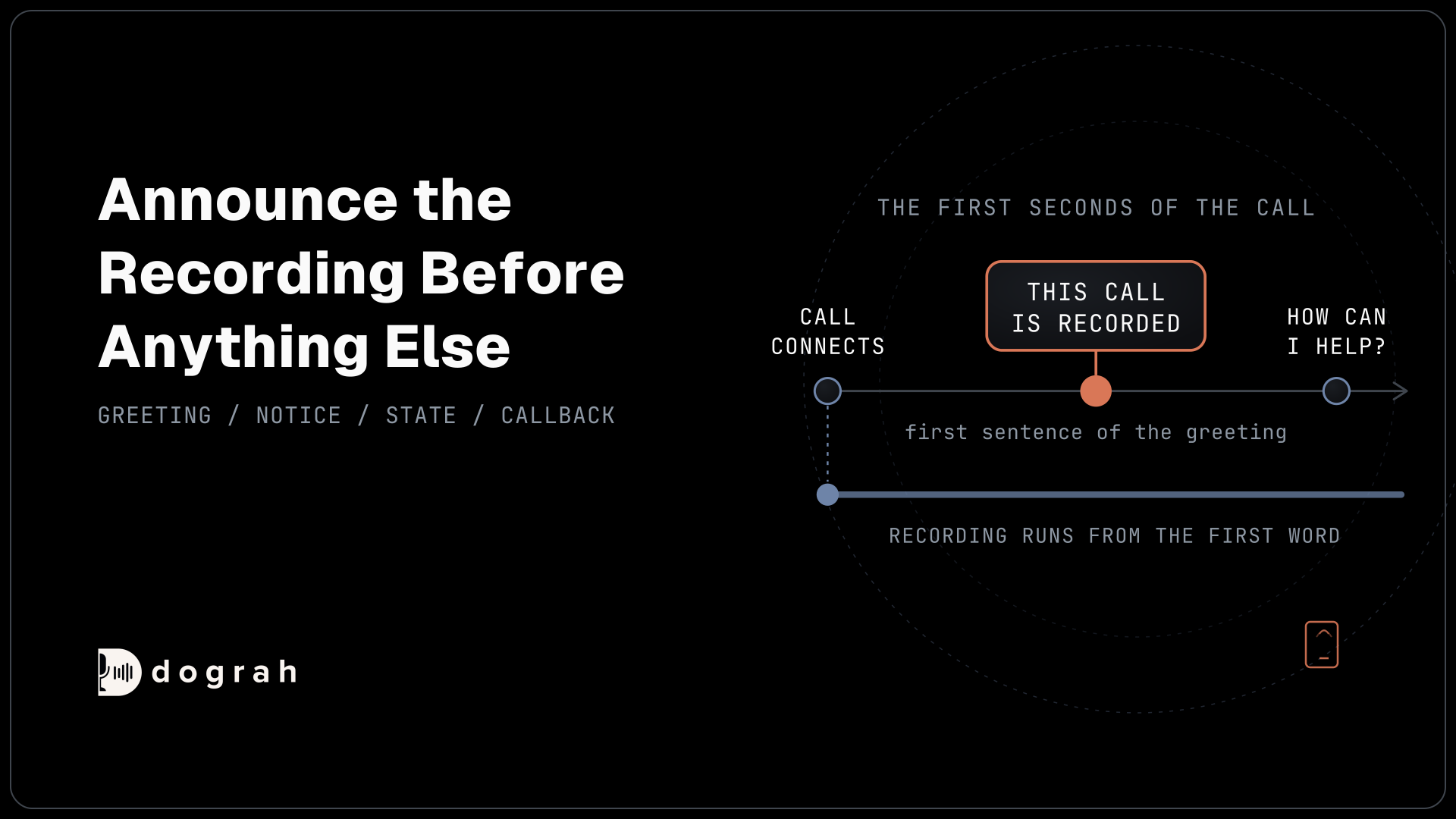
The right place is the Greeting Text on the Start Call node. It is a fixed line that Dograh plays word for word as the call connects, and the language model never writes or rewords it. You can also set the Greeting Type to Pre-recorded Audio and play a recorded clip instead. Recording starts as the call connects, so the greeting is on the recording, which is what Washington asks for.
The reason for fixed text is covered in our post on prompt and flow design patterns. Inside a node, the model writes its own words, so a prompt cannot guarantee exact wording. On a speech-to-speech agent, a text greeting is passed to the model as an instruction to say it exactly, and the model still generates the speech. Use a Pre-recorded Audio greeting there.
Two setups need extra care. A fixed greeting per contact, as text or a recorded clip, can come from the campaign file, and contacts without one hear the agent's normal greeting. Every per-contact greeting needs the notice too. And if the greeting uses variables, give each a fallback, such as {{customer_name | there}}, since a missing value with no fallback is left blank.
Writing a notice the caller actually hears
Put the recording notice in the first sentence of the greeting and keep it short. A caller who says two words or more while the greeting plays cuts it short, and anything after that point is never spoken. The Allow Interruption switch does not change this during the greeting, so the first sentence is the only part every caller hears.
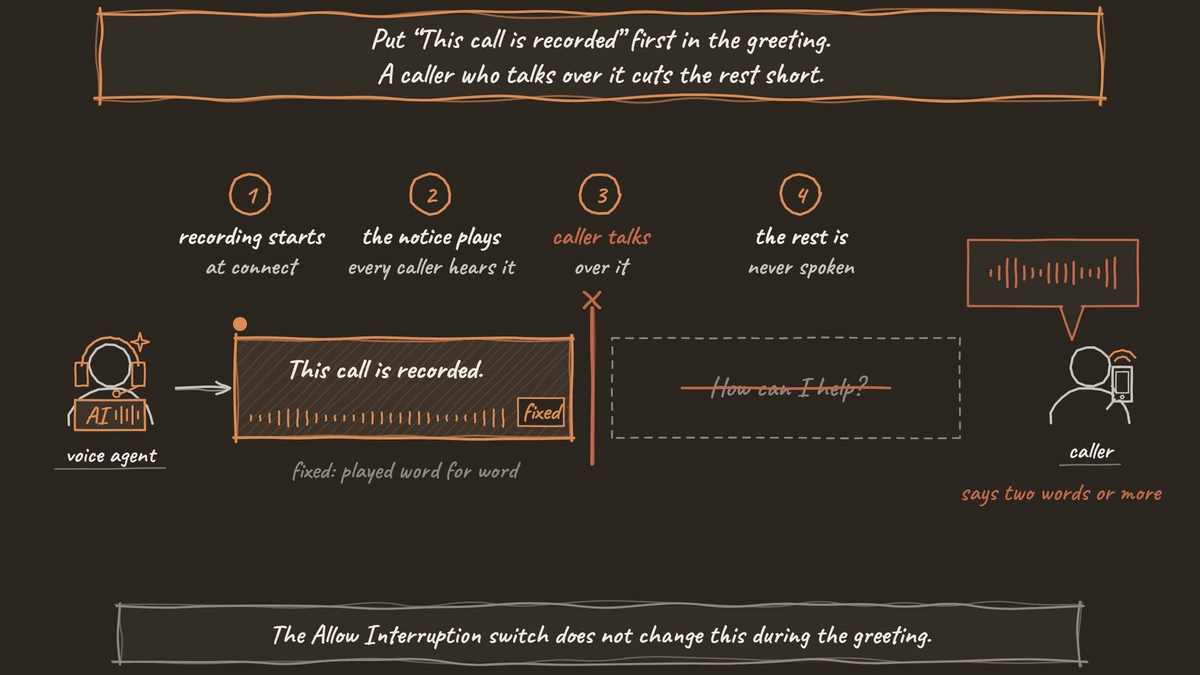
A greeting such as "Hi, this is Northside Dental. This call is recorded. How can I help?" gets the notice in within the first few seconds. If you want to tell callers they're speaking with an automated assistant, or your location requires it by law, write it in the Greeting Text along with the business's name: "This call is recorded, and you're speaking with our automated assistant." Recording consent and AI disclosure come from different laws, so keep them as two clear clauses.
If you leave interruption on, tell the agent in the prompt to say the call is recorded before it asks for any details. That repeat is written by the model, so the fixed greeting stays your main evidence. Listen to a sample of recordings where the greeting was cut short, and adjust the wording if callers keep missing it.
When a caller says no
A caller who objects cannot have recording switched off for that one call. The setting covers the whole server, so the agent needs another way to help.
Tell the agent in the prompt what to do when a caller says they do not want to be recorded. One simple path is to offer a callback from a person and write the request to your system with an HTTP API tool, then end the call politely. The End Call tool hangs up after a fixed goodbye, as text or a recorded clip.
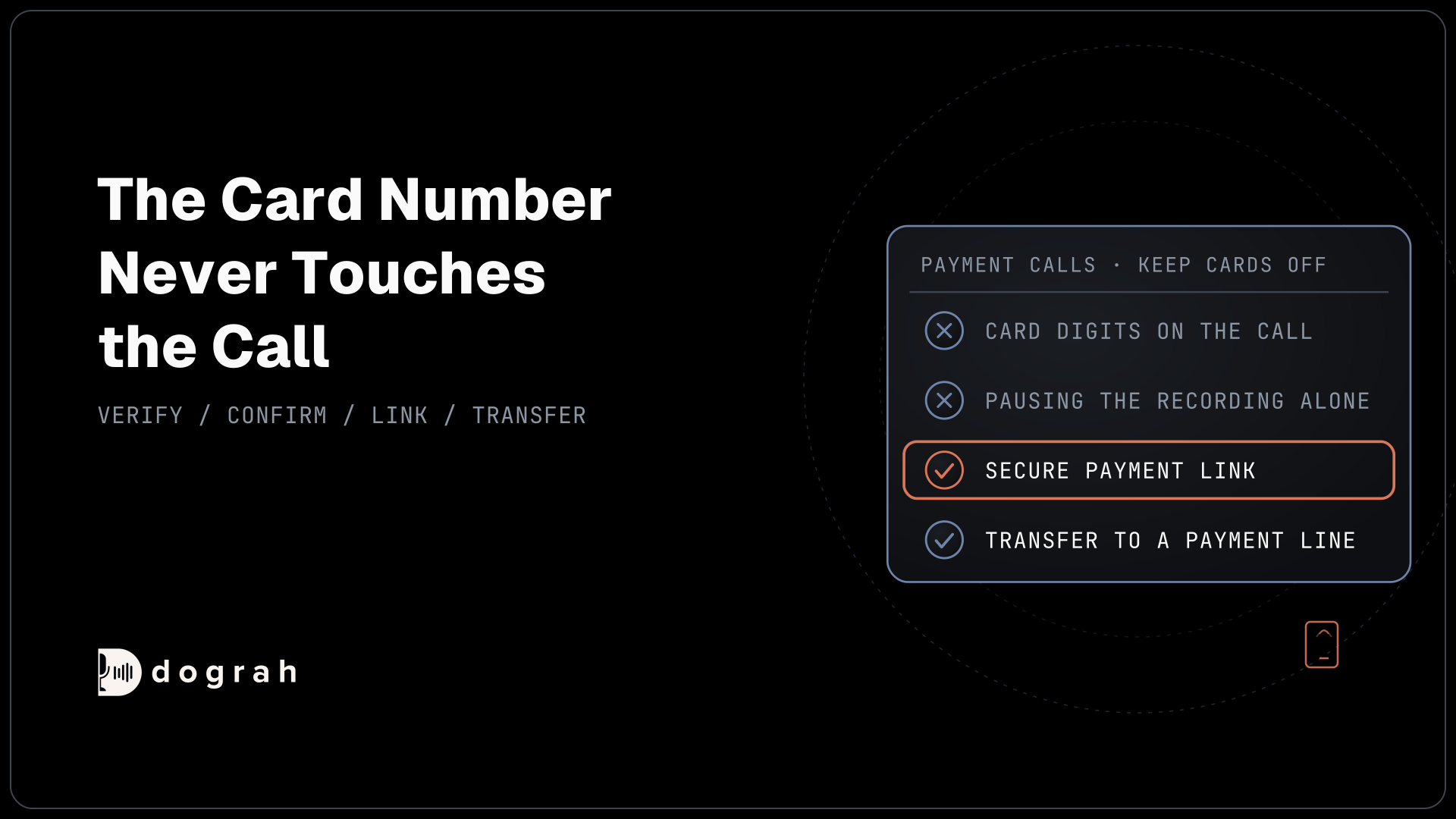
The part of the call before the objection is already recorded. Have the same HTTP API tool flag the call in your system, so your team deletes that recording from your own storage if your policy says to. Dograh has no retention setting and deletes nothing on its own. Recordings and transcripts also keep whatever is said, which is why card numbers never belong on the call. Our post on handling payment-sensitive (PCI) calls covers that.
Join the Dograh Community
Dograh is an OSS alternative to Vapi. Join our Slack community for queries, releases, best practices & community interactions.
Interstate calls, consent to call and other countries
A caller in one state can reach an agent in another, and you rarely know which state the caller is in. When callers can be in an all-party state, the simplest course is generally to announce recording on every call. Confirm your position with counsel.
Consent to record is a separate question from consent to call. Outbound calls with an AI voice generally need their own consent under federal telemarketing rules, covered in AI Voice Agents for Restaurants (US): Which Calls Need Consent. For callers in the UK or the EU, data protection law applies on top, and GDPR and Voice AI: Keeping Call Data Inside Your Borders covers it.
The setup above costs nothing extra. Self-hosted Dograh has no per-minute platform fee (servers, model keys and phone minutes still cost); Dograh Cloud has a 1¢-a-minute platform fee. Write the notice once, check every state your callers are in, and confirm your position with counsel.
Glossary
- All-party consent
- A recording rule under which everyone on the call must agree before it is recorded, as in California, Florida, Illinois and Washington. Federal law generally needs only one party's consent.
- Confidential communication
- California's test under Penal Code 632: a conversation where a party reasonably wants it kept between the parties. Calls involving a cell or cordless phone fall under 632.7, which has no such test.
- Greeting Text
- The optional fixed line on Dograh's Start Call node, played word for word as the call connects. It is where a recording notice goes, because the model never rewords it.
- Surreptitious recording
- Recording done secretly. Illinois makes recording a private conversation in a surreptitious manner eavesdropping unless all other parties consent, so an announced recording generally falls outside it.