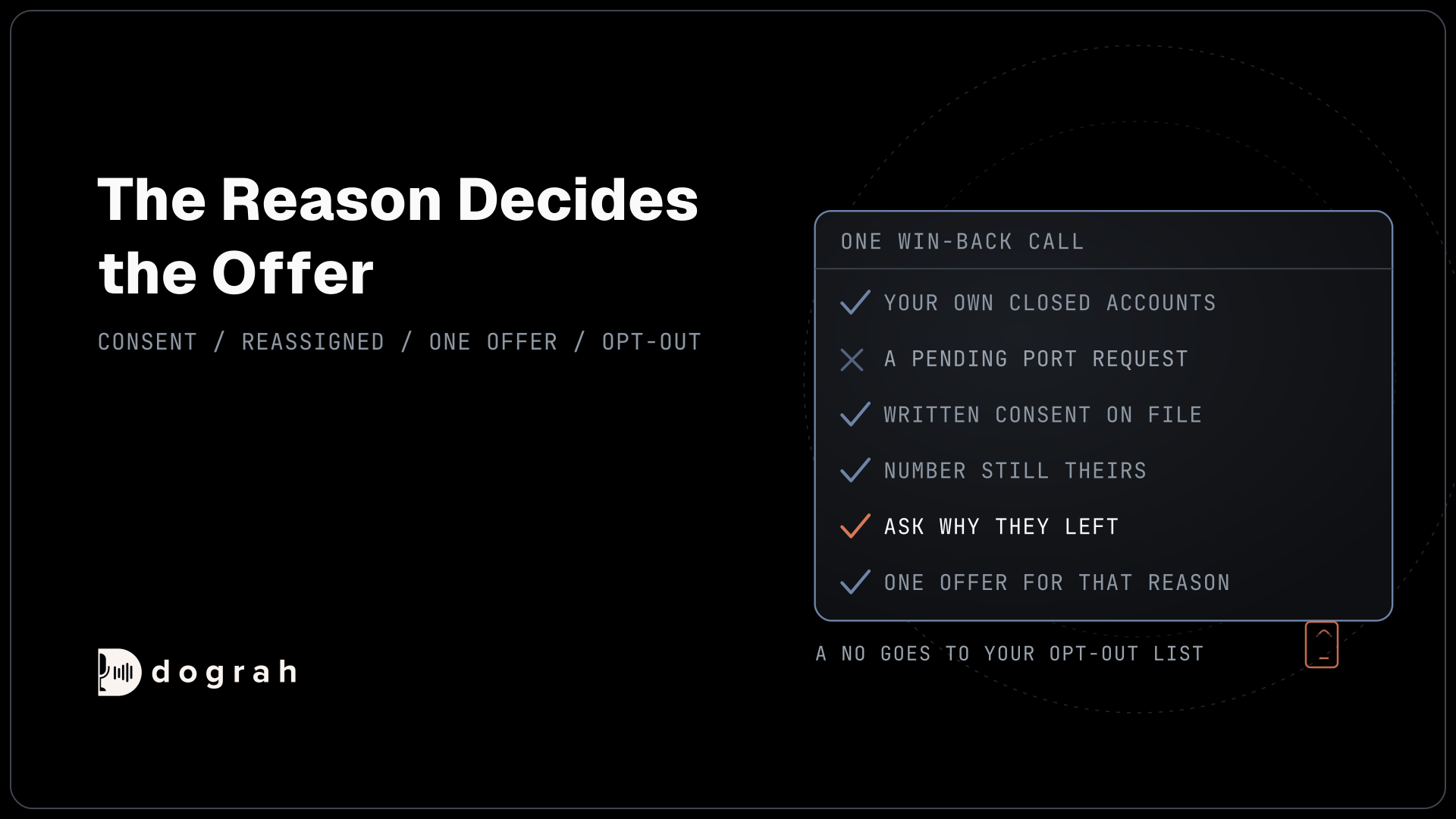

AI voice agents for win-back in telecom call former customers to ask why they left and make one offer that answers that reason. The list comes from the provider's own records, with written consent and reassigned numbers checked first. The agent verifies the account holder before naming any detail. One no ends the calls, and it is written back.
Key Takeaways
- Build the list from your own records, never another carrier's porting request.
- Check written consent and reassigned numbers before the first dial.
- Ask why they left before making one offer; a no ends it.
This post is part of our guide to AI voice agents for telecom, cable and broadband. The guide's section on growing the account puts the call in one line: "A win-back call asks a former customer why they left, then makes one offer that answers that reason." Here is that call in full, built on Dograh, an open-source, self-hostable voice agent platform, with the list and every outcome kept in the provider's own systems.
Build the list from your own records, never a porting request
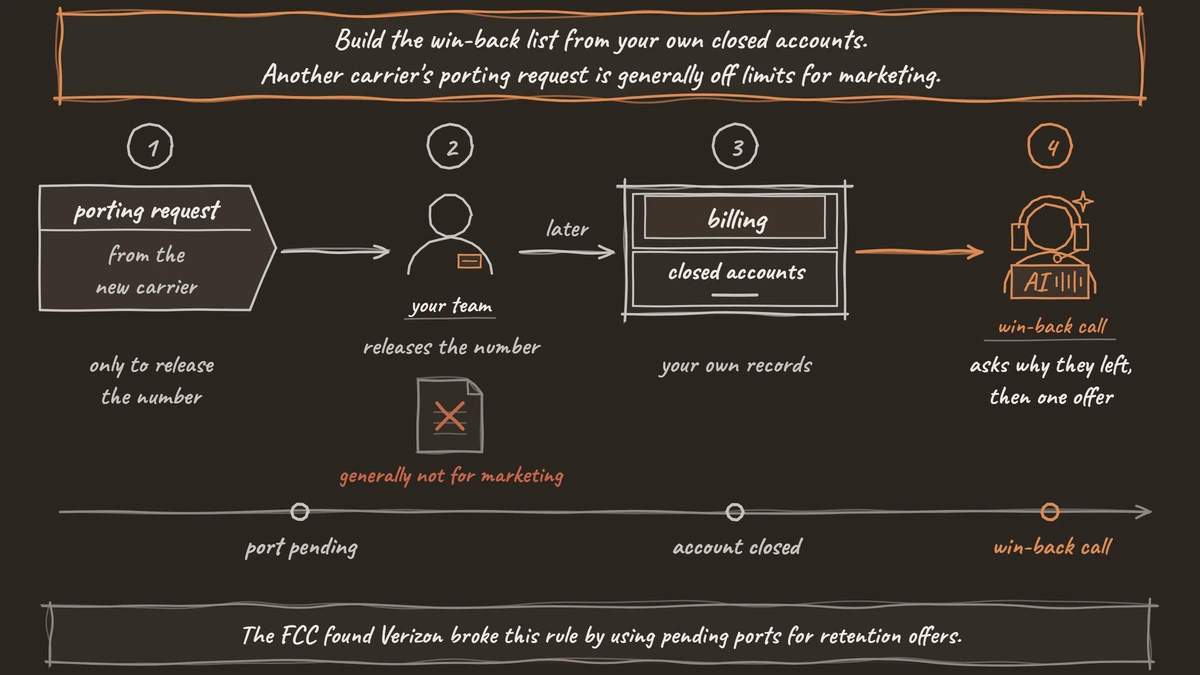
A win-back list should come from your own records of customers who left, and never from the porting request another carrier sent you. When a customer moves their number, the new carrier asks the old one to release it. That request tells the old carrier exactly who is about to leave, which makes it tempting to use.
Section 222 of the Communications Act closes that door. Paragraph (b) says: "A telecommunications carrier that receives or obtains proprietary information from another carrier for purposes of providing any telecommunications service shall use such information only for such purpose, and shall not use such information for its own marketing efforts."
This has been tested. In June 2008 the Federal Communications Commission (FCC) found that Verizon broke 222(b) by using porting information from other carriers for retention marketing while ports were pending. In February 2009 the D.C. Circuit denied Verizon's petition for review.
Our reading: a pending port is generally off limits as a trigger for any call that makes an offer. A customer whose account has closed in your own billing system, through your own cancellation process, is a different case, and that closed-accounts list is where a win-back campaign starts. This is general information, not legal advice; confirm your position with counsel.
Check consent and the number before the first dial
Two checks run before the voice agent dials anyone: written consent, and whether the number still belongs to the person who gave it.
A win-back call makes an offer, so it is generally a sales call under the Telephone Consumer Protection Act (TCPA). Under 47 CFR 64.1200, a call with an artificial or prerecorded voice that "includes or introduces an advertisement or constitutes telemarketing" needs "the prior express written consent of the called party". The FCC confirmed in 2024 that AI-generated voices count. Keep a consent flag on each former customer in your own system, and leave anyone without one, or with an opt-out, off the list.
Former customers often give up their number when they cancel, and the carrier may hand it to someone else. The FCC's Reassigned Numbers Database records permanently disconnected numbers. Under paragraph (m) of the same rule, a caller that queries "the most recent numbering information" and receives "a response of "no"" is generally protected if the database turns out to be wrong. Run that check on every list before you upload it.
Dograh keeps no do-not-call list of its own. It can tag a call "do_not_call", but that never blocks a future call, so opt-outs live in your system and come off the list before each upload to Campaigns. A contact cannot be removed from a running campaign; the campaign itself can only be paused and resumed. Retries never re-call someone who answered, and a campaign uses one time zone for its calling hours, so split lists by time zone. Leave voicemail on its default, "Disconnect the call": a voicemail that carries an offer is still a sales message. For the opening seconds of the call itself, see The First 15 Seconds Decide Everything in AI Outbound Calls.

Open Source Alternative to Vapi / Retell
Self-hosted voice agent platform — no per-minute fees
dograh-hq/dograh
Star on GitHub
How the call runs: ask why, then make one offer
The agent confirms who it is talking to, asks what made them leave, records the answer as stated, and only then reads one offer.
The call opens with the Greeting Text, fixed wording Dograh plays exactly as written. Name the provider there. If you want to tell people they're speaking with an automated assistant, or your location requires it by law, say that there too. The agent then confirms it is speaking with the former account holder, using an approved check such as the last digits of the old account number, before it mentions anything from the account, even the old plan.
Then it asks why they left. The reason decides the offer. In Innovative Systems' 2026 Rural Subscriber Study, 18% of respondents had switched internet provider in the past two years, and half of those cited lower or promotional pricing. Speed and reliability tied at 42%. A price leaver and a reliability leaver need different offers.
An HTTP API tool sends the stated reason and the address to your offer system and gets back what you can actually provide, such as a price or a faster tier now live at that address. The agent reads only that one offer, with its full monthly price, never a figure from its prompt. The same listen-first pattern runs in recruitment, in AI Voice Agents for Candidate Re-engagement.
When they say yes, and when they say no
A yes is written to your order system during the call, and a no is written to your opt-out list straight away.
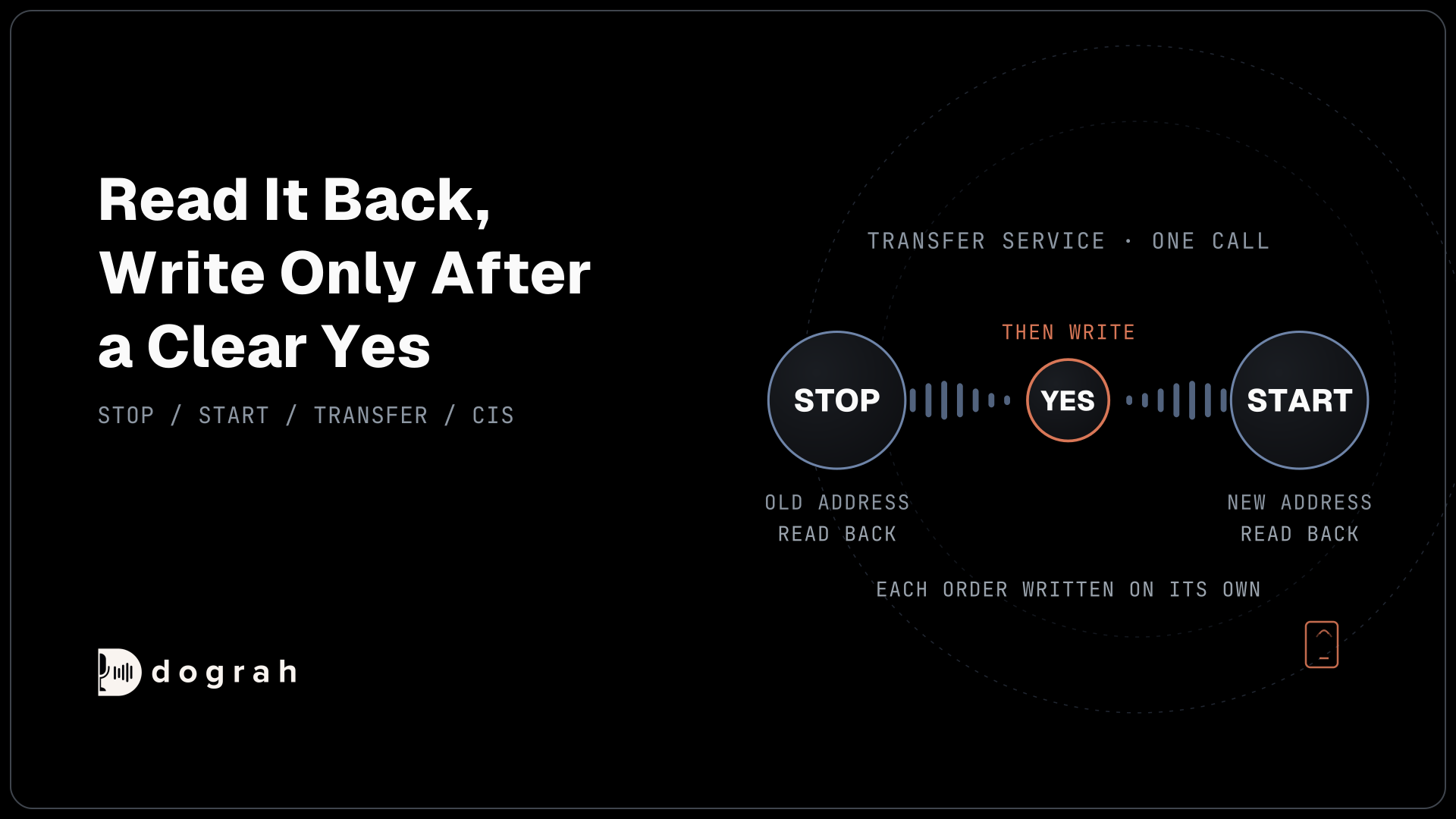
If the customer accepts, a second HTTP API tool creates the order or a callback request in your system. Add the call's workflow_run_id as a preset parameter so a retried request never creates the order twice. If the service needs an engineer, the booking follows the flow in AI voice agents for installation scheduling in telecom. Contract terms and special pricing go to a person through Transfer Call, which works on Twilio only and passes no summary, so the agent writes the details to your system first.
If the customer says no, the agent thanks them and ends the call. It does not ask twice, and it does not try a second offer. If they ask not to be called again, an HTTP API tool writes that to your system during the call, and a Webhook node sends the full outcome after it, retrying automatically if your endpoint is briefly down.
Join the Dograh Community
Dograh is an OSS alternative to Vapi. Join our Slack community for queries, releases, best practices & community interactions.
Where win-back fits, and where it does not
Win-back is for people who have already gone; customers who are still deciding belong on an earlier call.
Once a customer has asked to cancel, a save attempt rarely works. A retention or upgrade call while they are still a customer, triggered by a contract ending or a price change in your billing system, is usually the better tool, and AI voice agents for plan upgrades and cross-sell in telecom covers it. Verizon's chief financial officer put the wider point plainly after its churn fell to 0.92% in the second quarter of 2026, as Customer Experience Dive reported: "The key to reducing churn is becoming a customer-centric organization."
Start small. Run a short consented list, put the agent on a real phone number before any former customer hears it, and read the first transcripts for offers the system did not return and second asks the agent should not have made. Confirm your position with counsel before the first outbound campaign.
Glossary
- Porting request
- The request a new carrier sends the old one to move a customer's phone number. Section 222(b) generally bars the old carrier from using that information for its own marketing.
- Reassigned Numbers Database
- The FCC's database of permanently disconnected numbers. A caller that queries its most recent data and gets a "no" is generally protected if a number turns out to have been reassigned.
- Prior express written consent
- Under the TCPA, a signed written agreement that lets a business deliver telemarketing using an artificial or prerecorded voice, and states that signing is not a condition of purchase. A win-back call from an AI voice agent generally needs it, because it makes an offer.