
AI voice agents for installation scheduling in telecom book, confirm and reschedule engineer visits for new phone and broadband service. They verify the customer, offer only the slots the field service system returns, read back the window and access details, and write every change back. They also call customers when an engineer runs late.
Key Takeaways
- Offer only install slots the field service system returns during the call.
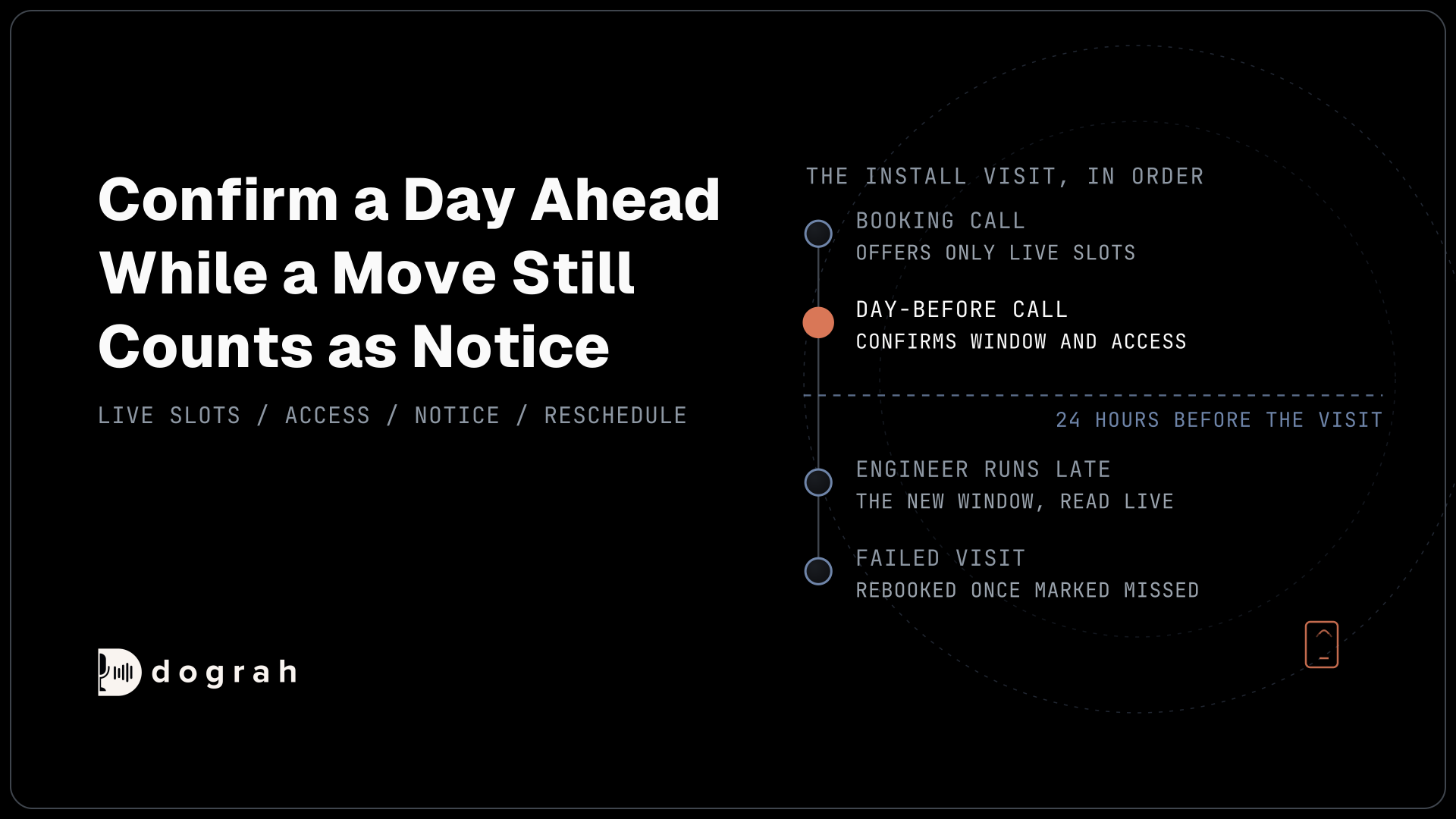
- Confirm a day ahead, early enough that a reschedule still counts as notice.
- Rebook a failed visit only once the system marks it missed.
This post is part of our guide to AI voice agents for telecom, cable and broadband. The guide's section on service calls sums up this call in one line: "The installation call books an engineer visit from live slots and confirms the window, the address, access and who will be home." Here is that call in full, built on Dograh, an open-source, self-hostable voice agent platform, with the operator's field service system kept as the only record of the visit.
Why the install visit is worth a call
A missed or late-cancelled install costs the operator money and costs the customer a day off work. In the UK the cost has a fixed price. From 1 April 2026, providers in Ofcom's automatic compensation scheme pay £32.31 for each missed engineer appointment and £6.46 a day when a new service starts late, according to Ofcom's 2026 compensation rates.
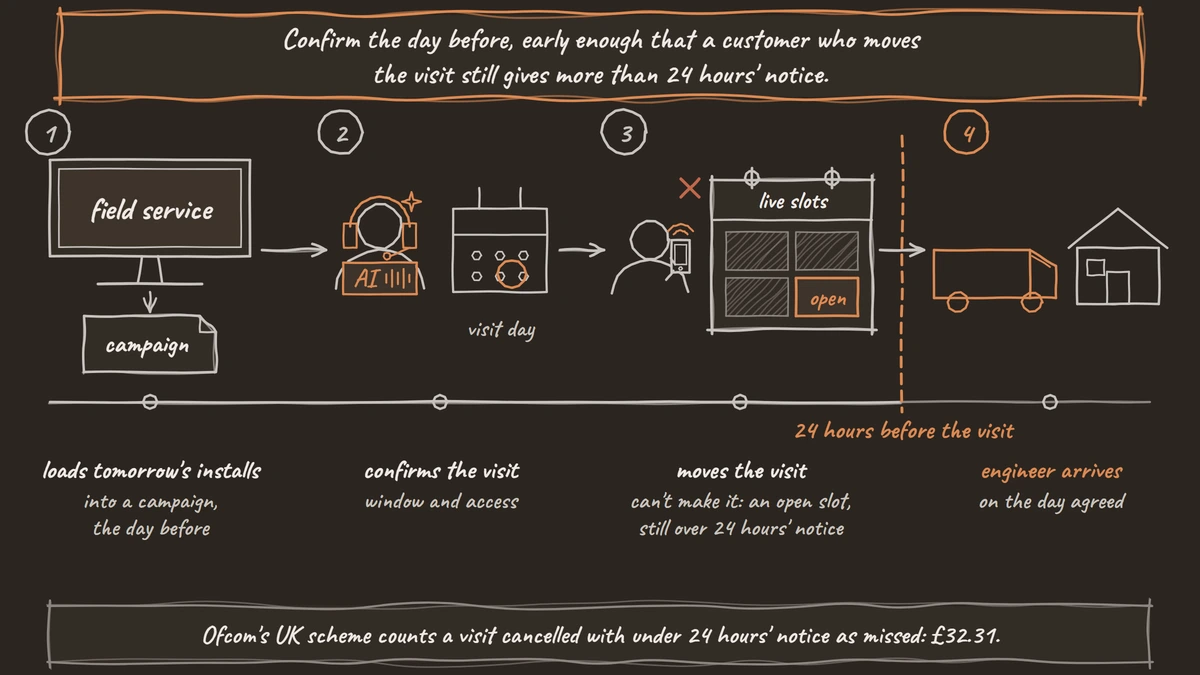
The definition matters for scheduling. Ofcom's guide to automatic compensation counts an appointment as missed "If an engineer does not turn up for a scheduled appointment, or it is cancelled with less than 24 hours' notice". The scheme covers the providers that signed up to it, among them BT, Sky, Virgin Media and Vodafone. These are UK rules.
Letting customers move the visit themselves helps. As Advanced Television reported, Openreach says its Change My Appointment tool "has helped cut missed appointments by 30 per cent". That is Openreach's own figure, with no period given.
So a texted self-scheduling link, sent by the operator's own system, is enough for many customers. Dograh sends no texts itself. The voice call is for everyone the link does not reach: customers who never reply, homes with access problems, engineers running late and visits that failed.
Booking the visit from live slots
The agent books from the slots the field service system returns and nothing else. A new order usually exists before the call, so a caller booking or moving a visit is an existing customer, and the call runs greet, verify, disclose.
The agent asks for an approved check, such as the order reference or the last digits of the account number, before it names the address or any visit date. A phone number finds the order but does not prove who is calling.
Then an HTTP API tool asks the field service system for open slots at that address, and the agent offers only those slots, never a time from its prompt. A short tool message such as "Let me check the engineer's diary" fills the pause. The tool does not retry on its own: after a 5-second default timeout the agent gets an error, so tell it in the prompt to apologise and offer a callback instead of guessing a time.
Before anything is written, the agent reads the booking back: the date, the install window, the address, and the access notes, such as parking, building entry, pets and where the line comes into the home. The customer confirms or corrects each one.
A second HTTP API tool writes the booking. Add a Preset Parameter named workflow_run_id with the value {{initial_context.workflow_run_id}}. Dograh adds no Idempotency-Key header itself, so the field service system uses that ID with the slot to ignore a duplicate if the request is sent twice.
Dograh has no built-in calendar integration; every connection is an HTTP API tool pointed at your own system's API. Our post on booking meetings mid-call shows the same read-then-write pattern, and AI voice agents for patient appointment scheduling applies it to clinic slots.

Open Source Alternative to Vapi / Retell
Self-hosted voice agent platform — no per-minute fees
dograh-hq/dograh
Star on GitHub
The day-before confirmation call
The confirmation call checks that the visit will happen while there is still time to move it. Your system loads tomorrow's installs into a campaign, so the campaign runs early enough that a customer who needs to move the visit still gives more than 24 hours' notice.
Campaign calling hours use one time zone per campaign, so split the list by region if your installs cross time zones. The Greeting Text names the operator and can greet by name with a fallback, such as {{customer_name | there}}, so a missing name is never read aloud as a placeholder. Because the greeting plays before verification, it names no address or date.
After the verify step, the agent confirms the window and asks the access questions an engineer needs: who will be home, where to park, any gate or building code to pass on, and whether a landlord has agreed to the work. Each answer is recorded as the customer stated it and written to the order. A customer who cannot make it gets a new slot from the same live lookup.
The call carries no offer, not even a faster package. An offer generally turns a service call into a marketing call with stricter consent rules. Confirm your position with counsel before the first outbound campaign. AI voice agents for service appointment booking in automotive uses the same confirm-or-move pattern for service bays.
When the engineer runs late or the visit fails
The late-engineer call tells the customer the new window before they start to wonder. When the engineer's job runs over, dispatch starts a call through the API Trigger, which dials at once; it has no field for a later time. After verification, the agent reads the new window from the system and offers to keep it or move the visit to another live slot.
A failed visit needs more care. The customer may call to say nobody came, or the engineer could not get in. The agent records the report as stated and checks the order. The order's status decides the next step, so the agent books the next slot only when the system shows the visit marked missed. Until then, it writes a follow-up request and tells the customer when to expect a call.
Complaints and compensation questions go to a person. Transfer Call works on Twilio only and passes no summary, so the agent writes the order reference and the reason to your system first. If nobody answers within the 30-second default, the customer stays with the agent; tell it in the prompt to offer a callback and write the request through an HTTP API tool.
Join the Dograh Community
Dograh is an OSS alternative to Vapi. Join our Slack community for queries, releases, best practices & community interactions.
Where to start and what it costs
Start with the inbound line for moving a visit, because it reads live slots before it writes anything and raises no outbound consent questions. Add the day-before campaign next, then the late-engineer call once dispatch can start it.
Put the agent on a real phone number before any customer hears it, and read the first week of transcripts for slots the agent did not get from the system. Faults that need a visit reach this flow from AI voice agents for telecom support lines. Self-hosted Dograh has no per-minute platform fee (servers, model keys and phone minutes still cost); Dograh Cloud has a 1¢-a-minute platform fee.
Glossary
- Install window
- The time range in which the engineer is due to arrive, such as 8 a.m. to 1 p.m. The voice agent reads it from the field service system and confirms it with the customer.
- Field service system
- The operator's system for engineer diaries, orders and visit status. The agent reads open slots from it during the call and writes every booking, change and access note back to it.
- Automatic compensation
- Ofcom's UK scheme in which signed-up providers credit customers for missed engineer appointments and for late repairs or new-service starts, without the customer having to claim.