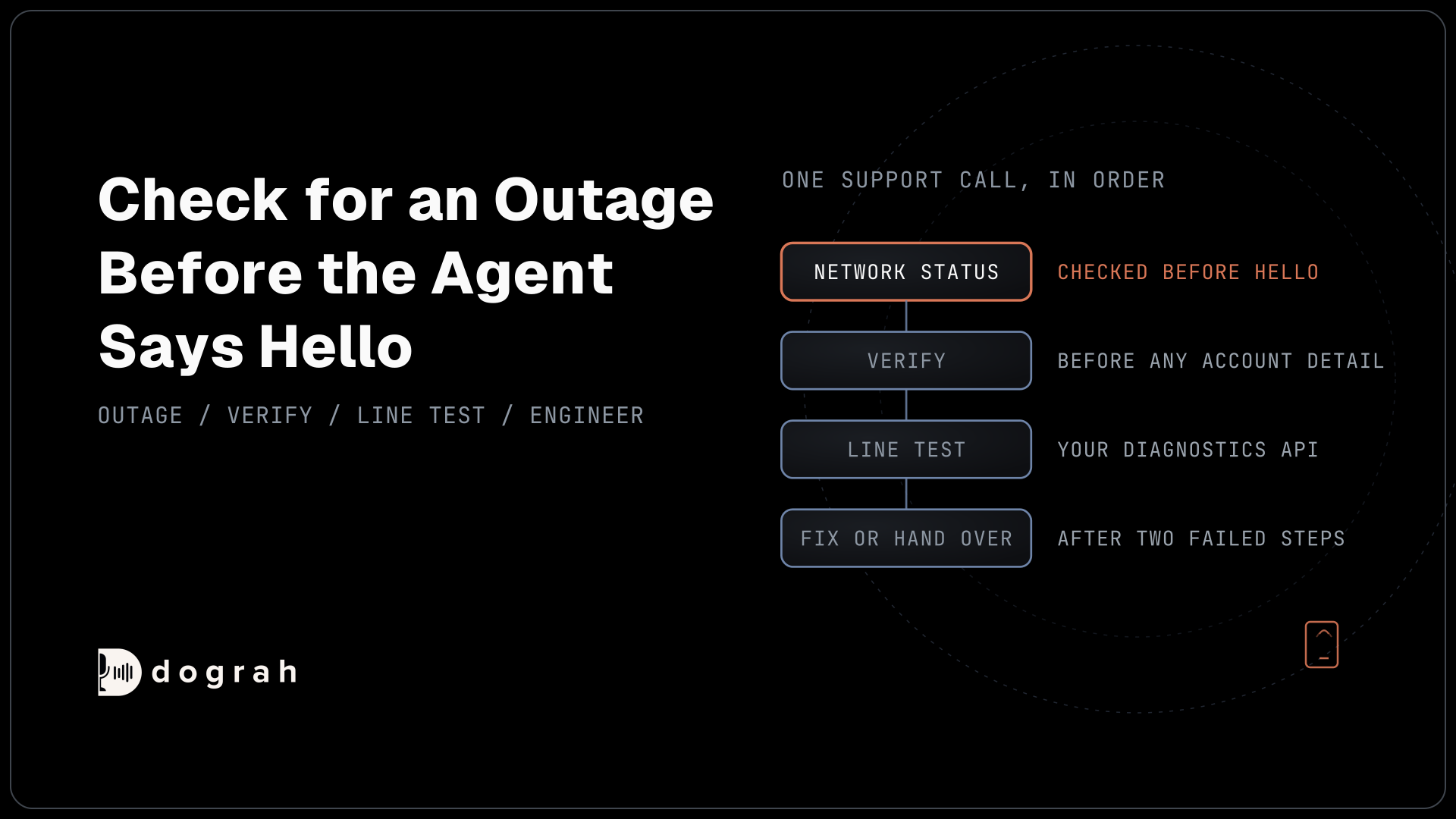

AI voice agents for telecom support lines answer inbound fault and service calls for phone, cable and broadband providers. They check network status by the calling number before the greeting, verify the caller before any account detail, run a line test through the provider's own systems, then confirm the fix or pass the fault to an engineer or a person.
Key Takeaways
- Check for an outage before the agent says hello.
- Verify before account details; never ask callers to speak a password.
- After two failed steps, book an engineer or transfer; never loop.
This post is part of our guide to AI voice agents for telecom, cable and broadband. The guide's section on service calls sums up this one in a line: "The support line resolves the fault or hands it over fast, and it never loops." Here is that call in full, built on Dograh, an open-source, self-hostable voice agent platform, with your network status and ticketing systems kept as the record.
Why the support line decides how customers feel
A support call is where a provider either fixes the problem or loses the customer's patience. Most telecom support lines already have some automation, and customers can tell when it does not finish the job.
In J.D. Power's 2026 wireless carrier study, 45% of phone-support interactions involved an AI assistant, and it resolved the issue 48% of the time. Satisfaction was 20 points higher when customers spoke to a person. For home internet, J.D. Power's 2026 internet provider study found that 37% of customers used phone support, and first-contact resolution on the phone was over 67% for wired and 69% for wireless customers. That is the bar an agent has to meet.
UK complaint data points at the same two jobs. In BTW Media's breakdown of Ofcom's figures for the first quarter of 2026, faults, service and provisioning made up 39% of broadband complaints, and complaint handling another 26%. Fix the fault, and handle the person well when you cannot.
Check the network before the customer explains
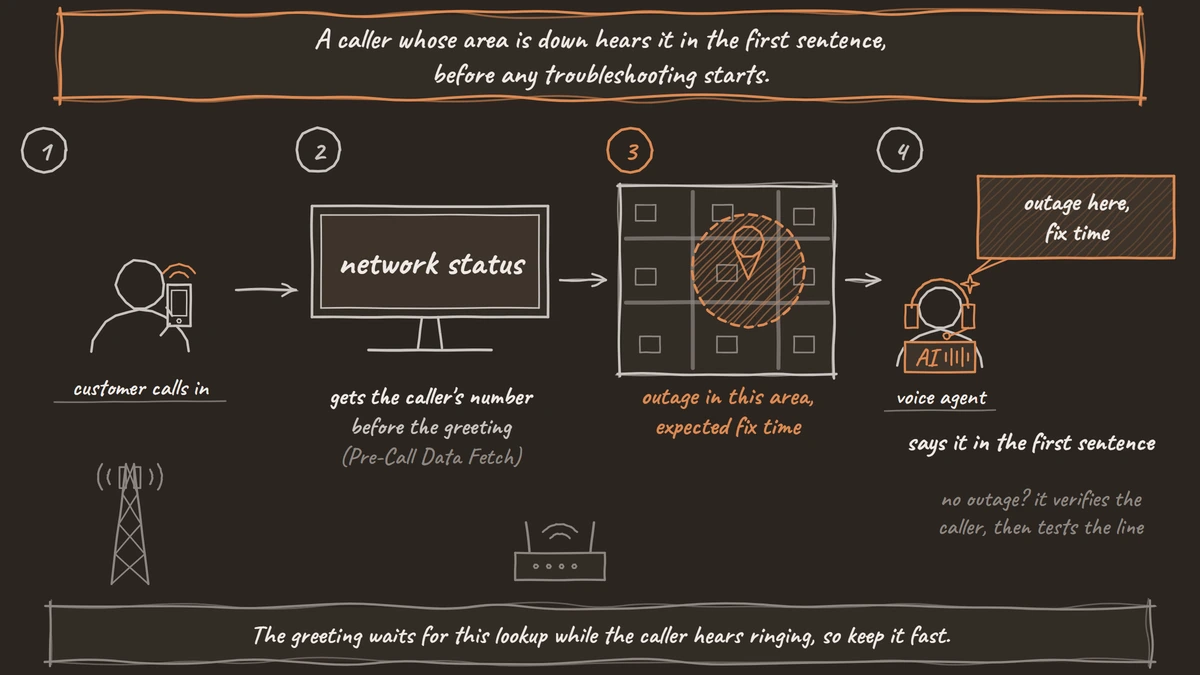
The agent should know about an outage before the customer has said a word. When the area is down, a router restart wastes the customer's time and yours.
Pre-Call Data Fetch, at the bottom of the Start Call node, set to Inbound calls only, sends the caller and called numbers to your endpoint once the call connects. Your endpoint asks the network status system about the area linked to that number and returns a short answer, such as the outage and its expected fix time. The greeting waits for this lookup, and the caller hears ringing meanwhile, so keep the endpoint fast. A caller whose area is down hears that in the first sentence. The lookup returns nothing about the account itself; write the prompt so no personal detail is spoken until the caller is verified.
Several support numbers, one per brand or region, can point at the same agent through each number's Inbound workflow setting. The dialled number reaches Pre-Call Data Fetch as to_number, so one flow can tell a cable caller from a mobile caller.
Outage days bring call spikes. Self-hosted Dograh runs 10 concurrent calls by default, raised with DEFAULT_ORG_CONCURRENCY_LIMIT, and Dograh Cloud Pay as you go includes 10, with more by contacting Dograh. When the limit is full, Dograh rejects the next inbound call at once, with no queue; on Twilio the caller hears a fixed message that cannot be changed. Set the limit for your outage peak, and add an overflow at your carrier to a human queue or a recorded outage message.
Verify, then test the line
Once there is no outage to explain, the agent verifies the caller and only then looks at the account and the line. A phone number finds an account; it does not prove who is calling.
For phone carriers this is a federal rule. 47 CFR 64.2010 says carriers "must properly authenticate a customer prior to disclosing CPNI based on customer-initiated telephone contact". Customer proprietary network information (CPNI) covers what the carrier knows from providing the service. The agent asks for an approved check your security team sets, such as the last digits of the account number, before naming the plan, a balance, the address or a past visit. Broadband-only providers are not named in the rule, but the same pattern is good practice. This is general information, not legal advice; check with counsel.
Call detail, such as numbers called and when, needs more: a password on an inbound call. Do not collect it by voice. Dograh keeps everything said in the transcript and recording, with no redaction, so never ask callers to speak a password or PIN. Without one, the rule sends call detail to the address of record or a callback to the telephone number of record, which your system can start through the API Trigger.
The line test runs through an HTTP API tool that calls your diagnostics API. Set a Message on the tool, such as "Let me run a quick test on your line," so the pause is filled. The tool does not retry on its own: after a 5-second default timeout the agent gets an error, so tell it in the prompt to offer a callback instead of guessing. The troubleshooting steps come from your own Knowledge Base files (PDF, DOCX, DOC, TXT or JSON, up to 5 MB each). For modem, router and plan names, open Dictionary in the agent's Settings, type them into the box (comma-separated) and click Save Dictionary, so speech-to-text hears them correctly.

Open Source Alternative to Vapi / Retell
Self-hosted voice agent platform — no per-minute fees
dograh-hq/dograh
Star on GitHub
When the fix fails, book an engineer or hand over
A support call should end with the fault fixed, and when it cannot be fixed, the agent stops and passes it on. Two failed steps are enough to stop troubleshooting.
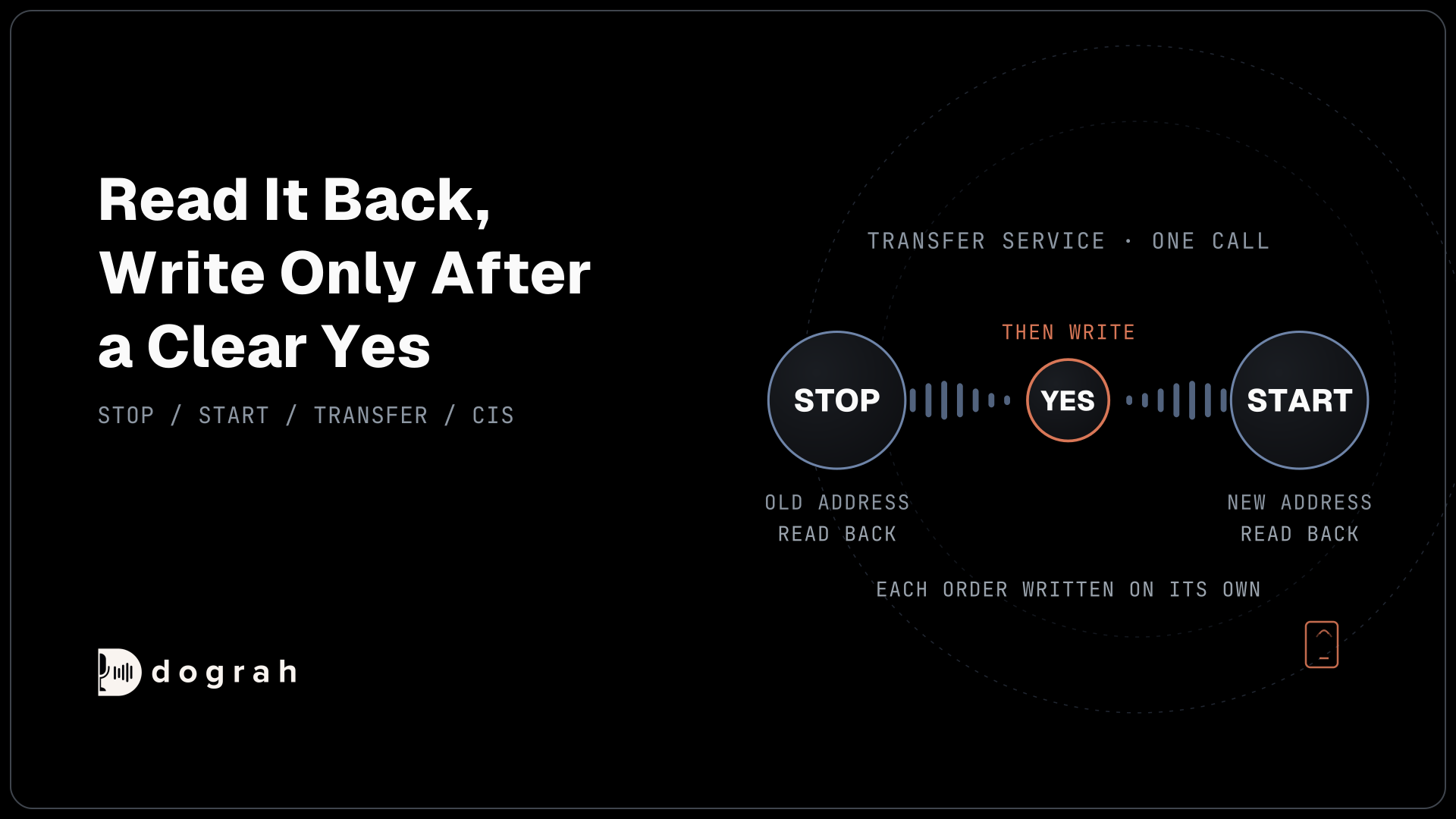
If the line test and a restart fix it, the agent confirms the service is back and ends the call. If the test shows a fault an engineer must fix, the agent books a visit from live slots, the flow set out in AI voice agents for installation scheduling in telecom. A complaint, or a request for a person, goes to a person.
Transfer Call works on Twilio only and passes no summary, so the agent writes the ticket to your system through an HTTP API tool first. If nobody answers within the 30-second default (settable from 5 to 120 seconds), the caller stays with the agent; tell it in the prompt to offer a callback and write the request through an HTTP API tool. Billing questions can go to a separate billing agent through Transfer to Agent, which carries the whole conversation so the customer repeats nothing; it works on cascade agents only.
When the call ends, a Webhook node sends the outcome, line test result, call duration and transcript link to your ticketing system, retrying a temporary failure automatically. Keep upgrade offers out of a support call until the customer's own issue is solved. Our comparison of AI voice agents and IVR explains why an open question beats a keypad menu for fault calls.
Join the Dograh Community
Dograh is an OSS alternative to Vapi. Join our Slack community for queries, releases, best practices & community interactions.
Before the support line goes live
Test the agent on a real phone number before any customer hears it. Most phone calls still reach the agent as 8 kHz audio, while a browser test runs at 16 kHz, and browser test calls cannot run Transfer Call, so test every handover on a real call.
When a call goes wrong, the trace shows which layer failed: speech-to-text, the AI step, a tool or the voice. How to Read Call Traces to Debug a Voice Agent walks through it. Once live, run QA on a random 5 to 10% sample of calls and look for loops and skipped verification. For answering from your own documents, the healthcare version of this call, AI voice agents for patient support lines, uses the same Knowledge Base pattern.
Self-hosted Dograh has no per-minute platform fee (servers, model keys and phone minutes still cost); Dograh Cloud has a 1¢-a-minute platform fee.
Glossary
- Customer proprietary network information (CPNI)
- What a phone carrier knows about a customer from providing the service, such as the plan and the calls made. FCC rules require carriers to authenticate a caller before disclosing it on a customer-initiated call.
- Telephone number of record
- The phone number tied to the underlying service on the account, not a contact number the customer gave. Calling it back is the safe route for call detail when no password is given.
- Line test
- A remote check of the customer's connection run from the provider's diagnostics system. The agent calls it through an HTTP API tool and uses the result to decide whether an engineer visit is needed.
- First-contact resolution
- The share of problems solved on the customer's first call, with no callback or second contact. J.D. Power put it at over 67% for wired and 69% for wireless internet phone support in 2026.