
AI voice agents for compliance disclosure calls speak the words a law or your compliance team requires, such as the business name at the start of an AI-voice call or a debt collector's notice. The approved text plays as fixed text or a recording, never as a prompt instruction, and the call recording proves it was said.
Key Takeaways
- A disclosure is a fixed string, so it never sits in a prompt.
- Per-contact versions come from the campaign file or your system before dialing.
- The recording proves the words were spoken, so keep it where you can produce it.
Have a voice agent say a call is from a debt collector, and it words that differently each time. We show where approved lines sit in Dograh so they never change, how one agent serves different states and languages, and what to check before launch. You can self-host Dograh or run it on Dograh Cloud.
What makes a call a disclosure call
A disclosure call is any call where a law or your compliance team decides some of the words before the call starts. The caller must hear those words, in that order, every time. Most outbound calls made with an AI voice in the US already fall into this group.
The base layer is the Telephone Consumer Protection Act (TCPA). In its 2024 ruling on AI-generated voices, the FCC said that an AI voice counts as an artificial voice under that law. The FCC's rules for artificial and prerecorded voice calls then require every such message to name the business behind the call at the start and to give a phone number. That applies whatever the call is about.
Sales calls add more. The Telemarketing Sales Rule asks the caller to say promptly who the seller is, that the purpose of the call is to sell, and what is being sold. Debt collection adds its own notice. Regulation F, the rule under the Fair Debt Collection Practices Act, has a collector say in the first conversation that it is trying to collect a debt and that any information will be used for that purpose, and say in later calls that the call is from a debt collector.
Then come notices that depend on where the caller lives or which language the call runs in, such as a recording notice or a notice repeated in Spanish. Your firm may add fixed lines of its own on top. Each of these is a sentence your compliance team approves once and the agent must never rephrase.
Why a prompt cannot carry a disclosure
A prompt is an instruction to a language model, and the model writes new words each time it follows one. A prompt that says "tell the caller the call is from a debt collector" gets a different sentence on every call. Most versions will be close. Some will shorten it, and some will move it after a question the caller asked.
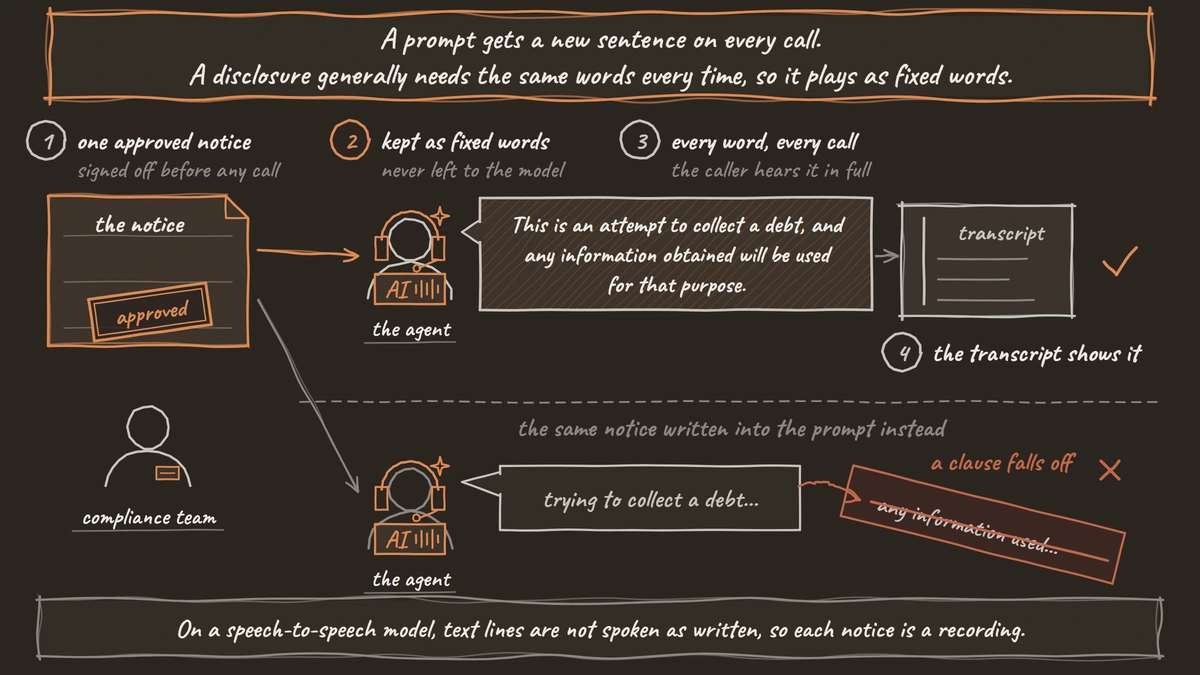
That is the core problem with letting the model deliver a notice "naturally". Prompts leak by paraphrase. The model avoids a banned phrase and says the banned meaning, or keeps the meaning and drops the clause your lawyer cared about. Drop one clause from a disclosure and you have made a different statement, however small the cut looks.
You also cannot test your way out of it. A generative system can pass a thousand test calls and still rephrase the line on call one thousand and one, because you cannot prove a negative about it. What you can prove is that the call took the path where fixed words play, and the transcript shows it.
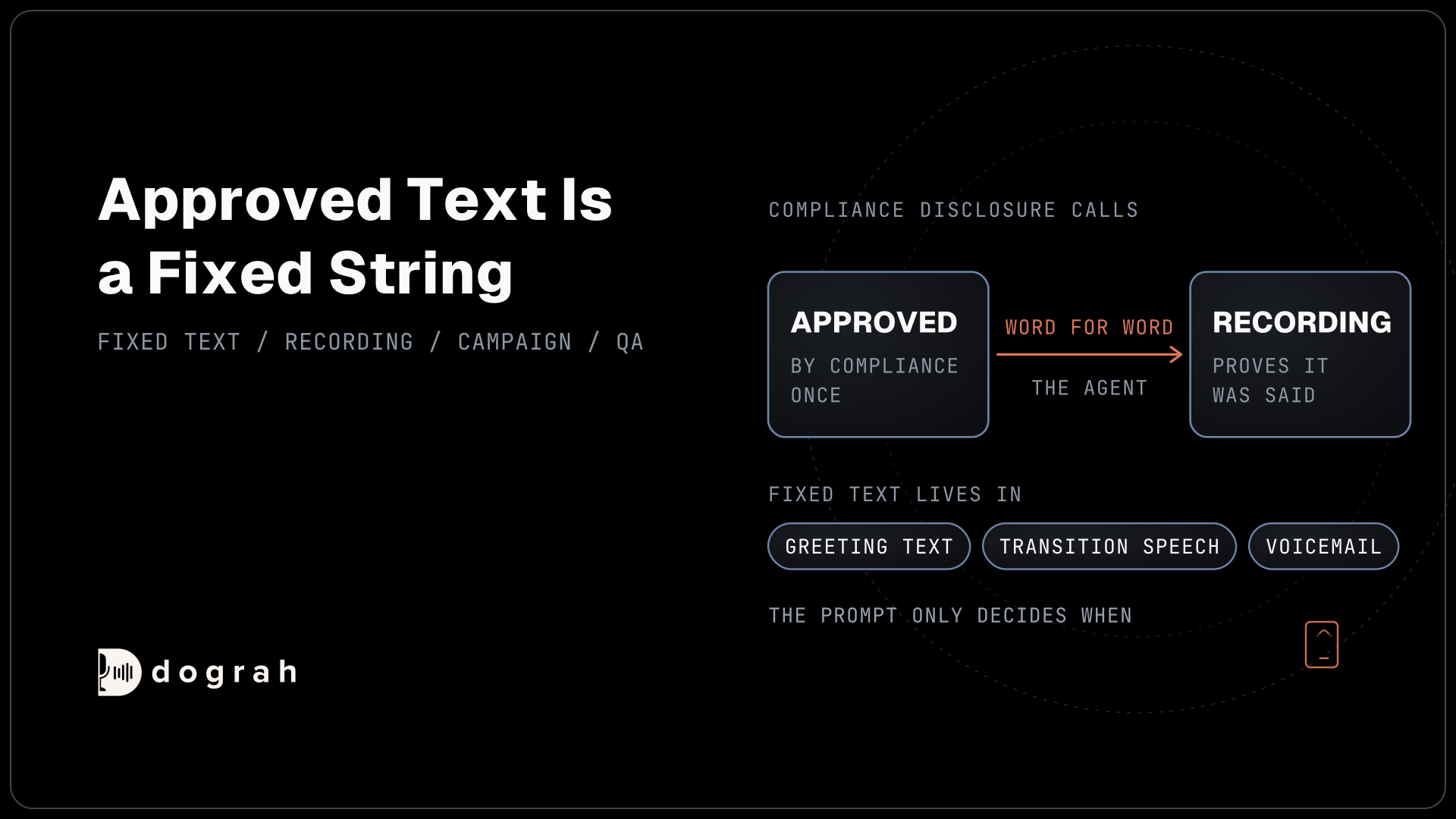
So the rule for this whole guide is simple. Approved text is a fixed string. It lives in a place where the agent plays it word for word, and the prompt only decides when the call reaches that place. Our post on prompt and flow design patterns explains this split between what the model writes and what it plays.
Where fixed words live in Dograh
Dograh plays exact words in a few places, and every approved notice should sit in one of them. The first is the Greeting Text on the Start Call node. It is an optional fixed line spoken as the call connects, and the model never rewords it. You can set the Greeting Type to a pre-recorded file instead, so the opening is a recording of a real person reading the approved script.
Check one setting before you rely on the greeting. Allow Greeting Interruption is on by default, and with it on, a caller who says two words can cut the greeting short. Switch it off for any greeting that carries a notice. The caller's words are then held until the greeting finishes, so the full notice plays.
The second place is Transition Speech, the line that plays when the call moves along a pathway from one step to the next. It can be fixed text or a recorded clip, and it plays with the caller muted, so it cannot be cut off midway. Transition Speech cannot include per-contact variables, which suits a notice that must read the same for everyone.
The voicemail message is the third. With voicemail handling turned on and set to Leave a message, the agent plays one fixed message, as text or a recording. The End Call tool has one fixed closing line too.
Two limits matter. On a speech-to-speech model, text lines are not spoken as written, so use recordings for every notice there. And if a fixed line uses a variable, give it a fallback, such as {{customer_name | there}}, because a missing value is spoken as empty text.
Greet, verify, then disclose
A regulated call runs in a fixed order: greet, verify the person, then disclose anything personal. A phone number finds a record, but it does not prove who answered. A housemate or a parent can pick up.
That order splits disclosures in two. The business identification the TCPA asks for belongs at the very start, so it goes in the Greeting Text. A notice that reveals something about the person, such as a collector's notice, must wait until the right person has confirmed who they are with an approved check, such as a date of birth or the last digits of an account number. That second notice therefore cannot sit in the greeting. It plays as Transition Speech on the pathway that follows a passed check.
Telling callers they are speaking with an AI works the same way. If you want callers to know they're speaking with an automated assistant, or your location requires it by law, write it in the Greeting Text along with the business's name. Some laws do name it, and your compliance team should check which apply to you. Many calls are under none of them, so the line is your choice there.
Collections show why the order matters most. Saying the word "debt" to whoever answers is a disclosure in itself. Our post on AI voice agents for debt collection covers verification and safe voicemail for those calls in depth.

Open Source Alternative to Vapi / Retell
Self-hosted voice agent platform — no per-minute fees
dograh-hq/dograh
Star on GitHub
One agent, many approved versions
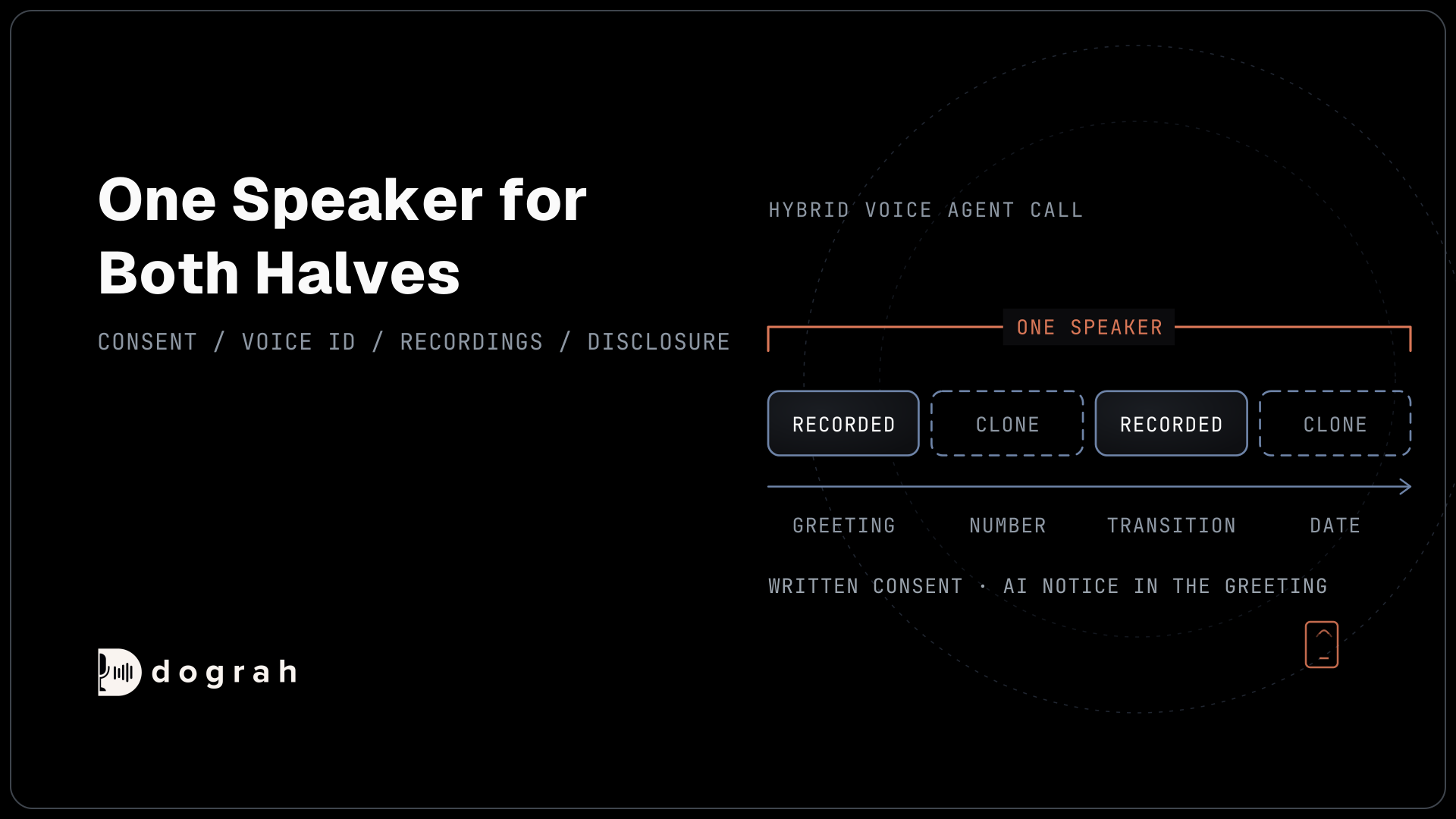
Most disclosures change by state or language, and you do not need a separate agent for each version. Dograh can swap the opening line per contact before the call starts.
On a campaign, add the columns greeting_override_type and greeting_override_text to the CSV file, or greeting_override_recording_id for a recorded version. Each row then opens with its own approved line, and the text can use other columns as variables. Leave the columns empty and that contact hears the Start Call greeting.
A single call started through the API Trigger can carry its own greeting_override inside initial_context. Pre-Call Data Fetch can also return one, and a fetched override wins over the one sent with the trigger. That lets your system pick the version at the moment the call connects, from data it already holds.
Here is how the work splits. Your compliance team writes and approves each version. Your system decides which version a contact gets, for example by the state on file or the recorded language preference. The agent plays what it is given, word for word. Some states and New York City add notices of their own, and this is how those versions reach the right people without anyone editing a prompt.
Collection calls, the clearest case
Debt collection carries more fixed words than almost any other outbound call, and mistakes show up in complaints. From January 1 to November 1, 2026, consumers sent 261,753 debt collection complaints to the CFPB's complaint database. Of those, 41,364 were about written notification of the debt, and 6,996 of those said the person never got a notice of their right to dispute. These are complaints, not findings, but they show how often notices are the issue.
On a collection call, the collector's notice, often called the mini-Miranda, plays after the identity check, as Transition Speech on the "identity confirmed" pathway. Later calls use the shorter line that the call is from a debt collector. Your system knows which call this is from the contact history, so it picks the version through the campaign file or Pre-Call Data Fetch. Agencies that want these calls and their recordings kept on their own servers can read our page on self-hosted voice agents for collection agencies.
A creditor collecting its own debt in its own name generally sits outside the Fair Debt Collection Practices Act, so its notices differ. That makes the business name in the greeting a legal choice too, since a name that suggests a third party is collecting can pull a creditor back under the Act.
AI voice agents for compliance-safe collection disclosures covers the full notice set, time-barred debts, call limits and calling hours.
The same notice in every language
A notice the caller cannot understand does little, so each language the agent speaks needs its own approved version. New York City makes this concrete for debt collectors. Its debt collection rules require a collector to record each consumer's language preference, and they treat a false, inaccurate or partial translation of any communication as a prohibited practice.
For an agent, that means a translated notice is a new approved text, not something the model translates on the fly. Write the Spanish or Hindi version with your compliance team, record it if you can, and store it as its own Transition Speech line or per-contact greeting. Greeting Text plays before Dograh can hear the caller's language, so a bilingual opening is written in both, for example "Hola, hello".
Language also changes speech recognition. Set the speech-to-text model to the language the call runs in, or to Multilingual (Auto-detect) with the right Language Hints, and test with real callers.
Spanish AI voice agents for debt collection covers US collection calls in Spanish, including Spanish validation notices. Hindi AI voice agents for collections covers India, where the Reserve Bank of India sets the rules.
Outside those two, the pattern holds anywhere a law fixes the opening. In the EU, the opening also has to say the caller is talking to an AI, and German AI voice agents for collections shows that line in German.
Other countries, other first lines
Each country decides what the first seconds of a call must carry, so the fixed lines change at the border. In the UK, Ofcom expects an information message within two seconds when an automated call cannot connect a person, and the Financial Conduct Authority's rules ask a firm to say who is calling and on whose behalf. AI voice agents for debt collection in the UK covers both, with the Breathing Space scheme.
In Canada, collection rules are provincial. Ontario requires larger collection agencies to record collection calls and tell the person the call is recorded, so the recording notice becomes a required spoken line. AI voice agents for debt collection in Canada walks through Ontario, Quebec and the federal automated-call rules.
Recording notices have rules of their own in many US states, and our post on call-recording consent laws covers where to put them.
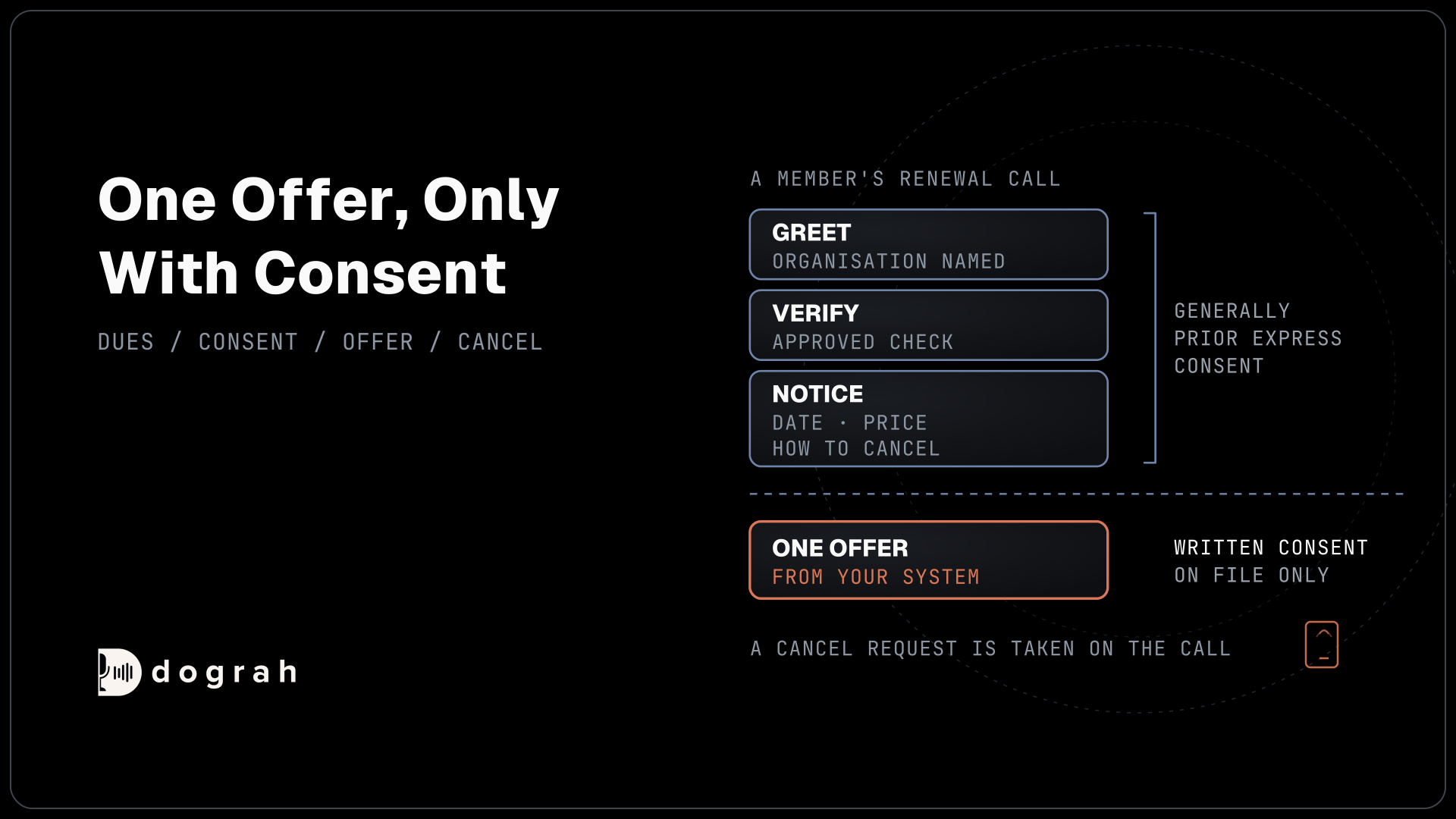
Two more things sit beside the disclosures. Consent decides whether you may call at all. A service call to a mobile with an AI voice generally needs the person's prior express consent, and adding any offer makes it telemarketing, which needs prior express written consent. Opt-outs come next. When a caller says something like "stop calling me", the agent logs that opt-out in your system through an HTTP API tool, and your system drops the number before the next list goes out. Callers answer by voice. Treat the legal points in this guide as general information, and confirm your setup, including whether your opt-out method fits your campaign, with counsel.
Join the Dograh Community
Dograh is an OSS alternative to Vapi. Join our Slack community for queries, releases, best practices & community interactions.
Proving the words were said
A disclosure only helps you later if you can show it played on that call. Every Dograh call keeps a recording and a transcript, and a notice that sits in fixed text is in both, word for word, in the order it played.
Use QA for the parts the model writes. Replace the QA System Prompt with checks such as whether the agent named any account detail before the identity check, or kept talking about the debt after a caller said it was not theirs. Keep the Sample Rate at 100% while you launch, then lower it once the flags settle. QA helps a person review calls. It does not replace that person.
Where the proof sits matters as much as the proof. Dograh is self-hostable, so recordings and transcripts can stay in your own storage, where your team can produce one call years later without asking a vendor. That proof sits in the layer Dograh runs, the call flow, tools and telephony, while the speech and language models that hear and voice each notice form a separate layer your team picks. Bringing your own keys (BYOK) puts the models under your own contract with the provider, yet the audio of every notice still travels to that provider. Call audio stays in-house only with open-weight models on your own servers, such as Qwen3.8 27B, Parakeet TDT 0.6B v2 and Magpie TTS.
Before real notice recordings pass through a self-hosted install, turn off the anonymous usage telemetry it sends by default, by setting ENABLE_TELEMETRY=false and removing POSTHOG_API_KEY. Your own retention policy decides how long recordings stay. On cost, a self-hosted install carries no per-minute platform fee, though you still pay for servers, model keys and phone minutes, and Dograh Cloud adds a 1¢-a-minute platform fee. Our complete guide to compliant AI voice agents follows the data through every layer.
Where to start
Start with one notice on one call type, and get it right on a real phone line before you add versions. Put the approved line in fixed text and switch off greeting interruptions. Then listen to a sample of recordings to confirm the whole line played each time. Most phone calls reach the agent as 8 kHz audio, while a browser test runs at 16 kHz, so a line that sounds clear in testing can land differently on a phone. Then add state and language versions through the campaign file. Each part of this guide has its own deep dive:
- AI Voice Agents for Compliance-Safe Collection Disclosures
- Spanish AI Voice Agents for Debt Collection: Every Notice in Spanish
- Hindi AI Voice Agents for Collections: RBI Rules, Fixed Words
- AI Voice Agents for Debt Collection in the UK: Ofcom and FCA Rules
- AI Voice Agents for Debt Collection in Canada: Province by Province
Glossary
- Greeting Text
- The optional fixed line on Dograh's Start Call node, spoken word for word as the call connects. It holds the business identification, and with Allow Greeting Interruption switched off, the caller cannot cut it short.
- Transition Speech
- A fixed line or recorded clip that plays as a call moves along a pathway, with the caller muted. A notice that must follow an identity check, such as a collector's notice, lives here.
- Mini-Miranda
- The common name for the debt collector's notice under Regulation F: in the first conversation, that the collector is trying to collect a debt and will use any information for that purpose, and in later calls, that the call is from a debt collector.
- Prior express written consent
- A signed agreement, electronic signatures included, that allows sales calls with an artificial or AI voice to a named number. A service call that adds an offer needs it.