
Spanish AI voice agents for debt collection call US consumers in Spanish under the same federal rules as English calls. Every notice, from the business name to the voicemail, plays as an approved Spanish fixed text or recording. Your system records the language preference and receives any request for a Spanish validation notice.
Key Takeaways
- The rules stay the same in Spanish, and every notice needs an approved Spanish version.
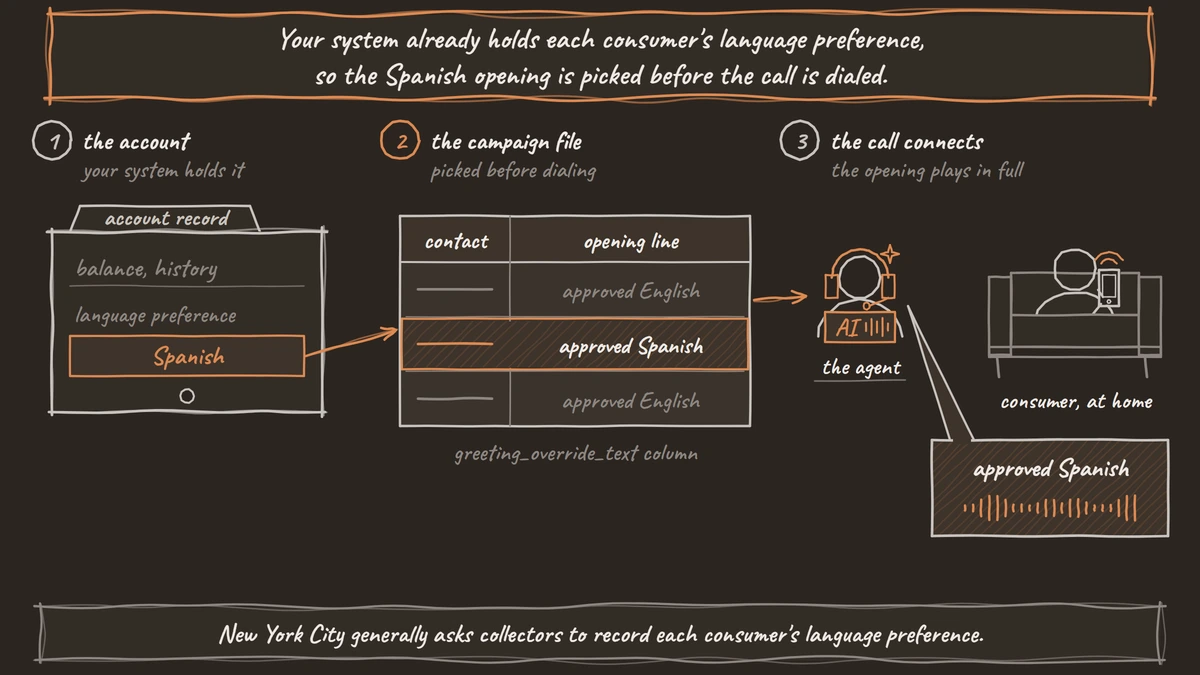
- The language preference on the account picks the Spanish version before dialing.
- A request for a Spanish form goes to your letter system as a record.
A collection notice in English does little for a consumer who speaks Spanish. We cover who gets a call in Spanish, why the rules stay the same, a Spanish twin for every fixed line, calls that switch languages and reviewing Spanish calls in Dograh. It sits within our guide to compliance disclosure calls.
Who gets a collection call in Spanish
Spanish is the second language of US collections, and the numbers are large. The Census Bureau's 2025 American Community Survey counts about 44.9 million people aged five and over who speak Spanish at home. About 17.3 million of them speak English less than "very well".
For a collector, that second figure is the one that matters. A consumer who cannot follow an English notice did not really hear it, and a call they cannot follow tends to end in a complaint.
This post covers US collectors calling consumers in the United States, under US rules. A collector working in Spain or Latin America works under different laws, and this setup would need to be checked against them.
The rules do not change, the language does
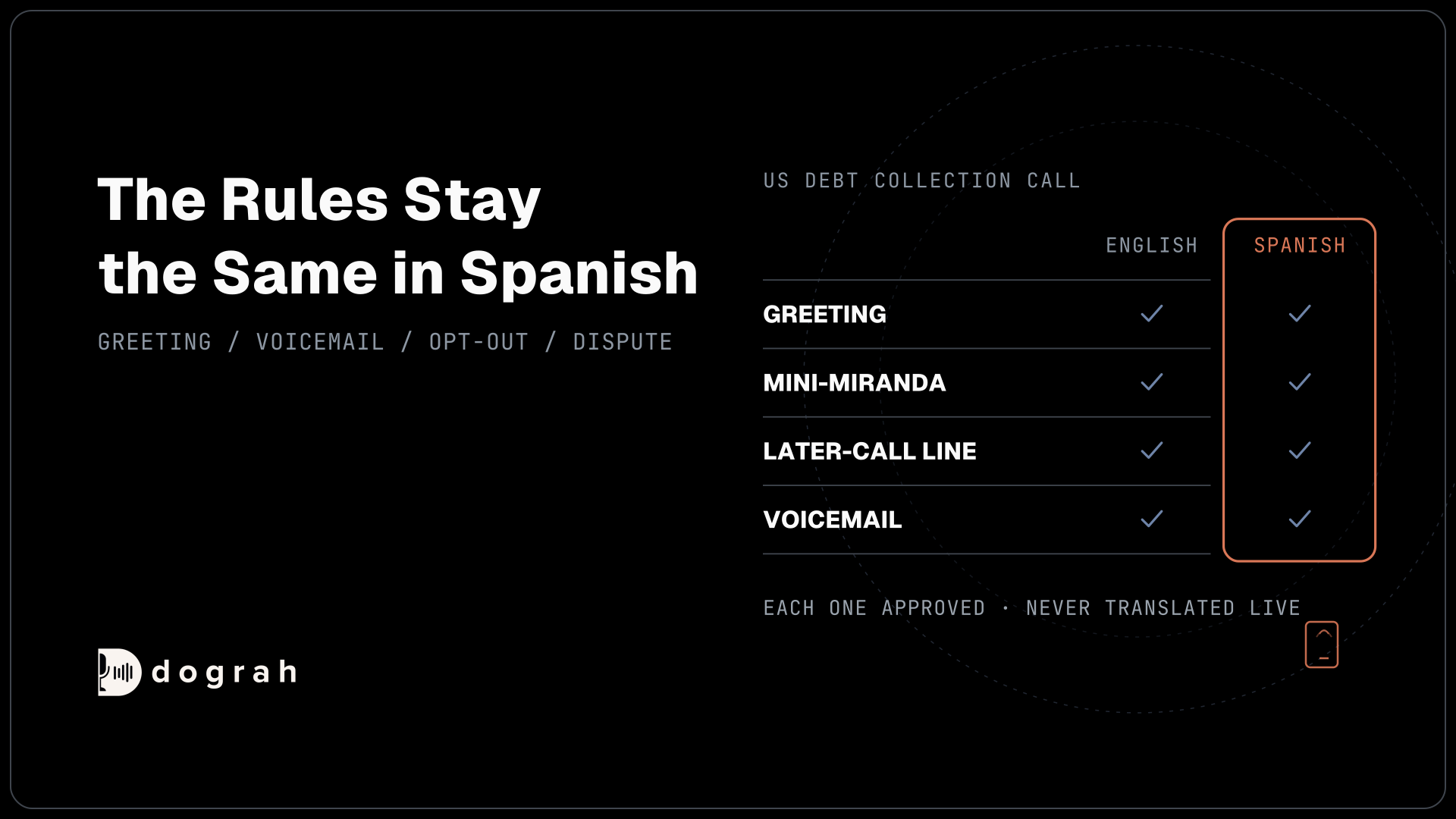
A call in Spanish carries the same notices as one in English. The business name goes at the start, the mini-Miranda follows the identity check, and later calls say they are from a debt collector. AI voice agents for compliance-safe collection disclosures covers that notice set and where each line plays.
Spanish adds two things. First, Regulation F's validation notice rule lets a collector add an optional Spanish statement to its written notice, offering a Spanish copy. If the collector offers one and the consumer asks, the collector sends a complete and accurate Spanish translation of the notice. A voice call is a natural place for that request to come up.
Second, New York City has its own language rules for collectors. Its debt collection rules ask a collector to record each consumer's language preference, unless it could not learn it after reasonable attempts, and they treat a false, inaccurate or partial translation of any communication as a prohibited practice. A Spanish notice that drops a clause is therefore its own problem in New York City, separate from the federal notice rules.

Open Source Alternative to Vapi / Retell
Self-hosted voice agent platform — no per-minute fees
dograh-hq/dograh
Star on GitHub
A Spanish version of every fixed line
Each fixed line in the agent needs a Spanish twin that your compliance team approves. That covers the Greeting Text, the mini-Miranda, the later-call line and the voicemail message. A Spanish notice is a separate approved text, written with your compliance team and recorded by a Spanish speaker if you can. It is never something the model translates during the call.
The language preference picks the version, and Allow Greeting Interruption stays off on every version so the opening plays in full. Your system already holds the preference for each account, so it picks the Spanish greeting for that contact. On a campaign, the CSV's greeting_override_type and greeting_override_text columns give each row its own opening, or greeting_override_recording_id gives it a recorded one.
For the mini-Miranda, give Spanish callers their own agent, or their own pathway, whose Transition Speech plays the approved Spanish line once the identity check passes, with the caller muted so it plays in full:
"Le llama Northgate Recovery. Esto es un intento de cobrar una deuda, y cualquier información que se obtenga se usará con ese fin."
The voicemail message gets the same treatment. With voicemail handling set to Leave a message, write the Spanish limited-content message as its own fixed text and use it on the Spanish agent.
One call, two languages
Some consumers switch languages in the middle of a sentence (code-switching), and the agent has to follow. If the preference on file is unknown, open in both languages. The Greeting Text plays before the agent can hear which language the caller uses, so write it in both, for example "Buenos días, good morning". Then the prompt has the agent ask which language the person prefers and continue in that one.
On the hearing side, set the speech-to-text model to Multilingual (Auto-detect) in the Model tab and add Spanish and English as Language Hints. Hints work with Dograh models and Deepgram Flux. Test with real recordings of your callers, since a phone line carries 8 kHz audio and accents vary.
If a caller needs a person, Transfer Call can hand them to a Spanish-speaking collector on Twilio, Telnyx, Plivo, Cloudonix or Asterisk ARI. The Spanish-speaking colleague picks up first, and only then is the consumer joined to the call. Our post on Spanish AI voice agents for real estate shows the same bilingual pattern on lighter calls.
Join the Dograh Community
Dograh is an OSS alternative to Vapi. Join our Slack community for queries, releases, best practices & community interactions.
Spanish requests become records
Several things a consumer says in Spanish must reach your system. When a consumer says "quiero este formulario en español", the agent confirms it and writes the request to your letter system through an HTTP API tool, which sends the Spanish validation notice. When they say "no me llame más", the agent accepts the opt-out, writes it the same way, and your system removes the number from the next list. A dispute in Spanish follows the dispute path. The agent stops discussing the account and records what they said for a person to follow up.
Each of these is a prompt instruction tied to a tool, so test that the agent hears the Spanish phrasing your callers actually use. The identity check works the same as in English, as our post on AI voice agents for debt collection explains.
Reviewing Spanish calls
The recordings and transcripts of Spanish calls are in Spanish, and so should be at least one reviewer. QA summaries are written in English by default, so a reviewer can read the flags in English and then check the Spanish recording itself. Ask the QA System Prompt to flag any call where a notice was missing or in the wrong language, and any call where the agent kept talking about the debt after a dispute.
Have a native speaker listen to the first batch of calls before you widen the campaign. Treat the rules here as general information, and confirm your Spanish notices and New York City process with counsel.
Glossary
- Validation notice
- The written notice a debt collector sends with the details of the debt and the consumer's rights. Under Regulation F it may offer a Spanish copy, and a consumer who asks then gets a full Spanish translation.
- Language preference
- A record of which language a consumer wants to be contacted in. New York City asks collectors to keep one, and the agent's Spanish or English version comes from it.
- Language Hints
- A Dograh speech-to-text setting that tells the model which languages to expect, such as Spanish and English. It works with Dograh models and Deepgram Flux.
- Code-switching
- Moving between two languages within one conversation or sentence, common among bilingual callers. The speech-to-text model needs both languages set to follow it.