
AI voice agents for compliance-safe collection disclosures name the business at the start, then, once the right person is confirmed, say the call is an attempt to collect a debt and any information will be used for that purpose. Later calls say they are from a debt collector. Each notice plays as fixed text, never a prompt.
Key Takeaways
- The mini-Miranda plays after the identity check, never in the opening line.
- Your system picks the first-call or later-call version for each contact.
- The per-debt call count lives in your system, not in the campaign.
Tell a housemate who answers that this is an attempt to collect a debt, and the call has already gone wrong. We cover each notice a collection call carries and when it plays, then make them fixed lines in Dograh, our open-source voice agent platform. It is part of our guide to compliance disclosure calls.
The notices a collection call carries
A third-party collection call carries two sets of fixed words, one from telephone rules and one from collection rules. The telephone rules come first. An AI voice counts as an artificial voice under the Telephone Consumer Protection Act (TCPA), so the call names the business behind it at the start and gives a callback number.
The collection rules come from Regulation F, which carries out the Fair Debt Collection Practices Act (FDCPA). In the first conversation with the consumer, the collector says it is trying to collect a debt and that any information obtained will be used for that purpose. This line is widely called the mini-Miranda. In every later conversation, the collector says the call is from a debt collector.
Notices are where many complaints start. From January 1 to November 1, 2026, the CFPB's complaint database logged 41,364 debt collection complaints about written notification of a debt, 6,996 of them from people who said they never got a notice of their right to dispute. Another 28,260 were about false statements or representations. Complaints are what people report, not proven failures, but they show where a firm gets asked to produce the call.
Where each notice plays on the call
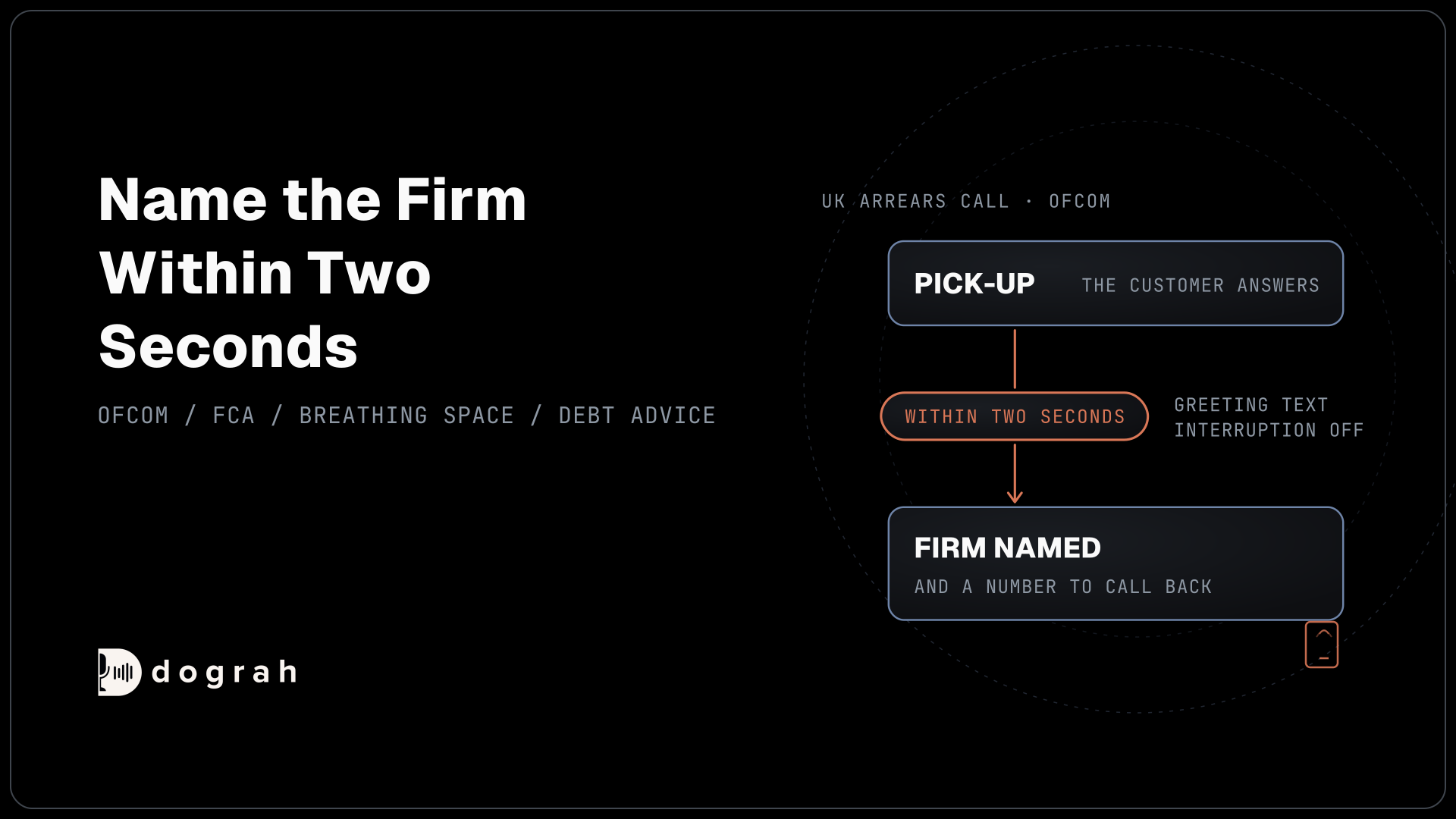
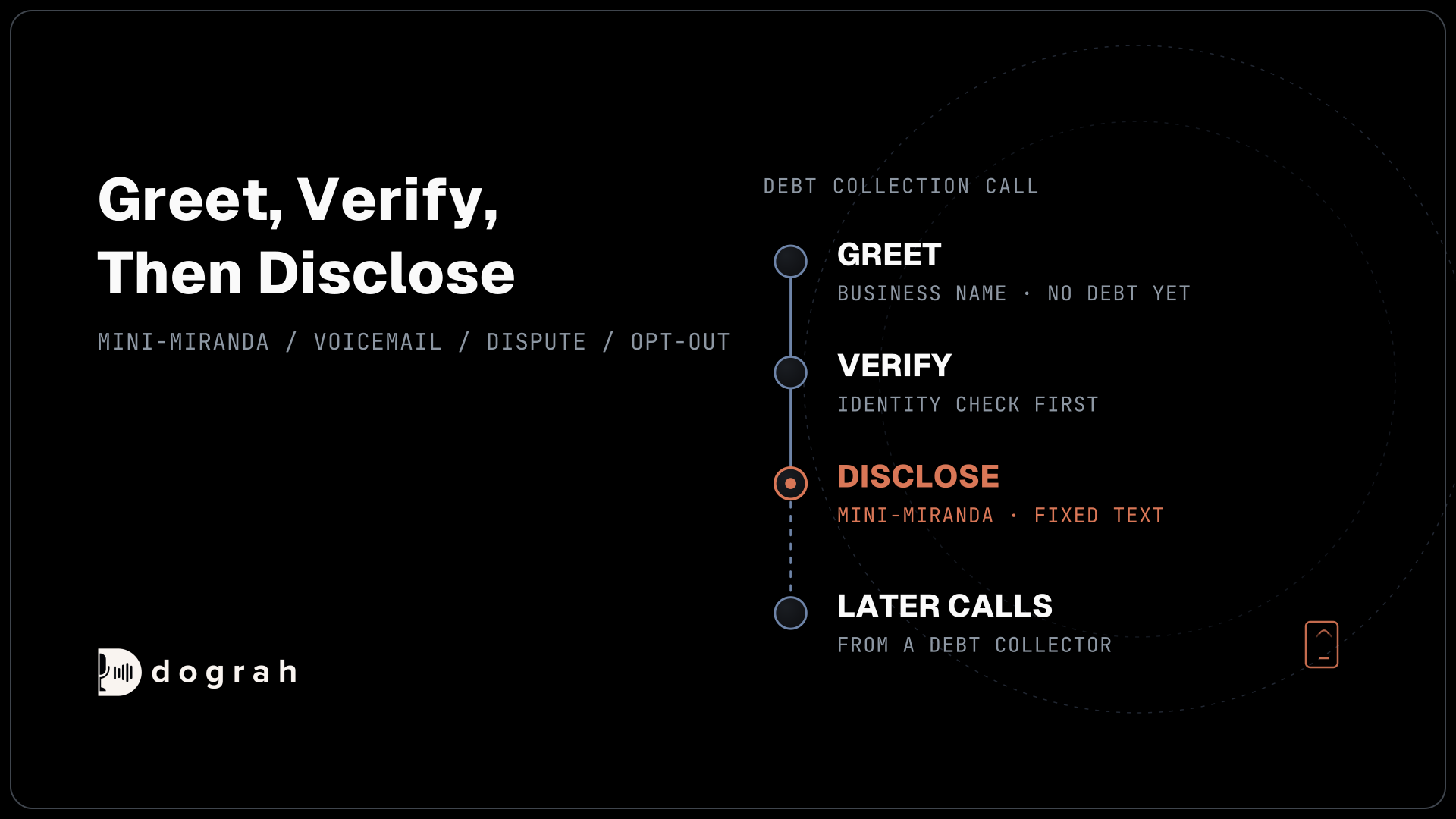
Each notice belongs to a fixed place on the call, and the order is greet, verify, then disclose. The Greeting Text on the Start Call node carries the business name and a request for the consumer by name, and nothing about a debt. Switch off Allow Greeting Interruption, which is on by default, so the caller cannot cut the opening short.
The mini-Miranda waits for the identity check. The prompt tells the agent to confirm the person with an approved check, such as a date of birth or the last digits of the account number, and to take the "identity confirmed" pathway only once it passes. The mini-Miranda plays as Transition Speech on that pathway, as fixed text or a recorded clip, with the caller muted so it cannot be cut off:
"This is Northgate Recovery. This is an attempt to collect a debt, and any information obtained will be used for that purpose."
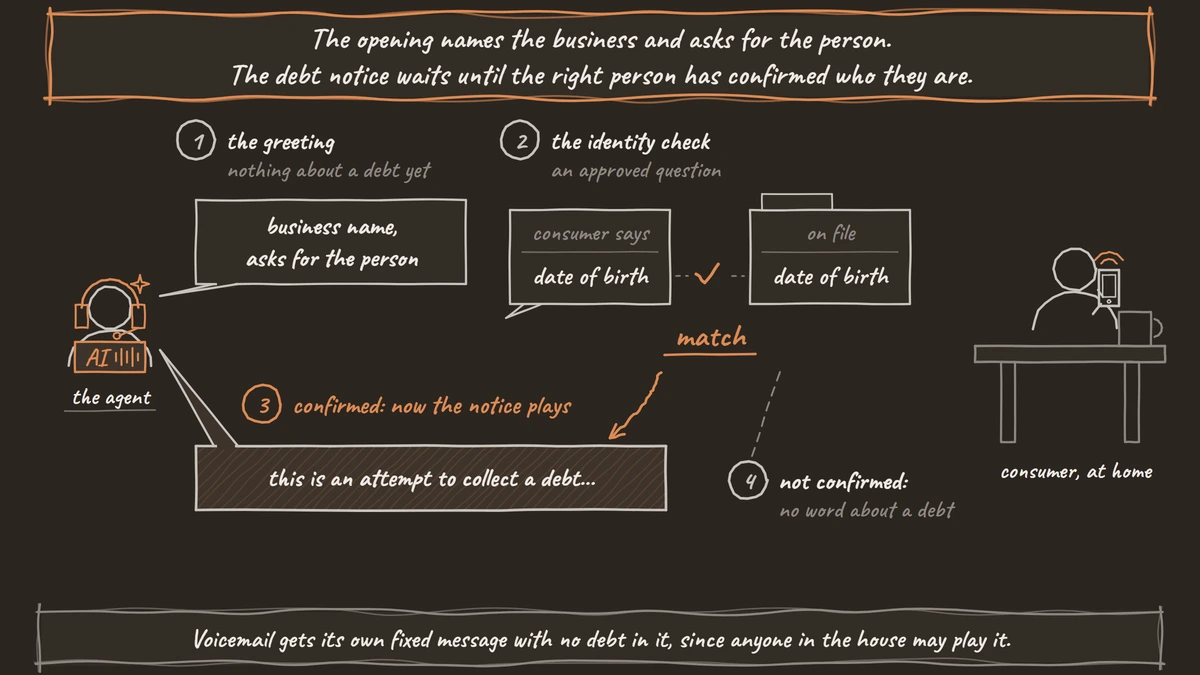
A notice the model delivers "naturally" is a new sentence on every call. Fixed text is the same sentence every time.
Later calls only need the shorter line that the call is from a debt collector. Your system knows from its contact history whether a first conversation has happened, so it picks the version. Set up a second agent whose pathway plays the later-call line, or carry the version in the campaign file. The campaign's CSV can replace the opening for each contact through the greeting_override_type and greeting_override_text columns, which suits a version that only changes the greeting.
Voicemail is its own case, because anyone in the house may play the message. With voicemail handling turned on and set to Leave a message, the agent plays one fixed message, which you write as a limited-content message. Our post on AI voice agents for debt collection covers what that message may and may not say, and how verification works.

Open Source Alternative to Vapi / Retell
Self-hosted voice agent platform — no per-minute fees
dograh-hq/dograh
Star on GitHub
First-party creditors and the name you use
A lender collecting its own debt is in a different position from a collection agency. The FDCPA reaches debts owed to someone else, so a creditor collecting in its own name generally sits outside it, and the mini-Miranda does not apply in the same way.
The name in the greeting can change that. A creditor that uses a name suggesting a third party is collecting can bring itself back under the Act. That makes the opening line a legal control, so it belongs in fixed Greeting Text, never in words the model writes. Our post on missed-payment recovery in BNPL walks through that name test.
Time-barred debts and state notices
Some debts are too old to sue on, and the call must not suggest otherwise. Regulation F's rule on time-barred debts bars a collector from bringing or threatening a lawsuit on such a debt. The prompt tells the agent never to mention court or legal action on these accounts, and QA checks that it never does.
Some states and New York City add notices of their own, such as a line about the age of the debt. Your compliance team writes each version once. Your system tags each account with the version it needs, and the campaign file carries that approved text as the contact's greeting or selects the agent whose pathway plays it. The agent never builds a notice from parts.
Call limits and calling hours
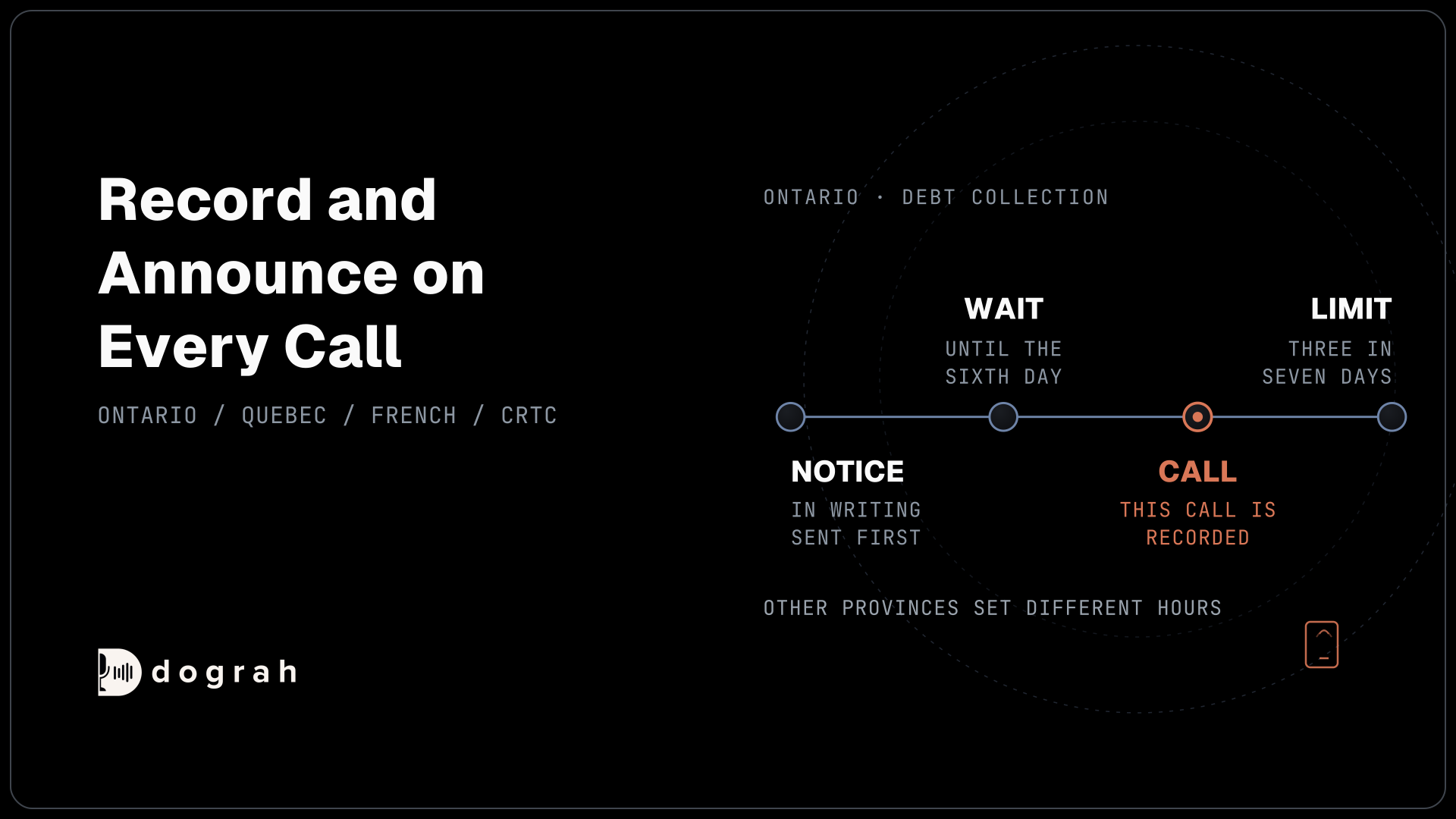
Call limits apply per consumer and per debt, so the count belongs in your own system. Regulation F's call-frequency rule presumes a collector is within its limits if it calls about a debt no more than seven times in seven days, and does not call within seven days after a phone conversation about it. Calls before 8 a.m. or after 9 p.m. at the consumer's location are presumed inconvenient.
In Dograh, a campaign's retry settings run from 0 to 10 retries, with a delay between attempts. Retries count within one campaign, so your system keeps the per-debt count across campaigns and drops a consumer from the list once they reach the limit, or you set retries to 0. Campaign calling hours run in one time zone, so split the list by time zone and give each part its own window.
Join the Dograh Community
Dograh is an OSS alternative to Vapi. Join our Slack community for queries, releases, best practices & community interactions.
Checking every collection call
The fixed lines are in every recording, so review focuses on the parts the model writes. Replace the QA System Prompt with checks such as whether the agent mentioned the debt before the identity check passed, or mentioned court on a time-barred account. A flagged call goes to a person the same week.
Two answers need a fixed path too. If the consumer disputes the debt or says it is not theirs, the agent stops discussing the account, records what they said and writes it to your system through an HTTP API tool for a person to follow up. If they ask not to be called, the agent writes the opt-out the same way, and your system removes them from the next list. Treat these points as general information, and confirm your notices and call limits with counsel.
Calls in Spanish need the same notices in Spanish, covered in Spanish AI voice agents for debt collection.
Glossary
- Mini-Miranda
- The collector's notice under Regulation F: in the first conversation, that it is trying to collect a debt and will use any information for that purpose, and in later calls, that the call is from a debt collector.
- Limited-content message
- A voicemail that leaves only a business name that does not reveal debt collection, a request to call back, a person's name and a phone number. It is written as the agent's fixed voicemail message.
- Time-barred debt
- A debt too old for the collector to sue on. Regulation F bars suing or threatening to sue on it, so the agent never mentions legal action on these accounts.
- Transition Speech
- A fixed line or recorded clip that plays as the call moves to a new step, with the caller muted. The mini-Miranda plays here, after the identity check passes.