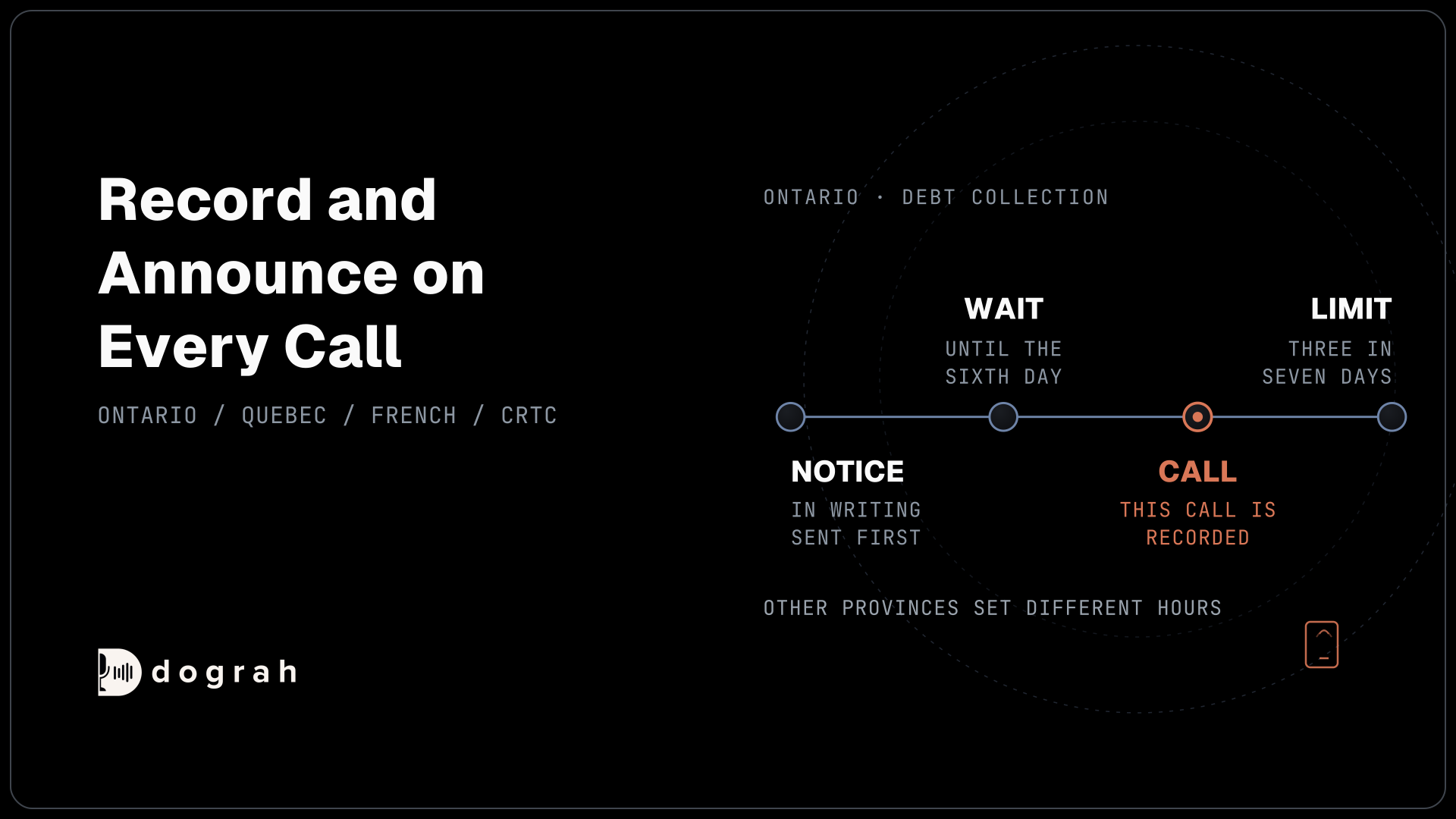

AI voice agents for debt collection in Canada follow provincial rules. Ontario, for example, requires a written notice first, allows at most three contacts in seven days within set hours, and has larger agencies record calls and tell the person. A Quebec call offers French from the first line. Fixed lines carry the notices, and campaign slots carry the hours.
Key Takeaways
- Collection rules are provincial, so each province gets its own settings.
- Ontario's hours and Sunday window map onto weekday campaign slots.
- Put the recording notice in the fixed opening on every call.
A national collection agency in Canada answers to a different rulebook in every province. We take Ontario's notice, contact limits and hours, turn them into campaign slots in Dograh, then cover French in Quebec, federal rules on automated calls and where records sit. It builds on our guide to compliance disclosure calls.
Collection rules are provincial
Canada has no single collection law. Each province licenses collection agencies and sets its own rules for when and how they call, so a national agency works under several sets of rules at once. This post uses Ontario as the worked example, because its rules are detailed and its guide for collection agencies explains them plainly. Other provinces set different hours and notices, so check each one before you call there.
Ontario's rules on a call
Ontario's rules come from the Collection and Debt Settlement Services Act and its regulation. An agency sends the debtor written notice first and waits until the sixth day after sending it before calling to collect. It may contact the debtor no more than three times in any seven days. Calls are allowed from 7 a.m. to 9 p.m. Monday to Saturday and from 1 p.m. to 5 p.m. on Sunday, and not on the statutory holidays the regulation lists.
Recording is a duty for larger agencies. An agency with ten or more collectors records its collection calls, tells the person the call is recorded, keeps each recording for a year, and gives the debtor a copy on written request. The Act counts collectors as people and says nothing about AI agents, so the simple course is to record and announce on every call anyway.
Put that notice in the Greeting Text, with the agency's name, so every call says it word for word:
"Hello, this is Northgate Collections calling for Sam Lee. This call is recorded. You can reach us at +1416555XXXX."
Turn off Allow Greeting Interruption, since it ships switched on, and the debtor hears the whole line. Dograh records calls by default, so the recording side is already in place.

Open Source Alternative to Vapi / Retell
Self-hosted voice agent platform — no per-minute fees
dograh-hq/dograh
Star on GitHub
Hours as campaign slots
Ontario's hours fit Dograh's campaign calling hours, which you set weekday by weekday. On the campaign, Monday to Saturday get one window and Sunday gets the afternoon only. For the listed holidays, pause the campaign or leave those dates out of the run.
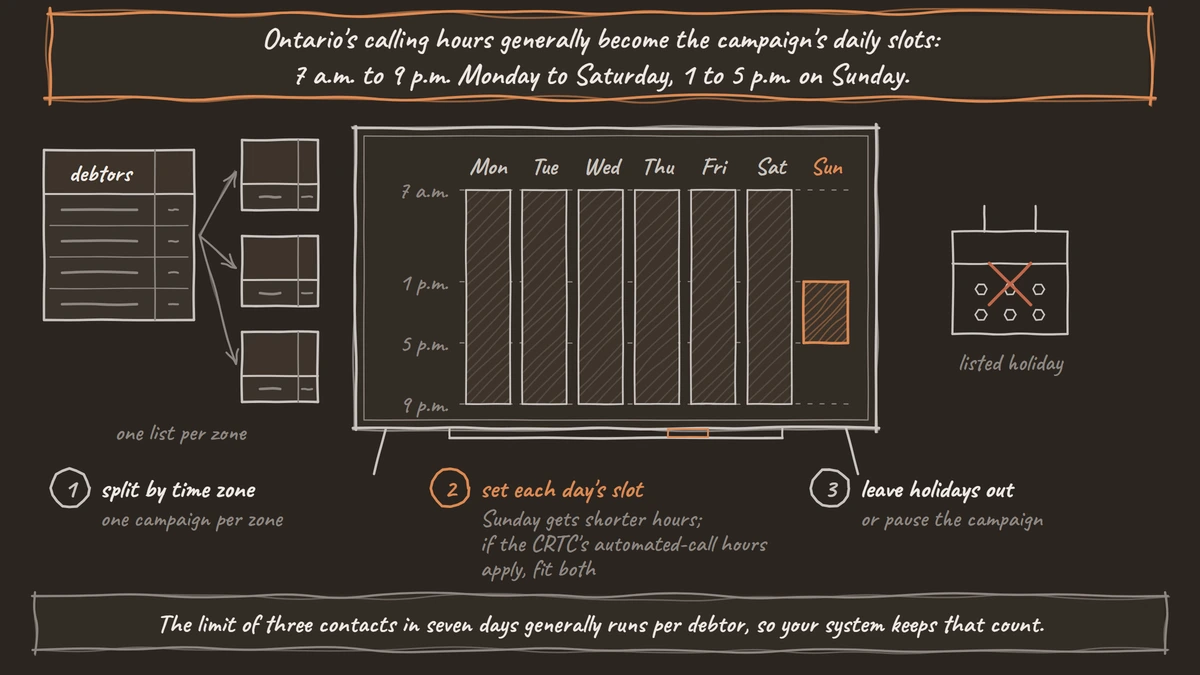
A campaign uses one time zone, and Canada spans six. Split the list by the debtor's time zone and run one campaign per zone, each with its own slots. The three-in-seven limit runs per debtor across every campaign, so your system keeps that count and drops a debtor from the next list once they reach it. Set campaign retries to match, or to 0, so the dialer never adds a fourth attempt.
Quebec and French
Quebec adds a language duty. Under the Charter of the French Language, consumers have the right to be informed and served in French, so a Quebec agent offers French from the first line. A bilingual opening such as "Bonjour, hello" lets the person choose, and the agent continues in that language. Every notice then needs an approved French version, played as fixed text or a recording rather than translated by the model during the call.
Quebec's Act respecting the collection of certain debts also has collectors identify themselves, and it has them stop calling a person who says they are not the debtor. The prompt has the agent end politely when someone says that, and an HTTP API tool writes it to your system so the number comes off the list. Our post on multilingual voice agents covers French and English speech on one call.
Join the Dograh Community
Dograh is an OSS alternative to Vapi. Join our Slack community for queries, releases, best practices & community interactions.
Federal rules on automated calls
The CRTC's Unsolicited Telecommunications Rules also cover automatic dialing-announcing devices. Under those rules, an automated call that is not a sales call begins by saying who is calling and why and gives contact details, and it runs only within the calling hours those rules set. The CRTC does not say whether an AI agent's dialer counts as such a device. A safe course is to keep the opening line that names the agency and gives a number, and to set slots that fit inside both the provincial and the federal hours.
Do not promise contact rates either. Phones now screen unknown callers, and fewer people may pick up a voice-first campaign than a team expects. Measure against your current results before you widen the rollout.
Records and data in Canada
The Personal Information Protection and Electronic Documents Act (PIPEDA), Canada's federal privacy law for businesses, keeps your agency responsible for call data it sends to a service provider, and it asks you to keep personal data only as long as you need it. It also allows a business to disclose personal data without consent to collect a debt owed to it. Retention is set by your own process, which keeps Ontario recordings for a year and then removes them per your policy. Our post on call-recording consent laws covers recording notices more broadly.
An agency can self-host Dograh and keep a year of Ontario recordings on its own servers in Canada. The platform handles the call flow, tools and telephony, while the speech and language models form their own layer that the agency selects. The debtor's audio stays in Canada only if those models run in Canada too. Check telemetry as well. A self-hosted install sends anonymous usage data by default until you set ENABLE_TELEMETRY=false and remove POSTHOG_API_KEY.
An agency hosting it pays no per-minute platform fee, though servers, model keys and phone minutes across six time zones still add up. Dograh Cloud charges its own 1¢-a-minute platform fee. Our voice AI data residency checklist walks through where each layer runs. Treat these points as general information, and confirm each province's rules with counsel before you call there.
Glossary
- Collection agency (Ontario)
- A business licensed under Ontario's Collection and Debt Settlement Services Act to collect debts for others. Agencies with ten or more collectors must record collection calls and tell the person.
- ADAD
- Automatic dialing-announcing device, the CRTC's term for equipment that dials and plays a message. Its rules set an identifying opening and calling hours, and they may reach AI dialers.
- Time slot
- A calling window on a Dograh campaign, set per weekday in the campaign's one time zone. Ontario's Sunday afternoon window is a separate slot from the weekday one.
- PIPEDA
- The Personal Information Protection and Electronic Documents Act, Canada's federal privacy law for businesses. It keeps a business responsible for data sent to service providers and limits how long data is kept.