
Key Takeaways
- Most BNPL misses are timing failures, not refusals. Call accordingly.
- The FDCPA follows debts owed to another, so first-party lenders usually sit outside it.
- If your agent uses an agency name instead of yours, the FDCPA applies.
A missed buy-now-pay-later payment is usually a card that expired or a date that slipped, and the call that follows should sound like a reminder rather than a recovery action. We build Dograh, an open-source voice agent platform, and lenders ask about this particular call more than almost any other.
AI voice agents recover missed BNPL payments by calling the borrower, confirming identity, stating the amount and due date, and taking payment or a promise to pay. Because most BNPL lenders collect their own debt, these calls generally sit outside third-party collection rules, so the guardrails have to be built deliberately rather than inherited.
Most missed BNPL payments are not refusals
The data points at a timing problem far more often than an inability to pay. LendingTree's 2026 BNPL tracker found that 47 percent of BNPL users had paid late at least once in the past year, up from 41 percent a year earlier. That survey reached 2,060 US consumers in March 2026.
Two other figures from the same survey matter more for call design. About 72 percent of people who paid late said their most recent late payment was no more than a week or so late. And 89 percent of those who asked to have a late fee waived got it reduced or removed entirely.
Put those together and the job changes shape. Plenty of these borrowers would have paid on time if someone had reminded them. Pressure is the wrong tool here. They need to be told the amount, told the date, and given a way to settle it before the fee compounds. The rising late-payment rate is not evidence that borrowers stopped caring. It reads much more like a volume problem that outbound calling was never staffed to handle.
That is the opening for a voice agent. The work is repetitive, the conversation is short, and the outcome is usually a payment or a scheduled one.
Why these calls sit outside the usual collection rules
The Fair Debt Collection Practices Act is narrower than most people assume. Its definition of a debt collector covers a person who regularly collects debts "owed or due or asserted to be owed or due another." The full statutory definition sits at 15 U.S.C. 1692a(6).
The operative word is another. A BNPL provider chasing an instalment on a plan it issued itself is not collecting for somebody else, so in most cases it falls outside that definition. This is worth stating carefully, because it is a question of scope rather than an exemption. There is no clause in the statute that exempts creditors. They simply are not what the definition describes.
That distinction has a practical edge. If you sell the debt or place it with an outside agency, rules that did not reach you now reach them, and the call script changes completely. We covered what that looks like for collectors who are bound by Regulation F, and none of those mechanics are repeated here.
Every lender's position is different, and state law reaches further than federal law in several places. Treat this as informed commentary rather than a legal opinion, and confirm your own footing with counsel before you script anything.
The first sentence decides which rulebook applies
Whether a first-party lender stays outside the FDCPA depends on the name it uses on the call. The statute says the term "includes any creditor who, in the process of collecting his own debts, uses any name other than his own which would indicate that a third person is collecting or attempting to collect such debts."
Read that with a voice agent in mind. Say your own company name and the definition does not cover you. Say something that sounds like an outside agency and the statute can reach you. The gap between the two is about ten words of script.
"Hi, this is a call from Acme Pay about your instalment plan" keeps the lender where it started. "Hi, this is Premier Recovery Solutions calling on behalf of Acme Pay" describes a third person collecting, which is close to the language the statute uses.
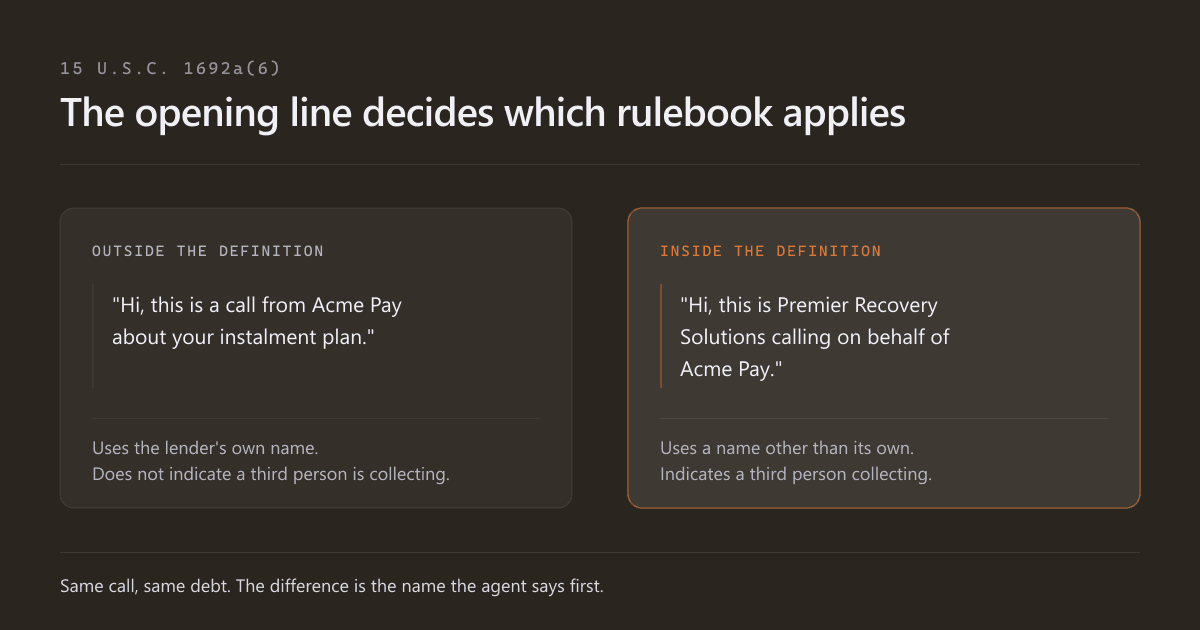
Nobody writes the second line intending a legal consequence. It usually arrives from a script template, or from an instinct that a firmer-sounding name gets taken more seriously.
This is why the opening line cannot be generated on the fly. A language model asked to introduce itself politely will paraphrase, and paraphrase is the failure mode here. The sentence has to be stored and identical on every call, because it is doing legal work rather than conversational work.

Open Source Alternative to Vapi / Retell
Self-hosted voice agent platform — no per-minute fees
dograh-hq/dograh
Star on GitHub
The states are now writing the rules
The federal picture got lighter in 2025 while the state picture got heavier in 2026.
In May 2025, the CFPB backed away from a 2024 rule that had treated BNPL lenders more like credit card companies. On 6 May it said it would stop enforcing the rule while reconsidering it, and on 12 May it formally withdrew it altogether, one of 67 guidance documents pulled back at the same time. Two separate steps, though they often get reported as one.
New York moved the other way. It announced a comprehensive BNPL framework in February 2026 and has been working through formal rulemaking since, with public comment closing on 14 September 2026. Once adopted, it would require BNPL companies to get licensed, limit late and penalty fees, set rules for handling disputes, and protect consumer data from misuse.
For anyone building recovery calling this quarter, the target moves. A script hard-coded to one jurisdiction's rules will need editing, and you want that edit to be a configuration change rather than a vendor support ticket.
What the call has to do in ninety seconds
A good BNPL recovery call resolves the payment without ever becoming a confrontation.
It opens by naming the lender, in the lender's own name, before anything else. It confirms it is speaking to the right person without disclosing the balance to whoever picked up, because a flatmate answering the phone should not learn about someone's finances from your agent. Then it gives the amount and the date together, and offers a way to settle in the same breath.
It also has to handle the waiver question gracefully. With 89 percent of people who ask getting some relief, the agent will meet that request constantly, and a script that cannot acknowledge it will sound broken. Anything that turns into a dispute or a hardship claim should route to a person quickly.
In Dograh, the parts of that call carrying legal weight are built as fixed utterance nodes rather than model output. The greeting, the identity check, and the disclosure language are stored text the agent traverses. Flexible conversation happens around them. You cannot prove a generative system will never say a particular thing, so the practical move is to prove which path the call actually took, and that means owning the transcript. A bank fraud callback runs into the same problem of sounding legitimate on the phone.
Join the Dograh Community
Dograh is an OSS alternative to Vapi. Join our Slack community for queries, releases, best practices & community interactions.
Where the spending data goes
BNPL recovery data is more revealing than a loan balance, and that shapes where it should live.
A single instalment record carries the merchant, the item, the amount, and the schedule. Pull a borrower's full BNPL history and you have a detailed picture of what they bought and when they started struggling. Payment stacking makes this sharper. A borrower running plans across several providers means no single company sees their full obligation, but each one still holds a detailed slice of it, purchase-level history that no one else can see.
Our position here has not moved. BNPL use cases need to be compliant by design, because they handle sensitive personal and financial data, which makes confidentiality and legal compliance the first constraint rather than a later one. The recommendation is to self-host and to run open-source models, so the data never leaves infrastructure you control. New York naming consumer-data protection directly in its framework suggests this is moving from good practice towards requirement. The same reasoning is why on-prem tends to win in enterprise voice AI.
Why most collection voice tools stop at the transcript
Most hosted collection tooling treats compliance as a claim on a feature page.
The pattern is easy to spot once you look for it. A vendor will say the agent is compliant, then never say which sentences are fixed and which are generated. That gap is the whole question. If the greeting is model output, the guarantee rests on hope about sampling behaviour, and you would have no way to demonstrate otherwise after a complaint.
The second unanswered question is where recordings and transcripts sit. Closed platforms rarely publish this, and the answer is usually their infrastructure rather than yours. For a first-party lender holding spending histories, that is the decision carrying the most risk, and it is the one you get the least control over.
An open-source, self-hosted stack answers both by construction. You can read the code enforcing a guardrail instead of trusting a promise about it, and recordings stay on hardware you already run everything else on. Auditable beats assured when a regulator asks what the agent said.
Start with the opening line, because it is the cheapest thing to fix and it carries the most legal weight. Own the recording next. Scale the calling volume once both of those are settled.
Glossary
- First-party collection
- A lender chasing a debt it is owed itself, under its own name, rather than placing it with an outside agency.
- Regulation F
- The CFPB rule implementing the FDCPA. It sets call frequency limits and disclosure requirements for third-party debt collectors.
- Fixed utterance node
- A step in a call flow where the agent reads stored wording verbatim instead of letting the model generate it.
- Payment stacking
- A borrower holding several BNPL plans at once, often across different providers, with no shared view of the total.