
AI voice agents for membership renewal call members before their renewal date, verify who they are, then read the date, the price and how to renew or cancel from the membership system. A plain notice is a service call. Asking the member to buy or making an offer needs written consent, and every cancel request is taken on the call.
Key Takeaways
- Renewal date and price come from your membership system, read after verifying.
- Any offer or request to buy needs written consent for an AI-voice call.
- The agent takes cancel requests and writes them to your system, without a sales loop.
One added sentence can turn a plain renewal notice into a sales call that needs written consent. This guide covers the consent rules, including the nonprofit tier, the notice and offer calls in Dograh, cancel requests, industry differences, retries and where member data sits. You can self-host Dograh or run it on Dograh Cloud.
Who makes renewal calls
Any organisation whose members pay again each year makes renewal calls, and most of them already have the list. Professional associations call about dues and gyms about the next term. Charities call recurring donors and telecom operators call as contracts end, while clubs, museums and subscription businesses run the same call before each renewal.
The call is narrow in every case. The member hears the date and the price, and some organisations add one offer. That narrow job suits a voice agent better than a broad assistant would. AI agents are still young, and caution about them is fair. The answer is scope. The agent reads facts from your system and makes at most one offer that your system returns. A person decides anything else.
Build the renewal-due list in your membership system, using its own fields such as the expiry date and the consent on file. A rule that lives in someone's head drifts from one month's list to the next.
Two calls in one: the notice and the offer
A renewal call can be a plain notice or a sales call, and one added sentence decides which. That choice sets the consent you need before the agent dials.
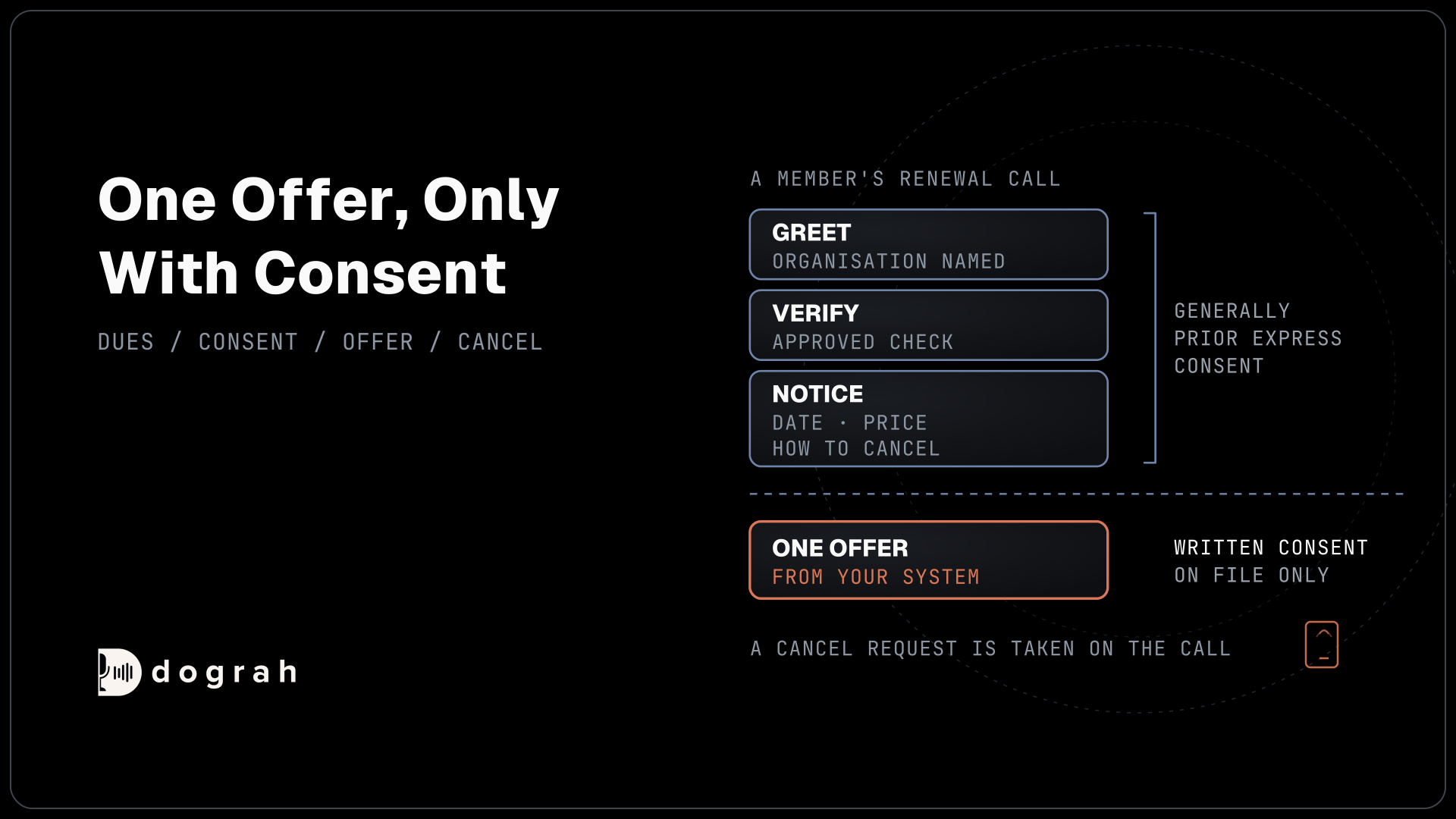
AI voices count as artificial voices under the Telephone Consumer Protection Act (TCPA), as the FCC's 2024 ruling on AI-generated voices made clear. A call that only states the renewal date, the price and how to change or cancel is generally informational, and needs the member's prior express consent, such as the number they gave when they joined.
Ask the member to renew, or add an upgrade or a multi-year discount, and the call encourages a purchase. The FCC's calling rules treat that as telemarketing, which needs prior express written consent for an artificial voice. Being a member for years does not count as written consent. Our post on AI voice agents for renewals and retention walks through the two halves line by line.
Nonprofits sit under a different rule
Tax-exempt nonprofits have their own consent tier, the tax-exempt nonprofit exemption, which matters for associations and charities. The rule differs by the kind of line called.
To home landlines, a tax-exempt nonprofit may make a limited number of AI-voice calls without consent, generally up to three in any 30 days, and it must honour opt-outs. On mobiles the line is what the call asks for. A call asking a member to pay for a renewal can count as telemarketing and need prior express written consent. A pure donation or information call generally needs prior express consent.
Whether your organisation counts as tax-exempt for this rule, and how a given renewal script is classed, are questions for your own lawyer. Confirm your setup with counsel before the first campaign.
The notice call, read from your system
The notice call reads every figure from your membership system and says nothing about the account until the member is verified. The order is always greet, verify, then disclose.
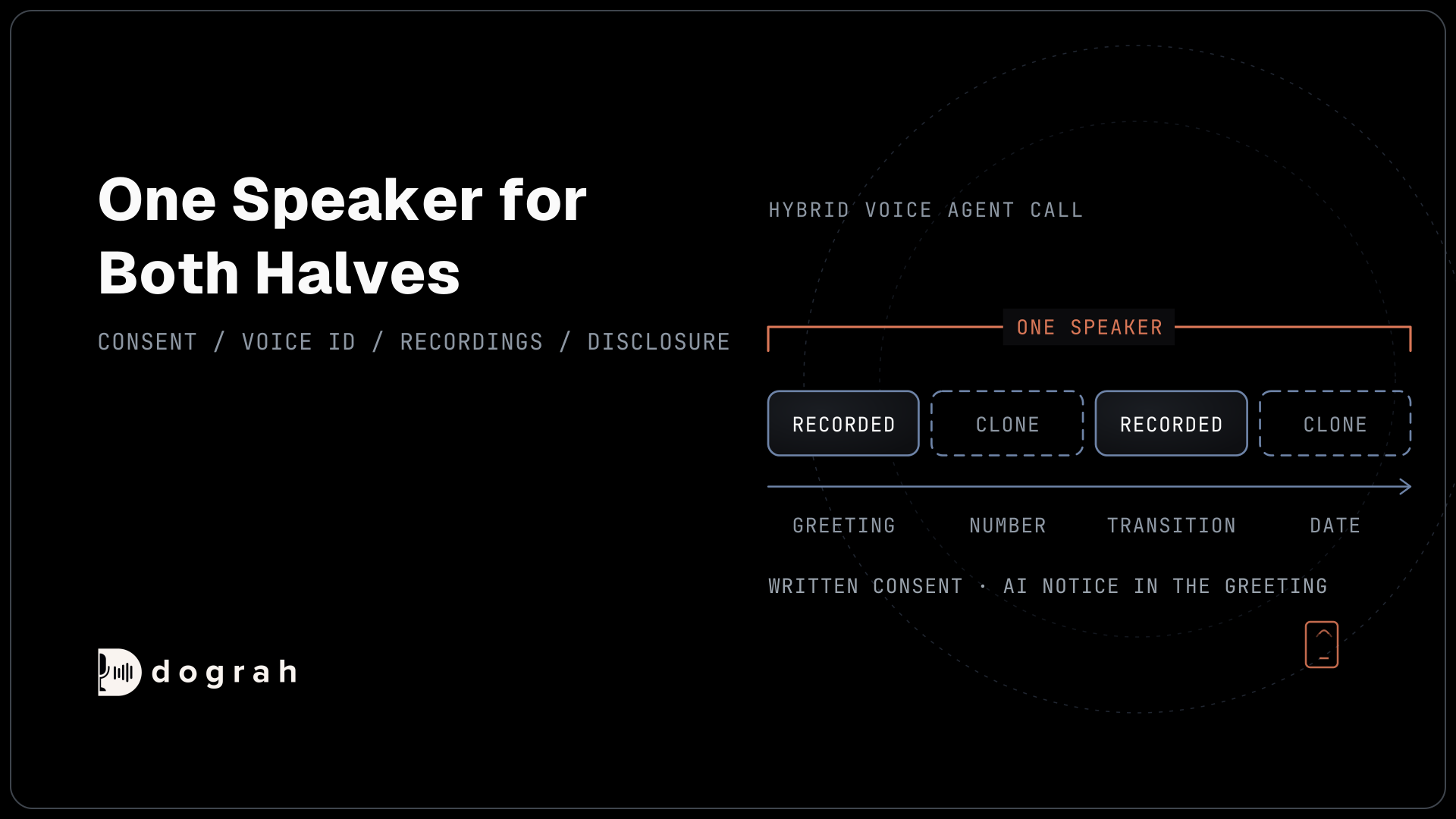
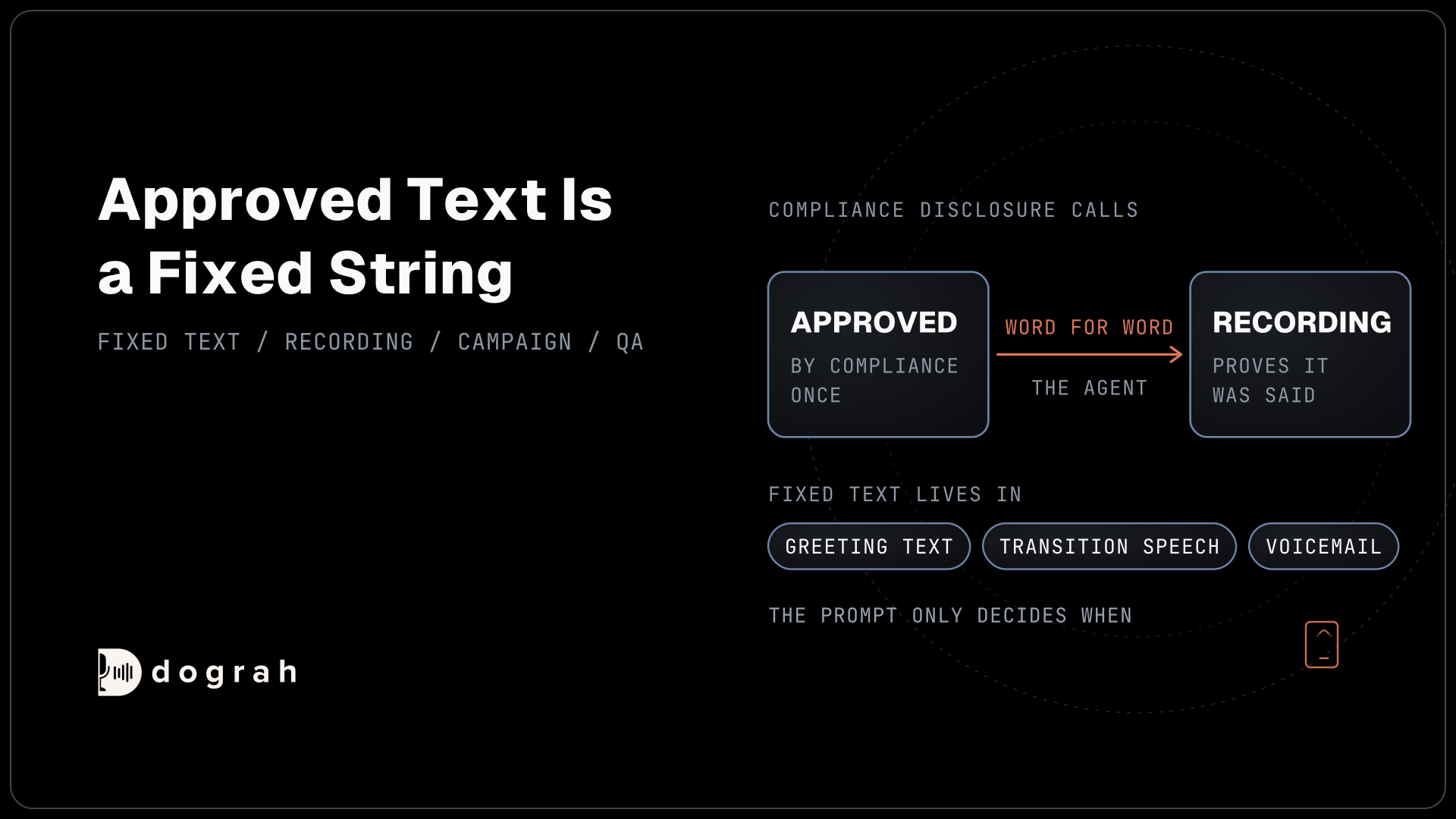
Start calls from a campaign built from your renewal-due export, or from the API Trigger when a member's renewal comes up in your system. Put the organisation's name in the Greeting Text, the fixed line Dograh speaks word for word as the call connects, and ask for the member by name. Allow Greeting Interruption is on by default, which lets the member cut in after two words, so switch it off on the Start Call node and the name plays in full. A member can also be told an automated assistant is calling, whether you choose that or local law requires it, in the same greeting.
Asking for the member by name only finds the right person. Before the agent names the renewal date or the dues, it asks for an approved check, such as date of birth or the last digits of the membership number. If the check fails, the prompt tells it to share nothing and offer a callback.
Pre-Call Data Fetch loads the current date and price as the call connects, so a member who renewed online yesterday is not asked again. Give each variable a fallback, such as {{renewal_date | soon}}, because a missing value is spoken as empty text.
Time the call after any written renewal notice your terms promise, so the member hears the same figures they have already seen. A call that quotes a different price from the letter creates a dispute, so both should come from the same record.
If the member wants to renew, an HTTP API tool asks your system to send its own secure payment link by text or email. The agent never takes card numbers, and members answer by voice.

Open Source Alternative to Vapi / Retell
Self-hosted voice agent platform — no per-minute fees
dograh-hq/dograh
Star on GitHub
One offer, only with consent
An offer belongs only on calls to members whose written consent is on file, and it comes from your system, never from the model. The safest way to keep it there is to sort the list before anyone is dialled.
Run two agents. One gives the notice only. The other gives the notice and may make one offer. Your membership system splits the renewal list by consent and sends each half to its own agent. Choosing a pathway inside one agent is the model reading the condition you wrote, so it is never a hard rule, while two agents keep an offer off a notice-only call entirely.
On the offer agent, your system returns the one offer that applies to this member, such as a multi-year rate. Wording that must never vary can sit in a pathway's Transition Speech, which plays fixed text. Transition Speech can't carry per-member values, so a price that changes by member is read from a variable in the prompt. Replace the QA System Prompt with instructions that flag any call where the price spoken differs from the returned value, or where a second offer followed a no.
Write into the prompt that a member who says no hears no second offer on that call. Questions about benefits or exceptions go to your team through Transfer Call, which works on Twilio, Telnyx, Plivo, Cloudonix and Asterisk ARI. The member is put through only after someone on your team answers, since that line is called first. Nothing about the call is passed along by default, so the agent records the question in your system first.
Cancel requests: take them, never stall
A member who asks to cancel gets the cancel, on the call, without a sales loop. The agent confirms the request, writes it to your membership system through an HTTP API tool and tells the member what happens next.
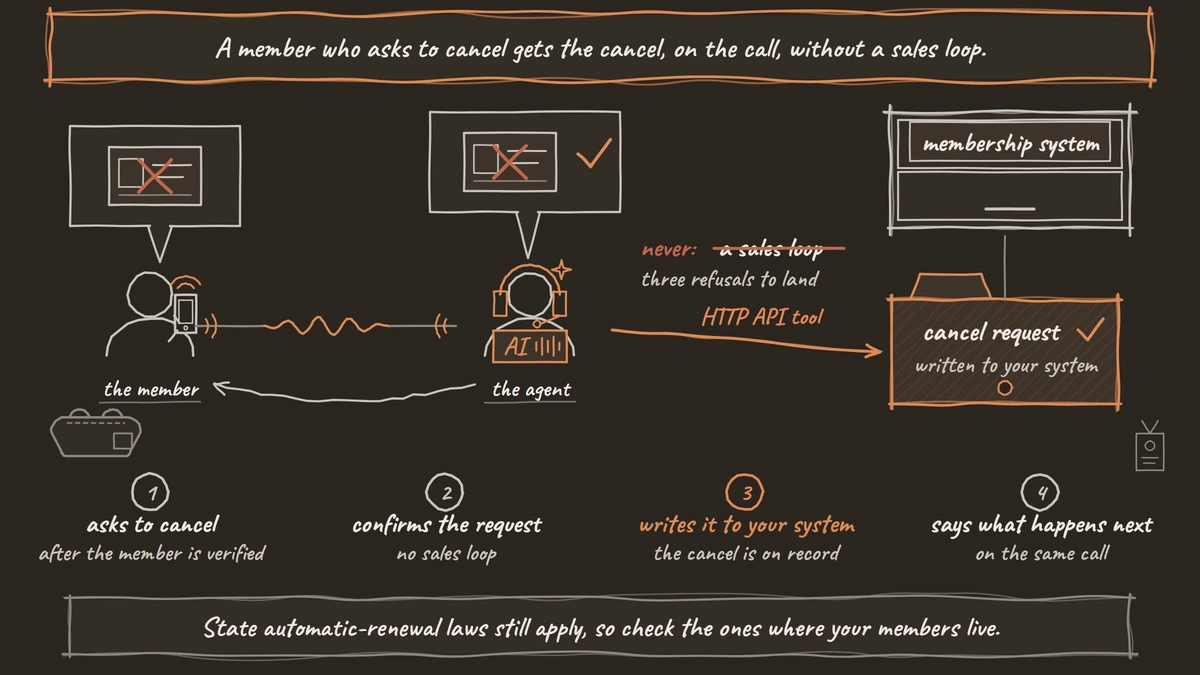
A cancel that takes three refusals to land is the experience that makes members distrust every later call. Our post on membership freeze and cancellation requests shows the gym version, where the agent follows the club's written policy and makes no save offer by default.
The federal picture is unsettled. After federal court decisions, the FTC revised its rule on negative options and has asked for comment on new amendments, which its negative option rule page tracks. State automatic-renewal laws still apply, so check the ones where your members live.
Renewal calls by industry
The call shape holds across industries, and what changes is the data, the consent tier and what the agent may never say.
Subscription businesses call before an annual plan renews, and many split notice and sale exactly as above. AI voice agents for subscription renewal reminders covers that call.
Charities depend on renewals more than most. Neon One's Recurring Donor Report, built on transaction data from 4,107 nonprofits, found recurring donors were retained at 79.11% in 2025, against 32.41% for donors who give one gift at a time. A failed recurring gift is the moment a call matters, and donor renewal and lapsed-donor win-back follows it.
Telecom operators call at the end of a contract, when the price is about to change and the operator's best offers apply. AI voice agents for renewals in telecom covers that window, including the UK notice rules.
Associations and clubs often tie renewal to something the member values, such as a credential or a season ticket. Name that in the notice if your system returns it, and keep any discount on the offer agent.
Professional bodies have one extra wrinkle. Membership can be linked to a licence, a register or continuing education hours, and a member who lets it lapse may lose more than a newsletter. Read that consequence from your system too, in the words your membership team approved, and never let the agent guess it. A member who asks whether a lapse affects their right to practise gets a callback from staff, written to your system, because that answer depends on rules the agent should not interpret.
Join the Dograh Community
Dograh is an OSS alternative to Vapi. Join our Slack community for queries, releases, best practices & community interactions.
Lists, retries and opt-outs
How often a member hears from you is decided by your own list, so build the limits into it. Campaign retries run from 0 to 10, two by default, with a delay you set between attempts. There is no per-member call cap, so a nonprofit keeping to three calls in 30 days to a landline enforces that in the list it uploads.
Calling hours sit in one time zone per campaign, so a national membership needs a campaign per zone. When a member says by voice to stop calling, the agent writes that opt-out to your membership system during the call, and the number comes off the next list. The do_not_call outcome is also saved on the call in Dograh, so an export of those calls catches any number your system missed before the next campaign.
Voicemail handling is set per agent. It either leaves one message or hangs up. A short message with the organisation's name and a number to call back is enough, and it should carry no offer.
Where member data sits
Renewal calls carry names, payment status and sometimes donation history, so decide where the audio and transcripts live before the first call. Dograh is self-hostable. Self-hosted, member calls stay on your servers and never pass through Dograh.
Call flow, tools and telephony run in Dograh, and you pick the speech and language models as a separate layer. Bring your own keys and your own contract with the model provider covers the models, though member audio still goes to that provider. Telemetry is the one default to change. A self-hosted install sends anonymous usage data until you set ENABLE_TELEMETRY=false and remove POSTHOG_API_KEY.
Membership teams that self-host pay no per-minute platform fee, though servers, model keys and phone minutes still cost money. Dograh Cloud sets a 1¢-a-minute platform fee.
Where to start
Start with the notice-only agent on members whose renewal is a month away. It needs only prior express consent, and it shows you what members ask before you add an offer.
Run test calls to a real phone number before the first member is called. Most phone calls reach the agent as 8 kHz audio, while a browser test runs at 16 kHz, so names and amounts can sound different to the speech model. Then ask to cancel in as many ways as your team can think of, and check that every one ends with the request written to your system. Each renewal call above has its own deep dive:
Glossary
- Prior express consent
- The member's agreement to be called at a number, such as the number given when joining. A renewal notice with no offer generally needs this for an AI-voice call to a mobile.
- Prior express written consent
- A signed agreement, electronic signatures included, that names a phone number and allows sales calls with an artificial or AI voice. A renewal call that asks the member to buy or makes an offer needs it.
- Tax-exempt nonprofit exemption
- The FCC rule that lets a tax-exempt nonprofit make a limited number of artificial-voice calls to home landlines without consent, generally up to three in 30 days, with opt-outs honoured. It does not reach mobiles.
- Negative option
- A plan that renews and charges unless the member acts to cancel. Automatic renewals are the common case, and state laws set how notice and cancelling must work.