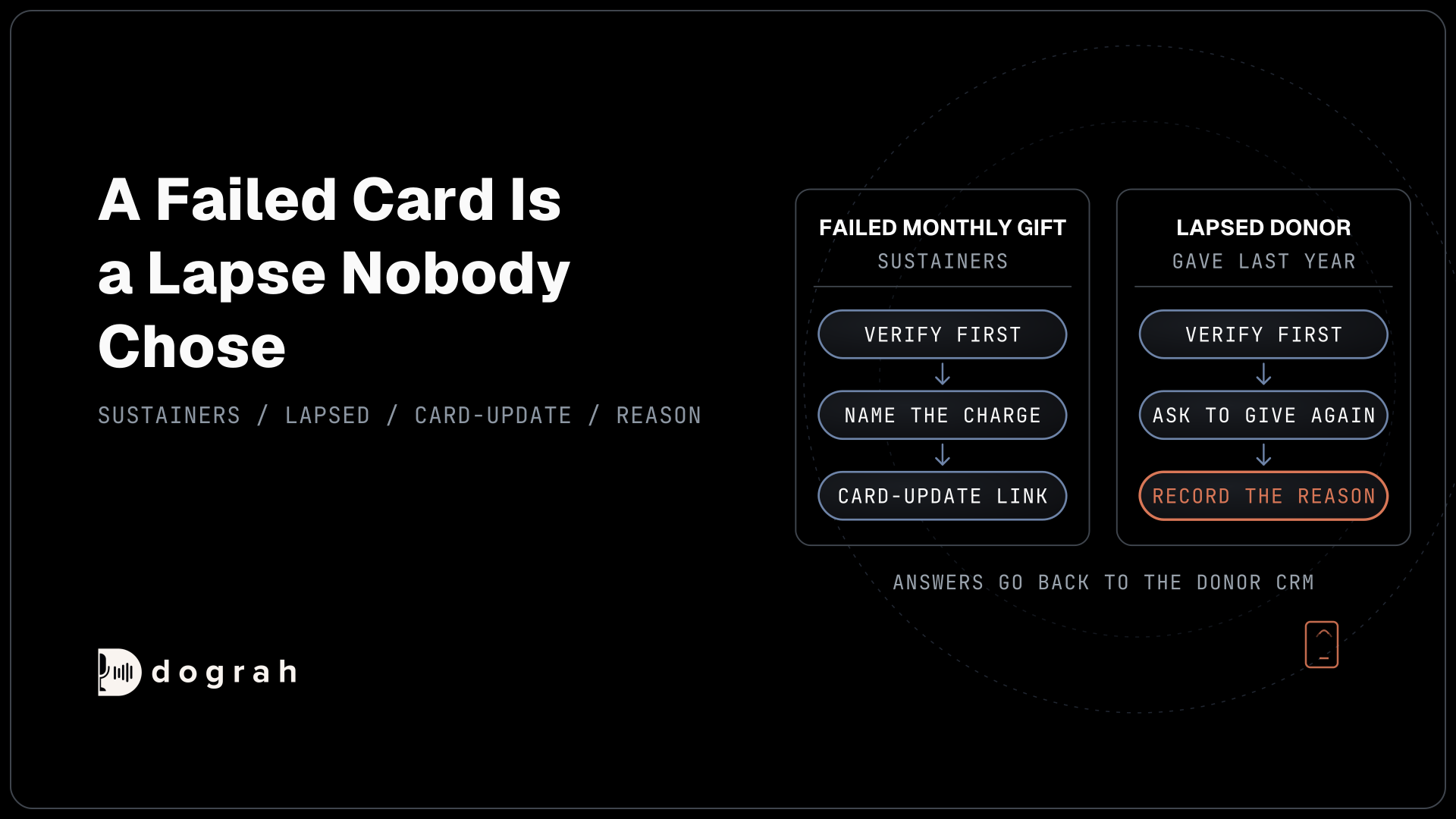

AI voice agents for donor renewal call two groups, sustainers whose monthly gift failed and annual donors who have not given again. After verifying the donor, the agent names the failed charge or last gift and asks the charity's donation platform to send its card-update or giving link. Any reason for stopping is recorded as the donor states it.
Key Takeaways
- A failed monthly card is a lapse nobody chose, so call before the donor drifts.
- Name the failed charge only after the donor passes an approved check.
- Record why a donor stopped, and offer only the options the charity set.
This post is part of our guide to AI voice agents for non-profits and fundraising. Below, we cover why renewal calls are where retention is won or lost. Then we follow the failed-gift call and the win-back call in Dograh, the open-source AI voice agent platform we build.
Why renewal calls are worth making
Most donors do not give a second time, so the donors you already have are the list worth calling. The Fundraising Effectiveness Project's 2025 report put the overall donor retention rate at 43.3%, up only slightly from 43.1% the year before, while donor counts fell 3.6%. More than half of each year's donors are gone the next year, and few charities have the staff to call the ones who slipped away.
Monthly donors are the exception, which makes losing one by accident expensive. Neon One's Recurring Donor Report, built on transaction data from 4,107 nonprofits, found recurring donors were retained at 79.11% in 2025, against 32.41% for donors who give one gift at a time. When a sustainer's card expires, the gift stops even though the donor decided nothing. That is an involuntary lapse, and a short call fixes it.
Who goes on the call list
The call list comes from your donor CRM, as two separate lists for two separate calls. The first list holds sustainers whose last monthly charge failed. The second holds annual donors who gave last year but not this year, often called LYBUNT (last year but unfortunately not this year) donors, plus older lapsed donors you still want to reach. Leave mid-level and major donors off both lists using a gift-size rule the charity sets. A gift officer calls them instead.
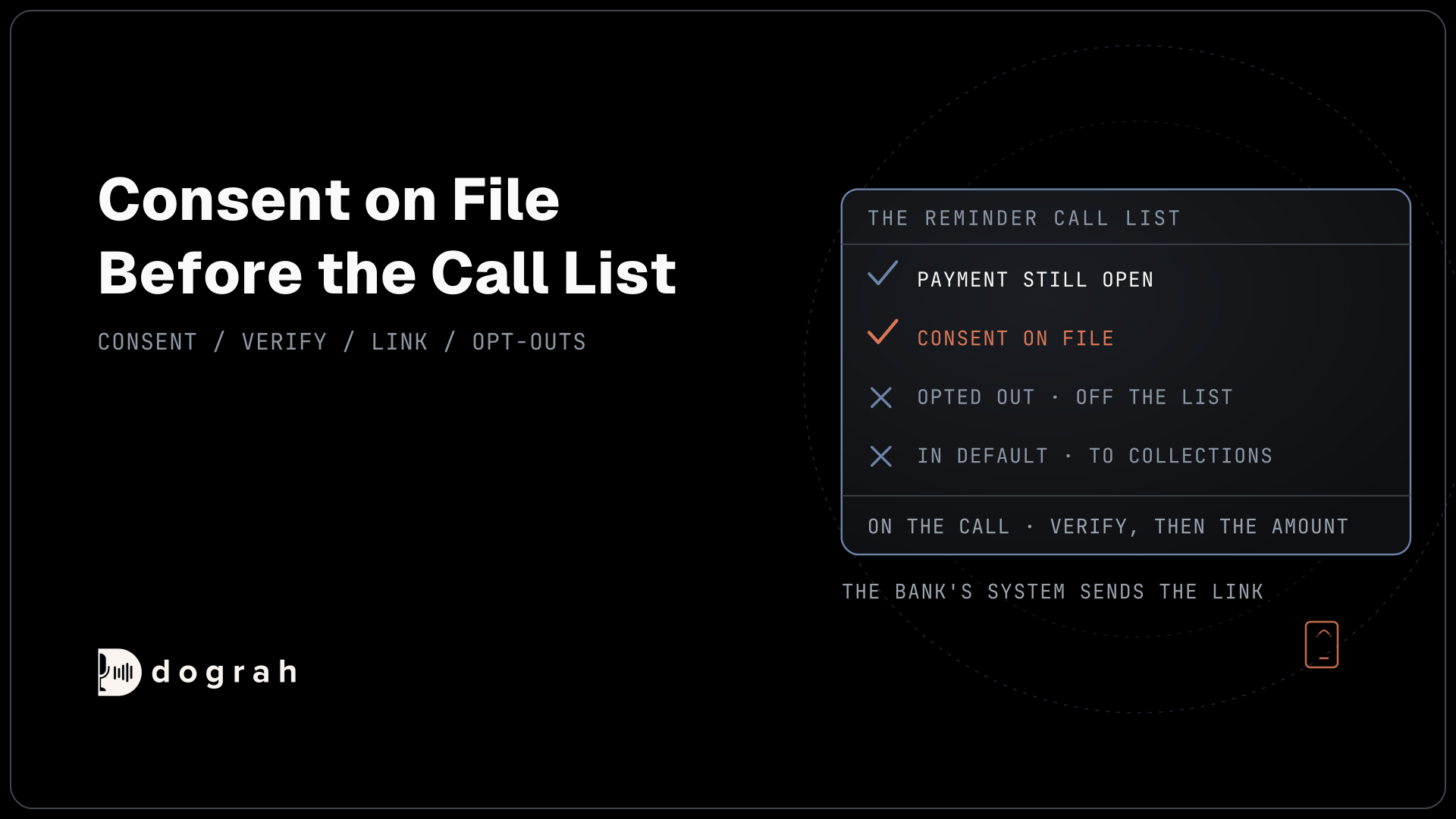
Consent works as our guide sets out. The Federal Communications Commission (FCC) treats AI voices as artificial voices under the Telephone Consumer Protection Act (TCPA), so AI-voice calls to a donor's mobile need prior express consent on file. The FCC's rule under the TCPA limits a nonprofit's artificial-voice calls to a home landline without consent to three in any 30 days, with an opt-out, and counsel can confirm how both rules apply to your lists.
Upload each list as a CSV to Campaigns, where extra columns, such as the donor's first name, become variables the agent can use. Campaigns set calling hours by weekday in one time zone per campaign, so split the list by time zone. Retries run from 0 to 10, 2 by default, and there is no per-donor call cap, so your own list enforces the 30-day limit, or retries are set to 0. A contact cannot be removed from a running campaign. The campaign can only be paused and resumed.

Open Source Alternative to Vapi / Retell
Self-hosted voice agent platform — no per-minute fees
dograh-hq/dograh
Star on GitHub
The failed monthly gift call
The failed-gift call names the charity, verifies the donor, then names the problem and asks the charity's platform to send a fix.
The Greeting Text is fixed text Dograh speaks word for word as the call connects, so it carries the charity's exact name and a line such as "Say stop at any time and we won't call again." If you want to tell donors they're speaking with an automated assistant, or your location requires it by law, say that there too.
A phone number finds the donor's record, but it does not prove who answered. So the agent asks for an approved check, such as the donor ID printed on past receipts. Only after the check does the agent say the monthly gift did not go through. If the check fails, or someone else answered, the agent leaves the charity's name and a callback number and says nothing about the gift.
Pre-Call Data Fetch loads the sustainer's record from the CRM once the call connects, with the mode set to "Outbound calls only", so a card the donor updated that morning is already counted. The prompt keeps that data unspoken until the check passes.
If the donor wants to keep giving, an HTTP API tool asks the charity's donation platform or payment provider to send its secure card-update link by text or email. Dograh has no keypad (DTMF) tool and no feature for taking payments on a call, so nobody reads a card number aloud. Our post on failed-payment and dunning recovery in SaaS shows the same pattern for subscriptions.
The win-back call to a lapsed donor
The win-back call asks whether the donor would like to give again, and it treats "no" as a full answer. After the same check, the agent thanks the donor for their last gift, read from the CRM, and asks whether they would like to support the charity again this year. If the answer is yes, the agent asks the donation platform to send its giving link. If the donor hesitates, the agent asks why and offers only the options the charity set in the prompt, such as a smaller monthly amount or a pause.
The reason matters as much as the gift. Variable extraction records it as the donor stated it, such as money being tight or no longer feeling connected to the work, and the transcript and recording stay as the exact record. After the call, the Webhook node writes the answer and the reason back to the CRM, retrying on its own if the CRM is briefly down, so the development team can see why donors stop.
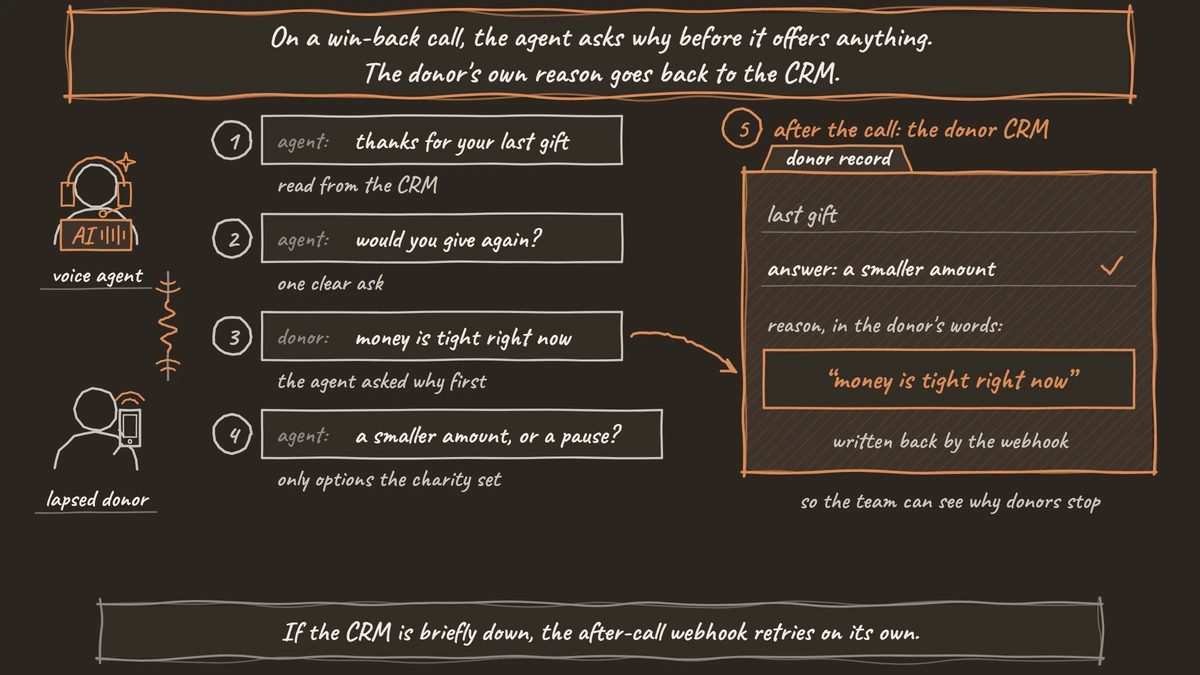
The prompt tells the agent never to push past a clear no or to argue with the reason. Our post on win-back and drop-off recovery explains why a win-back call should help first and ask second.
Opt-outs and handing over
A donor who says "stop calling me" is opting out, and that request belongs on the charity's own do-not-call list. When the donor says stop, the prompt tells the agent to write the number to your list and then end the call with the End Call tool. Dograh can also tag the finished call do_not_call when "Extract call disposition at the end of the call" is switched on, but the tag never blocks a later call. So remove those numbers before the next upload.
A donor who wants to talk about a larger gift or a complaint goes to a person. Transfer Call works on Twilio, Telnyx, Plivo, Cloudonix and Asterisk ARI. Dograh calls the destination first and connects the donor only when someone answers. On Twilio, it can play a short spoken introduction to both people before connecting them. No summary goes with the call by default, so the agent writes the request to the CRM first. If nobody answers within the 30-second default, the donor stays with the agent, so have the prompt offer a callback. Self-hosting has no per-minute platform fee (you still pay for your servers and for model and phone usage), and Dograh Cloud has a 1¢-a-minute platform fee.
Lapsed donors who appear on a year-end appeal list belong to this call, while the appeal itself is covered in AI voice agents for donation and fundraising outreach.
Join the Dograh Community
Dograh is an OSS alternative to Vapi. Join our Slack community for queries, releases, best practices & community interactions.
Glossary
- Involuntary lapse
- A recurring gift that stops because the card expired or was declined, not because the donor chose to stop. The card-update call is built for it.
- LYBUNT
- Short for last year but unfortunately not this year: a donor who gave last year but has not given this year. LYBUNT donors make up most of a renewal call list.
- Card-update link
- A secure link from the charity's own donation platform or payment provider where the donor enters new card details. The agent asks the platform to send it. No card number is spoken on the call.
- Donor retention rate
- The share of last year's donors who gave again this year. The Fundraising Effectiveness Project put it at 43.3% for 2025.