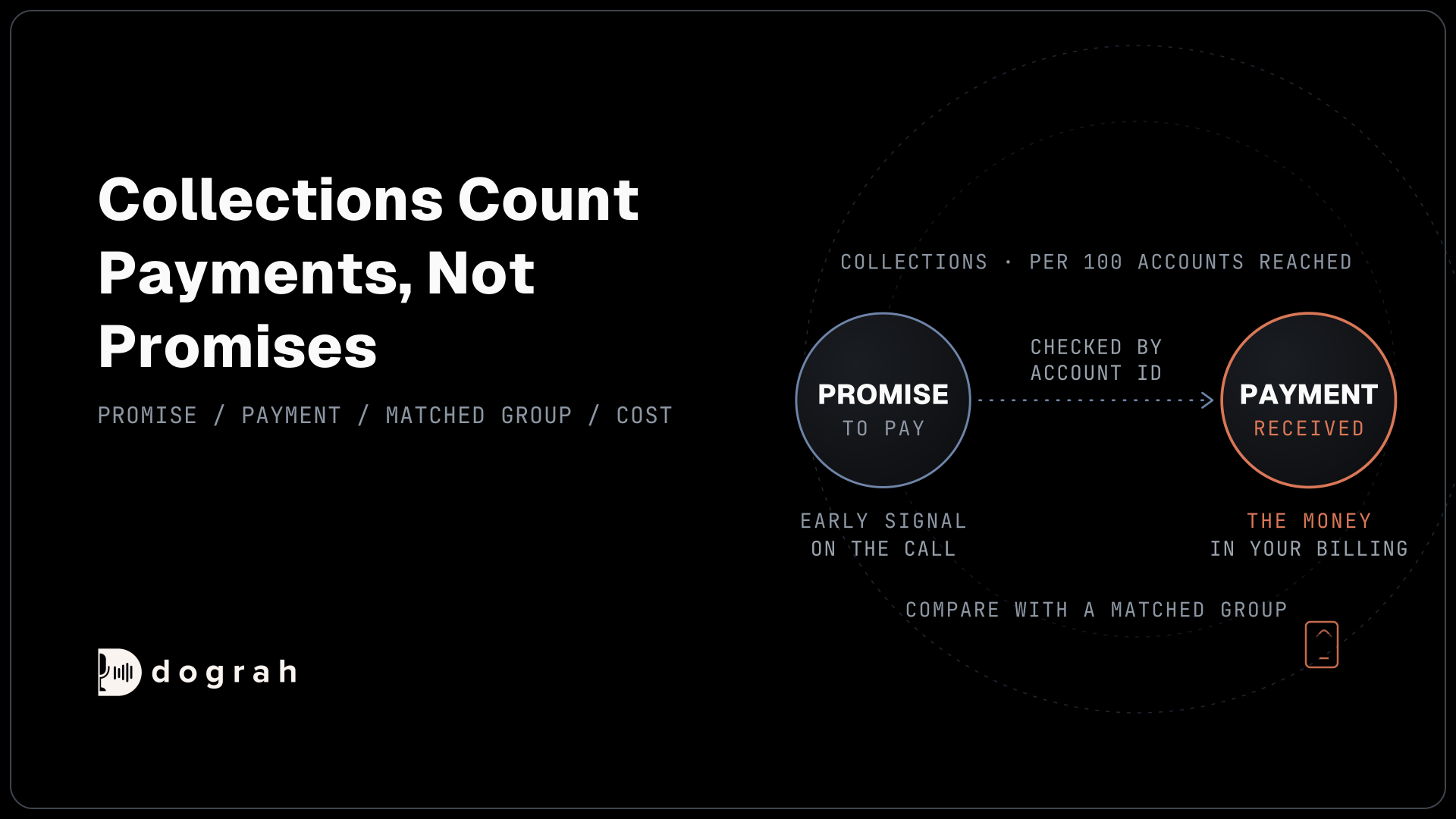

Measure automated collections calls two ways. First is the success rate, or how many of every 100 accounts the agent reaches pay within a set number of days, with a recorded promise to pay as the early signal. Second is the cost per payment, agent minutes times your per-minute cost, set against what human collectors cost for the same accounts.
Key Takeaways
- Count per 100 accounts reached, because retries put several calls on one account.
- A payment received is success, and a recorded promise is only the early signal.
- Compare with a matched group, or payments that came anyway look earned.
This post is part of our guide to The Business Case for AI Voice Agents: ROI and Payback. Its collections section names both measures. Here we define success per 100 accounts and set the cost against human collectors, measured in Dograh, the open-source AI voice agent platform we build.
Define success before you count
Decide what counts as a successful collection, and what you divide by, before the first call goes out. Success is a payment received in your billing system within a set number of days after the call, such as 14. That is the money. A promise to pay that the agent records on the call is the early signal. It shows up the same day, and you check it against payments when the window closes. A promise rate on its own overstates the result, because some promises never land.
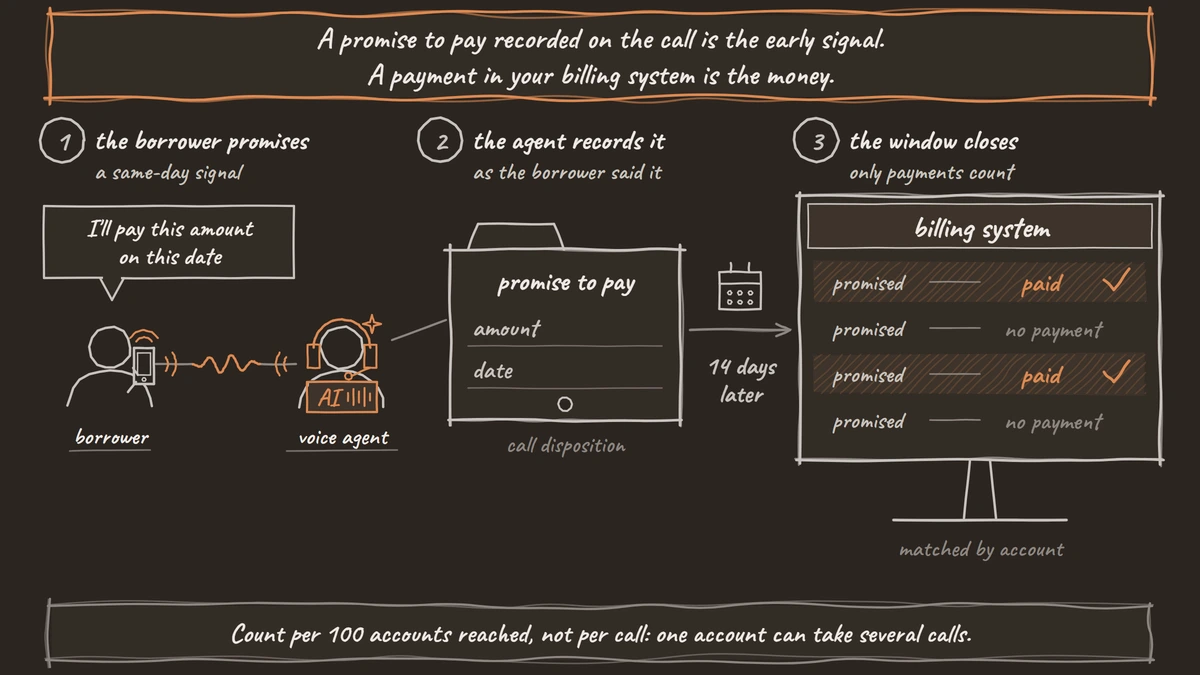
Divide by accounts reached, meaning accounts where the agent spoke with the right person. One account can take several calls, through retries and follow-ups, so a rate per 100 calls looks lower than the same result per 100 accounts. Report the per-100-calls figure as one extra line if your team is used to it.
The pool of work is large. The New York Fed's household debt report for the second quarter of 2026 found 4.7% of outstanding household debt in some stage of delinquency, and 4.9% of consumers with a third-party collection account on their credit report.
With success defined, you can measure it on its own, as payments per 100 accounts, and against a human team doing the same work.
Measure one: payments per 100 accounts
The first measure is how many of every 100 accounts reached pay inside your window, compared with a matched control group the agent did not call.
Some accounts pay anyway, so the raw rate flatters the agent. Split the list at random before you start. One group gets the agent, and the other gets no call, or your current process. Give both groups the same calling hours and attempt counts, and close the payment window on the same day.
Say 1,000 accounts were reached in each group. In the agent's group, 21 of every 100 paid within 14 days. In the matched group, 15 did. The agent earned the gap, 6 payments per 100 accounts, or 60 extra payments per 1,000. If each account took 2.4 calls on average, the agent's group also shows about 9 payments per 100 calls. Every number here is an example. Your pilot supplies the real ones.
To count promises in Dograh, add a custom code such as promise_to_pay to Call Dispositions, which are off by default. Have the agent extract the promised amount and date as the caller states them. The agent's Report CSV then lists each call's disposition, duration and extracted values, ready to match against payments in your billing system by account ID.
To send results as each call ends instead, a Webhook node can post the disposition and the extracted values to your own system. Temporary failures are retried automatically.

Open Source Alternative to Vapi / Retell
Self-hosted voice agent platform — no per-minute fees
dograh-hq/dograh
Star on GitHub
Measure two: cost against a human team
The second measure sets the agent's cost per payment against what human collectors cost for the same accounts. For the agent, multiply its minutes per account, across every attempt, by your all-in cost per minute. Our post on what an AI voice agent costs per minute builds that number from the platform fee, model usage and the phone line.
For the team, start from pay. The BLS pay data for bill and account collectors gives a median wage of $22.61 an hour, or $47,030 a year, in May 2025. That is the wage alone. Add your own benefits, seats, tools and supervision, then divide by the accounts a collector works in an hour.
Here is the comparison on example inputs, each one to be replaced with yours:
| Input | Agent | Human team |
|---|---|---|
| Accounts reached | 1,000 | 1,000 |
| Minutes per account, all attempts | 4 | Not used |
| Cost per minute, all lines | $0.08 | Not used |
| Accounts a collector works an hour | Not used | 8 |
| Hourly cost | Not used | $22.61 (wage only) |
| Cost for 1,000 accounts | $320 | about $2,826 |
| Payments within 14 days | 210 | 240 |
| Cost per payment | about $1.52 | about $11.78 |
In this example the team collects 30 more payments and the agent costs far less per payment. Both facts belong in the case. Those 30 payments are money, and they may point to accounts that should go to a person. Add the agent's fixed costs, such as the build and the hours spent reviewing calls, before you call the result ROI.
Rules that change the math
The rules on how often and when you may call cap the attempts behind each account, so they shape both measures.
Regulation F, the Consumer Financial Protection Bureau's rule under the Fair Debt Collection Practices Act (FDCPA), presumes that a debt collector complies when it places no more than seven calls in seven days to a person about a debt, and no call within seven days after a conversation about it. The call-frequency rule in Regulation F has the detail. A lender collecting its own debt under its own name is generally outside the FDCPA, though many keep to the same limits.
Dograh's Campaigns set retries from 0 to 10, 2 by default, and calling hours in one time zone per campaign. There is no per-person call cap, so your own list has to enforce the frequency limit, and lists spanning time zones need one campaign per zone.
Consent comes first for calls to mobiles. Under the Telephone Consumer Protection Act (TCPA), the Federal Communications Commission ruled in February 2024 that AI-generated voices count as artificial voices, so the consent rules for those calls apply, which counsel can confirm for your lists. The call itself still runs greet, verify, then disclose, which our post on AI voice agents for debt collection covers.
Join the Dograh Community
Dograh is an OSS alternative to Vapi. Join our Slack community for queries, releases, best practices & community interactions.
Read the results honestly
A few traps make collections ROI look better than it is. A payment that arrives two weeks earlier than it would have is cash timing. Count as gain only the payments your matched group did not make, and count the timing benefit separately, if at all. A one-time pull-forward of cash is not a yearly return.
Report promises kept next to promises made. If 40 of 100 reached accounts promise and 21 pay, the kept-promise rate is about half, and that gap is where follow-up calls or a person can help.
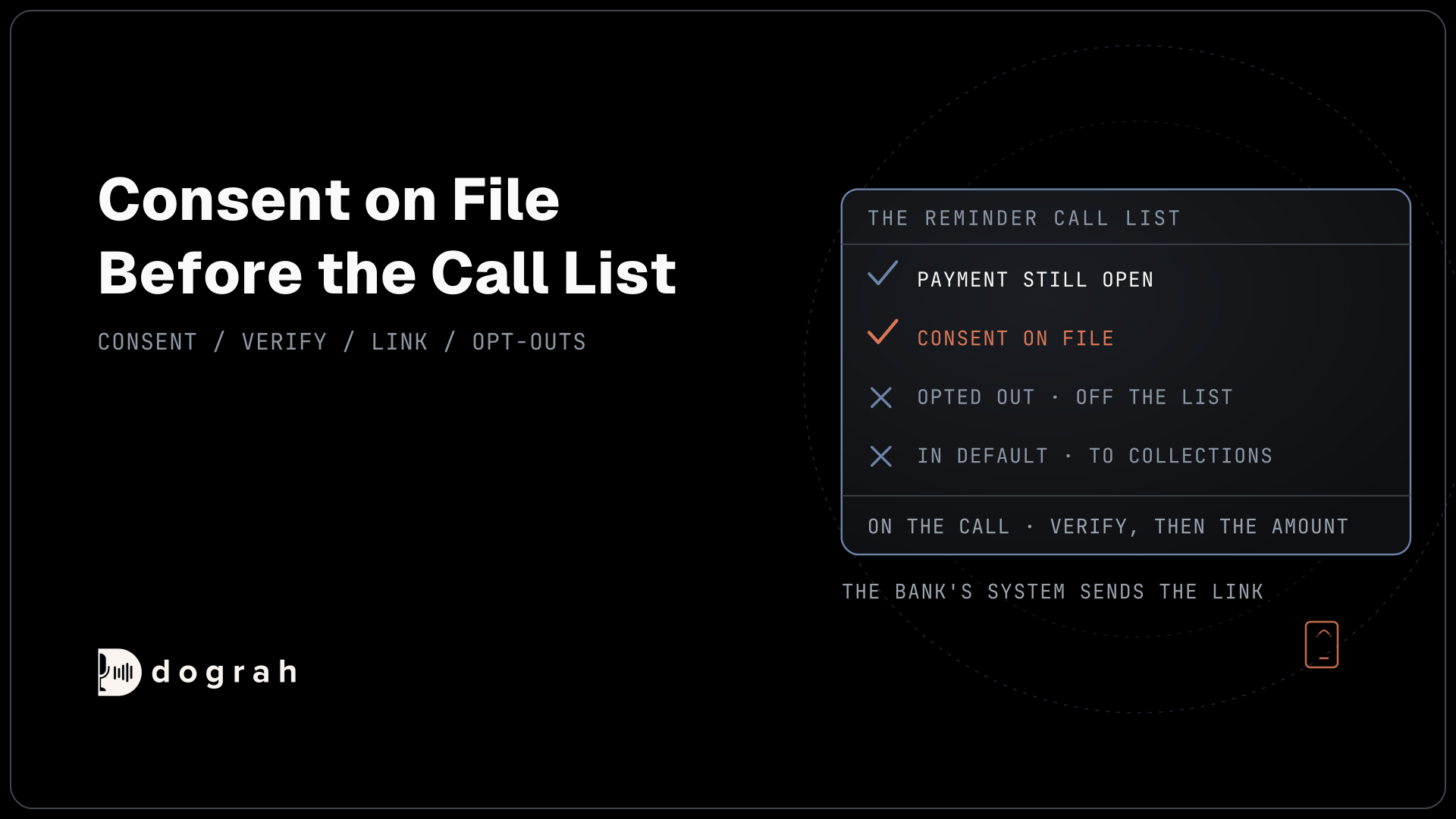
Count the costs that do not show on the bill. Wrong-party contacts and complaints carry a cost, and so do opt-outs, which the agent marks with the starter do_not_call code. Your own list then removes those numbers before the next upload.
Self-hosted Dograh has no per-minute platform fee (servers, model keys and phone minutes still cost). Dograh Cloud has a 1¢-a-minute platform fee. Calls before the due date are reminders, a different job with its own measure, covered in AI voice agents for payment and bill reminders.
Collections is one of several lender calls our guide to AI voice agents for fintech and lending covers. Start with one portfolio and a matched group, and let the gap decide the next step.
Glossary
- Accounts reached
- Accounts where the agent spoke with the right person, after verification. It is the base for collections ROI, because one account can take several calls.
- Promise to pay
- A date and amount the person states on the call, recorded by the agent as stated. It is the early signal, checked against payments received when the window closes.
- Matched control group
- A random share of the same list that the agent does not call, worked on the same calling hours and attempt counts. The gap between the two groups is the payments the agent actually earned.
- Regulation F
- The Consumer Financial Protection Bureau's rule under the FDCPA. It presumes a debt collector complies with no more than seven calls in seven days to a person about a debt.