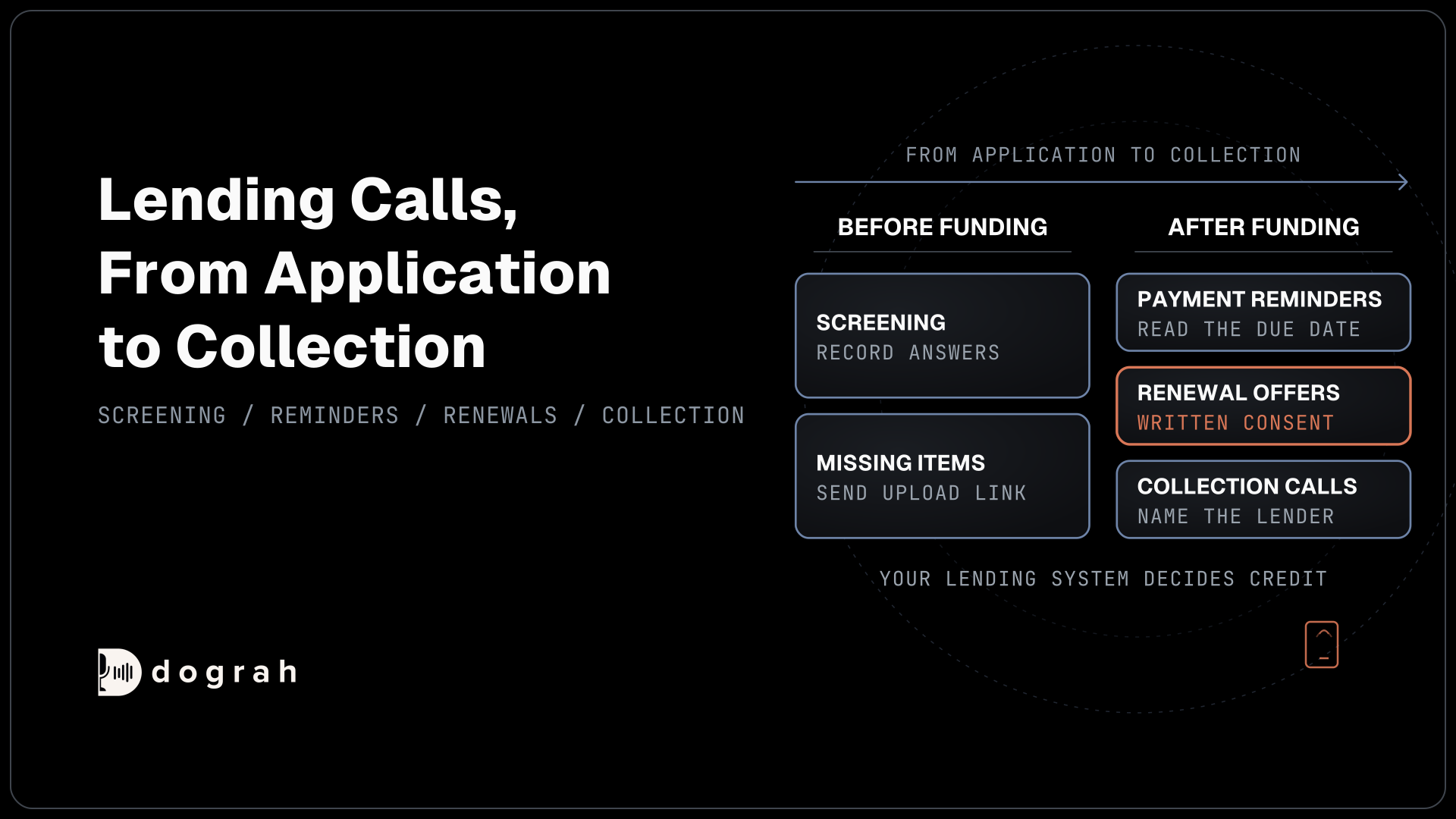

AI voice agents for fintech and lending place and answer routine borrower calls, such as application questions, missing documents, payment reminders, renewal offers and collection calls. After verifying the borrower, they read every figure from the lender's own systems and record answers as stated. The lender's system makes every credit decision, and offers go only to borrowers with written consent.
Key Takeaways
- The agent records what borrowers say. Your lending system makes every credit decision.
- A renewal or top-up offer is a sales call that needs written consent.
- Every balance and term comes from your systems, read only after verification.
This guide covers each lending call, from application to collection, and what the agent reads from your loan origination or loan management system. We show how each part works in Dograh, the open-source AI voice agent platform we build. You can self-host it or run it on Dograh Cloud.
The lending calls, from application to collection
A lender's phone calls follow the loan, and most of them are routine. Before funding there are application questions and missing items. After funding come payment reminders, renewal offers and, for some accounts, collection calls.
The volume is growing at both ends. TransUnion's Q2 2026 credit industry report put US unsecured personal loan balances at a record $281 billion, up 9.6% in a year, with 6.4 million new personal loans opened in the first quarter of 2026, up 19.5%. The share of borrowers 60 or more days past due rose to 3.81%, from 3.37% a year earlier. More applications to work through and more early-delinquency calls to place both land on the same phone team.
Every answer the agent gives comes from your loan origination system (LOS) or loan management system (LMS). Pre-Call Data Fetch can load the borrower's record once the call connects, and the greeting waits until the data is in. It refreshes data for a call that is already happening. Your own list or system decides whom to call.
During the call, an HTTP API tool asks your system for anything else the call needs, such as a payoff amount or an open document condition, and a second tool writes back what the borrower said. Each tool waits 5 seconds by default and does not retry. After the call, the Webhook node sends the outcome to your system. There is no built-in LOS or LMS connector, so each of these points at your system's own API.
Mortgage lenders have their own guide, AI Voice Agents for Mortgage & Home Loans, which follows that loan from lead to payment. Deposit banks are covered in AI voice agents for banking and credit unions. This guide is for non-bank lenders and fintech apps that make personal loans, small-business loans and buy now, pay later plans.
Application screening: record answers, never decide
The screening call asks the applicant the lender's own questions and records each answer. The credit decision stays in the lender's system.
An agent that flags disqualifying answers or approves applications on the call takes on a decision the law puts on the lender. In Dograh, variable extraction is an AI step that pulls each answer into a named field as the applicant stated it, and the transcript and recording stay as the exact record. The answers go to the LOS during the call, or through the webhook after it, and your underwriting rules take it from there.
Fair lending law shapes the wording too. Regulation B, the rule that carries out the Equal Credit Opportunity Act (ECOA), bars a lender from saying anything to applicants or would-be applicants that would put a reasonable person off applying on a prohibited basis, such as race or age. Regulation B's rule against discouraging applicants is why the agent never comments on anyone's chances, and every applicant hears the same questions in the same order.
Dograh's call outcome needs one change here. Its default outcomes include "qualified", which means the call reached its goal. Rename it under "Configure options" to something like application_complete, so nobody reads it as a credit result. AI voice agents for loan application screening covers the question list and the notice clock behind a missing-item call.
Document collection: name the item, send the link
The document call tells a verified borrower which item is missing and why underwriting needs it, then asks your system to send its secure upload link by text or email. Nothing is collected on the call, and Dograh sends no texts itself. Campaigns have no per-borrower call cap, so cap follow-ups in your own list, or the chase starts to feel like collection. AI voice agents for loan document collection covers the full call, and its pattern fits a personal or small-business loan file as well as a mortgage.

Open Source Alternative to Vapi / Retell
Self-hosted voice agent platform — no per-minute fees
dograh-hq/dograh
Star on GitHub
Reminders before default, collection after it
A reminder before the due date and a collection call after default run under different rules, so build them as separate agents with separate lists.
The payment reminder verifies the borrower, reads the amount and due date from the LMS and records any promise-to-pay date as the borrower stated it. Your system sends the payment link. Dograh has no keypad (DTMF) tool and no feature for taking payments on a call, so nobody reads out a card number.
Who is calling decides which federal collection rules apply. The Fair Debt Collection Practices Act (FDCPA) defines a debt collector as someone who regularly collects debts owed to another. A lender collecting its own loans, which is first-party collection, is generally outside that definition. The same definition pulls a lender back in if it collects under a name that suggests a third party is doing the collecting.
That makes the first sentence of the call a legal control. Put the lender's exact name in the Greeting Text, which Dograh speaks word for word as the call connects, and never let the model write the opening. Our post on missed-payment recovery in BNPL explains this name test.
Once an account goes to an outside agency, the agency is a debt collector, and Regulation F, the Consumer Financial Protection Bureau's rule under the FDCPA, sets limits on how often it may call. AI Voice Agents for Debt Collection covers that call. Verify first, then talk, and keep the recording where you can produce it.
Renewals and top-ups are sales calls
Asking an existing borrower to renew or take a top-up is generally telemarketing, because the call encourages them to take more credit.
The FCC's calling rule under the Telephone Consumer Protection Act (TCPA) treats a call made to encourage a purchase as telemarketing. The FCC also treats AI-generated voices as artificial voices, and an artificial-voice telemarketing call needs the person's prior express written consent, meaning a signed agreement that clearly authorizes the lender to call. An existing loan is not that consent. A payment reminder can generally rest on the number the borrower gave for the loan, but an offer added to the reminder turns it into a sales call.
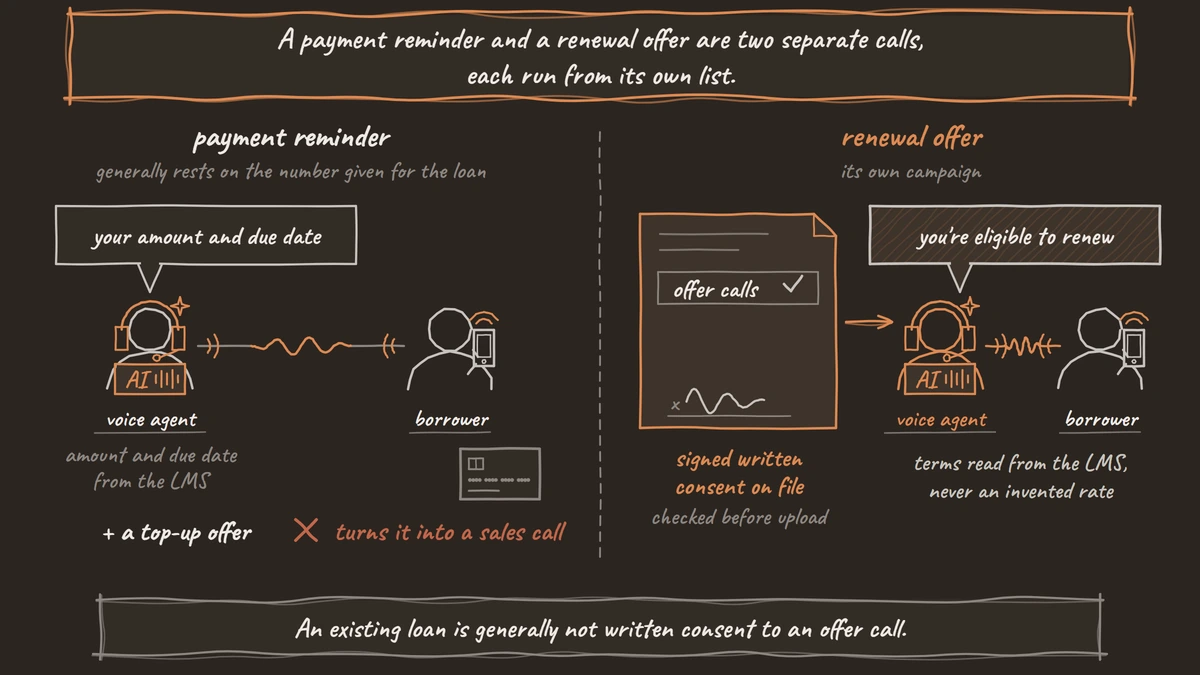
So offers go on their own campaign, built only from borrowers whose written consent is in your system. Dograh stores no consent record, so the check happens before the list is uploaded. On the call, the agent reads the eligibility and terms the LMS returns and never invents a rate, and signing happens in your own e-sign flow. AI voice agents for loan renewals covers the consent check and the offer call.
KYC callbacks and fraud alerts
Outbound calls about identity checks or suspicious payments sound exactly like the scams aimed at a fintech's customers, so these calls tell and never ask.
A know your customer (KYC) callback or a fraud alert says what happened and where to act, such as the app or the number on the back of the card. The agent never asks for a one-time code or a full card number, even after the borrower passes a check. Add terms such as KYC and your product names to the agent's Dictionary, in its Settings, so speech-to-text hears them correctly. AI Voice Agents for Fraud-Alert Callbacks covers why that callback cannot rely on the prompt alone.
Rules that hold on every lending call
A few rules apply to every call in this guide, whatever the loan. Verify before you disclose anything. A phone number finds an account but does not prove who is speaking, so the agent asks for an approved check, such as date of birth or the last four digits of the loan number, before it names any amount or term. If someone else answers, the agent leaves only the lender's name and a callback number. Voicemail handling is off by default. Once set to "Leave a message", the message carries the same two things and nothing about the loan.
Terms come from your systems, never from the model. Rates and balances are read as your LMS returns them. A prompt cannot guarantee wording, because the model writes each sentence, so check transcripts for any line that sounds like an approval or a quote.
Stop requests go to your own list. With "Extract call disposition at the end of the call" switched on, an AI step tags the finished call with one outcome, such as do_not_call, but that tag never blocks a later call. So the agent writes the request to your own list during the call, and those numbers come off before the next upload. A running campaign's list cannot be edited. Pause it and start a new one from a corrected list.
Hardship and disputes go to a person, and so does any request for special pricing. Transfer Call works on Twilio, Telnyx, Plivo, Cloudonix and Asterisk ARI. Dograh calls the destination first and connects the borrower only when someone answers. No summary goes with the call by default, so the agent writes the details to your system first. On Twilio it can play a short spoken introduction to both people. If nobody answers within the 30-second default, the borrower stays with the agent, so have the prompt offer a callback.
Join the Dograh Community
Dograh is an OSS alternative to Vapi. Join our Slack community for queries, releases, best practices & community interactions.
Lending outside the US
The TCPA and the FDCPA are US laws. A lender calling borrowers in the EU works under the General Data Protection Regulation (GDPR) for the call data, and the EU AI Act requires that people be told when they are talking with an AI system, unless that is obvious. Collection rules are then set country by country. German AI voice agents for collections walks through a German collections call, including the German speech models that run in Dograh.
Where the borrower's call data goes
A lending call carries account numbers and income, sometimes hardship details too, so count every company that hears it. On a hosted platform, that can be the voice platform, each model provider and the phone carrier.
Two layers handle the call. As the orchestration layer, Dograh runs the call flow, tools and telephony, while the speech and language models are a separate layer you choose. Self-hosted, it keeps recordings and transcripts on your own servers. Bringing your own keys (BYOK) changes whose contract covers the models, not where the audio goes. The audio stays in-house only when open-weight models run on your servers too.
Self-hosted, recording can be switched off only server-wide, and transcripts are still saved. There is no retention setting, so your own policy decides how long calls are kept. Self-hosted Dograh has no per-minute platform fee (servers, model keys and phone minutes still cost). Dograh Cloud has a 1¢-a-minute platform fee.
Both run 10 concurrent calls by default. Self-hosted teams can raise that with DEFAULT_ORG_CONCURRENCY_LIMIT, and Dograh Cloud customers contact Dograh for more.
Which lending call to automate first
Start where the agent only reads, with inbound status and payoff questions, then document reminders. Payment reminders come next, once your verification check is tested. Offers wait until your consent records are clean, and collection calls go live alongside your collections team.
Test every agent on a real phone line, because most phone calls reach the agent as 8 kHz audio while a browser test runs at 16 kHz, and transfers only work on phone calls. Once live, run quality assurance (QA) on a random 5 to 10% sample of calls. Dograh's QA scores the agent's conduct at each step, never the borrower. To size the return on collection calls, see Calculating ROI on Automated Collections Calls.
Each lending call above has its own deep dive:
- AI Voice Agents for Loan Application Screening
- AI Voice Agents for Loan Document Collection
- AI Voice Agents for Debt Collection
- AI Voice Agents for Loan Renewals in Fintech
- German AI Voice Agents for Collections
Glossary
- Loan management system (LMS)
- The lender's system of record after funding: balances, due dates, payment history and renewal eligibility. Reminder, renewal and collection calls read from it during the call and write the outcome back.
- Prior express written consent
- A signed agreement in which a person clearly authorizes a seller to make telemarketing calls to them with an artificial or prerecorded voice. A renewal or top-up offer made by an AI voice agent generally needs it.
- First-party collection
- A lender collecting its own loans in its own name. It generally falls outside the FDCPA's definition of a debt collector, unless the lender uses a name that suggests a third party is collecting.
- Call outcome
- The single label an AI step gives a finished Dograh call when call disposition is switched on, such as do_not_call or callback_requested. It records what happened. It never blocks a future call or decides credit.